A Step-by-Step Guide to Criminal Writ Proceedings Under Indian Law
Understanding the procedural journey of a criminal writ petition helps individuals protect their fundamental rights, challenge illegal actions, and seek urgent judicial intervention from the High Court.
A criminal writ petition is an extraordinary constitutional remedy that a person may invoke when illegal detention, abuse of criminal process, violation of procedural safeguards, or infringement of fundamental rights occurs.
Unlike regular criminal trials, criminal writ petitions arise directly under the constitutional jurisdiction of the High Courts under Article 226 of the Constitution of India and, in appropriate cases, under Article 227 of the Constitution of India.
Although the power flows from the Constitution, the issues raised in such petitions often involve provisions of the Code of Criminal Procedure, 1973 (CrPC) and the Bharatiya Nagarik Suraksha Sanhita, 2023 (BNSS).
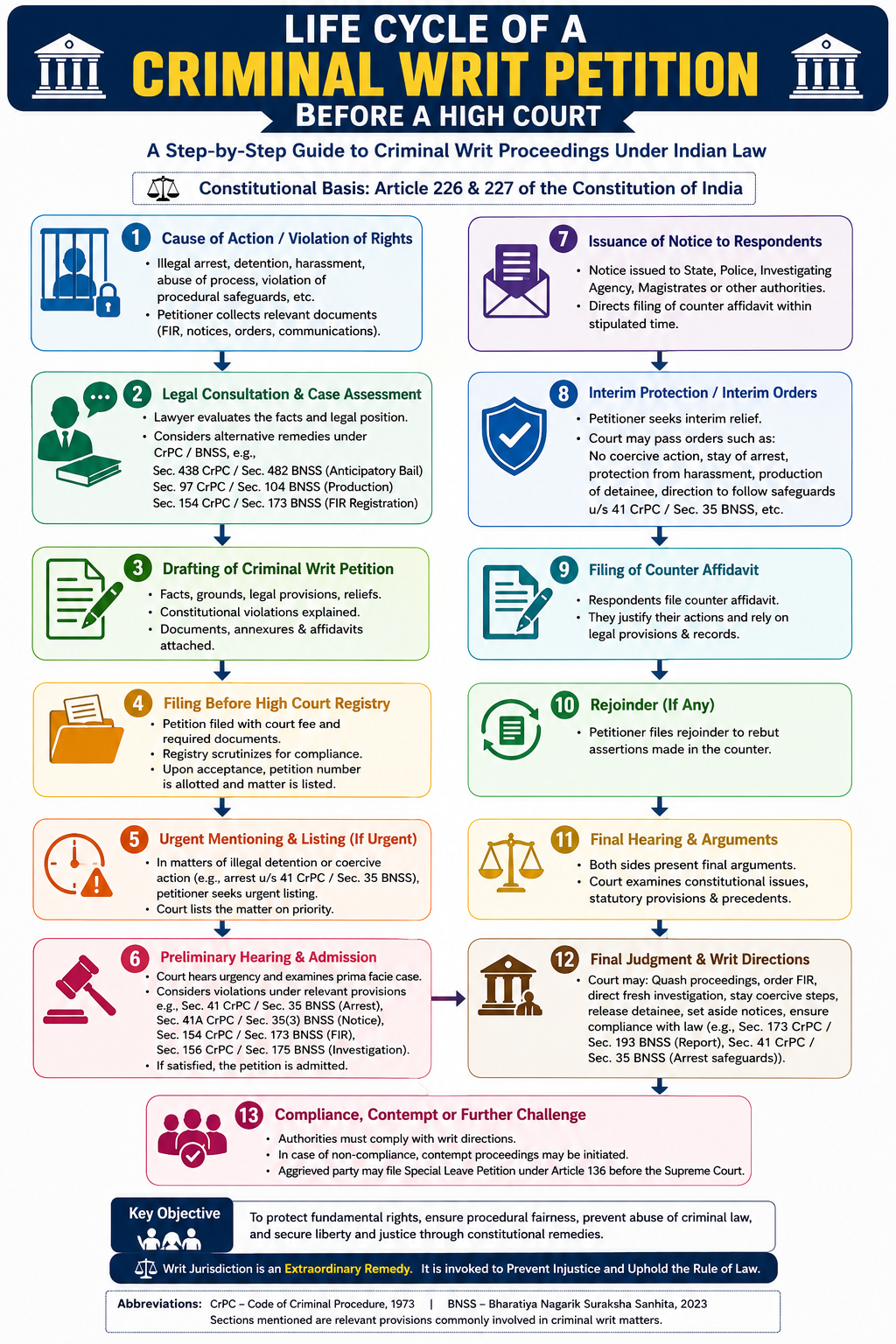
The following stages explain the complete life cycle of a criminal writ petition before a High Court.
1. Legal Foundation of Criminal Writ Jurisdiction
First, it is important to understand the legal foundation of criminal writ proceedings.
High Courts exercise writ jurisdiction under Article 226 of the Constitution of India to protect legal and fundamental rights. Additionally, High Courts exercise supervisory jurisdiction under Article 227 of the Constitution of India over subordinate courts and tribunals.
A person may file a criminal writ petition in situations involving:
- Illegal arrest or detention
- Violation of procedural safeguards
- Abuse of criminal investigation
- Failure of police authorities to act
- Threat to personal liberty under Article 21
- Illegal issuance of lookout notices or coercive action
- Failure to follow mandatory criminal procedure
For instance, petitions may involve violations relating to arrest under Section 41 CrPC / Section 35 BNSS, notice of appearance under Section 41A CrPC / Section 35(3) BNSS, search and seizure, remand, or investigation.
Therefore, writ jurisdiction acts as an immediate constitutional safeguard.
2. Stage One: Cause of Action or Violation of Rights
Typically, a criminal writ petition begins when a person experiences an illegal action by police, investigating agencies, or other public authorities.
For example, the grievance may involve illegal detention, unlawful summons, harassment during investigation, refusal to register an FIR, or violation of procedural safeguards.
The aggrieved person first identifies the violation and gathers relevant documents, notices, FIR copies, summons, remand orders, or communication records.
Therefore, identifying the cause of action forms the foundation of the writ petition.
3. Stage Two: Legal Consultation and Case Assessment
Next, the aggrieved person consults a legal practitioner experienced in criminal and constitutional litigation.
At this stage, the lawyer evaluates whether the grievance requires a writ remedy or an alternative statutory remedy.
For example, the lawyer may examine whether relief could arise through:
- FIR registration under Section 154 CrPC / Section 173 BNSS
- Anticipatory bail under Section 438 CrPC / Section 482 BNSS
- Regular bail under Section 439 CrPC / Section 483 BNSS
- Production of a detained person under Section 97 CrPC / Section 104 BNSS
If immediate constitutional intervention becomes necessary, the lawyer prepares for writ proceedings.
4. Stage Three: Drafting of Criminal Writ Petition
After assessing the facts, the legal team drafts the criminal writ petition.
The petition generally includes:
- Details of parties
- Facts leading to the violation
- Relevant constitutional rights violated
- Relevant criminal law provisions
- Grounds for invoking writ jurisdiction
- Interim relief sought
- Final relief sought
Additionally, the petitioner annexes supporting documents such as FIR copies, notices, complaint copies, remand orders, call records, or medical records.
A properly drafted petition significantly strengthens the case.
5. Stage Four: Filing Before the High Court Registry
Once the petition is ready, the petitioner files it before the Registry of the jurisdictional High Court.
The Registry scrutinises the petition for procedural compliance, court fees, formatting requirements, affidavits, and annexures.
If defects appear, the Registry returns the matter for correction.
Once compliance is complete, the Registry assigns a writ petition number and lists the matter before the appropriate bench.
Thus, the petition formally enters the judicial system.
6. Stage Five: Urgent Mentioning and Listing
In urgent matters involving personal liberty, illegal detention, or coercive police action, the petitioner may seek urgent listing.
For example, habeas corpus petitions involving unlawful detention may require immediate listing.
Similarly, petitions challenging illegal arrest under Section 41 CrPC / Section 35 BNSS may also require urgent hearing.
After hearing the urgency submissions, the High Court may list the matter on priority.
Therefore, urgent mentioning plays a crucial role in criminal writ proceedings.
7. Stage Six: Preliminary Hearing and Admission
Next, the High Court conducts a preliminary hearing.
At this stage, the petitioner’s counsel explains the urgency, constitutional violation, and statutory breaches.
The court examines whether the petition discloses a prima facie case.
For example, the court may examine violations involving:
- Arrest procedure under Section 41 CrPC / Section 35 BNSS
- Notice procedure under Section 41A CrPC / Section 35 BNSS
- FIR registration under Section 154 CrPC / Section 173 BNSS
- Investigation procedure under Section 156 CrPC / Section 175 BNSS
If the court finds merit, it admits the petition.
8. Stage Seven: Issuance of Notice to Respondents
After admission, the High Court issues notice to the respondents.
The respondents may include:
- State Government
- Police authorities
- Investigating agencies
- Magistrates or subordinate authorities, where legally permissible
- Other affected parties
The notice directs the respondents to file their reply within a specified period.
This stage ensures compliance with principles of natural justice.
9. Stage Eight: Interim Protection or Interim Orders
Meanwhile, the petitioner may seek interim protection.
Depending on the facts, the High Court may pass interim directions such as:
- No coercive steps
- Stay of arrest
- Protection from harassment
- Production of detainee
- Protection of evidence
- Direction to follow procedural safeguards
For instance, the court may direct compliance with arrest safeguards under Section 41 CrPC / Section 35 BNSS.
In urgent cases, interim protection may determine the immediate outcome.
10. Stage Nine: Filing of Counter Affidavit and Rejoinder
Subsequently, the respondents file their counter affidavit.
The respondents justify their actions by relying on investigation records, statutory powers, or procedural compliance.
After that, the petitioner may file a rejoinder to rebut factual or legal assertions.
This stage helps the court understand the complete factual matrix.
11. Stage Ten: Final Hearing and Arguments
After pleadings conclude, the High Court hears final arguments.
The petitioner demonstrates constitutional violations, abuse of power, or procedural irregularities.
Conversely, the respondents defend the legality of their actions.
Both parties rely on constitutional principles, statutory provisions, and judicial precedents.
At this stage, the court examines whether state action violates due process or personal liberty.
12. Stage Eleven: Final Judgment and Writ Directions
Finally, the High Court delivers its judgment.
Depending on the facts, the court may:
- Quash illegal proceedings
- Direct registration of FIR
- Order fresh investigation
- Stay coercive action
- Release an illegally detained person
- Set aside unlawful notices
- Direct compliance with procedural safeguards
- Award costs in appropriate cases
For instance, the court may direct authorities to comply with investigation procedures under Section 173 CrPC / Section 193 BNSS or arrest safeguards under Section 41 CrPC / Section 35 BNSS.
Thus, the writ remedy ensures accountability.
13. Stage Twelve: Compliance, Contempt, or Further Challenge
After the judgment, authorities must comply with the writ directions.
If authorities fail to comply, the petitioner may initiate contempt proceedings before the High Court.
Additionally, an aggrieved party may challenge the judgment before the Supreme Court through:
- Special Leave Petition under Article 136, or
- Other constitutional remedies, where applicable.
Therefore, post-judgment remedies ensure continued judicial oversight.
Conclusion
Criminal writ petitions play a vital role in protecting personal liberty, procedural fairness, and constitutional rights.
Therefore, High Courts follow a structured process that balances urgent intervention with judicial scrutiny.
Understanding the life cycle of a criminal writ petition helps individuals seek timely constitutional remedies against illegal criminal action.
Ultimately, writ jurisdiction remains one of the strongest safeguards against misuse of criminal law.
Other Life Cycles: DV Case Lifecycle || Maintenance Case u/s 125 CrPC Lifecycle. Index is here.
Key Contributor :
Mrs. Suprajaa Rajan B.Com., LL.B., LL.M.
+91-9606345150