Citations :
Other Sources :
Citations :
Other Sources :
After filing divorce petition in 2013 by husband, it took 9 years for the both parties to bury the issues and come for compromise. So, Who won? The ecosystem, which looted lakhs of rupees.
Citations :
Other Sources :
https://indiankanoon.org/doc/66228067/
After wasting opportunities given, the knife moved an application to file Counter but husband opposed it at Karnataka High Court.
From Paras 3-6,
4. However, insofar as the position of law as to whether the opportunity to file the objection statement can be granted subsequent to the expiry of the period as provided under Order 8, Rule 1 of CPC has in fact been stated by the Hon’ble Supreme Court wherein, it is held that it is only directory and not mandatory. The said decision in Salem Advocate Bar Association -vs- Union of India has also been referred to by the Court below.
From Para 5, (Pass an ex-parte order, what are you waiting for?)
5. In the instant case, though the petitioner contends that the respondent has not putforth any justifiable reasons seeking such opportunity, what cannot be lost sight is that the instant case is a matrimonial dispute where personal allegations would be made by the parties. If that be so, unless such personal allegations as made are controverted and thereafter evidence is available before the Court below, the Court in any event cannot come to an appropriate conclusion. Therefore, if in that light, when it is seen that the petition filed by the petitioner is for annulment of the marriage under Section 12 of the Hindu Marriage Act, 1955, it is more so that the petition averments would have to be controverted and thereafter a conclusion is to be reached. Therefore, in that circumstance, in any event, the Court below was justified in allowing the application and taking on record the objection statement.
Citations :
Other Sources :
https://indiankanoon.org/doc/135443264/
Index here.
A division bench of Karnataka High Court said, provide body cameras to all officers conducting arrests so that a record of the arrest may be made. Also ordered compensation be paid for hand cuffing the accused.
Citations :
Other Sources :
https://www.latestlaws.com/case-analysis/hc-maintenance-granted-u-s-12-of-dv-act-cannot-be-enhanced-u-s-127-cr-p-c-read-order
https://indianlawwatch.com/maintenance-granted-under-dv-act-cannot-be-subjected-to-enhancement-under-s-125-crpc-karnataka-high-court/
A Single judge of Karnataka High Court (Dharwad bench) held as thus…
(If it feels like biased/pre-judged, I too felt the same)
20. Having heard the learned counsel for the parties, the following issue arises for consideration in this writ petition. Whether, it is permissible for a Family Court to summon the medical records of a spouse on the request of the other spouse, especially when it pertained to records relating to any procedures relating to the reproductive choices of the spouse?
Illogical Reasoning of the Court:
22. Regulation 7.14 of the Regulation, 2002, upon which, reliance was placed is a reflection of this declaration. The said regulation reads as follows : 7.14. The registered medical practitioner shall not disclose the secrets of a patient that have been learnt in the exercise of his/her profession except
i) in a court of law under orders of the Presiding Judge;
ii) in circumstances where there is a serious and identified risk to a specific person and / or community ; and
iii) notifiable diseases. In case of communicable / notifiable diseases, concerned public health authorities should be informed immediately.23. As could be seen in Regulation 7.14 of the Regulations, 2002, there is an absolute embargo on the medical practitioner from disclosing the secrets of a patient that comes within the knowledge of the medical practitioner during the discharge of his professional duties.
24. To this embargo, however, there are three exceptions. The first exception, with which we are concerned, is when a presiding Judge passes an order calling upon the medical practitioner to divulge a secret that he is aware of regarding his patient. Thus, unless there is a specific order of a Judge presiding over a Court of law, no medical practitioner can disclose the secrets that he has become privy to during the discharge of his professional duties.
25. Merely because a Court of law possesses that power to direct the medical practitioner to divulge a secret confided with a medical practitioner, that power would not and should not be exercised merely for the asking or routinely. The power to direct a medical practitioner to act in violation of his declaration should be exercised only for strong and compelling reasons and would be more or less be exercised only when an element of public interest was involved.
26. The Courts, therefore, cannot direct medical practitioners to disclose the secrets that they are privy to Divorce proceeding, by their very nature, is adversarial and more often than not a bitter and acrimonious battle, at times initiated to tarnish the reputation of the warring spouse. Thus, the power of the Court to direct the medical practitioners to divulge secrets that are confided to them should be exercised very sparingly and only for exceptional reasons.
27. In order to get over the bar imposed on the medical practitioners to disclose the secrets of the patients to which they are privy, the Courts should not be asked to exercise their power to secure medical records. If this is permitted, it would mean the Medical practitioner is required to divulge the secrets that the patient has disclosed to him contrary to his professional ethics only because an adversary in litigation wishes to use it to non-suit the other.
28. It is to be kept in mind that the medical records of an individual are very private and are not for public consumption. If the medical record of a person is private to him, a direction to his medical practitioner to produce the medical records or divulge any secret that he is privy to it would essentially amount to infringing the fundamental right of privacy guaranteed to an individual, which emanates from the Right to Life granted under Article 21 of Constitution of India.
Conclusions:
40. The Doctor, even if summoned, cannot by the production of medical records, assist the Court in concluding as to whether the wife had voluntary sexual intercourse with a person other than the husband. If the husband can prove that he had no access to his and if he can establish that his wife had or was having any illicit sexual relationship with another person, the same will have to be established by appropriate evidence as provided under the Evidence Act.
41. In any event, the illicit relationship of a spouse cannot be proved by securing his or her private medical records. In fact, if this approach is to be accepted, it would amount to the destruction of the entire concept of Doctor and patient confidentiality and also drag the Doctor into a marital dispute.
Citations :
Other Sources :
https://indiankanoon.org/doc/54113030/
https://www.casemine.com/judgement/in/61c2b9899fca1942b75d83b1
https://www.lawyerservices.in/Gayatri–Gadigevva-Versus-Vijay-2021-12-03
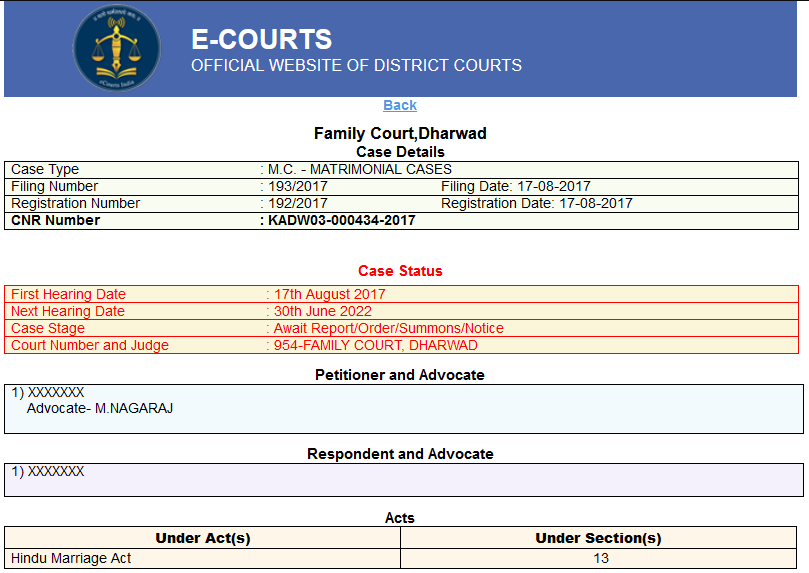
Lower Family Court Divorce Case details:
(: KADW03-000434-2017)
Related News:
Jan 3, 2022, 05:05 IST
https://timesofindia.indiatimes.com/india/medical-records-private-cant-be-used-to-prove-adultery-karnataka-hc/articleshow/88655481.cms
Jan 3, 2022, 05:36 IST
https://timesofindia.indiatimes.com/city/bengaluru/cant-use-medical-records-to-prove-spouses-relationship-dharwad-bench-of-karnataka-hc/articleshow/88655662.cms

Single bench of Karnataka High Court nailed the perjuror, A medical doctor.
From point c of Para 4,
c) The vehement contention of Mr. Jhadhav, learned Sr. Adv. that a Police investigation is launched against the petitioner-husband for producing copies of IT Returns and other documents of the respondent and therefore, till after its completion, no action for the commission of alleged perjury can be initiated, is bit difficult to countenance, more particularly, when the authenticity of these documents is not disputed even before this Court; in fact the Court below too has recorded a specific finding to this effect; the said Police investigation has nothing to do with perjury allegedly committed by the respondent; act of perjury is treated as a heinous offence in all civilized societies; consideration of complaints with regard to the same cannot be deferred or delayed; otherwise there is all possibility of the fountain of justice being polluted.
e) Lastly, heavy reliance placed by Mr. Jhadhav on the decision of Apex Court in V.K.Gupta’s case supra, does not much come to his rescue; there are some observations in the said ruling that recognize greater degree of discretion with the Courts in deciding application of the kind, is true; however, that cannot be construed as a discretion of the Moguls; the sages of law like Lord Halsbury have said that discretion means according to rules of reason & justice; the reason assigned by the Court below for holding petitioner’s subject application to be premature, is unsustainable to say the least; the view of the learned trial Judge that petitioner can move similar application subsequently offends sense of justice; applications of the kind need to be considered on merits at the earliest point of time so that a loud message goes to the unscrupulous section of the litigant public as to what would befall the perjuring parties.
Citations :
Other Sources :
https://www.livelaw.in/news-updates/karnataka-hc-perjury-complaints-not-to-be-deferred-wifes-false-maintenance-claim-181709
Index here.
A Single Judge of Karnataka High Court held that a woman having illicit relationship with accused does not constitute the commission of the offence.
3. Learned counsel for the petitioner submits that only allegation against the petitioner – accused No.5 is that, she is having illicit relationship with accused No.1, who is her legally wedded husband. Hence, the allegation made against the petitioner – accused No.5 does not constitute the commission of the offences alleged against the petitioner. Hence, the registration of FIR for the aforesaid offences is impermissible.
6. The only allegation as against the petitioner – accused No.5 is that she is having illicit relationship with the accused No.1 who is the husband of respondent No.3 – informant. This allegation does not constitute the commission of the offences alleged against the petitioner – accused No.5 and itn the absence of any essential ingredients so as to constitute the commission of the said offences, registration of FIR against accused No.5 is without any substance.
A single judge of Karnataka High Court upheld the law the way it is.
From Para 5,
5. The application is filed admittedly invoking Section 12 of the Act. Sub-section (5) of Section 12 of the Act reads as follows:
“12. Application to Magistrate.-
(5) The Magistrate shall Endeavour to dispose of every application made under sub-section (1) within a period of sixty days from the date of its first hearing.”
Sub-section (5) mandates that every application filed under the Act shall be disposed of by the Court within six months from the date of its presentation. The order sheet reveals that the application was filed on 12-11-2021 seeking maintenance. Six months have passed by. The order sheet does not demonstrate any consideration of the application. Therefore, the petitioner is entitled to a mandamus at the hands of this Court or a direction to the learned Magistrate to dispose of the application for maintenance expeditiously.
Connects to a PIL here.
Bad Behavior has blocked 1711 access attempts in the last 7 days.

