web analytics

Menu

Skip to content
Shades of Knife
  • Home
  • True Colors of a Vile Wife
  • Need Inspiration?
  • Blog Updates
  • SOK Gallery
  • Vile News Reporter
  • About Me
  • Contact Me

Shades of Knife

True Colors of a Vile Wife

Appeal Strategy After Conviction – A Practical Guide to Challenging Criminal Convictions

Posted on May 5 by Suprajaa Rajan

A criminal conviction can feel like the final chapter of a case. However, in law, a conviction is not necessarily the end of the road. Indian criminal jurisprudence provides multiple appellate remedies that allow an accused person to challenge findings of guilt, sentence, procedural irregularities, or evidentiary errors.

In fact, many convictions are modified, suspended, or even set aside in appeal when the defence presents a structured appellate strategy supported by law, evidence, and procedural precision.

Therefore, understanding the appeal strategy after conviction becomes essential for accused persons, family members, and defence lawyers navigating criminal litigation.

This article explains the legal framework, grounds of appeal, procedural roadmap, suspension of sentence strategy, document preparation, and practical appellate tactics, with references to both the Code of Criminal Procedure, 1973 (CrPC) and the Bharatiya Nagarik Suraksha Sanhita, 2023 (BNSS).

What Is a Criminal Appeal?

A criminal appeal is a statutory remedy that allows a convicted person to challenge:

  • Findings of guilt
  • Quantum of sentence
  • Errors in appreciation of evidence
  • Procedural irregularities
  • Misapplication of law
  • Jurisdictional defects

An appellate court may:

  • Confirm conviction
  • Set aside conviction
  • Modify sentence
  • Order retrial
  • Acquit the accused
  • Remand the matter

Thus, an appeal is not merely a technical formality—it is often the most critical stage after trial.

Legal Framework for Criminal Appeals

Appeals against conviction are governed by:

Appeals from Sessions and Magistrate Courts

  • Section 374 CrPC (BNSS Section 415) – Appeals from convictions

Powers of Appellate Court

  • Section 386 CrPC (BNSS Section 427) – Powers of appellate court

Suspension of Sentence Pending Appeal

  • Section 389 CrPC (BNSS Section 430) – Suspension of sentence

Taking Additional Evidence

  • Section 391 CrPC (BNSS Section 432) – Additional evidence in appeal

Revisionary Jurisdiction

  • Section 397 CrPC (BNSS Section 438) – Revision powers

These provisions form the backbone of appellate strategy.

When Should You File an Appeal?

A convicted person should act immediately after conviction.

Do not wait for:

  • Execution of sentence
  • Arrest warrants
  • Recovery proceedings
  • Bail cancellation
  • Delay in obtaining documents

The first few days after conviction often determine whether the accused secures immediate relief.

Step 1: Obtain Certified Copies Immediately

The first strategic step is obtaining certified copies of:

  • Judgment
  • Order on sentence
  • Deposition of witnesses
  • Exhibits
  • Applications and orders
  • Case proceedings

Why is this important?

Because appellate strategy depends on identifying:

  • Contradictions
  • Procedural defects
  • Missing findings
  • Evidentiary inconsistencies

Without the complete trial record, appellate grounds remain weak.

Step 2: Secure Suspension of Sentence

If the trial court convicts the accused and imposes imprisonment, the immediate priority becomes:

Suspension of sentence

Apply under:

  • Section 389 CrPC (BNSS Section 430)

This application seeks:

  • Suspension of sentence
  • Release on bail pending appeal

Courts often consider:

  • Nature of offence
  • Length of sentence
  • Past conduct
  • Bail compliance during trial
  • Chances of appeal being heard soon

Strategic Tip

Always prepare the suspension application simultaneously with the appeal.

Delay can result in unnecessary custody.

Step 3: Analyse the Trial Record Thoroughly

An effective appeal never relies on emotional arguments.

Instead, analyse:

Witness Depositions

Check for:

  • Contradictions
  • Improvements
  • Omissions
  • Inconsistencies

Documentary Evidence

Verify:

  • Admissibility
  • Authenticity
  • Chain of custody
  • Missing originals

Cross-Examination

Ask:

  • Did prosecution witnesses withstand cross-examination?
  • Did trial court ignore contradictions?

Judicial Findings

Review:

  • Whether findings are reasoned
  • Whether crucial defence evidence was ignored

Step 4: Identify Strong Grounds of Appeal

Every appeal must focus on legally sustainable grounds.

Ground 1: Misappreciation of Evidence

Argue that the trial court:

  • Ignored contradictions
  • Relied on unreliable testimony
  • Misread documentary evidence

This is one of the most common appellate grounds.

Ground 2: Failure to Consider Defence Evidence

Challenge findings if:

  • Defence witnesses were ignored
  • Documentary defence was not discussed
  • Exculpatory material was overlooked

Ground 3: Procedural Irregularities

Examples:

  • Improper examination of accused
  • Denial of cross-examination
  • Refusal to summon documents
  • Improper framing of charge

Relevant provisions:

  • Section 313 CrPC (BNSS Section 351) – Examination of accused
  • Section 91 CrPC (BNSS Section 94) – Production of documents

Ground 4: Conviction Based on Weak or Interested Witnesses

Challenge:

  • Lack of independent corroboration
  • Improvements in testimony
  • Motivated witnesses

Ground 5: Benefit of Doubt Ignored

Argue that:

  • Material inconsistencies created reasonable doubt
  • Trial court applied incorrect burden of proof

Ground 6: Sentencing Errors

Even if conviction survives, sentence may be challenged if:

  • Sentence is disproportionate
  • Mitigating factors were ignored
  • Age, health, or family circumstances were overlooked

Step 5: Draft a Structured Memorandum of Appeal

A strong appeal must contain:

Case Details

  • Trial court name
  • Case number
  • Conviction date

Factual Background

Brief case history.

Grounds of Challenge

Numbered legal grounds.

Prayer Clause

Seek:

  • Acquittal
  • Suspension of sentence
  • Modification of sentence
  • Remand or retrial

Clarity matters more than volume.

Step 6: Consider Additional Evidence

In exceptional cases, additional evidence may be necessary.

Apply under:

  • Section 391 CrPC (BNSS Section 432)

Examples:

  • Newly discovered documents
  • Expert reports
  • Missing records
  • Technical evidence unavailable earlier

However, courts allow this sparingly.

Step 7: Prepare Oral Hearing Strategy

Appeals succeed not only on paper but also in oral arguments.

Focus on:

Three Strong Grounds

Do not overload the court.

Record-Based Arguments

Take the appellate court directly to:

  • Deposition pages
  • Exhibits
  • Contradictions

Legal Precedents

Use relevant case law strategically.

Special Strategy in Matrimonial Criminal Cases

In convictions arising from:

  • Section 498A IPC cases
  • Dowry harassment prosecutions
  • Domestic violence-related proceedings

Focus on:

Omnibus Allegations

Were all relatives treated identically?

Separate Residence

Did accused live elsewhere?

Delayed Complaints

Was there unexplained delay?

Settlement Motive

Was criminal litigation used as pressure?

These factors often become decisive.

Common Mistakes After Conviction

Avoid:

Delaying Appeal

Delay may complicate suspension of sentence.

Filing Emotional Grounds

Appeals require legal defects, not sympathy alone.

Ignoring Trial Record

Grounds must come from evidence.

Filing Generic Drafts

Every appeal must be case-specific.

Neglecting Sentence Suspension

Custody can become unnecessary.

Practical Appellate Checklist

Before filing appeal, ensure:

  • Certified copies obtained
  • Sentence suspension draft prepared
  • Witness contradictions marked
  • Exhibits reviewed
  • Defence evidence analysed
  • Procedural defects identified
  • Grounds numbered clearly
  • Limitation period checked

Judicial Approach in Appeals

Appellate courts generally examine:

  • Whether evidence supports conviction
  • Whether law was correctly applied
  • Whether findings are perverse
  • Whether procedural fairness was maintained

Courts interfere when:

  • Findings are unreasonable
  • Material evidence was ignored
  • Miscarriage of justice appears

Conclusion

A conviction may be serious—but it is not always final. Indian criminal law provides strong appellate safeguards to ensure that errors at trial do not become permanent injustice.

A successful appeal depends on:

  • Immediate action
  • Careful record analysis
  • Strong legal grounds
  • Effective sentence suspension strategy
  • Focused oral advocacy

By combining timely preparation, procedural accuracy, and strategic legal drafting, a convicted person can significantly improve the chances of reversal, modification, or acquittal.

In criminal litigation, the appeal is often where the real battle begins.


Index of Legal Strategies and Defence is here. 

Key Contributor : 

Mrs. Suprajaa Rajan B.Com., LL.B., LL.M.

+91-9606345150


Post Views: 140
Posted in Legal Procedure | Tagged Appeal Criminal Appeal CrPC 374 - Appeals from convictions Legal Rights Legal Strategies and Defence Suspension of Sentence | Leave a comment

Inherent Powers of High Court

Posted on May 4 by Suprajaa Rajan

The inherent powers of the High Court constitute one of the most important safeguards within the criminal justice system. These powers enable the High Court to ensure that judicial proceedings remain fair, just, and free from misuse.

Under Indian criminal law, these powers are expressly recognised under the Code of Criminal Procedure, 1973 and the corresponding provisions under the Bharatiya Nagarik Suraksha Sanhita, 2023.

The High Court exercises these powers to prevent abuse of process of law and to secure the ends of justice.

Statutory Framework

The legal basis for inherent powers is contained in:

  • Section 482 CrPC (Section 528 BNSS) – Saving of inherent powers of High Court

This provision does not confer new powers. Instead, it recognises and preserves the inherent jurisdiction already vested in the High Court.

The High Court may exercise these powers to:

  • Prevent abuse of process of any court
  • Secure the ends of justice
  • Pass appropriate orders where no specific provision exists

Meaning and Scope of Inherent Powers

“Inherent powers” refer to those powers that are essential for the administration of justice, even if they are not expressly provided in statutory provisions.

These powers are:

  • Residual in nature
  • Extraordinary in character
  • To be exercised sparingly

The High Court invokes these powers only when ordinary remedies are inadequate or unavailable.

Objectives of Exercising Inherent Powers

The High Court primarily exercises inherent powers for the following purposes:

Prevent Abuse of Process

The court intervenes when legal proceedings are used for malicious or improper purposes.

Secure Ends of Justice

The court ensures that justice prevails, even in situations where procedural law is silent.

Fill Procedural Gaps

The court may pass orders where the law does not provide a specific remedy.

Thus, inherent powers function as a safety valve within the legal system.

Common Situations Where Powers Are Invoked

The High Court frequently exercises inherent powers in the following situations:

  • Quashing of FIR or criminal proceedings
  • Preventing multiplicity of proceedings
  • Correcting gross procedural irregularities
  • Intervening in cases of manifest injustice
  • Protecting fundamental rights

These situations demonstrate how inherent powers act as a corrective and preventive mechanism.

Judicial Principles Governing Exercise of Powers

Courts have laid down guiding principles for exercising inherent powers.

In
State of Haryana v. Bhajan Lal, the Supreme Court clarified that these powers must be exercised:

  • With great caution
  • Only in exceptional cases
  • Without interfering in legitimate prosecution

The Court emphasised that inherent powers should not be used to stifle genuine proceedings.

Limitations on Inherent Powers

Although wide, these powers are not unlimited.

The High Court cannot:

  • Override express statutory provisions
  • Conduct a detailed trial or evaluate evidence
  • Interfere in routine matters
  • Substitute appellate or revisional jurisdiction

Therefore, the exercise of inherent powers remains carefully controlled and limited.

Difference Between Inherent Powers and Other Remedies

It is important to distinguish inherent powers from other remedies.

Inherent Powers:

  • Extraordinary and discretionary
  • Invoked under Section 482 CrPC (Section 528 BNSS)
  • Used to prevent injustice

Appeal/Revision:

  • Statutory remedies
  • Governed by specific provisions
  • Follow structured procedure

Thus, inherent powers act as a last resort remedy.

Importance in Criminal Justice System

The inherent powers of the High Court play a crucial role in maintaining the integrity of the legal system.

They:

  • Prevent misuse of judicial process
  • Ensure fairness and justice
  • Protect individuals from harassment
  • Strengthen judicial oversight

Without these powers, courts would be unable to address exceptional situations effectively.

Conclusion

The inherent powers of the High Court serve as a cornerstone of criminal justice. They empower courts to act beyond procedural limitations to ensure that justice prevails.

However, courts exercise these powers with restraint to maintain a balance between preventing misuse of law and allowing legitimate prosecution to proceed.


Related Legal Concepts

Explore related remedies and powers in criminal law:

  • Quashing of FIR
  • Abuse of Process of Law
  • Appeal, Revision & Review
  • Criminal Trial Procedure
  • Cognizable and Non-Cognizable Offences


Index of Law Concepts explained here.


Key Contributor :

Mrs. Suprajaa Rajan B.Com., LL.B., LL.M.

+91-9606345150


Post Views: 102
Posted in LLB Study Material | Tagged abuse of process Abuse of process of law BNSS Sec 528 – Saving of inherent powers of High Court CrPC 482 - Saving of inherent powers of High Court Law Concepts explained Quashing of FIR | Leave a comment

How to Challenge Ex Parte Orders in Criminal and Matrimonial Proceedings – Legal Remedies

Posted on May 4 by Suprajaa Rajan

An ex parte order can significantly affect a party’s legal rights without their side being heard. In criminal, matrimonial, maintenance, domestic violence, and related proceedings, courts may pass ex parte orders when one party fails to appear despite service of notice.

However, an ex parte order does not automatically become final or irreversible. Indian law provides multiple remedies to challenge such orders if the affected party can show sufficient cause, improper service, procedural irregularity, or miscarriage of justice.

Therefore, understanding how to challenge ex parte orders strategically becomes crucial for litigants, especially in high-conflict matrimonial and criminal disputes.

This article explains the legal framework, grounds, procedure, defence strategy, and practical remedies, with references to both the Code of Criminal Procedure, 1973 (CrPC) and the Bharatiya Nagarik Suraksha Sanhita, 2023 (BNSS).

What Is an Ex Parte Order?

An ex parte order is an order passed:

  • In the absence of one party
  • After the court records non-appearance
  • Usually after presumed service of notice

Such orders commonly arise in:

  • Maintenance proceedings
  • Domestic violence proceedings
  • Interim compensation applications
  • Matrimonial litigation
  • Complaint cases
  • Protection order proceedings

Although courts may proceed in the absence of one party, they must still ensure:

  • Proper service of notice
  • Compliance with procedural fairness
  • Observance of principles of natural justice

When Are Ex Parte Orders Passed?

Courts may proceed ex parte when:

1. The Respondent Fails to Appear

Even after summons or notice is issued.

Relevant provisions:

  • Section 61 CrPC (BNSS Section 66) – Summons
  • Section 64 CrPC (BNSS Section 69) – Service when person unavailable

2. Service Is Presumed Complete

The court may record that:

  • Notice was duly served
  • The party intentionally avoided appearance

3. Repeated Non-Appearance

If adjournments are repeatedly granted without appearance.

Common Proceedings Where Ex Parte Orders Arise

Maintenance Proceedings

  • Section 125 CrPC (BNSS Section 144)

Alteration of Maintenance

  • Section 127 CrPC (BNSS Section 146)

Domestic Violence Proceedings

Under the Protection of Women from Domestic Violence Act, 2005

Complaint Cases

  • Section 200 CrPC (BNSS Section 223)

Interim Compensation Proceedings

In matrimonial criminal litigation.

Can Ex Parte Orders Be Challenged?

Yes. Ex parte orders can be challenged through:

  • Recall application
  • Setting aside application
  • Revision petition
  • Appeal
  • Inherent jurisdiction petitions

The correct remedy depends on:

  • Nature of proceeding
  • Type of order
  • Stage of litigation

Ground 1: Improper Service of Notice

One of the strongest grounds is defective service.

Challenge the order if:

  • Notice was never served
  • Address was incorrect
  • Service report is false
  • Service was incomplete

Ask:

  • Was summons actually delivered?
  • Was acknowledgment obtained?
  • Was substituted service legally ordered?

If service is defective, the ex parte order becomes vulnerable.

Ground 2: Sufficient Cause for Non-Appearance

Courts may recall ex parte orders if genuine reasons prevented appearance.

Examples:

  • Medical emergency
  • Hospitalisation
  • Travel restrictions
  • Family emergency
  • Incorrect communication by counsel
  • Calendar error with supporting proof

Documentary evidence becomes crucial.

Ground 3: Violation of Natural Justice

Every litigant has a right to be heard.

If the court proceeded without giving:

  • Adequate opportunity
  • Reasonable time
  • Proper notice

the order may be challenged on grounds of natural justice.

Ground 4: Fraud or Suppression by Opposite Party

If the applicant obtained the ex parte order by:

  • Concealing service defects
  • Suppressing material facts
  • Misrepresenting addresses

the court may recall the order.

Courts take a strict view against procedural abuse.

Ground 5: Jurisdictional Error

Challenge the order if the court:

  • Lacked territorial jurisdiction
  • Lacked subject-matter jurisdiction
  • Proceeded beyond statutory authority

Jurisdictional defects often invalidate proceedings.

Remedy 1: File Recall Application

The most common remedy is a recall application before the same court.

Explain:

  • Why appearance was missed
  • Why the order should be recalled
  • Why no prejudice will be caused

Attach:

  • Medical documents
  • Travel proof
  • Communication records
  • Affidavit

Remedy 2: Revision Petition

If recall is rejected, you may file revision.

Relevant provisions:

  • Section 397 CrPC (BNSS Section 438) – Revision powers
  • Section 399 CrPC (BNSS Section 440)
  • Section 401 CrPC (BNSS Section 442)

Revision becomes useful where:

  • Procedural illegality exists
  • Judicial discretion was exercised arbitrarily

Remedy 3: Inherent Jurisdiction

In exceptional cases, approach the High Court under:

  • Section 482 CrPC (BNSS Section 528)

This remedy applies when:

  • Abuse of process occurs
  • Gross injustice is apparent
  • Alternate remedies are ineffective

Step-by-Step Strategy to Challenge Ex Parte Orders

Step 1: Obtain Certified Copy

Immediately obtain:

  • Ex parte order
  • Service reports
  • Case proceedings

This helps identify procedural defects.

Step 2: Analyse Service Records

Check:

  • Address used
  • Date of service
  • Signature or acknowledgment
  • Process server remarks

Step 3: Collect Supporting Documents

Prepare:

  • Medical records
  • Travel tickets
  • Communication logs
  • Counsel correspondence
  • Proof of incorrect service

Step 4: File Recall Application Quickly

Delay weakens credibility.

Therefore, act immediately after knowledge of the order.

Step 5: Seek Interim Stay

Request:

  • Stay of execution
  • Suspension of coercive directions

until recall is decided.

Step 6: Prepare Merits Defence

Once the order is recalled, be ready to contest the case on merits.

Practical Defence Strategy in Matrimonial Litigation

In matrimonial criminal litigation, ex parte orders often involve:

  • Interim maintenance
  • Protection orders
  • Residence orders
  • Compensation directions

Defence should focus on:

Challenging Service

Was notice genuinely received?

Challenging Financial Disclosure

Was income suppression involved?

Challenging Urgency Claims

Was the court misled into urgent ex parte relief?

Seeking Modification Alongside Recall

Sometimes modification may be more practical than total recall.

Common Mistakes to Avoid

Avoid:

Ignoring Summons

Never assume the case will disappear.

Delayed Action

Delay weakens your “sufficient cause.”

Filing Without Evidence

Unsupported explanations rarely succeed.

Aggressive Allegations Without Proof

Courts expect factual precision.

Appearing Without Strategy

Recall is only the first step—prepare for merits.

Judicial Approach

Courts generally prefer:

  • Deciding disputes on merits
  • Allowing both sides to be heard
  • Preventing procedural injustice

However, courts also discourage:

  • Intentional avoidance
  • Dilatory tactics
  • Repeated absence

Therefore, credibility matters.

Conclusion

An ex parte order may seem alarming, but it is not necessarily the end of the road. Indian law provides strong remedies to challenge such orders where:

  • Notice was defective
  • Genuine circumstances prevented appearance
  • Natural justice was compromised
  • Fraud or suppression occurred

By:

  • Acting quickly
  • Collecting documentary proof
  • Choosing the correct remedy
  • Presenting a structured legal strategy

you can effectively challenge ex parte orders and restore your opportunity to defend the case on merits.

In litigation, timely action often matters as much as the legal argument itself.


Index of Legal Strategies and Defence is here. 

Key Contributor : 

Mrs. Suprajaa Rajan B.Com., LL.B., LL.M.

+91-9606345150


Post Views: 159
Posted in Legal Procedure | Tagged Ex Parte Order legal strategy and defence Matrimonial dispute Matrimonial Litigation India matrimonial offences Recall Application | Leave a comment

Cross-Examination Strategy in 498A Trials – Defence Tactics That Can Change the Outcome

Posted on May 4 by Suprajaa Rajan

In criminal trials arising out of matrimonial disputes, cross-examination often determines the final outcome more than the FIR itself. While allegations under Section 498A of the IPC may appear serious at the initial stage, many prosecutions weaken when witnesses face a structured and legally sound cross-examination.

A well-planned cross-examination can:

  • Expose exaggerations and contradictions
  • Reveal omissions in prior statements
  • Test credibility of prosecution witnesses
  • Challenge documentary evidence
  • Build a foundation for acquittal

Therefore, understanding the cross-examination strategy in 498A trials becomes critical for every accused person, defence lawyer, and family member involved in matrimonial criminal litigation.

This article explains the legal framework, strategic approach, practical techniques, and common mistakes to avoid, with references to both the Code of Criminal Procedure, 1973 (CrPC) and the Bharatiya Nagarik Suraksha Sanhita, 2023 (BNSS).

Understanding Cross-Examination in Criminal Trials

Cross-examination is the process where the defence questions prosecution witnesses after examination-in-chief.

In criminal trials, evidence is recorded before the trial court under:

  • Section 273 CrPC (BNSS Section 308) – Evidence to be taken in presence of accused
  • Section 231 CrPC (BNSS Section 254) – Evidence for prosecution in Sessions trial
  • Section 242 CrPC (BNSS Section 265) – Evidence in warrant cases instituted otherwise than on police report
  • Section 246 CrPC (BNSS Section 269) – Evidence in warrant cases on police report

Cross-examination forms a core part of the constitutional guarantee of a fair trial.

Why Cross-Examination Is Crucial in 498A Cases

In many matrimonial prosecutions, allegations involve:

  • Mental cruelty
  • Physical harassment
  • Dowry demands
  • Emotional abuse
  • Family-wide allegations against relatives

However, many complaints also contain:

  • General allegations
  • Omnibus accusations
  • Emotional exaggerations
  • Lack of dates, places, and specific incidents

A strategic cross-examination can expose these weaknesses.

Step 1: Study the Entire Prosecution Record

Before asking even one question, the defence must thoroughly analyse:

FIR

Compare:

  • Dates of incidents
  • Sequence of allegations
  • Names of accused persons
  • Specific acts attributed to each accused

Relevant provision:

  • Section 154 CrPC (BNSS Section 173) – Registration of FIR

Statements During Investigation

Compare witness statements recorded under:

  • Section 161 CrPC (BNSS Section 180) – Police statements

Look for:

  • Improvements
  • Omissions
  • Contradictions

Documents Filed with Chargesheet

Review:

  • Medical records
  • Chat records
  • Emails
  • Financial documents
  • Photographs
  • Call records

Chargesheet filed under:

  • Section 173 CrPC (BNSS Section 193)

Step 2: Identify the Defence Theory First

Cross-examination should never be random.

First establish:

What is your defence?

Examples:

  • False implication after matrimonial dispute
  • Property dispute disguised as criminal complaint
  • Pressure for settlement
  • Retaliation after divorce proceedings
  • Inclusion of distant relatives without role

Every question must support this theory.

Step 3: Challenge Specificity of Allegations

One of the strongest strategies in 498A trials is to expose vague allegations.

Ask questions such as:

  • On what exact date did this happen?
  • At what location?
  • Who was present?
  • What exact words were spoken?
  • Was any complaint made immediately?

If the witness cannot answer clearly, credibility weakens.

Step 4: Expose Omnibus Allegations Against Family Members

In many 498A cases, multiple relatives are implicated.

Cross-examination should establish:

  • Whether the accused lived separately
  • Whether the accused was even present
  • Whether there was direct interaction

Ask:

  • Did the accused live in the matrimonial home?
  • Can you produce any communication with this accused?
  • How many times did you personally meet them?

This becomes especially important for:

  • Elderly parents
  • Married sisters
  • Relatives living in other cities

Step 5: Use Prior Contradictions Effectively

Contradictions are powerful tools.

If the witness changes the story from earlier statements recorded under:

  • Section 161 CrPC (BNSS Section 180)

the defence may confront them with prior omissions.

Examples:

FIR says:

“Dowry demanded.”

Court testimony says:

“₹10 lakhs demanded in front of relatives.”

If amount, date, or persons were missing earlier, the defence should highlight the improvement.

Step 6: Test Delay in Complaint

Delay often matters in matrimonial litigation.

Ask:

  • When did the alleged incident occur?
  • When did you first tell your parents?
  • Did you visit police immediately?
  • Did you seek medical treatment?
  • Did you send any written complaint?

Unexplained delay may weaken prosecution.

Step 7: Challenge Documentary Evidence

If chats, emails, audio clips, or financial documents are produced:

Question:

  • Who created this document?
  • Is it original?
  • Was it altered?
  • Who had access?
  • When was it first disclosed?

This becomes crucial in digital evidence disputes.

Step 8: Test Conduct After Alleged Cruelty

Human conduct often reveals inconsistencies.

Ask:

  • Did you continue living with the accused?
  • Did you travel together afterward?
  • Did you celebrate festivals together?
  • Did you exchange affectionate messages later?

Post-incident conduct may contradict allegations.

Step 9: Cross-Examine Independent Witnesses

Independent witnesses often strengthen or weaken the case.

Question:

  • Were you personally present?
  • Did you hear the alleged demand directly?
  • Are you related to the complainant?
  • Did you make any written complaint?

This helps distinguish hearsay from direct evidence.

Step 10: Maintain Courtroom Discipline

A strong cross-examination is:

  • Calm
  • Structured
  • Precise
  • Non-argumentative

Never:

  • Intimidate the witness
  • Ask emotional or irrelevant questions
  • Repeat questions unnecessarily

Judges observe both content and conduct.

Common Defence Mistakes

Avoid these mistakes:

Asking Questions Without Purpose

Every question must support your defence.

Asking Open-Ended Questions

Open questions may allow witnesses to repair weak testimony.

Revealing Defence Too Early

Do not disclose your entire strategy at the beginning.

Ignoring Documentary Contradictions

Documents often defeat oral exaggerations.

Emotional Cross-Examination

Aggressive questioning may backfire.

Judicial Approach in 498A Trials

Courts increasingly scrutinise:

  • Vague allegations
  • Mechanical implication of relatives
  • Improvements in testimony
  • Delayed complaints

Courts expect prosecution witnesses to withstand cross-examination with consistency.

Practical Defence Checklist

Before cross-examination, ensure:

  • FIR analysed
  • Section 161 statements compared
  • Chargesheet reviewed
  • Timeline prepared
  • Contradictions marked
  • Documentary evidence examined
  • Defence theory finalised

Conclusion

In 498A trials, cross-examination is not merely a procedural stage—it is often the turning point of the case.

A carefully planned cross-examination can:

  • Break the prosecution narrative
  • Expose exaggeration
  • Separate genuine allegations from omnibus accusations
  • Create reasonable doubt

By combining legal preparation, factual precision, and courtroom discipline, the defence can significantly improve the chances of acquittal.

In criminal trials, facts matter—but how those facts are tested in cross-examination often matters even more.


Index of Legal Strategies and Defence is here. 


Key Contributor : 

Mrs. Suprajaa Rajan B.Com., LL.B., LL.M.

+91-9606345150


Post Views: 323
Posted in Legal Procedure | Tagged 498A cases 498A Defence 498A defence strategy Cross-examination strategy Legal Strategies and Defence Matrimonial Litigation India | Leave a comment

Bail for Senior Citizens in Matrimonial Cases – Legal Strategy & Safeguards

Posted on May 3 by Suprajaa Rajan

Matrimonial disputes often result in criminal complaints—particularly under provisions like cruelty or dowry harassment—where multiple family members, including elderly parents, are implicated. However, courts have increasingly recognised that senior citizens require special consideration due to their age, health, and limited involvement in marital conflicts.

As a result, bail jurisprudence in India has evolved to provide greater protection to elderly accused persons, especially in matrimonial cases.

This article explains the legal framework, judicial approach, and practical strategy for securing bail for senior citizens, with reference to the Code of Criminal Procedure, 1973 (CrPC) and the Bharatiya Nagarik Suraksha Sanhita, 2023 (BNSS).

Why Senior Citizens Deserve Special Consideration

Courts acknowledge that senior citizens:

  • Are less likely to abscond
  • Usually have minimal involvement in matrimonial disputes
  • May suffer serious health risks due to arrest or custody

Therefore, courts adopt a more liberal approach while granting bail to elderly persons.

Legal Provisions for Bail

Senior citizens can seek:

1. Anticipatory Bail

  • Section 438 CrPC (Section 482 BNSS)

This protects against arrest before it happens.

2. Regular Bail

  • Section 437 CrPC (Section 480 BNSS)
  • Section 439 CrPC (Section 483 BNSS)

Courts consider age and health as important factors.

Important Judicial Safeguards

In Arnesh Kumar v. State of Bihar, the Supreme Court laid down strict guidelines:

  • Arrest should not be automatic
  • Police must justify necessity of arrest
  • Notice under Section 41A CrPC (Section 35 BNSS) should be issued

These safeguards are particularly relevant for senior citizens, as they reduce unnecessary arrests.

Grounds for Grant of Bail to Senior Citizens

Courts consider the following factors:

1. Advanced Age

Elderly individuals are given leniency due to:

  • Physical vulnerability
  • Reduced mobility

2. Medical Condition

If the accused suffers from:

  • Chronic illness
  • Age-related health issues

courts are more inclined to grant bail.

3. Absence of Specific Allegations

In many matrimonial cases, allegations against elderly parents are:

  • General
  • Vague

or Courts often grant bail where no specific role is attributed.

4. Separate Residence

If the senior citizen:

  • Lives separately from the couple

this weakens the prosecution’s case.

5. No Criminal Antecedents

Clean past record strengthens the case for bail.

Role of Omnibus Allegations

In Kahkashan Kausar v. State of Bihar, the Supreme Court held:

  • Vague allegations against relatives cannot justify prosecution
  • Courts must scrutinise individual roles

This principle strongly supports grant of bail to elderly relatives.

Step-by-Step Strategy to Secure Bail

Step 1: Apply for Anticipatory Bail

File under:

  • Section 438 CrPC (Section 482 BNSS)

Highlight:

  • Age
  • Medical condition
  • Lack of involvement

Step 2: Emphasise Health and Age

Submit:

  • Medical records
  • Age proof

Step 3: Highlight Weak Allegations

Point out:

  • Lack of specific role
  • General accusations

Step 4: Show Cooperation

Assure the court that:

  • The accused will cooperate
  • No interference with investigation

Step 5: Seek Interim Protection

Request:

  • Protection from arrest during pendency of application

Conditions Typically Imposed by Courts

Courts may grant bail subject to:

  • Appearance before investigating officer
  • Non-interference with witnesses
  • Travel restrictions

These conditions balance liberty and investigation needs.

Judicial Approach

Courts today aim to:

  • Prevent misuse of criminal law
  • Protect vulnerable accused persons
  • Ensure fair investigation

They consistently emphasize that:

  • Arrest should be last resort
  • Bail should be the rule, especially for senior citizens

Practical Defence Insights

  • Courts are more sympathetic toward elderly parents in matrimonial disputes
  • Early legal action significantly improves chances of bail
  • Proper documentation (medical + residence proof) is critical

Common Mistakes to Avoid

  • Delaying bail application
  • Ignoring police notices
  • Failing to present medical evidence
  • Inconsistent statements

Conclusion

Senior citizens accused in matrimonial cases are entitled to enhanced legal protection. Courts recognize the risks of unnecessary arrest and therefore adopt a liberal approach in granting bail.

By:

  • Filing timely applications
  • Highlighting age and health factors
  • Demonstrating lack of involvement

elderly accused persons can effectively secure bail and avoid undue hardship.

Ultimately, the law seeks to ensure that criminal proceedings do not become a tool of harassment against vulnerable individuals.


Related Legal Concepts

  • Anticipatory Bail
  • Regular Bail
  • First Information Report (FIR)
  • Omnibus Allegations
  • Notice under Sec 41A


Index of Legal Strategies and Defence is here. 

Key Contributor : 

Mrs. Suprajaa Rajan B.Com., LL.B., LL.M.

+91-9606345150


Post Views: 237
Posted in Legal Procedure | Tagged Code of Criminal Procedure CrPC 41A - Notice of appearance before police officer Legal Procedure Explained - Interpretation of Statutes Legal Strategies and Defence Senior Citizen Bail | Leave a comment

Complaint Against Harassment During Investigation – Format, Procedure & Sample Draft

Posted on April 30 by Suprajaa Rajan

A practical remedy to report unlawful police conduct and ensure fair investigation.

During criminal investigations, individuals may sometimes face harassment, coercion, or misuse of authority by investigating agencies. However, the law strictly requires that investigations be conducted fairly, transparently, and in accordance with due process. Therefore, when such harassment occurs, a person can file a formal complaint against harassment during investigation before senior police authorities or other competent forums.

This article explains the legal framework, when to file such a complaint, drafting strategy, and provides a ready-to-use sample format with copy-to-clipboard functionality.

I. Legal Framework Governing Investigation

Police investigations must comply with statutory safeguards under:

Under the Code of Criminal Procedure, 1973

  • Section 41 CrPC – Conditions for arrest
  • Section 41A CrPC – Notice of appearance before police
  • Section 160 CrPC – Attendance of witnesses
  • Section 161 CrPC – Examination of witnesses

Corresponding Provisions under BNSS, 2023

  • Section 35 BNSS – Arrest without warrant
  • Section 35(7) BNSS – Notice of appearance
  • Section 179 BNSS – Examination of witnesses

Thus, the police must act within legal limits and procedural safeguards.

II. What Constitutes Harassment During Investigation?

Harassment may include:

  • Repeated and unnecessary summons
  • Threats or coercion
  • Illegal detention or intimidation
  • Forcing statements without due process
  • Summoning women or elderly persons at odd hours

Such actions violate constitutional protections and statutory safeguards.

III. Where Can You File the Complaint?

You can submit your complaint before:

  • Station House Officer (SHO) (if issue is with subordinate officers)
  • Superintendent of Police (SP)
  • Deputy Commissioner of Police (DCP)
  • Judicial Magistrate
  • Human Rights Commission (in serious cases)

Therefore, choosing the correct authority ensures effective redressal.

IV. Why is Filing a Complaint Important?

Filing a complaint helps to:

  • Create an official record of harassment
  • Prevent further misuse of authority
  • Strengthen your case in future proceedings
  • Demonstrate willingness to cooperate

Moreover, courts take such complaints seriously when assessing fairness of investigation.

V. Essential Elements of the Complaint

Before drafting, you should include:

  • Name and details of complainant
  • Details of police station and officer involved
  • FIR details (if applicable)
  • Specific instances of harassment
  • Dates and timeline of events
  • Request for appropriate action

These elements ensure that the complaint is clear, factual, and actionable.

VI. Drafting Strategy

While drafting:

  • Use clear and factual language
  • Avoid exaggeration or emotional tone
  • Mention specific incidents with dates
  • Emphasise willingness to cooperate
  • Request lawful investigation, not interference

This approach enhances the credibility and effectiveness of the complaint.

VII. Sample Draft Format – Complaint Against Harassment During Investigation


Sample Draft – Complaint Against Harassment During Investigation

To
The Superintendent of Police
[District/City]

Subject: Complaint Against Harassment During Investigation

Respected Sir/Madam,

I respectfully submit that I am being subjected to harassment during the course of investigation in connection with FIR No. [____] registered at [Police Station].

It is submitted that despite my full cooperation, the Investigating Officer has been repeatedly summoning me without reasonable cause and has subjected me to undue pressure.

On [date], I was called to the police station and was made to wait for long hours without any lawful justification.

Further, I am being threatened/coerced to make statements which are not voluntary.

I submit that I am a law-abiding citizen and am willing to cooperate with the investigation in accordance with law.

I request that appropriate directions be issued to ensure that the investigation is conducted fairly and without harassment.

I also request that my statement be recorded strictly in accordance with legal procedure.


Thanking you.


Yours faithfully,
[Name]
[Address]
[Contact Details]
[Signature]

Date: [____]
Place: [____]

✔ Draft Copied Successfully!

VIII. Common Mistakes to Avoid

Avoid:

  • Making vague or general allegations
  • Using aggressive or defamatory language
  • Failing to mention specific incidents
  • Not showing willingness to cooperate

Instead, focus on facts, clarity, and legal compliance.

Conclusion

A Complaint Against Harassment During Investigation is an important safeguard against misuse of police powers. Therefore, by documenting incidents and asserting your rights, you can ensure that the investigation remains fair, lawful, and unbiased.


Index of Legal Templates and Drafting is here.


Disclaimer

These templates are provided for educational and informational purposes. Every case depends on specific facts and procedural posture. Professional legal advice should be obtained before filing any application.


Key Contributor :

Mrs. Suprajaa Rajan B.Com., LL.B., LL.M.

+91-9606345150


Post Views: 83
Posted in Legal Procedure | Tagged Criminal law criminal law drafts Criminal law in India legal drafting Legal templates and drafting Police Harassment | Leave a comment

Dr. Garima Dubey and Ors Vs Dr. Saurabh Anand Dubey on 21 Apr 2026 – Judgement Summary

Posted on April 30 by Suprajaa Rajan

In Dr. Garima Dubey & Ors. v. Dr. Saurabh Anand Dubey, the Allahabad High Court addressed whether a highly qualified spouse can claim interim maintenance under Section 24 of the Hindu Marriage Act, 1955 (HMA) despite having the capacity to earn.

The case arose from a matrimonial dispute where the husband, a neurosurgeon, filed for divorce, and the wife, a qualified gynaecologist (M.D.), sought maintenance for herself and her children under Sections 24 and 26 HMA. While the trial court granted ₹60,000 per month for the children under Section 26, it denied maintenance to the wife under Section 24.

Challenging this partial rejection, the wife approached the High Court, claiming unemployment and entitlement to maintain the same standard of living. The Court, however, emphasised that earning capacity and qualifications cannot be ignored, particularly where evidence shows substantial prior income.

The Court ultimately upheld the trial court’s decision, reiterating that maintenance is not meant to support voluntary unemployment.

“5. Undisputedly, the appellant is a trained Gynecologist being a Post- Graduate possessing a degree in M.D. (Gynecology)…..”

“6. Where a qualified person is capable of earning more than enough through the use of her expertise and still refrains from doing so only to impose a burden upon her husband, in such a situation the Courts can deny maintenance under Section 24. Therefore, having gone through the order passed by the learned trial court where the application under Section 24 was rejected where the learned trial court has held that the appellant was earning handsomely based upon her ITRs which reflected that she was earning more than Rs.31 lakhs per annum.”

“7. Under the circumstances, this Court is of the opinion that the impugned order cannot be faulted.”

Decision

The Allahabad High Court dismissed the appeal and upheld the trial court’s order, holding that:

  • The wife, being a highly qualified medical professional, possesses sufficient earning capacity.
  • Voluntary unemployment cannot be a ground to claim maintenance under Section 24 HMA.
  • Documentary evidence (ITRs) demonstrated that the wife had substantial prior earnings, weakening her claim of financial dependency.
  • Maintenance granted to the children under Section 26 HMA was appropriate and continues at ₹60,000 per month.

The Court concluded that the trial court’s decision was legally sound and required no interference.


Garima Dubey and Ors Vs Saurabh Anand Dubey on 21 Apr 2026


Citation : 2026:AHC:88382-DB

Other Sources:


Index of Maintenance Judgments under Hindu Marriage Act is here.


Key Contributor :
Mrs. Suprajaa Rajan B.Com., LL.B., LL.M.
+91-9606345150


Post Views: 339
Posted in High Court of Allahabad Judgment or Order or Notification | Tagged 2-Judge (Division) Bench Decision Dr. Garima Dubey and Ors Vs Dr. Saurabh Anand Dubey Hindu Marriage Act HMA Sec 24 Matrimonial dispute Matrimonial law Summary Post | Leave a comment

Reducing Maintenance – Legal Grounds and Strategy

Posted on April 30 by Suprajaa Rajan

Maintenance orders are passed to ensure financial support for a spouse, children, or parents who are unable to maintain themselves. However, these orders are not permanent or unchangeable.

If circumstances change, the paying party has the legal right to seek reduction of maintenance. Courts recognize that financial obligations must remain fair, reasonable, and proportionate to current realities.

This article explains the legal grounds, procedure, and strategy for reducing maintenance, with reference to the Code of Criminal Procedure, 1973 (CrPC) and the Bharatiya Nagarik Suraksha Sanhita, 2023 (BNSS).

Legal Framework for Maintenance

Maintenance is primarily governed by:

  • Section 125 CrPC (Section 144 BNSS) – Maintenance to wife, children, and parents
  • Section 127 CrPC (Section 146 BNSS) – Alteration in allowance

While Section 125 grants maintenance, Section 127 provides the mechanism to increase, decrease, or cancel it.

When Can Maintenance Be Reduced?

Courts allow reduction of maintenance when there is a material change in circumstances.

Key Legal Grounds for Reduction

1. Change in Financial Condition of Husband

If the paying party experiences:

  • Job loss
  • Salary reduction
  • Business losses

the court may reduce maintenance accordingly.

However, the burden lies on the applicant to prove genuine financial hardship.

2. Increase in Income of Wife

If the wife:

  • Becomes employed
  • Starts earning sufficiently

maintenance may be reduced or even cancelled.

Courts consider whether she is capable of maintaining herself independently.

3. Remarriage of Wife

Under law:

  • A remarried wife is generally not entitled to maintenance

Thus, maintenance may be terminated or reduced.

4. Voluntary Desertion by Wife

If the wife:

  • Leaves the matrimonial home without sufficient cause

the court may reconsider or reduce maintenance.

5. Misconduct or Suppression of Facts

If the claimant:

  • Conceals income
  • Misrepresents financial status

courts may reduce maintenance upon discovery.

6. Change in Needs of Parties

Courts consider:

  • Cost of living
  • Educational expenses of children
  • Medical conditions

If financial needs decrease, maintenance may be reduced.

Legal Provision for Reduction

Application for reduction must be filed under:

  • Section 127 CrPC (Section 146 BNSS)

The applicant must show:

  • Substantial change in circumstances
  • Supporting evidence

Step-by-Step Procedure

Step 1: Identify Change in Circumstances

Clearly establish:

  • What has changed since the original order
  • Why the current maintenance is excessive

Step 2: Collect Documentary Evidence

Gather:

  • Salary slips / termination letter
  • Bank statements
  • Medical records
  • Proof of wife’s income

Step 3: File Application Before Magistrate

File a modification application under:

  • Section 127 CrPC (Section 146 BNSS)

Clearly state:

  • Grounds for reduction
  • Supporting facts

Step 4: Attend Court Proceedings

The court will:

  • Hear both parties
  • Examine evidence
  • Assess fairness

Step 5: Court Decision

The Magistrate may:

  • Reduce maintenance
  • Maintain existing amount
  • Cancel maintenance (in rare cases)

Judicial Approach

Courts aim to strike a balance between:

  • Right to maintenance
  • Financial capacity of the payer

Courts emphasise:

  • Maintenance should not be punitive
  • It must be realistic and sustainable

Important Factors Considered by Courts

Courts evaluate:

  • Income and liabilities of both parties
  • Standard of living
  • Number of dependents
  • Inflation and cost of living

Thus, maintenance is always case-specific and dynamic.

Practical Defence Strategy

1. Be Honest About Financial Status

Do not:

  • Conceal income
  • Provide false information

Courts take strict view of dishonesty.

2. Show Genuine Hardship

Provide clear evidence of:

  • Reduced income
  • Increased liabilities

3. Highlight Opposite Party’s Income

If the spouse is earning:

  • Provide proof
  • Demonstrate financial independence

4. Avoid Delay in Filing Application

File for reduction as soon as circumstances change.

5. Maintain Consistency in Defence

Ensure:

  • All documents match your claims
  • No contradictions arise

Common Mistakes to Avoid

  • Filing without evidence
  • Concealing income
  • Delaying application unnecessarily
  • Ignoring court proceedings

These mistakes can weaken your case.

Conclusion

Maintenance orders are not rigid—they evolve with changing circumstances. The law under Section 127 CrPC (Section 146 BNSS) ensures that maintenance remains fair, balanced, and realistic.

If there is a genuine change in financial condition or circumstances, courts are open to reducing maintenance.

By:

  • Presenting proper evidence
  • Following correct procedure
  • Adopting a strategic approach

you can effectively seek modification of maintenance orders.


Index of Legal Strategies and Defence is here. 
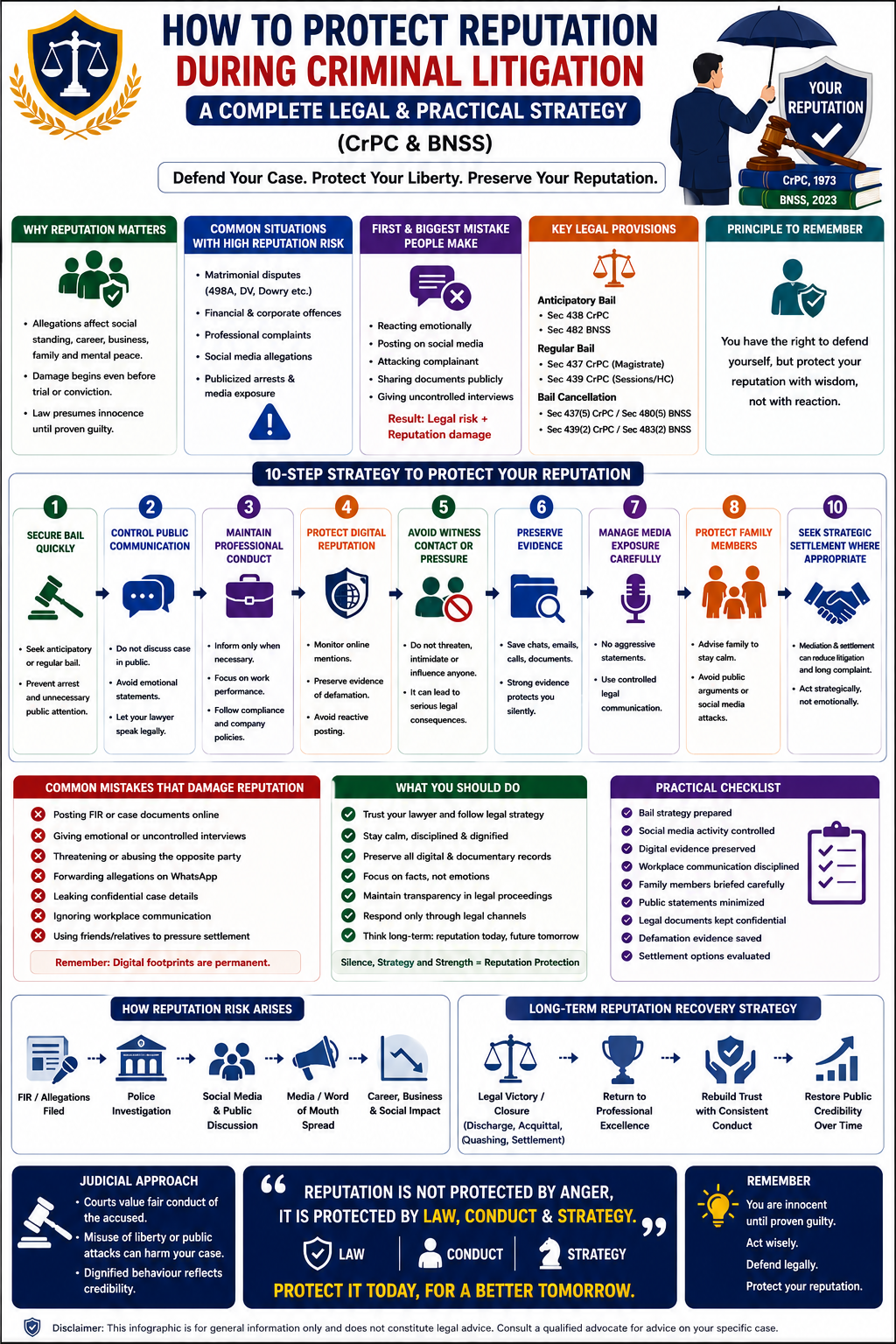

Key Contributor : 

Mrs. Suprajaa Rajan B.Com., LL.B., LL.M.

+91-9606345150


Post Views: 260
Posted in Legal Procedure | Tagged CrPC Sec 125 or BNSS Sec 144 - Interim Maintenance Reduced Divorce Strategy legal strategy and defence Maintenance law Matrimonial dispute matrimonial offences | Leave a comment

What to Say (and Not Say) During Investigation – A Practical Legal Guide

Posted on April 29 by Suprajaa Rajan

An investigation is a critical stage in criminal proceedings, where statements made by an individual can significantly impact the outcome of the case. Many accused persons unknowingly make statements that later weaken their defence or strengthen the prosecution’s case.

Therefore, understanding what to say—and what to avoid saying—during investigation is essential for protecting your legal rights.

This article explains the correct legal approach during police investigation, along with safeguards under the Code of Criminal Procedure, 1973 (CrPC) and the Bharatiya Nagarik Suraksha Sanhita, 2023 (BNSS).

Understanding Your Legal Position During Investigation

During investigation, the police have the authority to:

  • Call individuals for questioning
  • Record statements
  • Collect evidence

Relevant provisions:

  • Section 160 CrPC (Section 179 BNSS) – Attendance of witnesses
  • Section 161 CrPC (Section 180 BNSS) – Examination by police

However, this power is not unlimited. Individuals have specific rights that protect them from self-incrimination and coercion.

Right Against Self-Incrimination

Under Article 20(3) of the Constitution of India, no person can be compelled to:

  • Be a witness against themselves

This means:

  • You are not required to confess
  • You cannot be forced to make incriminating statements

This principle forms the foundation of your conduct during investigation.

What You Should Say During Investigation

1. Provide Basic Identification Details

You should always provide:

  • Name
  • Address
  • Contact details

This ensures compliance with legal requirements.

2. Confirm Willingness to Cooperate

You should clearly state:

  • Your willingness to cooperate with the investigation
  • Your readiness to appear when required

This helps avoid adverse inference and unnecessary coercive action.

3. Stick to Verified Facts Only

If you choose to answer questions:

  • Speak only about facts you are certain of
  • Avoid assumptions or speculation

Consistency is key to maintaining credibility.

4. Exercise Your Right to Silence Where Necessary

If a question may incriminate you, you can:

  • Politely decline to answer
  • State that you wish to consult your lawyer

This is a legally protected right.

5. Request Legal Assistance

While police questioning may proceed, you can:

  • Consult a lawyer before making detailed statements

This ensures that your rights are protected at every stage.

What You Should NOT Say During Investigation

1. Do Not Make Confessions to Police

Statements made to police are generally not admissible as evidence.

Relevant provision:

  • Section 25 of the Indian Evidence Act

However, such statements may still:

  • Influence investigation
  • Lead to recovery of evidence

Therefore, avoid making confessional statements.

2. Do Not Provide False Information

Giving false statements can:

  • Damage your credibility
  • Lead to additional legal consequences

Always avoid misleading the investigating officer.

3. Do Not Guess or Speculate

Never:

  • Assume facts
  • Provide uncertain answers

Speculative answers may later be used against you.

4. Do Not Sign Blank or Unread Documents

Before signing any document:

  • Read it carefully
  • Ensure it reflects your actual statement

Signing incorrect documents can seriously harm your case.

5. Do Not Get Provoked or Intimidated

Maintain composure even if:

  • Questioning becomes aggressive
  • Pressure is applied

Any emotional reaction can be misinterpreted.

Importance of Statements Under Section 161 CrPC

Statements recorded under:

  • Section 161 CrPC (Section 180 BNSS)

are:

  • Not signed by the person
  • Used for contradiction during trial

Therefore, even informal statements can later affect your defence.

Special Note on Section 164 Statements

If the Magistrate records your statement under:

  • Section 164 CrPC (Section 183 BNSS)

it carries higher evidentiary value.

Such statements:

  • Are recorded voluntarily
  • Can be used as substantive evidence

Hence, extreme caution is required before making such statements.

Role of Notice Under Section 41A

Instead of arrest, police may issue notice under:

  • Section 41A CrPC (Section 35 BNSS)

You must:

  • Comply with the notice
  • Appear before the officer

Cooperation reduces the risk of arrest.

Step-by-Step Practical Strategy

Step 1: Stay Calm and Composed

Do not panic or react impulsively.

Step 2: Understand the Nature of Allegations

Ask for:

  • Basic information about the case
  • Reason for questioning

Step 3: Avoid Incriminating Statements

Use your right to silence where necessary.

Step 4: Consult a Lawyer

Seek legal advice before making detailed statements.

Step 5: Maintain Consistency

Ensure that all statements remain:

  • Accurate
  • Consistent

Judicial Approach

Courts recognise that:

  • Statements made during investigation can be misused
  • Accused persons must be protected from coercion

Courts emphasise:

  • Voluntariness of statements
  • Protection against self-incrimination
  • Fair investigation process

Practical Insight

Many cases are weakened not because of evidence, but due to:

  • Incorrect statements
  • Inconsistent versions
  • Unnecessary admissions

Therefore, careful communication during investigation is a key defence strategy.

Conclusion

What you say during investigation can significantly influence your case. While cooperation is important, protecting your legal rights is equally essential.

By:

  • Speaking cautiously
  • Avoiding unnecessary disclosures
  • Exercising your right to silence

you can ensure that your defence remains strong throughout the proceedings.

A balanced approach—cooperative yet legally aware—is the best strategy during any investigation.


Related Legal Concepts

  • Police Investigation
  • Reply to Notice under Section 41A
  • Rights during police investigation
  • First Information Report(FIR)
  • Arrest and Custodial procedures


Index of Legal Strategies and Defence is here. 


Key Contributor : 

Mrs. Suprajaa Rajan B.Com., LL.B., LL.M.

+91-9606345150

Post Views: 120
Posted in Legal Procedure | Tagged Legal Rights Legal Strategies and Defence Police Investigation Section 160 CrPC Section 41A Notice | Leave a comment

Sivaraman Nair and Ors Vs State of Kerala and Anr on 24 Apr 2026 – Judgement Summary

Posted on April 29 by Suprajaa Rajan

In Sivaraman Nair & Ors. v. State of Kerala & Anr., the Supreme Court examined whether criminal proceedings for offences under Sections 498A, 494 read with 34 IPC (now corresponding provisions under Bharatiya Nyaya Sanhita (BNS)) could be sustained against the husband’s relatives in the absence of specific allegations.

The case arose from an FIR alleging dowry harassment, cruelty, and bigamy. While detailed accusations were made against the husband, the allegations against the in-laws were largely general, vague, and based on their familial relationship.

The accused-appellants approached the High Court under Section 482 CrPC (now Section 528 BNSS) seeking quashing of proceedings, but the High Court refused. On appeal, the Supreme Court re-evaluated whether the continuation of proceedings amounted to abuse of process of law.

The Court ultimately held that mere presence, passive knowledge, or general allegations are insufficient to prosecute relatives in matrimonial disputes. Consequently, it quashed proceedings against the in-laws while allowing the case against the husband to continue.

“21. That the inherent powers of the Court under section 482 CrPC are to be exercised ‘to prevent the abuse of the process of any court or otherwise to secure the ends of justice.”

“24. The FIR does not attribute to them any specific act of demand, threat, or physical assault on any identifiable occasion.”

“25. Accused-appellant no. 3, the sister-in-law, is alleged to have received money for the purchase of a flat from the proceeds of the sale of gold, but no specific act of cruelty or coercion on her part has been alleged.”

“26….the complainant is required to prima facie prove the overt act or omission of the accused persons in the second marriage ceremony. The prosecution has failed to provide any cogent evidence to establish such overt act or intention on part of the accused-appellants.”

“27. However, such inferential knowledge, without more, is insufficient to satisfy the threshold established in S. Nitheen (supra), which requires evidence of an overt act or omission. While it has been alleged that the accused-appellants were aware of the second marriage, mere knowledge that an act is being or has been committed by another person does not, by itself, establish the requisite common intention.”

Decision

The Supreme Court allowed the appeal and held that:

  • Proceedings against the in-laws lacked specific, credible allegations necessary to constitute offences under Sections 498A and 494 IPC (read with Section 34 IPC) [BNS equivalents].
  • The continuation of such proceedings would amount to abuse of process of law under Section 482 CrPC (Section 528 BNSS).
  • Mere familial relationship, presence, or passive knowledge does not establish criminal liability.
  • No material existed to show active participation in the alleged second marriage, a requirement for Section 494 IPC.

Accordingly, the Court quashed the criminal proceedings qua the accused-appellants (in-laws) while leaving the case against the husband unaffected.


Sivaraman Nair and Ors Vs State of Kerala and Anr on 24 Apr 2026


Citation : 2026 INSC 412

Other Sources :


Index of Quash judgements is here.


Related Legal Concepts

Explore related remedies and procedural safeguards in criminal law:

  • Abuse of Process of Law
  • First Information Report (FIR)
  • Quashing of FIR
  • Inherent Powers of High Court


Key Contributor :
Mrs. Suprajaa Rajan B.Com., LL.B., LL.M.
+91-9606345150


Post Views: 162
Posted in Supreme Court of India Judgment or Order or Notification | Tagged 2-Judge (Division) Bench Decision Abuse Or Misuse of Process of Court CrPC 482 - Quash Matrimonial disputes law Matrimonial Litigation India Sivaraman Nair and Ors Vs State of Kerala and Anr | Leave a comment

Post navigation

  • Older posts
  • Newer posts

Search within entire Content of “Shades of Knife”

My Legal X Timeline

Advocate Sandeep Pamarati 🇮🇳💪👨🏻‍🎓 Follow

AP High Court Advocate with M Tech (CS) || 12 years in 'Software Industry' as Solution Architect || Blogs at https://t.co/29CB9BzK4w || #TDPTwitter

SandeepPamarati
Retweet on Twitter Advocate Sandeep Pamarati 🇮🇳💪👨🏻‍🎓 Retweeted
rupokacharjee

Rupok Acharjee

Verified account @rupokacharjee ·
15 Aug

What is Bharat?

Bharat is not just a piece of land. It is home to different people with different lives, traditions and histories.

We all come from the same civilization - Bhartiya culture.

Reply on Twitter 2088579588175835212 Retweet on Twitter 2088579588175835212 267 Like on Twitter 2088579588175835212 1050 X 2088579588175835212
Retweet on Twitter Advocate Sandeep Pamarati 🇮🇳💪👨🏻‍🎓 Retweeted
besurataansane

Sameer

Verified account @besurataansane ·
15 Aug

Thankless bastards

Reply on Twitter 2088678125542728075 Retweet on Twitter 2088678125542728075 201 Like on Twitter 2088678125542728075 836 X 2088678125542728075
Retweet on Twitter Advocate Sandeep Pamarati 🇮🇳💪👨🏻‍🎓 Retweeted
manatdpfamily

BSB2020

Verified account @manatdpfamily ·
15h

చూస్తే కల్పిత వీడియోలా అనిపించొచ్చు…
కానీ దీని వెనుక ఉన్న నిజం మాత్రం వాస్తవమే…
ఆలోచించండి.. బాధ్యతని గుర్తించండి.

Reply on Twitter 2088837380010848322 Retweet on Twitter 2088837380010848322 10 Like on Twitter 2088837380010848322 35 X 2088837380010848322
Retweet on Twitter Advocate Sandeep Pamarati 🇮🇳💪👨🏻‍🎓 Retweeted
chopsyturvey

Aviator Anil Chopra

Verified account @chopsyturvey ·
14h

World Junior Women's Squash Champion : Ms. Anahat Singh. Proud

Reply on Twitter 2088852454259687842 Retweet on Twitter 2088852454259687842 39 Like on Twitter 2088852454259687842 215 X 2088852454259687842

Recent Posts

  • Antics of Advocates in India August 14, 2026
  • Antics of Police Personnel in India August 14, 2026
  • Application for Closure of Prosecution Evidence – Format, Procedure & Sample Draft August 6, 2026
  • Ishwar Chand Sharma and Ors Vs State of U.P. on 29 May 2026 July 26, 2026
  • Prabhakar Yeshwant Masram and Anr Vs Sou Tula Namdeorao Jaipurkar and Anr on 21 Jul 2026 July 26, 2026

Most Read Posts

  • Reply to Section 41A CrPC Notice – Format with Legal Explanation (5,193 views)
  • Charge Sheet and Final Report Explained (3,273 views)
  • Regular Bail Application Format (Section 437/439 CrPC) (2,643 views)
  • Arrest Procedure in 498A cases after Arnesh Kumar (2,210 views)
  • Discharge Application Format in 498A Case – Draft, Procedure & Sample Template (2,188 views)
  • Can You Travel Abroad After an FIR Is Registered? – Legal Position Explained (2,166 views)
  • Life Cycle of a Perjury Case (2,138 views)
  • Application for Certified Copy of FIR – Format, Procedure and Sample Draft (1,871 views)
  • Appeal, Revision and Review Explained (1,833 views)
  • Life Cycle Stages of a Restitution of Conjugal Rights Case (1,774 views)

Tags

Reportable Judgement or Order (439)2-Judge (Division) Bench Decision (424)Legal Procedure Explained - Interpretation of Statutes (387)Landmark Case (384)1-Judge Bench Decision (370)Catena of Landmark Judgments Referred/Cited to (298)Work-In-Progress Article (215)3-Judge (Full) Bench Decision (101)Sandeep Pamarati (91)Article 21 - Protection of life and personal liberty (80)Issued or Recommended Guidelines or Directions or Protocols to be followed (71)Perjury Under Section 340 CrPC (70)Absurd Or After Thought Or Baseless Or False Or General Or Inherently Improbable Or Improved Or UnSpecific Or Omnibus Or Vague Allegations (62)Reprimands or Setbacks to YCP Govt of Andhra Pradesh (49)Summary Post (47)CrPC 482 - Quash (44)CrPC 125 or BNSS 144 - Order for Maintenance of Wives Children and Parents (43)HM Act Sec 13 - Divorce Granted to Husband (42)Abuse Or Misuse of Process of Court (42)Divorce Granted on Cruelty ground (42)

Categories

Supreme Court of India Judgment or Order or Notification (760)Bare Acts or State Amendments or Statutes or GOs or Notifications issued by Central or State Governments (329)High Court of Andhra Pradesh Judgment or Order or Notification (187)High Court of Delhi Judgment or Order or Notification (167)High Court of Bombay Judgment or Order or Notification (112)High Court of Karnataka Judgment or Order or Notification (95)Legal Procedure (84)High Court of Madras Judgment or Order or Notification (71)High Court of Allahabad Judgment or Order or Notification (63)LLB Study Material (59)General Study Material (56)High Court of Punjab & Haryana Judgment or Order or Notification (53)Assorted Court Judgments or Orders or Notifications (53)High Court of Kerala Judgment or Order or Notification (47)Judicial Activism (for Public Benefit) (47)Prakasam DV Cases (46)District or Sessions or Magistrate Court Judgment or Order or Notification (44)High Court of Madhya Pradesh Judgment or Order or Notification (38)High Court of Gujarat Judgment or Order or Notification (28)High Court of Telangana Judgment or Order or Notification (28)

Recent Comments

  • vinod gupta on Reply to Section 41A CrPC Notice – Format with Legal Explanation
  • eCourts India on Compromise-Based Quashing in Matrimonial Cases – Complete Legal Strategy
  • The Divorce Law Firm on Life Cycle Stages of a Divorce case
  • The Divorce Law Firm on Life Cycle Stages of a Divorce case
  • ShadesOfKnife on Sandeep Pamarati Vs Ungrateful Knife (IPC 498A Case)

Archives of SoK

  • August 2026 (3)
  • July 2026 (19)
  • June 2026 (19)
  • May 2026 (24)
  • April 2026 (33)
  • March 2026 (42)
  • February 2026 (30)
  • January 2026 (21)
  • December 2025 (2)
  • November 2025 (3)
  • October 2025 (17)
  • September 2025 (12)
  • August 2025 (5)
  • July 2025 (10)
  • June 2025 (15)
  • May 2025 (3)
  • April 2025 (10)
  • March 2025 (7)
  • February 2025 (8)
  • January 2025 (1)
  • December 2024 (3)
  • November 2024 (4)
  • October 2024 (16)
  • September 2024 (15)
  • August 2024 (14)
  • July 2024 (11)
  • June 2024 (18)
  • May 2024 (13)
  • April 2024 (9)
  • March 2024 (23)
  • February 2024 (15)
  • January 2024 (11)
  • December 2023 (11)
  • November 2023 (9)
  • October 2023 (13)
  • September 2023 (12)
  • August 2023 (15)
  • July 2023 (17)
  • June 2023 (11)
  • May 2023 (6)
  • April 2023 (5)
  • March 2023 (10)
  • February 2023 (9)
  • January 2023 (12)
  • December 2022 (12)
  • November 2022 (8)
  • October 2022 (13)
  • September 2022 (17)
  • August 2022 (10)
  • July 2022 (21)
  • June 2022 (27)
  • May 2022 (23)
  • April 2022 (32)
  • March 2022 (17)
  • February 2022 (6)
  • January 2022 (2)
  • December 2021 (7)
  • November 2021 (7)
  • October 2021 (6)
  • September 2021 (10)
  • August 2021 (31)
  • July 2021 (45)
  • June 2021 (17)
  • May 2021 (17)
  • April 2021 (18)
  • March 2021 (58)
  • February 2021 (14)
  • January 2021 (50)
  • December 2020 (35)
  • November 2020 (68)
  • October 2020 (67)
  • September 2020 (28)
  • August 2020 (41)
  • July 2020 (20)
  • June 2020 (36)
  • May 2020 (40)
  • April 2020 (38)
  • March 2020 (26)
  • February 2020 (43)
  • January 2020 (35)
  • December 2019 (34)
  • November 2019 (4)
  • October 2019 (18)
  • September 2019 (57)
  • August 2019 (33)
  • July 2019 (12)
  • June 2019 (18)
  • May 2019 (5)
  • April 2019 (19)
  • March 2019 (58)
  • February 2019 (11)
  • January 2019 (90)
  • December 2018 (97)
  • November 2018 (43)
  • October 2018 (31)
  • September 2018 (73)
  • August 2018 (47)
  • July 2018 (143)
  • June 2018 (92)
  • May 2018 (97)
  • April 2018 (59)
  • March 2018 (8)

Blogroll

  • Daaman Promoting Harmony 0
  • Fight against Legal Terrorism Fight against Legal Terrorism along with MyNation Foundation 0
  • Good Morning Good Morning News 0
  • Insaaf India Insaaf Awareness Movement 0
  • MyNation Hope Foundation Wiki 0
  • MyNation.net Equality, Justice and Harmony 0
  • Sarvepalli Legal 0
  • Save Indian Family Save Indian Family Movement 0
  • SIF Chandigarh SIF Chandigarh 0
  • The Male Factor The Male Factor 0
  • Unitedmen Foundation a dedicated community forged with the mission to unite men facing legal challenges in marital disputes. 0
  • Vaastav Foundation The Social Reality 0
  • Vinayak my2centsworth – This blog is for honest law abiding men, married or planning to get married 0
  • Voice4india Indian Laws, Non-profits, Environment 0
  • Writing Law Writing Law by Ankur 0

RSS Cloudflare Status

  • EWR (Newark) on 2026-09-02 September 2, 2026
    Jul 21, 15:30 UTCScheduled - We will be performing scheduled maintenance in EWR (Newark) datacenter on 2026-09-02 between 05:00 and 09:00 UTC. Traffic might be re-routed from this location, hence there is a possibility of a slight increase in latency during this maintenance window for end-users in the affected region. For PNI / CNI customers […]
    Cloudflare

RSS List of Spam Server IPs from Project Honeypot

  • 34.182.240.218 | SD August 15, 2026
    Event: Bad Event | Total: 48 | First: 2026-08-15 | Last: 2026-08-15
Owned and Operated by Advocate Sandeep Pamarati and Advocate Suprajaa Rajan
Proudly powered by WordPress
Theme: Flint by Star Verte LLC

Bad Behavior has blocked 421 access attempts in the last 7 days.

pixel