web analytics

Menu

Skip to content
Shades of Knife
  • Home
  • True Colors of a Vile Wife
  • Need Inspiration?
  • Blog Updates
  • SOK Gallery
  • Vile News Reporter
  • About Me
  • Contact Me

Shades of Knife

True Colors of a Vile Wife

Legal Strategies and Defence – A practical legal guide

Posted on February 23 by Suprajaa Rajan

Facing a criminal complaint, matrimonial dispute, FIR, arrest threat, trial, or court proceedings can be overwhelming. Every stage of litigation requires a different legal approach.

This Legal Strategies & Defence Guide provides practical legal information, procedural guidance, and defence strategies to help individuals understand their rights and take informed decisions.

The guides are arranged according to different stages of a legal dispute — from early warning signs, FIR registration, arrest, bail, investigation, trial, settlement, and post-litigation remedies.

Matrimonial Criminal Litigation – Complete Defence & Strategy Guides

For individuals facing matrimonial disputes, criminal complaints, or allegations arising from marital conflicts.

Explore:

  1. Matrimonial Criminal Litigation – The Complete Defence Guide here.
    Understand defence strategy, legal rights, evidence preparation, and practical steps when facing matrimonial criminal proceedings.
  2. Matrimonial Criminal Litigation – The Complete Prosecution Strategy Guide here. 
    Understand how complainants approach matrimonial criminal cases and the legal framework involved.
  3. Falsely Accused Under Section 498A IPC – Legal Defence Strategy here. 
    Learn the steps to protect yourself against false or exaggerated allegations.
  4. False Domestic Violence Allegations – Legal Defence Strategy in India here. 
    Understand available remedies and defence planning against misuse of domestic violence proceedings.
  5. Top 10 Mistakes Accused Make in Matrimonial Cases – And How to Avoid Them here.
    Avoid common errors that can negatively impact your defence.
  6. How Courts Quash Omnibus Allegations in Matrimonial FIRs – Case Study here. 
    Understand how courts examine vague and general allegations.
  7. Myth vs Reality: Bail in 498A Cases – Legal Position Explained here.
    Understand practical bail considerations in matrimonial offences.
  8. Defence Strategy When Elderly Parents Are Named in FIR here.
    Learn how elderly family members can protect themselves when unnecessarily implicated.

Arrest Protection & Bail Strategy

For individuals facing arrest, police action, or criminal proceedings.

Explore:

9. Anticipatory Bail in Matrimonial Offences – Complete Guide here.
Understand pre-arrest protection, procedure, and strategy.

10. Arrest Procedure in 498A Cases After Arnesh Kumar here.
Learn arrest safeguards and important legal protections.

11. Second Anticipatory Bail Application – Is It Legally Possible? Complete Strategy here.
Understand when a second bail application may be considered.

12. Bail Conditions – How to Avoid Cancellation of Bail here.
Learn how to comply with bail conditions and avoid cancellation.

13. How to Prepare for Police Interrogation? – Legal Rights and Practical Guidance here.
Understand what to do and what to avoid during investigation.

14. Can You Travel Abroad After an FIR Is Registered? – Legal Position Explained here.
Understand travel restrictions, court permissions, and practical steps.

15. Passport Implications in 498A Cases – A Complete Practical Guide here.

Understand how FIRs, bail conditions, court permissions, and pending criminal proceedings can affect passport renewal, travel abroad, and immigration decisions.

FIR, Investigation & Chargesheet Defence Strategy

For individuals dealing with police complaints and criminal proceedings.

Explore:

16. Quashing of FIR Under Section 482 CrPC – Explained here. 
Understand when High Courts can stop criminal proceedings.

17. Checklist Before Filing Quashing Petition – Complete Practical Guide here.
A step-by-step preparation guide before approaching the High Court.

18. Compromise-Based Quashing in Matrimonial Cases – Complete Legal Strategy here. 
Understand how settlement may help resolve matrimonial criminal cases.

19. What to Do After Chargesheet Is Filed – Defence Strategy here.
Learn the next steps after investigation is complete.

20. Speedy Trial Rights in Matrimonial Litigation here.
Understand your right to timely proceedings.

Investigation, Evidence & Trial Defence Strategy

For individuals whose matters have progressed to court proceedings.

Explore:

21. What to Say (and Not Say) During Investigation – A Practical Legal Guide here. 
Learn how communication during investigation can affect your case.

22. Cross-Examination Strategy in 498A Trials – Defence Tactics That Can Change the Outcome here. 
Understand how witness examination impacts trial results.

23. How to Handle Hostile Witnesses in Criminal Trials – Complete Defence Strategy here.
Learn how courts evaluate witnesses who change testimony.

24. Objections a Defence Advocate Can Raise When the Prosecution Produces Documentary Evidence – Complete Trial Strategy Guide here.
Understand how documentary evidence can be challenged.

Court Remedies & Procedural Challenges

For challenging unfair proceedings or seeking legal remedies.

Explore:

25. How to Challenge Ex Parte Orders in Criminal and Matrimonial Proceedings – Legal Remedies here. 
Learn available options against orders passed without your presence.

26. When Can Court Cancel Exemption Under Section 205 CrPC – Explained here. 
Understand when personal appearance exemption may be withdrawn.

27. How to Seek Compensation for False Arrest in India? here. 
Understand legal remedies available after wrongful arrest.

28. When to File Defamation for False Allegations – Legal Strategy here. 
Learn when false allegations may justify defamation proceedings.

29. Petition Prayers Are Not Final Outcomes – Understanding Legal Strategy Before Making Decisions here.

Understand why allegations and prayers are only requests — and how final court outcomes depend on legal evaluation.

Maintenance & Financial Dispute Strategy

For cases involving financial claims and maintenance disputes.

Explore:

30. How to Defend Excessive Maintenance Claims in Matrimonial Cases here. 
Understand legal grounds to challenge unreasonable maintenance demands.

31. Reducing Maintenance – Legal Grounds and Strategy here. 
Learn when maintenance amounts may be modified.

32. Strategic Divorce Filing After Criminal Complaint – A Legal Perspective here. 
Understand timing and strategy behind divorce proceedings.

Settlement & Resolution Strategy

For individuals looking for practical ways to resolve disputes.

Explore:

33. Compromise-Based Quashing in Matrimonial Cases – Complete Legal Strategy here. 
Understand settlement-based closure of criminal proceedings.

34. Warning Signs of Escalating Matrimonial Litigation – Early Red Flags Every Spouse Should Recognise here. 
Identify early indicators before disputes become prolonged litigation.

35. How to Protect Reputation During Criminal Litigation – Complete Legal & Practical Strategy here.
Learn how to protect professional and personal reputation during legal proceedings.

Digital Evidence & Reputation Protection

Modern litigation often depends heavily on digital records.

Explore:

36. How to Protect Digital Evidence in Matrimonial Disputes – A Practical Legal Guide here.
Learn how to preserve chats, emails, recordings, and online evidence.

37. How to Protect Reputation During Criminal Litigation – Complete Legal & Practical Strategy here.
Understand digital reputation management and responsible legal communication.

Advocate Complaints & Professional Ethics

For clients facing issues with legal representation.

Explore:

38. How to File a Complaint Against an Advocate in India – A First-Timer’s Complete Guide here.
Understand the process, documents required, and disciplinary mechanism.


Need Legal Strategy for Your Situation?

Every case depends on its facts, evidence, and procedural stage.

A timely legal strategy can help you:

  • Protect your rights
  • Avoid procedural mistakes
  • Preserve important evidence
  • Make informed decisions
  • Prepare effectively for litigation

Views: 356
Posted in Legal Procedure/Tool | Leave a comment

What To Do If You Are Falsely Accused Under Section 498A IPC

Posted on February 23 by Suprajaa Rajan

Introduction

Being named in an FIR under Section 498A of the Indian Penal Code can be legally and emotionally overwhelming. The provision deals with cruelty by a husband or his relatives toward a married woman. It is cognizable and non-bailable, which means arrest is legally permissible without a warrant.

However, courts have repeatedly recognised that vague and omnibus allegations should not automatically result in arrest or prosecution.

If you believe the complaint is false or exaggerated, you must act strategically and immediately. This guide explains the precise legal steps you should take.

I. Understand the Nature of Section 498A IPC

Indian Penal Code :

Section 498A defines cruelty as:

  • Wilful conduct likely to drive a woman to suicide, or

  • Harassment in connection with unlawful dowry demands.

Mere marital discord, incompatibility, or trivial disputes do not automatically amount to statutory cruelty.

II. Do Not Panic or Engage in Direct Confrontation

Avoid contacting the complainant to “settle” the issue emotionally. Any communication may later be produced as evidence.

Do not:

  • Threaten

  • Argue

  • Attempt private coercive settlement

Instead, consult a criminal law practitioner immediately.

III. Secure Anticipatory Bail Without Delay

If arrest appears imminent, file for anticipatory bail under:

Code of Criminal Procedure, 1973

Specifically under Section 438 CrPC.

The Supreme Court in Arnesh Kumar v. State of Bihar held that automatic arrests in 498A cases violate personal liberty. Police must comply with Section 41 and 41A CrPC safeguards before arrest.

Anticipatory bail protects you from custodial detention during investigation.

Read also : “Anticipatory Bail in Matrimonial Offences – Complete Guide”

IV. Collect and Preserve Documentary Evidence

Your defence begins with documentation.

Secure:

  • WhatsApp chats and emails

  • Call records

  • Bank transactions

  • Proof of financial transfers

  • Travel history

  • Medical records

  • Photographs and CCTV footage

  • Witness details

Preserve electronic evidence in original format. Do not tamper with devices.

V. Evaluate Grounds for Quashing the FIR

If the complaint contains:

  • Vague allegations

  • No specific date or incident

  • General accusations against distant relatives

  • No specific dowry demand

You may approach the High Court under Section 482 CrPC seeking quashing.

The Supreme Court in State of Haryana v. Bhajan Lal laid down categories where criminal proceedings may be quashed, especially when allegations do not disclose a prima facie offence or appear mala fide.

Read also : “File a Discharge or Quash petition”

VI. Challenge Illegal Arrest or Procedural Violations

If police arrest without complying with Section 41 CrPC safeguards, you may:

  • Seek immediate bail

  • Move for departmental action

  • File writ petition for violation of Article 21 rights

Personal liberty remains constitutionally protected.

VII. Avoid Counter-Litigation in Anger

Filing multiple retaliatory complaints may weaken your credibility.

Instead, take structured legal action such as:

  • Defamation proceedings (in appropriate cases)

  • Petition for restitution or divorce

  • Application for discharge at charge stage

Each step must align with long-term strategy.

VIII. Understand the Investigation Process

After FIR registration:

  1. Police record statements under Section 161 CrPC

  2. Evidence is collected

  3. Charge sheet may be filed before Magistrate

If evidence is weak, you may seek discharge before trial begins.

Read also : “Lifecycle stages of a Section 498A IPC case”

IX. Protect Elderly Parents and Relatives

Courts frequently criticise the practice of implicating all family members without specific allegations.

If distant relatives are named without overt acts, this strengthens grounds for quashing.

Courts consistently hold that criminal law cannot be used as a tool for matrimonial pressure.

X. Maintain Dignity and Composure

498A litigation often accompanies:

  • Domestic Violence proceedings

  • Maintenance claims

  • Divorce petitions

Coordinate defence strategy across all proceedings. Fragmented legal responses create contradictions.

Conclusion

A false accusation under Section 498A IPC demands calm, structured, and legally sound action. Panic or retaliation worsens the situation.

Indian courts recognise misuse concerns. They insist on procedural safeguards and evidentiary scrutiny. Early anticipatory bail, evidence preservation, and strategic litigation under Section 482 CrPC can prevent prolonged harassment.

Criminal law must protect genuine victims. It must not become an instrument of coercion in matrimonial disputes.


Frequently Asked Questions

No. After Arnesh Kumar, police must justify arrest under Section 41 CrPC.

Yes. High Courts exercise inherent powers under Section 482 CrPC where allegations fail to disclose an offence.

It is generally non-compoundable, but courts may quash proceedings in case of genuine settlement.

Courts discourage prosecution based on vague or omnibus statements.

Views: 623
Posted in Legal Procedure/Tool | Tagged bhajan lal principles CrPC Sec 438 - Anticipatory Bail Dowry Case Law False 498A case Quashing of FIR Section 498A IPC | Leave a comment

Bagadi Santhosh Kumar Vs Union of India and Ors on 12 Mar 2025

Posted on February 21 by ShadesOfKnife

The Andhra Pradesh High Court examined the legality of a Look-Out Circular (LOC) issued against the petitioner in a matrimonial-related criminal case.

The Court held that authorities cannot issue an LOC routinely. The Court emphasised that an LOC affects personal liberty and must satisfy the conditions laid down in the Ministry of Home Affairs guidelines. Since the petitioner had cooperated with the investigation and the case did not fall within exceptional categories, the Court directed withdrawal of the LOC.

Before reproducing the relevant extracts, the Court examined the constitutional protection of personal liberty and the statutory guidelines governing Look-Out Circulars.

Relevant Extracts from the Judgment:

“14. It is basic that merely because a person is involved in a criminal case, he is not denude of his Fundamental Rights, it is the fundamental of a person to move anywhere he likes including foreign countries. One’s such personal freedom and liberty cannot be abridged. [See; Article 21 Constitution of India].”

“14. But, in any case, it must be fair and reasonable. It should not be indiscriminate without any reason or basis.”

“17. Sub-para J of Office Memorandum dated 22.02.2021 mandates that a Look-Out Circular shall remain in force until and unless a deletion request is received by the Bureau of Immigration from the Originator and that no Look-Out Circular shall be deleted automatically.”

“18. Sub-para L of the circular dt. 22.02.2021 indicates that Look-Out Circulars could be issued in exceptional cases where the departure of the person concerned will be detrimental to the sovereignty, security and integrity of India…”

“20. Issuance of LOC, in the peculiar facts of this case, is unwarranted.”

“21. Given the facts and circumstances of the case, the 5th respondent shall withdraw the Look-Out Circular issued against the petitioner in connection with Crime No.319 of 2024… forthwith.”

Decision

The Andhra Pradesh High Court allowed the writ petition. The Court directed the authorities to withdraw the Look-Out Circular forthwith. The Court permitted the petitioner to approach the Magistrate for travel permission in the pending criminal case.


Bagadi Santosh Kumar Vs Union of India and Ors on 12 Mar 2025

Citation :

Other Sources :


Index of Look Out Circular notices is here. 


Key Contributor :

Mrs. Suprajaa Rajan B.Com., LL.B., LL.M.

+91-9606345150


Views: 183
Posted in High Court of Andhra Pradesh Judgment or Order or Notification | Tagged 1-Judge Bench Decision Article 21 - Protection of life and personal liberty Article 226 - Lookout Circular (LOC) Quashed Bagadi santhosh kumar Vs Union of India and Ors Criminal law Criminal Procedure LOC in Matrimonial Dispute Look Out Circular Look Out Circular Notices Quashing of LOC Right to Travel | Leave a comment

Pothugutla Sushmitha Vs State of AP and Anr on 05 Sep 2022

Posted on February 20 by ShadesOfKnife

A single judge of AP High Court held as follows,

From Paras 10 and 11,

10. The observations made in both the decisions are similar and they go to show that if anyone is declared as an absconder/proclaimed offender in terms of Section 82 of the Code, he is not entitled to the relief of anticipatory bail.
11. In the instant case, Non-Bailable-Warrant was issued against the petitioner/A-4 as she was shown absconding in the charge sheet and it is not the case that proclamation proceedings were initiated and thus, the petitioner cannot at all be termed as a ‘proclaimed offender’ so as to disentitle her from getting the relief of anticipatory bail. Thus, as per the observations of the Hon’ble Supreme Court and since proclamation proceedings under section 82 Cr.P.C. are not initiated, the present petition is maintainable.

Pothugutla Sushmitha Vs State of AP and Anr on 05 Sep 2022
Views: 85
Posted in High Court of Andhra Pradesh Judgment or Order or Notification | Tagged 1-Judge Bench Decision CrPC 82 - Proclamation For Person Absconding CrPC Sec 438 - Anticipatory Bail Granted Pothugutla Sushmitha Vs State of AP and Anr Reportable Judgement or Order | Leave a comment

Rashmi Raikhy and Anr Vs The State of NCT Delhi and Ors on 1 Feb 2018

Posted on February 19 by ShadesOfKnife

The High Court of Delhi, quashed the Look Out Circular (LOC) issued against the petitioners registered under Sections 406/498-A/34 IPC.

The Court held that issuance and continuation of an LOC in a matrimonial dispute involving Section 406 IPC was neither reasonable nor justified, especially when the petitioners had regularly appeared before the trial court, complied with bail conditions under Section 438 CrPC, and had not misused permission to travel abroad.

The Court emphasised that an LOC is a serious coercive measure and cannot be mechanically issued in matrimonial disputes where the accused are neither absconding nor involved in heinous offences.

The LOC was accordingly directed to be withdrawn.


The following paragraphs were instrumental in the Court’s decision to quash the Look Out Circular:

Para 4 “Record reveals that on several occasions permissions were sought by the petitioners to travel abroad and the said permissions were granted; there are no allegations of their misuse. Record further reveals that the petitioners are regularly appearing before the court concerned in the said proceedings.”

Para 5 “During this period since 2009/2010, the petitioners have suffered a lot due to issuance of LOC against them. Even after discharge order on 11.12.2017, LOC against the petitioner No.2 has not been rescinded.”

Para 7 “For the offence under Section 406 IPC, in matrimonial dispute, issuance of LOC against the petitioners till disposal of the case cannot be justified; the offence is not heinous in nature.”

Para 8 “In the case of E.V.Perumal Samy Reddy, E.V.R.Santosh Reddy and Rajeshwari vs. State represented by the Deputy Commissioner of Police and State represented by the Inspector of Police MANU/TN/2308/2013, Madras High Court noted various types of persons who could be included in the LOC:-

(i) Persons with Terrorists or Militant Links,
(ii) Belligerent Foreigners,
(iii) Foreigners previously noticed for violations of visa conditions.
(iv) Persons required by courts in criminal/civil cases who are absconding
(v) Absconding Offenders wanted by Police/CBI/Customs /Central excise/ Directorate of Rev. Intelligence/other agencies”

Para 9 “Apparently, the petitioners do not fall in any of the above categories. There are no allegations that petitioner No.1 ever absconded and did not participate in the criminal proceedings.”

Para 10 “Issuance of LOC is a serious matter as it contains full particulars of the individual which are sent throughout the world. Peculiar facts and circumstances of the case and due to subsequent development whereby the petitioner No.1 was charged only under Section 406 IPC, continuation of LOC against her can’t be considered reasonable and justified.”

Para 11 “In view of the above discussion, the concerned authorities are directed to withdraw the LOC order issued against the petitioners.”


Decision of the Court

Exercising jurisdiction under Articles 226/227 of the Constitution of India read with Section 482 CrPC, the Delhi High Court allowed the writ petition and directed the withdrawal of the Look Out Circular issued against the petitioners.


Rashmi Raikhy Vs State of NCT of Delhi

Citation: [2018:DHC:785]

Other Sources :


Index of Look Out Circular decisions is here.


Key Contributor:
Mrs Suprajaa Rajan B.Com, LL.B., LL.M.
+91-9606345150

Views: 119
Posted in High Court of Delhi Judgment or Order or Notification | Tagged 1-Judge Bench Decision Article 226 Constitution Criminal Procedure Code Dowry Case Law LOC in Matrimonial Dispute Look Out Circular Matrimonial Litigation India Quashing of LOC Rashmi Raikhy & Anr Vs The State of NCR Delhi Reportable Judgement or Order Section 406 IPC Section 498A IPC Writ Petition | Leave a comment

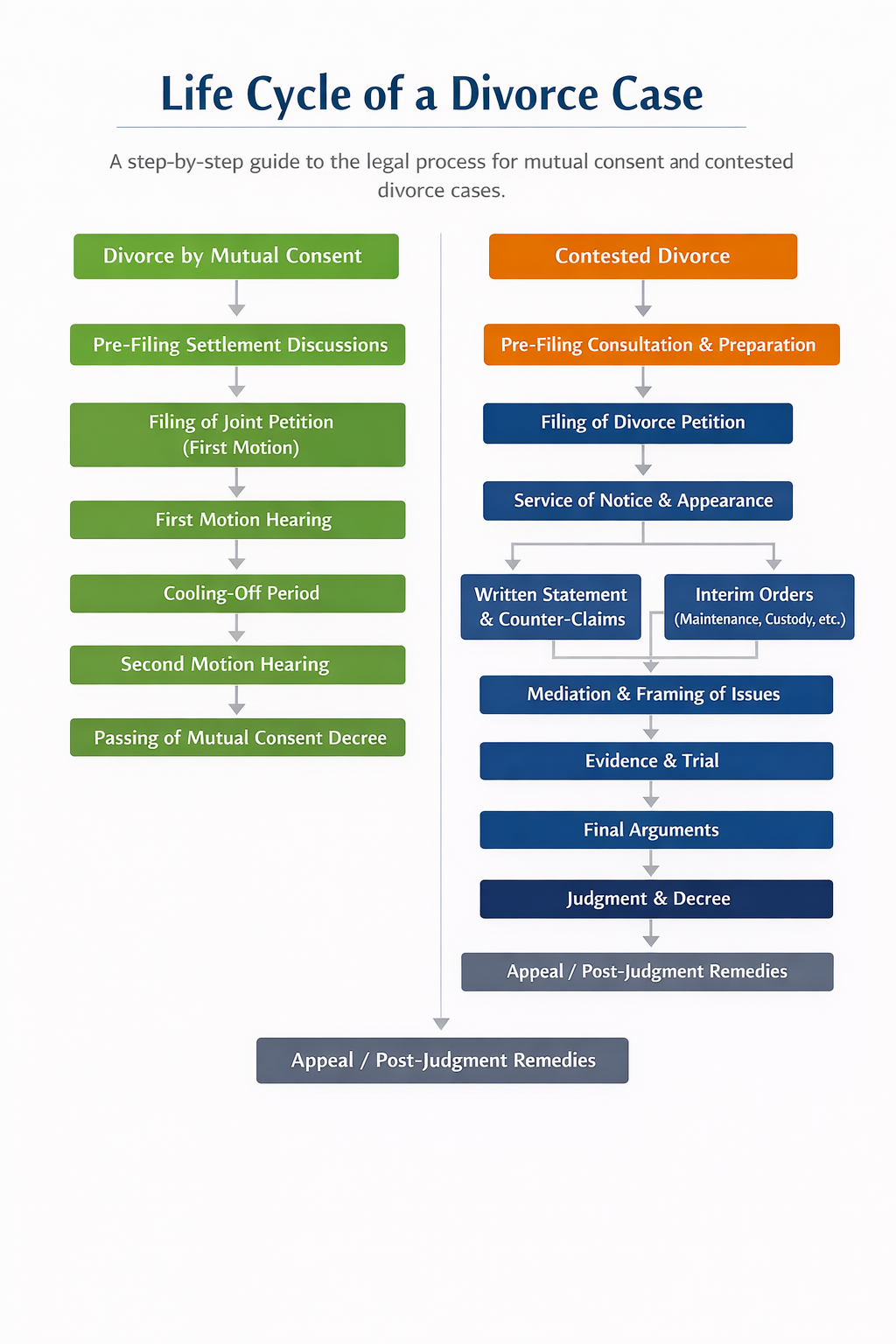
Life Cycle Stages of a Divorce case

Posted on February 19 by Suprajaa Rajan

A divorce case follows a structured legal pathway, and understanding each stage enables individuals to approach the process with preparedness and clarity.

Here is a Detailed Step-by-Step Guide to Divorce by Mutual Consent and Contested Divorce in India.

Divorce is a formal legal process through which a valid marriage is dissolved by a court of law. The procedure follows a structured framework under personal laws and procedural statutes. In India, divorce proceedings are primarily governed by personal laws such as the Hindu Marriage Act, 1955, the Special Marriage Act, 1954, and procedural provisions under the Code of Civil Procedure, 1908.

This article explains the complete life cycle of a divorce case. It focuses on two major types of divorce proceedings: divorce by mutual consent and contested divorce.

Types of Divorce Cases

1. Divorce by Mutual Consent

Divorce by mutual consent arises when both spouses agree to dissolve the marriage. They mutually decide that they can no longer live together harmoniously. Section 13B of the Hindu Marriage Act, 1955 provides for divorce by mutual consent.

Both parties must agree on key issues before filing the petition. These issues include child custody, maintenance, alimony, and division of property.
The agreement must reflect free will and absence of coercion. Courts encourage this method because it reduces emotional and financial strain.
This process is generally faster than contested divorce proceedings.

2. Contested Divorce

A contested divorce occurs when one spouse files for divorce without the consent of the other spouse. The petitioner must prove legally recognised grounds for divorce. Section 13 of the Hindu Marriage Act, 1955 lists grounds such as cruelty, adultery, desertion, conversion, mental disorder, and others.

The respondent may oppose the petition and deny the allegations. The matter then proceeds through evidence, trial, and judicial determination.
Contested divorces often require detailed examination of facts and legal arguments.

1. Stage One: Pre-Filing Consultation and Legal Preparation

The divorce process usually begins with legal consultation. A spouse consults an advocate to understand rights, obligations, and potential outcomes.
The lawyer evaluates the facts to determine whether grounds for divorce exist.

At this stage, parties gather essential documents. These documents include the marriage certificate, proof of residence, identity documents, and evidence supporting allegations. Financial documents such as income statements and property records are also collected.

In mutual consent cases, spouses negotiate settlement terms before filing.In contested cases, the petitioner prepares factual pleadings and supporting material.

Legal preparation ensures clarity and reduces procedural delays.

2. Stage Two: Filing of the Divorce Petition

The formal process begins when the petitioner files a divorce petition before the competent Family Court. Jurisdiction depends on place of marriage, last residence together, or current residence of the respondent.

The petition contains material facts of the marriage. It states the date of marriage, details of children, and grounds for divorce. It also specifies relief sought, including dissolution of marriage, custody, maintenance, and litigation expenses.

In mutual consent divorce, both parties jointly file a petition under Section 13B. In contested divorce, only one spouse files the petition citing statutory grounds.

After scrutiny, the court registers the case and assigns a case number. The court then issues notice to the respondent.

3. Stage Three: Service of Notice and Appearance

The court ensures proper service of notice upon the respondent. Service of notice guarantees adherence to principles of natural justice. The respondent must receive an opportunity to present a defence.

The notice specifies the next hearing date. The respondent must appear personally or through legal counsel.Failure to appear may result in ex-parte proceedings.

Proper service validates further proceedings in the case.

4. Stage Four: Filing of Written Statement and Counter-Claims

In contested divorce cases, the respondent files a written statement. The written statement responds to each allegation in the petition. The respondent may admit, deny, or explain specific claims.The respondent may also raise counter-claims seeking independent relief. Counter-claims may include restitution of conjugal rights or custody rights.

In mutual consent cases, both parties submit affidavits confirming voluntary agreement. The court verifies that consent is genuine and informed.

This stage defines the scope of dispute between parties.

5. Stage Five: Interim Applications and Temporary Relief

During pendency of the case, parties may seek interim relief. Section 24 of the Hindu Marriage Act allows maintenance pendente lite and litigation expenses. Either spouse may apply for interim financial support.

Courts may also pass temporary custody orders in the best interest of the child. Interim protection orders ensure stability during litigation.

The court evaluates financial capacity and needs before granting interim relief. These orders remain effective until final judgment.

6. Stage Six: Mediation and Reconciliation Efforts

Family Courts often refer parties to mediation or conciliation. Section 9 of the Family Courts Act encourages settlement efforts. Mediation promotes amicable resolution without prolonged litigation. A neutral mediator facilitates constructive dialogue. Parties may resolve disputes regarding custody and property during mediation.

If mediation succeeds, parties record settlement terms before the court.
If mediation fails, the case proceeds to trial.

7. Stage Seven: Framing of Issues

In contested divorce, the court frames issues for determination. Issues identify disputed questions of fact and law. Each issue requires evidence and adjudication. For example, the court may frame an issue on whether cruelty occurred. The court may also frame issues regarding entitlement to maintenance.

Framing of issues narrows the scope of trial.
It provides procedural clarity to both parties.

8. Stage Eight: Evidence and Trial

The trial stage begins with the petitioner presenting evidence. Evidence may include documents, photographs, medical reports, or electronic records.
Witnesses may testify in support of allegations.

The respondent cross-examines the petitioner’s witnesses. Cross-examination tests credibility and factual accuracy.After the petitioner closes evidence, the respondent presents defence evidence. The petitioner may cross-examine defence witnesses.

The court records all testimonies systematically. The trial ensures procedural fairness and evidentiary scrutiny.

9. Stage Nine: Final Arguments

After completion of evidence, the court schedules final arguments. Advocates summarise factual findings and legal provisions. They cite relevant precedents to strengthen submissions.

The judge evaluates oral and written arguments carefully. The court may raise clarificatory questions during arguments. Final arguments provide an opportunity to persuade the court.

10. Stage Ten: Judgment and Decree

After considering pleadings, evidence, and arguments, the court delivers judgment. The judgment explains reasoning and legal conclusions. If grounds are proved, the court grants a decree of divorce. The decree formally dissolves the marriage. The court also decides maintenance, custody, and property disputes.

In mutual consent cases, the court grants decree after second motion confirmation. The decree becomes effective upon pronouncement.

11. Post-Judgment Remedies and Appeal

An aggrieved party may file an appeal before a higher court. Appeals must comply with statutory limitation periods. The appellate court reviews legal and procedural correctness. Parties may also seek modification of custody or maintenance orders. Courts entertain modification applications upon change in circumstances.

Conclusion

A divorce case follows a structured and legally regulated life cycle.
Divorce by mutual consent offers a cooperative and time-efficient resolution.
Contested divorce involves detailed judicial examination and trial.

Each stage safeguards fairness, transparency, and due process.
Understanding the procedure empowers individuals to approach the process confidently.
Proper legal guidance and informed decision-making significantly improve outcomes.


Other Life Cycles: 498A IPC Case Lifecycle || Maintenance Case u/s 125 CrPC Lifecycle. Index of all life cycles is here.


Key Contributor:
Mrs Suprajaa Rajan B.Com, LL.B., LL.M.
+91-9606345150

Views: 1,762
Posted in Legal Procedure/Tool | Tagged HM Act Sec 13 - Divorce HM Act Sec 13B - Divorce by Mutual Consent Life Cycle Stages of a Divorce case Life Cycles of Various case types | 2 Comments

Ravi Prakash Saxena Vs Priyanka Rani on 04 Sep 2025

Posted on February 19 by ShadesOfKnife

A single judge of Patna High Court held as follows,

From Para 3, (Gold Digger looking for next bakra)

3. The petitioner has alleged that the opposite party/wife is in the habit of duping different young men with the sole motive of earning huge amounts of money after marriage, either by way of alimony or claiming maintenance allowance. Even during the strained relation with the petitioner, the opposite party started to find out another person as a groom to whom she could marry.

From Para 7,

7. The petitioner medically treated her and came to know that the opposite party was suffering from Obsessive Compulsive Disorder (OCD) leading to suicidal tendencies.

From Para 28,

28. While Section 125 proceedings are summary, courts consider conduct and financial disclosures critically. If a wife conceals her actual income or alimony, it may disentitle her as the court relies on bona fide disclosures to decide maintenance amount. Reference in this regard may be made to a Punjab & Haryana High Court case of Jaspreet Singh v. Gurleen Kaur, reported in 2020 SCC OnLine P&H 55

From Paras 29 and 30,

29. On the basis of the discussion made hereinabove, this Court is of the view that before passing a final order of maintenance, the learned Principal Judge, Family Court, Saran at Chapra is under statutory obligation to direct the parties to file affidavits of assets and liabilities. Only on due consideration of such affidavits of assets and liabilities, it will be possible for the Court to consider the status of the parties, their assets, respective needs, capability of earning and on the basis of such documents, Court can come to a conclusive decision with regard to amount of maintenance.
30. In view of such circumstances, this Court does not have any other alternative but to hold that the impugned order suffers from impropriety and illegality in over looking suppression of material facts, income of the parties, their source of income, their assets and liabilities and other similar factors, which are required to be considered for determination of maintenance allowance.

Finally, from Paras 33 and 34,

33. Let a copy of this order be sent to the learned Principal Judge, Family Court, Saran at Chapra for information with a direction that he shall direct both the parties to file their affidavits of assets and liabilities as per the guidelines laid down by the Hon’ble Supreme Court in Rajnish (supara) within four weeks from the date of communication of the order.
34. After receiving the affidavits of assets and liabilities from both the parties, the learned Trial Judge shall dispose of the proceeding under Section 125 of the Cr.P.C. by passing a fresh judgement within four weeks thereafter.

Ravi Prakash Saxena Vs Priyanka Rani on 04 Sep 2025

Citations:

Other Sources:

https://indiankanoon.org/doc/10821398/

https://www.casemine.com/judgement/in/68b9b4b3f964826458fefb71

https://www.verdictum.in/court-updates/high-courts/patna-high-court/ravi-prakash-saxena-v-priyanka-rani-patna-high-court-divorce-proceedings-maintenance-section-125-crpc-1590606

Family Law September 2025 | Important Case Law and Judicial Updates

Patna High Court Sets Aside ₹20K Monthly Maintenance, Affidavits of Assets & Liabilities Must Be Filed Before Deciding Maintenance Rajnish v. Neha


Index of Maintenance Judgments under Section 144 BNSS is here.

Views: 200
Posted in High Court of Patna Judgment or Order or Notification | Tagged 1-Judge Bench Decision CrPC 125 or BNSS 144 - Remanded for Fresh Determination Perjury - Wilful Omission or Supression of Material Information Ravi Prakash Saxena Vs Priyanka Rani | Leave a comment

Mohammed Azeem Vs Sabeeha & Ors on 22 Sep 2025

Posted on February 18 by ShadesOfKnife

The High Court of Karnataka held that a Family Court has no jurisdiction to issue a Look Out Circular (LOC) for recovery of maintenance under Section 125 Cr.P.C. 

The Court ruled that enforcement of maintenance orders must strictly follow the mechanism provided under Section 125(3) CrPC read with Section 421 CrPC. It permits recovery through attachment and sale of property, and not by issuance of a Look Out Circular.

The Court further observed that continuing an LOC despite a judicial stay order amounts to violation of Article 21 of the Constitution of India. 

Below are the crucial paragraphs that formed the foundation of the Court’s decision:

Para 2

“It is submitted that Section 125(3) provides that in enforcement of the maintenance order Court may issue a warrant for levying the amount due in the manner provided for fines as prescribed under Section 421 of Cr.P.C. Section 421 provides that a warrant for levy of fine by attachment of sale of immovable property.”

“Proviso to Section 421 provides that no such warrant shall be executed by arrest or detention in prison of the offender. The Family Court has no power to issue the look out circular in the process of executing the order of maintenance.”

“The Family Court has no power to issue the look out circular in the process of executing an order that is passed under Section 125 of CrPC.”

“Maintenance orders passed under Section 125 of CrPC is a civil obligation enforced through judicial orders. If party defaults the remedy is to seek execution of the order i.e., attachment of property, warrant of arrest and civil imprisonment.”

“Look out circulars are meant to prevent the accused/offenders from evading criminal process. The LOC cannot be issued for recovering the dues of maintenance.”

Para 6

“Further, continuing the LOC despite the order passed by the Court is illegal and amounts to contempt of Court and it also amounts to violation of rights guaranteed under article 21 of the Constitution of India.”


Mohammed Azeem Vs Saheeba and Ors

Citation :

Other Sources :


Index of Judgments about Look Out Circular notices is here. 


Key Contributor :

Mrs. Suprajaa Rajan B.Com., LL.B., LL.M.,

+91-9606345150


Views: 197
Posted in High Court of Karnataka Judgment or Order or Notification | Tagged 1-Judge Bench Decision Article 21 violation BNSS Sec 144 - Order for maintenance of wives children and parents Criminal Procedure Code 1973 CrPC 125 or BNSS 144 - Order for Maintenance of Wives Children and Parents Family Court jurisdiction LOC in matrimonial disputes Look Out Circular Maintenance recovery Matrimonial dispute Matrimonial law Mohammed Azeem Vs Saheeba and Ors | Leave a comment

Abuzar Ahmed and Ors Vs State of Karnataka and Anr on 8 Jan 2026

Posted on February 17 by ShadesOfKnife

The High Court of Karnataka quashed criminal proceedings initiated under Section 498A and Section 504 of the IPC, read with Sections 3 and 4 of the Dowry Prohibition Act, 1961.

The Court examined the complaint in detail. It found that the allegations described routine marital disagreements. They did not disclose grave cruelty or a specific unlawful dowry demand.

The Bench clarified an important principle. Section 498A IPC does not criminalise incompatibility or ordinary wear and tear of marriage. Criminal law cannot become a tool in matrimonial discord.

The following paragraphs formed the core reasoning of the Court:

Para 8

“A careful reading of the complaint reveals grievances such as dietary restrictions, expectations regarding attire, allocation of household responsibilities, disagreements over television preferences laced with a statement that the husband treated the complainant/wife as his servant. These allegations even if accepted at face value, portray a portrait of marital discord, but falls woefully short of depicting the statutory cruelty contemplated under Section 498A of the IPC.”

Para 8 (continued)

“If this is the complaint against the husband and in-laws, it cannot but be held that it is an abuse of the process of law, as minor skirmishes that happens in the family between the husband and the wife are projected to become a crime for offences punishable under Section 498A of the IPC or even under Section 504 IPC.”

Para 9

“The law does not criminalize incompatibility, nor does it punish imperfect marriages. Section 498A of the IPC is not a panacea for all matrimonial ills. It is a targeted provision meant to address grave cruelty, conduct so wilful and pernicious so as to imperil life, limb or mental health or even harassment tethered to unlawful demands of dowry.”

Para 12

“The present case forms, as observed hereinabove, a classic illustration of the said abuse. The Apex Court, in such cases, holds that the offence should be nipped in the bud by interfering under Section 482 of the Cr.P.C.”

Para 26

“The allegations of cruelty, mental harassment and voluntarily causing hurt have been made with a mala-fide intent with vague and general allegations… It is neither expedient nor in the interest of justice to permit the present prosecution to continue.”


Abuzar ahmed Vs State of Karanataka on 8 Jan 2026

Citation :

Other Sources :


Key Contributor :
Mrs. Suprajaa Rajan
B.Com., LL.B., LL.M.
Contact : 9606345150

Views: 322
Posted in High Court of Karnataka Judgment or Order or Notification | Tagged Abuse Or Misuse of Process of Court Abuzar ahmed and Ors Vs State of Karnataka CrPC 482 – Criminal Proceeding Quashed cruelty under IPC Dowry Harassment law Dowry Prohibition Act 1961 Matrimonial disputes law Quashing of FIR Section 482 CrPC Section 498A IPC | Leave a comment

Tasmeer Qureshi Vs Asfia Mazaffar on 29 Oct 2025

Posted on February 14 by ShadesOfKnife

In Tasmeer Qureshi v. Asfia Muzaffar, the Delhi High Court held that a Family Court cannot fix interim maintenance without recording a clear assessment of the husband’s income. While concealment of income permits an adverse inference, the Court must still determine actual or notional monthly income before fixing the quantum. Since the Family Court failed to disclose the income basis for the amount awarded, the High Court set aside the order and remanded the matter for fresh determination in accordance with law and the principles laid down in Rajnesh v. Neha.

Before setting out the relevant extracts, the Court emphasized that maintenance cannot be fixed in vacuum and must reflect a reasoned assessment of income.

Relevant Extracts from the Judgement :

“9. Apparently, it is the petitioner’s case that he had left his job on 04.01.2019, therefore, it is questionable as to how there were credit entries of Rs.15,45,131/- in the period 2021–23, in case he was unemployed.”

“10. In these circumstances, the learned Family Court drew an adverse inference that the petitioner is a man of means and has sufficient capacity to maintain the respondent and their minor child.”

“17. However, the order does not disclose any assessment – either actual or notional – of the petitioner’s monthly income on the basis of which this quantum was determined.”

18. In view of the above discussion, this Court is of the opinion that the impugned order cannot be sustained in its present form. While the learned Family Court rightly observed that the petitioner had concealed his true income and possessed sufficient means, it proceeded to fix the amount of maintenance without recording any assessment of his income or indicating the basis on which the figure of ₹20,000/- per month was arrived at.

“19. Accordingly, the impugned order is set aside and the matter is remanded back to the learned Family Court for a fresh determination of interim maintenance…”

From Paras 47 to 49, A caution was sounded.

46. However, the method must be applied with accuracy and care. Minimum wages are not uniform across India; they vary by State/Union Territory, by scheduled employment, and by skill category (unskilled, semi-skilled, skilled, or highly skilled), and they are periodically revised. The learned Family Courts must therefore:
(i) identify the correct State,
(ii) determine the appropriate skill category on a prima facie view of the husband‟s qualifications, experience and past vocation, and
(iii) note the effective date of the minimum wage schedule relied upon.
47. Orders that simply assume “minimum wages in Delhi” without examining whether the husband resides or is ordinarily employed in another State result in a higher or lower income assessment. For instance, if the husband resides in the State of Haryana and there is no proof that he is employed in Delhi, the minimum wage schedule applicable in Haryana has to be applied. The inadvertent practice of applying Delhi’s minimum wages merely because the proceedings are before a court in Delhi or because the wife resides in Delhi ought to be avoided.
48. However, it is also to be considered that minimum wages are a floor, not a ceiling. If the record supports a higher prima facie income (for instance, on the basis of prior salary slips, tax returns, bank account statements, etc.), the Family Court should assess the income accordingly rather than resorting to default minimum wages.
49. It must also be borne in mind that minimum wages notified by each State are periodically revised. Therefore, while determining the income for a past period, the Family Court must refer to the minimum wages that were in force at that time, and not to the rates prevailing on the date of the order. For instance, if the income of the husband for the year 2022 is under consideration, the Court should take into account the minimum wages applicable in 2022 for the relevant category and State, rather than the revised figures of 2025.


Tasmeer Qureshi Vs Asfia Muzaffar on 29 Oct 2025

Citation: [2025:DHC:9479]

Other Sources:

https://indiankanoon.org/doc/107706650/


Index of maintenance judgements under 125 Cr.P.C is here.


Key Contributor :
Mrs. Suprajaa Rajan B.Com., LL.B, LL.M.
Contact : 9606345150

Views: 179
Posted in High Court of Delhi Judgment or Order or Notification | Tagged CrPC 125 or BNSS 144 - Maintenance Order Set Aside CrPC 125 or BNSS 144 - Remanded for Fresh Determination Income assessment Rajnesh Vs Neha Tasmeer Qureshi Vs Asfia Mussafar | Leave a comment

Post navigation

  • Older posts
  • Newer posts

Search within entire Content of “Shades of Knife”

My Legal X Timeline

Advocate Sandeep Pamarati 🇮🇳💪👨🏻‍🎓 Follow

AP High Court Advocate with M Tech (CS) || 12 years in 'Software Industry' as Solution Architect || Blogs at https://t.co/29CB9BzK4w || #TDPTwitter

SandeepPamarati
Retweet on Twitter Advocate Sandeep Pamarati 🇮🇳💪👨🏻‍🎓 Retweeted
goi_meity

Ministry of Electronics & IT

@goi_meity ·
20 Nov

Designed in India, made in India, 5-axis precision CNC machines with the accuracy of 2 microns!

For reference, the thickness of human hair is about 80 microns.

This is the way the electronics and semiconductor manufacturing ecosystem is taking shape.

#DigitalIndia

Reply on Twitter 2123651286021308520 Retweet on Twitter 2123651286021308520 410 Like on Twitter 2123651286021308520 2140 X 2123651286021308520
Retweet on Twitter Advocate Sandeep Pamarati 🇮🇳💪👨🏻‍🎓 Retweeted
exsecular

exsecular

Verified account @exsecular ·
8 Nov

Chor era ( don’t forget they hired 24 lawyers against Ram mandir ) to Modi Era 🚩🚩🔥🔥🚩🚩

Reply on Twitter 2119236931808862565 Retweet on Twitter 2119236931808862565 252 Like on Twitter 2119236931808862565 888 X 2119236931808862565
Retweet on Twitter Advocate Sandeep Pamarati 🇮🇳💪👨🏻‍🎓 Retweeted
bjp4india

BJP

Verified account @bjp4india ·
8 Nov

This never gets old... Happy Diwali to you-know-who! 😉🪔

Reply on Twitter 2119407089118302307 Retweet on Twitter 2119407089118302307 3284 Like on Twitter 2119407089118302307 23476 X 2119407089118302307
Retweet on Twitter Advocate Sandeep Pamarati 🇮🇳💪👨🏻‍🎓 Retweeted
ani

ANI

Verified account @ani ·
7 Nov

#WATCH | Ayodhya, Uttar Pradesh: At Ram ki Paidi, visitor Simona from Ukraine says, "... My sister invited me. I really like everything here. I am amazed by how beautiful everything looks..."

Reply on Twitter 2119119499194675541 Retweet on Twitter 2119119499194675541 899 Like on Twitter 2119119499194675541 7109 X 2119119499194675541

Recent Posts

  • Ali Hemati and Ors Vs The Food Safety Officer on 30 Jun 2026 November 27, 2026
  • Shivam Pandey Vs State of Assam on 19 Nov 2026 November 27, 2026
  • Satender Kumar Antil Vs CBI and Anr on 16 Jul 2025 November 27, 2026
  • Judgments invoking BNSS Sec 530 (Trial and proceedings in electronic mode) November 27, 2026
  • M.S. Ahlawat Vs State of Haryana and Anr on 27 Oct 1999 November 27, 2026

Most Read Posts

  • Pune Bar Association Vs Union of India on 22 May 2026 (1,008 views)
  • Sachin Arora Vs Manju Arora on 02 Jul 2026 (640 views)
  • Ravi S Vs Sahana Devi A and Ors on 18 Jun 2026 (614 views)
  • How to File a Complaint Against an Advocate in India – A First-Timer’s Complete Guide (572 views)
  • Application for Permanent Exemption from Appearance – Format, Procedure & Sample Draft (569 views)
  • Are BCI and State Bar Councils Statutorily empowered to Levy Fees for Transfer of Enrollment? (498 views)
  • Prahlad Singh Bhati Vs N.C.T. Delhi and Anr on 23 Mar 2001 (477 views)
  • Ayush Bajpai Vs State of U.P. and Ors 25 Jun 2026 (472 views)
  • Pooja Ramesh Singh Vs JnK Bank and Anr on 02 Jul 2026 (458 views)
  • Passport Implications in 498A Cases – A Complete Practical Guide (447 views)

Tags

Reportable Judgement or Order (458)2-Judge (Division) Bench Decision (448)1-Judge Bench Decision (395)Legal Procedure Explained - Interpretation of Statutes (393)Landmark Case (391)Catena of Landmark Judgments Referred/Cited to (304)Work-In-Progress Article (215)3-Judge (Full) Bench Decision (103)Sandeep Pamarati (92)Article 21 - Protection of life and personal liberty (80)Issued or Recommended Guidelines or Directions or Protocols to be followed (75)Perjury Under Section 340 CrPC (71)Absurd Or After Thought Or Baseless Or False Or General Or Inherently Improbable Or Improved Or UnSpecific Or Omnibus Or Vague Allegations (63)Reprimands or Setbacks to YCP Govt of Andhra Pradesh (49)Summary Post (47)Divorce Granted on Cruelty ground (46)CrPC 482 - Quash (44)Abuse Or Misuse of Process of Court (44)HM Act Sec 13 - Divorce Granted to Husband (43)CrPC 125 or BNSS 144 - Order for Maintenance of Wives Children and Parents (43)

Categories

Supreme Court of India Judgment or Order or Notification (781)Bare Acts or State Amendments or Statutes or GOs or Notifications issued by Central or State Governments (329)High Court of Andhra Pradesh Judgment or Order or Notification (193)High Court of Delhi Judgment or Order or Notification (170)High Court of Bombay Judgment or Order or Notification (113)High Court of Karnataka Judgment or Order or Notification (98)Legal Procedure/Tool (86)High Court of Madras Judgment or Order or Notification (75)High Court of Allahabad Judgment or Order or Notification (64)LLB Study Material (60)General Study Material (56)Assorted Court Judgments or Orders or Notifications (56)High Court of Punjab & Haryana Judgment or Order or Notification (53)High Court of Kerala Judgment or Order or Notification (48)Judicial Activism (for Public Benefit) (47)Prakasam DV Cases (46)District or Sessions or Magistrate Court Judgment or Order or Notification (45)High Court of Madhya Pradesh Judgment or Order or Notification (39)High Court of Telangana Judgment or Order or Notification (30)High Court of Calcutta Judgment or Order or Notification (30)

Recent Comments

  • Aman Kumar on Case Lifecycle Explorer – BNS s.85, DV Act and Maintenance
  • ShadesOfKnife on How to Challenge Ex Parte Orders in Criminal and Matrimonial Proceedings – Legal Remedies
  • pradeep jain on How to Challenge Ex Parte Orders in Criminal and Matrimonial Proceedings – Legal Remedies
  • Lawyer Sonia on Regular Bail Application Format (Section 437/439 CrPC)
  • vinod gupta on Reply to Section 41A CrPC Notice – Format with Legal Explanation

Archives of SoK

  • November 2026 (23)
  • October 2026 (19)
  • September 2026 (13)
  • August 2026 (6)
  • July 2026 (19)
  • June 2026 (19)
  • May 2026 (24)
  • April 2026 (33)
  • March 2026 (42)
  • February 2026 (30)
  • January 2026 (21)
  • December 2025 (2)
  • November 2025 (3)
  • October 2025 (17)
  • September 2025 (12)
  • August 2025 (5)
  • July 2025 (10)
  • June 2025 (15)
  • May 2025 (3)
  • April 2025 (10)
  • March 2025 (7)
  • February 2025 (8)
  • January 2025 (1)
  • December 2024 (3)
  • November 2024 (4)
  • October 2024 (16)
  • September 2024 (15)
  • August 2024 (14)
  • July 2024 (11)
  • June 2024 (18)
  • May 2024 (13)
  • April 2024 (9)
  • March 2024 (23)
  • February 2024 (15)
  • January 2024 (11)
  • December 2023 (11)
  • November 2023 (9)
  • October 2023 (13)
  • September 2023 (12)
  • August 2023 (15)
  • July 2023 (17)
  • June 2023 (11)
  • May 2023 (6)
  • April 2023 (5)
  • March 2023 (10)
  • February 2023 (9)
  • January 2023 (12)
  • December 2022 (12)
  • November 2022 (8)
  • October 2022 (13)
  • September 2022 (17)
  • August 2022 (10)
  • July 2022 (21)
  • June 2022 (27)
  • May 2022 (23)
  • April 2022 (32)
  • March 2022 (17)
  • February 2022 (6)
  • January 2022 (2)
  • December 2021 (7)
  • November 2021 (7)
  • October 2021 (6)
  • September 2021 (10)
  • August 2021 (31)
  • July 2021 (45)
  • June 2021 (17)
  • May 2021 (17)
  • April 2021 (18)
  • March 2021 (58)
  • February 2021 (14)
  • January 2021 (50)
  • December 2020 (35)
  • November 2020 (68)
  • October 2020 (67)
  • September 2020 (28)
  • August 2020 (41)
  • July 2020 (20)
  • June 2020 (36)
  • May 2020 (40)
  • April 2020 (38)
  • March 2020 (26)
  • February 2020 (43)
  • January 2020 (35)
  • December 2019 (34)
  • November 2019 (4)
  • October 2019 (18)
  • September 2019 (57)
  • August 2019 (33)
  • July 2019 (12)
  • June 2019 (18)
  • May 2019 (5)
  • April 2019 (19)
  • March 2019 (58)
  • February 2019 (11)
  • January 2019 (90)
  • December 2018 (97)
  • November 2018 (43)
  • October 2018 (31)
  • September 2018 (73)
  • August 2018 (47)
  • July 2018 (143)
  • June 2018 (92)
  • May 2018 (97)
  • April 2018 (59)
  • March 2018 (8)

Blogroll

  • Daaman Promoting Harmony 0
  • Fight against Legal Terrorism Fight against Legal Terrorism along with MyNation Foundation 0
  • Good Morning Good Morning News 0
  • Insaaf India Insaaf Awareness Movement 0
  • MyNation Hope Foundation Wiki 0
  • MyNation.net Equality, Justice and Harmony 0
  • Sarvepalli Legal 0
  • Save Indian Family Save Indian Family Movement 0
  • Saving Men by Himanshu R Chanda 0
  • SIF Chandigarh SIF Chandigarh 0
  • Unitedmen Foundation a dedicated community forged with the mission to unite men facing legal challenges in marital disputes. 0
  • Vaastav Foundation The Social Reality 0
  • Vinayak my2centsworth – This blog is for honest law abiding men, married or planning to get married 0
  • Voice4india Indian Laws, Non-profits, Environment 0
  • Writing Law Writing Law by Ankur 0

RSS feed: Cloudflare Status Cloudflare Status

  • DFW (Dallas) on 2026-12-15 December 15, 2026
    Nov 25, 09:41 UTCScheduled - We will be performing scheduled maintenance in DFW (Dallas) datacenter on 2026-12-15 between 08:00 and 12:00 UTC. Traffic might be re-routed from this location, hence there is a possibility of a slight increase in latency during this maintenance window for end-users in the affected region. For PNI / CNI customers […]
    Cloudflare Status

RSS feed: List of Spam Server IPs from Project Honeypot List of Spam Server IPs from Project Honeypot

  • 20.69.127.5 | S November 26, 2026
    Event: Bad Event | Total: 2 | First: 2026-11-24 | Last: 2026-11-24
Owned and Operated by Advocate Sandeep Pamarati and Advocate Suprajaa Rajan
Proudly powered by WordPress
Theme: Flint by Star Verte LLC

Bad Behavior has blocked 414 access attempts in the last 7 days.

pixel