web analytics

Menu

Skip to content
Shades of Knife
  • Home
  • True Colors of a Vile Wife
  • Need Inspiration?
  • Blog Updates
  • SOK Gallery
  • Vile News Reporter
  • About Me
  • Contact Me

Shades of Knife

True Colors of a Vile Wife

Reply to Section 41A CrPC Notice – Format with Legal Explanation

Posted on March 4 by Suprajaa Rajan

A structured response template to protect your liberty during investigation.

Receiving a notice under Section 41A of the Code of Criminal Procedure, 1973 means the police require your appearance during investigation. It does not automatically mean arrest.

The provision was strengthened by the Supreme Court in Arnesh Kumar v. State of Bihar. The Court held that arrest is not mandatory in offences punishable up to seven years and that compliance with Section 41A safeguards personal liberty.

This guide explains:

  • When 41A notice is issued

  • Why replying properly is important

  • A structured reply format

  • Common mistakes to avoid

I. What Is Section 41A CrPC?

Code of Criminal Procedure, 1973

Section 41A empowers police to issue a Notice of Appearance instead of arrest.

It applies where:

  • Arrest is not immediately necessary

  • Offence is punishable up to 7 years

  • Investigation requires cooperation

If the accused complies, arrest should ordinarily not follow unless justified.

II. Why You Should Reply in Writing

Although appearance is mandatory, a written reply helps to:

  • Record willingness to cooperate
  • Avoid allegations of non-compliance
  • Demonstrate clean conduct
  • Strengthen anticipatory bail defence
  • Prevent coercive action

A structured reply builds documentary protection.

III. Important Points Before Drafting

  1. Do not admit allegations.

  2. Do not argue the case in detail.

  3. Confirm willingness to cooperate.

  4. Mention availability dates.

  5. Keep language professional and neutral.

The purpose is compliance — not defence evidence.

IV. Sample Format – Reply to Section 41A Notice


Sample Format – Reply to Section 41A CrPC Notice

BEFORE THE STATION HOUSE OFFICER

[Name of Police Station]
[District/City]


Subject: Reply to Notice under Section 41A CrPC

Respected Sir/Madam,

I acknowledge receipt of notice dated [insert date] issued under Section 41A of the Code of Criminal Procedure, 1973, in connection with FIR No. [____].

I respectfully submit that I am a law-abiding citizen and have deep respect for the legal process.

I assure my full cooperation in the investigation and undertake to appear before the Investigating Officer on [date] at [time] or on any other date convenient to the investigating authority.

I further undertake not to tamper with evidence or influence any witness.

I request that no coercive steps be taken against me as I am fully cooperating with the investigation.

Kindly acknowledge receipt of this reply.


Yours faithfully,

[Name]
[Address]
[Contact Details]
[Signature]

V. Strategic Additions (Optional)

Depending on facts, you may include:

  • Medical condition details

  • Senior citizen status

  • Residence in another State

  • Request for video appearance (if justified)

Avoid unnecessary factual rebuttal at this stage.

VI. What Happens After You Reply?

If you:

  • Appear as required
  • Cooperate during questioning
  • Provide documents when requested

Arrest should not ordinarily follow unless new circumstances arise.

Failure to comply may justify arrest under Section 41 CrPC.

VII. Common Mistakes to Avoid

  • Ignoring the notice
  • Sending emotional or aggressive replies
  • Admitting facts inadvertently
  • Sending incomplete contact details
  • Skipping appearance after written reply

Non-compliance weakens defence in bail proceedings.

Conclusion

A Section 41A notice is a procedural safeguard, not a presumption of guilt. Responding properly protects liberty and demonstrates bona fide conduct.

Strategic compliance strengthens future remedies including anticipatory bail and quashing.


Index of All Legal templates and Drafting is here. 


Disclaimer

These templates are provided for educational and informational purposes. Every case depends on specific facts and procedural posture. Professional legal advice should be obtained before filing any application.


Key Contributor :

Mrs.Suprajaa Rajan B.Com., LL.B., LL.M.

+91-9606345150

Views: 5,172
Posted in Legal Procedure/Tool | Tagged 498A arrest procedure Arnesh Kumar Vs State Of Bihar and Anr pre-arrest strategy Section 41A Notice | 1 Comment

Legal Templates and Drafting

Posted on March 4 by Suprajaa Rajan

Structured legal formats and drafting guidance for criminal and matrimonial litigation.

Legal drafting is not merely clerical work. It is strategic advocacy in written form. A well-drafted application can protect liberty, prevent arrest, secure interim relief, or even terminate proceedings.

This section provides educational templates, structured formats, and drafting guidance for proceedings under:

  • Section 498A IPC

  • Section 406 IPC

  • Section 438 CrPC

  • Section 482 CrPC

  • Section 125 CrPC

  • Domestic Violence Act, 2005

Each format includes:

  • Legal foundation
  • When to use it
  • Important drafting principles
  • Common mistakes to avoid
  • Sample structure

I. FIR & Investigation Stage Templates

  1. Reply to Section 41A CrPC Notice – Sample Format here.

  2. Application for Certified Copy of FIR here.

  3. Representation to SHO Against Illegal Arrest here.

  4. Complaint Against Harassment During Investigation here. 

  5. Application for Exemption from Personal Appearance During Investigation here.

  6. Representation for Deletion of Name from FIR here.

  7. Application to Police for Fair Investigation here.

  8. Application for Addition of Relevant Documents to Case Record here.

II. Bail-Related Templates

  1. Draft Format of Anticipatory Bail Application (Section 438 CrPC) here. 
  2. Regular Bail Application Format (Section 437/439 CrPC) here.

  3. Interim Bail Application Format here.

  4. Transit Anticipatory Bail Petition Format here.

  5. Application for Modification of Bail Conditions here.

  6. Reply to Bail Cancellation Application here.

  7. Surety Affidavit Format here.

  8. Bail Compliance Undertaking Format here.

  9. Affidavit of Cooperation with Investigation here.

III. Chargesheet & Trial Stage Templates

  1. Discharge Application Format in 498A Case here.
  2. Application for Exemption Under Section 205 CrPC here.

  3. Application for Permanent Exemption from Appearance here.

  4. Application for Day-to-Day Trial here.

  5. Application for Closure of Prosecution Evidence here.

  6. Application for Recall of Witness here.

  7. Cross-Examination Preparation Checklist (Template Form) here.

  8. Application for Supply of Documents Under Section 207 CrPC here.

  9. Application for Adjournment (Properly Drafted Format) here.

IV. Quashing & High Court Templates

  1. Basic Skeleton of Section 482 CrPC Petition here.
  2. Affidavit Format for Quashing Petition here. 

  3. Application for Interim Stay of Proceedings here.

  4. Compromise Affidavit Format for Quashing here.

  5. Joint Memo of Settlement Format here.

  6. Application for Early Hearing in High Court here.

  7. Memo for Partial Quashing Against Specific Accused here.

  8. Application for Urgent Listing here.

V. Domestic Violence Act Templates

  1. Reply to Domestic Violence Complaint Format here.
  2. Application for Modification of Interim Maintenance here.
  3. Application for Dismissal of DV Complaint here.

  4. Affidavit of Income & Assets Format here.

  5. Application Challenging Residence Order here.

  6. Application for Cross-Examination of Complainant here.

  7. Application to Set Aside Ex Parte Order here.

VI. Maintenance Defence Templates

  1. Income Disclosure Affidavit Format here.
  2. Application for Reduction of Maintenance here.

  3. Application for Modification Due to Change in Circumstances here.

  4. Application Seeking Production of Complainant’s Income Documents here.

  5. Application Challenging Interim Maintenance Order here.

  6. Execution Objection Format in Maintenance Proceedings here.

  7. Compromise Format in Maintenance Settlement here.

  8. Application for Stay of Maintenance Order here.

VII. Post-Acquittal & Strategic Templates

  1. Legal Notice for Defamation (Post False 498A) here.
  2. Complaint for Malicious Prosecution here.

  3. Application for Return of Seized Articles here.

  4. Application for Cancellation of Look Out Circular here.

  5. Application for Removal of Passport Restrictions here.

  6. Petition Seeking Compensation for Illegal Arrest here. 

  7. Police Complaint Against False Evidence here.

  8. Representation for Departmental Proceedings here.

  9. Application for Certified Copy of Judgment here. 

VIII. Procedural & Administrative Templates

  1. Vakalatnama Format here.
  2. Memo of Appearance Format here.

  3. Memo to Court Seeking Compliance of Affidavit of Assets & Liabilities here.

  4. Affidavit Verification Format here.

  5. Indexing & Filing Checklist Format here.

  6. Chronology of Events Format here. 

  7. List of Dates Format here.  

  8. Application for Condonation of Delay here.

  9. Application for Transfer of Case here.

  10. Application for Consolidation of Proceedings here.

Drafting Principles – Before You Use Any Template

  1. Facts govern drafting, not format.

  2. Avoid unnecessary emotional language.

  3. Maintain consistency across proceedings.

  4. Verify statutory citations.

  5. Support pleadings with documentary annexures.

A template is a structure. It must be tailored to the case.

Disclaimer

These templates are provided for educational and informational purposes. Every case depends on specific facts and procedural posture. Professional legal advice should be obtained before filing any application.

Views: 569
Posted in Books | Tagged Drafting Legal templates Matrimonial dispute Matrimonial law matrimonial offences | Leave a comment

Speedy Trial Rights in Matrimonial Litigation

Posted on March 4 by Suprajaa Rajan

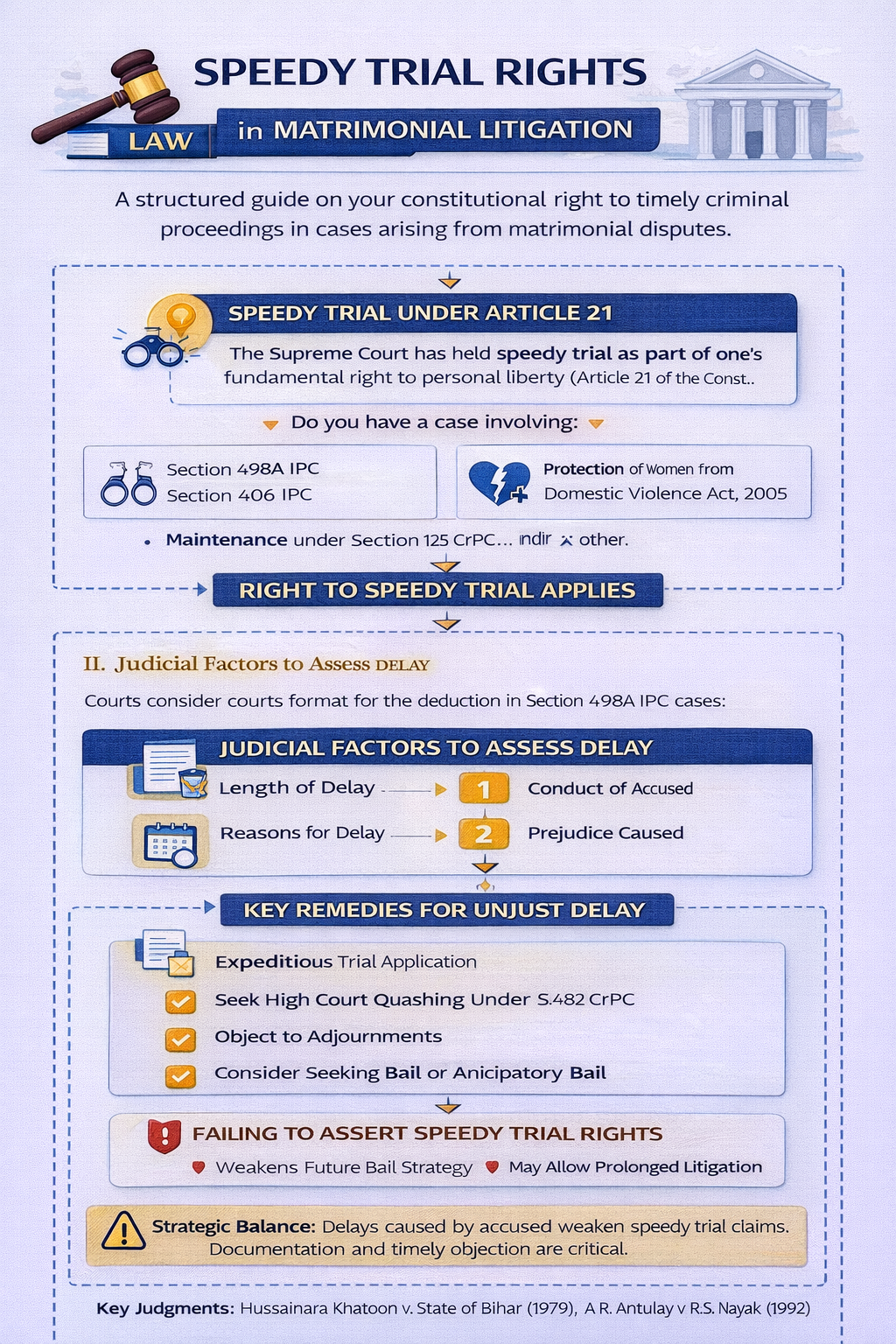
Speedy Trial Rights – Understanding the constitutional guarantee against prolonged criminal and matrimonial proceedings accordingly. 

Litigation arising out of matrimonial disputes often extends for years, undeniably. Criminal complaints under Section 498A IPC, proceedings under the Domestic Violence Act, and maintenance claims under Section 125 CrPC frequently remain pending for prolonged periods.

However, the right to a speedy trial is not merely procedural. It is a constitutional guarantee flowing from Article 21 of the Constitution of India.

This article explains the scope, judicial interpretation, remedies, and strategic use of speedy trial rights in matrimonial criminal litigation.

I. Constitutional Foundation of Speedy Trial

The Supreme Court in Hussainara Khatoon v. State of Bihar recognised that the right to speedy trial is implicit in Article 21.

The Court held that, “A procedure that keeps an accused under prolonged uncertainty violates the guarantee of personal liberty.”

The principle applies equally to matrimonial criminal cases.

II. Applicability in Matrimonial Litigation

Speedy trial rights become relevant in:

  • Criminal complaints under Section 498A IPC

  • Proceedings under Section 406 IPC

  • Cases under the Protection of Women from Domestic Violence Act, 2005

  • Maintenance proceedings under Section 125 CrPC

  • Parallel divorce proceedings impacting criminal defence

Prolonged pendency may undeniably result in:

  • Social stigma

  • Financial burden

  • Career disruption

  • Travel restrictions

  • Psychological distress

Thus, courts recognise that delay itself may amount to prejudice.

III. Judicial Tests for Determining Delay

In A.R. Antulay v. R.S. Nayak, the Supreme Court laid down guiding factors to assess violation of speedy trial rights.

Courts consider:

  • Length of delay
  • Reasons for delay
  • Conduct of the accused
  • Prejudice caused

There is no fixed time limit as such. Each case is assessed on facts.

IV. Can Delay Lead to Quashing?

Yes, in appropriate cases.

Where delay is:

  • Inordinate

  • Unexplained

  • Attributable to prosecution

  • Causing serious prejudice

High Courts may exercise inherent powers under Section 482 CrPC to quash proceedings.

However, mere passage of time is insufficient. The delay must defeat justice.

V. Delay in 498A Trials

Matrimonial criminal cases often suffer delay due to:

  • Repeated adjournments

  • Non-appearance of witnesses

  • Mediation attempts

  • Parallel civil litigation

  • Transfer petitions

Courts have repeatedly emphasised that matrimonial disputes should not become instruments of prolonged harassment.

In Pankaj Kumar v. State of Maharashtra, the Supreme Court reiterated that oppressive delay can violate Article 21.

VI. Speedy Trial in Domestic Violence & Maintenance Proceedings

Proceedings under the Protection of Women from Domestic Violence Act, 2005 are intended to be summary in nature.

Similarly, Section 125 CrPC proceedings aim at immediate relief. Additionally, unjustified delay defeats the object of these provisions.

Respondents may seek:

  • Expedited hearing

  • Time-bound cross-examination

  • Closure of evidence where complainant delays

Hence, courts increasingly discourage unnecessary adjournments.

VII. Remedies Available for Delay

If proceedings are unduly delayed, the accused may:

  • File application for expeditious trial
  • Seek day-to-day hearing
  • Oppose adjournments
  • Approach High Court under Section 482 CrPC
  • Seek discharge where delay impacts fairness

In extreme cases, delay may result in:

  • Quashing of proceedings

  • Reduction of sentence

  • Acquittal due to prejudice

VIII. When Delay Is Attributable to the Accused

The right to speedy trial is reciprocal.

If delay is caused by:

  • Repeated exemption applications

  • Non-cooperation

  • Filing frivolous petitions

  • Seeking adjournments

Undoubtedly, courts will reject speedy trial claims.

Clearly, clean conduct strengthens constitutional argument.

IX. Strategic Importance in Matrimonial Defence

Speedy trial rights become strategically relevant when:

  • Allegations are weak

  • Complainant avoids cross-examination

  • Prosecution witnesses remain absent

  • Case lingers without progress

Also, an application highlighting prejudice may pressure prosecution to proceed diligently.

Delay can weaken prosecution case due to:

  • Fading memory

  • Unavailable witnesses

  • Documentary inconsistencies

However, strategic balance is essential.

X. Practical Checklist for Accused Persons

If your matrimonial criminal case is pending for several years insignificantly:

  • Track hearing dates
  • Maintain record of adjournments
  • Identify cause of delay
  • File written objection to repeated adjournments
  • Seek High Court intervention if necessary

Documenting delay strengthens your case eventually.

XI. Key Judicial Principles

  • Speedy trial is a fundamental right.
  • No rigid time limit exists.
  • Delay must cause prejudice.
  • Conduct of parties is relevant.
  • Courts balance societal interest with individual liberty by all means.

XII. Conclusion

The right to speedy trial, thus, protects individuals from endless criminal litigation. In matrimonial disputes, where personal relationships and reputations are at stake, delay compounds injury.

Also, courts recognise that justice delayed may become justice denied. However, relief depends on facts, conduct, and demonstrable prejudice.

Invoking Article 21 strategically can prevent criminal process from becoming prolonged punishment significantly.


Index of Legal Strategies and Defence is here. 


Frequently Asked Questions

No statutory limit exists, but unreasonable delay may violate Article 21.

Not automatically. Prejudice must be demonstrated.

Yes. Courts often issue directions for expeditious disposal.

Settlement may lead to quashing, rendering speedy trial issue redundant.


Key Contributor :

Mrs. Suprajaa Rajan B.Com., LL.B., LL.M.

+91-9606345150

Views: 333
Posted in Legal Procedure/Tool | Tagged Article 21 - Protection of life and personal liberty Criminal Procedure Matrimonial Criminal Law Matrimonial dispute Matrimonial Litigation India Right to Liberty Right to Speedy Trial | Leave a comment

Amit Bajpai Vs State of U.P. and Anr on 15 Dec 2023

Posted on March 4 by Suprajaa Rajan

The Allahabad High Court held that when a party files an application under Section 340 Cr.P.C. alleging false affidavit, the Family Court must decide that application before proceeding with the maintenance case under Section 125 Cr.P.C. The Court ruled that failure to do so vitiates the maintenance order if it relies on the disputed affidavit. The High Court set aside the maintenance order and directed the Family Court to first decide the perjury application within a fixed time frame.

“It is further submitted by learned counsel for the revisionist that the learned Family Court without deciding the application filed by the revisionist under Section 340 Cr.P.C. has proceeded with the case and decided the application filed by opposite party no.2 under Section 125 Cr.P.C. and maintenance has been awarded on relying the false affidavit filed by opposite party no.2.”

“Learned counsel for the opposite party no.2 and learned A.G.A. for the State do not dispute the aforesaid legal position.”

“In view of above the criminal revision is allowed. The judgement and order dated 14.06.2023 passed by Additional Principal Judge, Family Court, Court No.-1, Kanpur Nagar in Case No.- 502 of 2020 is set aside.”

“Learned Principal Judge, Family Court, Court No.-1/court concerned is directed to decide the application filed by revisionist under Section 340 Cr.P.C. which was registered as Misc. Application No. 473 of 2022 within a period of three months from the date of production of certified copy of this order, and thereafter the application filed by opposite party no.2 under Section 125 Cr.P.C. expeditiously, without granting undue adjournments to either of the parties unless there is any legal impediments.”

Decision

The High Court allowed the criminal revision.

  • It set aside the maintenance order.
  • It directed the Family Court to first decide the Section 340 Cr.P.C. application.
  • It ordered that the maintenance case proceed only thereafter.

Amit Bajpai Vs State of UP on 15 Dec 2023

Citation: [2023:AHC:238266]

Other Sources :


Index of Perjury Judgements is here. 


Key Contributor :

Mrs. Suprajaa Rajan B.Com.,LL.B.,LL.M.

+91-9606345150


Views: 534
Posted in High Court of Allahabad Judgment or Order or Notification | Tagged Amit Bajpai Vs State of UP and Anr BNSS Sec 144 - Order for maintenance of wives children and parents Cases where Perjury Proceedings were initated CrPC 125 or BNSS 144 - Order for Maintenance of Wives Children and Parents maintenance order set aside Perjury Under Section 340 CrPC | Leave a comment

Dr.Praveen R Vs Dr.Arpitha on 31 Aug 2021

Posted on March 3 by ShadesOfKnife

The Karnataka High Court held that when a court records a specific finding that a party suppressed material facts on oath, it cannot dismiss a perjury application as premature merely because the main case remains pending. The Court ruled that allegations of false evidence affect the purity of judicial proceedings and require prompt consideration. It set aside the Family Court’s order and remitted the matter for fresh consideration.

The following paragraphs form the foundation of the Court’s decision.

Para 4(a):

“…If these IT Returns are taken into consideration, the respondent is having income and she is also earning income… She has not filed any counter to the objections filed by the petitioner and also with respect to these IT Returns. In fact, by filing a complaint she has admitted that she has filed Income Tax Returns… Under such circumstances, she has suppressed the fact that she was earning income…”

Para 4(b):

“…when the Court below has recorded a specific finding as to the income of the respondent from the medical profession that too on the basis of undisputed IT Returns for the relevant period; when it has also recorded a specific finding that the respondent has suppressed the fact that she was earning income; that being the position, the application of petitioner for initiating action for the offence of perjury, could not have been turned down as being premature merely because main matter is still pending…”

Para 4(c):

“…act of perjury is treated as a heinous offence in all civilized societies; consideration of complaints with regard to the same cannot be deferred or delayed; otherwise there is all possibility of the fountain of justice being polluted.”

Para 4(e):

“…applications of the kind need to be considered on merits at the earliest point of time so that a loud message goes to the unscrupulous section of the litigant public as to what would befall the perjuring parties.”

Decision

The High Court allowed the writ petition.

  • It set aside the Family Court’s order.
  • It remitted the matter for fresh consideration of the perjury application.
  • It directed that the main matrimonial case remain in abeyance until such consideration.

All contentions remained open.


Praveen R Vs Arpitha on 31 Aug 2021

Citation :2021:KHC:33333

Other Sources :


Index of Perjury Judgements is here. 


Key Contributor :

Mrs. Suprajaa Rajan B.Com., LL.B, LL.M.

+91-9606345150


Views: 192
Posted in High Court of Allahabad Judgment or Order or Notification | Tagged Cases where Perjury Proceedings were initated false affidavit Hindu Marriage Act HMA Sec 24 income suppression | Leave a comment

Quashing of FIR Under Section 482 CrPC

Posted on March 3 by Suprajaa Rajan

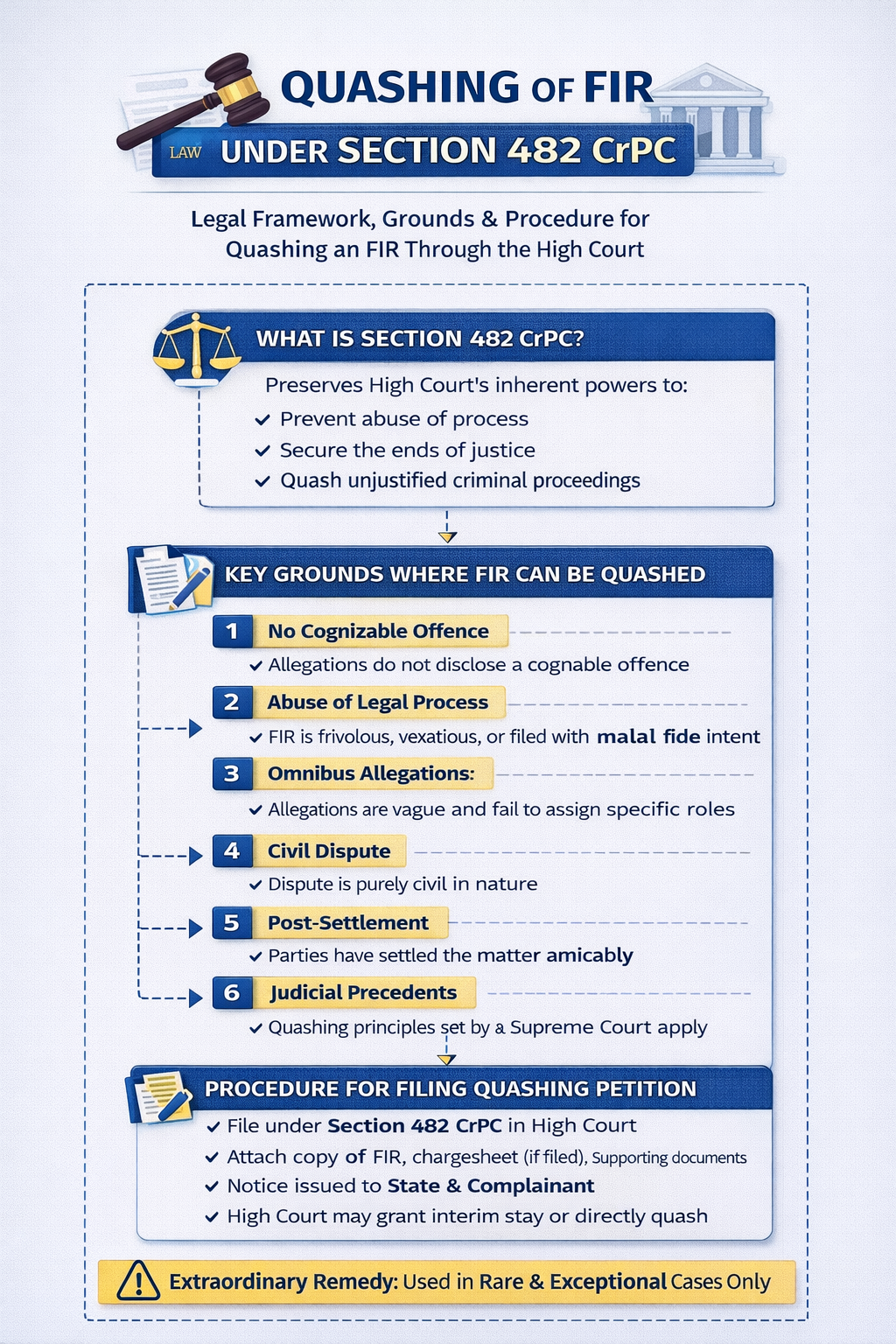
Understanding the scope, grounds, and judicial principles governing quashing of criminal proceedings.

Criminal prosecution can severely affect personal liberty, reputation, and professional life. However, not every FIR discloses a legally sustainable offence. In such situations, the law provides a constitutional safeguard.

The remedy lies under:

Code of Criminal Procedure, 1973

Specifically, Section 482 CrPC, which preserves the inherent powers of the High Court to:

  • Prevent abuse of process of law

  • Secure the ends of justice

  • Quash criminal proceedings where continuation is unjustified

This article explains the legal framework, judicial tests, landmark precedents, and strategic considerations for filing a quashing petition in brief.

Steps under Quashing FIR

I. What Is Section 482 CrPC?

Section 482 states that nothing in the Code shall limit the inherent powers of the High Court.

These powers are extraordinary in nature and must be exercised:

  • Sparingly

  • With caution

  • Only in rare and exceptional cases

Nevertheless, it is not an appellate power. In fact, it is a supervisory and preventive jurisdiction.

II. When Can FIR Be Quashed?

The Supreme Court laid down guiding principles in:

State of Haryana v. Bhajan Lal

This judgment identified illustrative categories where quashing may be justified.

Key Grounds for Quashing:

  • Allegations do not disclose a cognizable offence
  • FIR is manifestly attended with mala fide intent
  • Allegations are absurd or inherently improbable
  • There is no legal evidence supporting prosecution
  • Proceedings amount to abuse of process
  • Dispute is purely civil in nature
  • Parties have settled the dispute (in appropriate cases)

III. Quashing in Matrimonial Offences (498A Cases)

Quashing petitions frequently arise in complaints under:

  • Section 498A IPC

  • Section 406 IPC

  • Section 34 IPC

Courts have repeatedly cautioned against mechanical implication of relatives.

In Arnesh Kumar v. State of Bihar, the Supreme Court addressed misuse in matrimonial litigation and emphasised procedural safeguards.

High Courts often quash proceedings where:

  • Allegations are omnibus

  • No specific role is attributed

  • Distant relatives reside separately

  • Complaint lacks prima facie material

IV. Settlement-Based Quashing

Even though Section 498A IPC is non-compoundable, courts permit quashing where matrimonial disputes are amicably resolved.

In Gian Singh v. State of Punjab, the Supreme Court held that High Courts may quash non-compoundable offences if the dispute is personal and continuation would serve no purpose.

Similarly, in Narinder Singh v. State of Punjab, guidelines were laid down for compromise-based quashing.

The principle: criminal law should not be used as a weapon once parties have settled significantly.

V. Can FIR Be Quashed After Chargesheet?

Yes. Quashing is maintainable even after filing of chargesheet under Section 173 CrPC.

However, courts are more cautious once investigation is complete.

The test becomes:

  • Whether materials collected disclose a prima facie case

  • Whether continuation would amount to injustice

In case the evidence supports trial, courts may refuse interference.

VI. Procedure for Filing Quashing Petition

A petition under Section 482 CrPC is filed before the jurisdictional High Court.

Typical Components:

  • Copy of FIR
  • Chargesheet (if filed)
  • Relevant documents
  • Affidavit
  • Grounds invoking Bhajan Lal principles

Notice is issued to:

  • State

  • Complainant

High Court may:

  • Issue interim stay

  • Grant protection from coercive steps

  • Dismiss petition

  • Quash FIR entirely

  • Quash proceedings partially against specific accused

VII. Judicial Caution: What Courts Will Not Do

High Courts will not:

  • Conduct mini-trials

  • Examine disputed facts

  • Evaluate credibility of witnesses

  • Weigh evidence

If allegations disclose prima facie offence, trial must proceed. In any case, section 482 is not a substitute for trial.

VIII. Strategic Considerations Before Filing

Filing a premature petition may weaken credibility.

Consider:

  • Stage of investigation

  • Strength of allegations

  • Documentary contradictions

  • Settlement possibilities

  • Parallel civil proceedings

Thus strategic timing is undoubtedly crucial.

IX. Common Mistakes in Quashing Petitions

  • Raising factual disputes requiring evidence
  • Filing without examining FIR carefully
  • Over-reliance on defence documents
  • Ignoring Supreme Court precedents
  • Filing multiple repetitive petitions

Subsequently, courts may impose costs for frivolous petitions.

X. Recent Judicial Approach

Courts increasingly:

  • Protect distant relatives in 498A cases

  • Scrutinise omnibus allegations

  • Encourage settlement in matrimonial disputes

  • Emphasise that criminal law should not become harassment

However, courts remain strict where allegations show serious cruelty or violence.

Conclusion

Section 482 CrPC ,thus, acts as a constitutional safety valve against misuse of criminal process. Additionally, it ensures that criminal law does not become a tool of oppression.

However, it is an extraordinary remedy. Courts exercise it with restraint. A well-structured petition grounded in settled principles significantly improves prospects.

The guiding test remains:

Does continuation of prosecution serve justice — or defeat it?

Therefore, when proceedings lack legal foundation or arise from matrimonial vendetta, inherent powers of the High Court restore balance.


Index of Legal Strategies and Defence is here. 


Frequently Asked Questions

Not automatic. Court examines genuineness and societal impact.

Yes. Proceedings may be quashed selectively.

No. It terminates proceedings before trial.

Often exempted unless court directs otherwise.


Key Contributor:

Mrs. Suprajaa Rajan B.Com., LL.B., LL.M.

+91-9606345150


Views: 765
Posted in Legal Procedure/Tool | Tagged abuse of process Criminal law CrPC 482 – IPC 498A Quashed Matrimonial Litigation India Quashing of FIR Section 482 CrPC | Leave a comment

BNSS 379 – Procedure in cases mentioned in section 215

Posted on March 3 by ShadesOfKnife

379. Procedure in cases mentioned in section 215.—
(1) When, upon an application made to it in this behalf or otherwise, any Court is of opinion that it is expedient in the interests of justice that an inquiry should be made into any offence referred to in clause (b) of sub-section (1) of section 215, which appears to have been committed in or in relation to a proceeding in that Court or, as the case may be, in respect of a document produced or given in evidence in a proceeding in that Court, such Court may, after such preliminary inquiry, if any, as it thinks necessary,—
(a) record a finding to that effect;
(b) make a complaint thereof in writing;
(c) send it to a Magistrate of the first class having jurisdiction;
(d) take sufficient security for the appearance of the accused before such Magistrate, or if the alleged offence is non-bailable and the Court thinks it necessary so to do, send the accused in custody to such Magistrate; and
(e) bind over any person to appear and give evidence before such Magistrate.
(2) The power conferred on a Court by sub-section (1) in respect of an offence may, in any case where that Court has neither made a complaint under sub-section (1) in respect of that offence nor rejected an application for the making of such complaint, be exercised by the Court to which such former Court is subordinate within the meaning of sub-section (4) of section 215.
(3) A complaint made under this section shall be signed,—
(a) where the Court making the complaint is a High Court, by such officer of the Court as the Court may appoint;
(b) in any other case, by the presiding officer of the Court or by such officer of the Court as the Court may authorise in writing in this behalf.
(4) In this section, “Court” has the same meaning as in section 215.


Entire BNSS is here.

Views: 396
Posted in Bare Acts or State Amendments or Statutes or GOs or Notifications issued by Central or State Governments | Tagged BNSS 379 - Procedure in cases mentioned in section 215 Perjury Under Section 340 CrPC | Leave a comment

Shailendra Sharma and Ors Vs Indus Residency Pvt Ltd and Ors on 07 Jan 2026

Posted on March 3 by ShadesOfKnife

A single judge of Madhya Pradesh Hugh Court at Jabalpur Bench held as follows,

From Para 8,

8. A police officer cannot directly register a crime for offence under Section 215 B.N.S.S. once the offence is committed in or in relation to a proceeding in the Court. As per Section 379 B.N.S.S., the Court has to cause preliminary enquiry and then can make a complaint in writing. However, in the present case, the Court has not made any enquiry, nor recorded any prima-facie satisfaction and has simply directed the police authorities to carry out an investigation and submit a report before the Court. Though the Court in its discretion could have directed the police authorities to investigate the matter and to furnish report before the Court, but the discretion to register FIR should not have been left at the discretion of the police authorities. It was for the Court to have applied its mind after receiving the preliminary enquiry report of the police authorities.

Shailendra Sharma and Ors Vs Indus Residency Pvt Ltd and Ors on 07 Jan 2026

Citations: [2026:MPHC-JBP:1337]

Other Sources:


Index of Perjury judgments is here.

Views: 146
Posted in High Court of Madhya Pradesh Judgment or Order or Notification | Tagged 1-Judge Bench Decision BNSS 379 - Procedure in cases mentioned in section 215 Legal Procedure Explained - Interpretation of Statutes Perjury Under Section 340 CrPC Shailendra Sharma and Ors Vs Indus Residency Pvt Ltd and Ors | Leave a comment

BNSS Sec 393 – Language and contents of judgment

Posted on February 28 by ShadesOfKnife

393. Language and contents of judgment.—
(1) Except as otherwise expressly provided by this Sanhita, every judgment referred to in section 392,—
(a) shall be written in the language of the Court;
(b) shall contain the point or points for determination, the decision thereon and the reasons for the decision;
(c) shall specify the offence (if any) of which, and the section of the Bharatiya Nyaya Sanhita, 2023 (45 of 2023) or other law under which, the accused is convicted, and the punishment to which he is sentenced;
(d) if it be a judgment of acquittal, shall state the offence of which the accused is acquitted and direct that he be set at liberty.
(2) When the conviction is under the Bharatiya Nyaya Sanhita, 2023 (45 of 2023) and it is doubtful under which of two sections, or under which of two parts of the same section, of that Sanhita the offence falls, the Court shall distinctly express the same, and pass judgment in the alternative.
(3) When the conviction is for an offence punishable with death or, in the alternative, with imprisonment for life or imprisonment for a term of years, the judgment shall state the reasons for the sentence awarded, and, in the case of sentence of death, the special reasons for such sentence.
(4) When the conviction is for an offence punishable with imprisonment for a term of one year or more, but the Court imposes a sentence of imprisonment for a term of less than three months, it shall record its reasons for awarding such sentence, unless the sentence is one of imprisonment till the rising of the Court or unless the case was tried summarily under the provisions of this Sanhita.
(5) When any person is sentenced to death, the sentence shall direct that he be hanged by the neck till he is dead.
(6) Every order under section 136 or sub-section (2) of section 157 and every final order made under section 144, section 164 or section 166 shall contain the point or points for determination, the decision thereon and the reasons for the decision.


BNSS is here.

Views: 445
Posted in Bare Acts or State Amendments or Statutes or GOs or Notifications issued by Central or State Governments | Tagged BNSS Sec 393 - Language and contents of judgment CrPC Sec 354 - Language and contents of judgment | Leave a comment

Praveen Kumar Singh Vs State of UP and Anr on 17 Feb 2026

Posted on February 28 by ShadesOfKnife

A single judge of Allahabad High Court held as follows,

From Para 4,

4. Learned counsel for the revisionist submits that the revisionist had filed written submissions before the trial court specifically alleging that opposite party no. 2 was living in adultery with one Rocky @ Tarun. However, the trial court did not consider the said allegation on the ground that no certificate under Section 65-B of the Indian Evidence Act had been filed in support of the electronic evidence.

From Para 7,

7. On considering the facts and circumstances of the case, the submissions advanced by learned counsel for revisionist and learned A.G.A., as well as perusal of the record and the order passed by the trial court, it appears that the WhatsApp chats annexed by the revisionist were not accepted solely on the ground that a certificate under Section 65-B of the Indian Evidence Act had not been submitted. However, Section 14 of the Family Courts Act provides that a Family Court may receive as evidence any report, statement, document, information, or matter that may, in its opinion, assist it in effectively dealing with a dispute, whether or not such evidence would otherwise be relevant or admissible under the Indian Evidence Act, 1872. Moreover, while adjudicating matrimonial disputes, the Family Court may lay down its own procedure.

Praveen Kumar Singh Vs State of UP and Anr on 17 Feb 2026

Citations: [2026:AHC:34917]

Other Sources:

https://lawtrend.in/family-court-must-consider-whatsapp-chat-indicating-adultery-even-without-section-65-b-certificate-allahabad-hc-sets-aside-maintenance/


Index

Views: 327
Posted in High Court of Allahabad Judgment or Order or Notification | Tagged 1-Judge Bench Decision BNSS Sec 393 - Language and contents of judgment BSA Sec 63 - Admissibility of electronic records Evidence Act 65B - Admissibility of electronic records Family Courts Act Sec 14 - Application of Indian Evidence Act 1872 Praveen Kumar Singh Vs State of UP and Anr | Leave a comment

Post navigation

  • Older posts
  • Newer posts

Search within entire Content of “Shades of Knife”

My Legal X Timeline

Advocate Sandeep Pamarati 🇮🇳💪👨🏻‍🎓 Follow

AP High Court Advocate with M Tech (CS) || 12 years in 'Software Industry' as Solution Architect || Blogs at https://t.co/29CB9BzK4w || #TDPTwitter

SandeepPamarati
Retweet on Twitter Advocate Sandeep Pamarati 🇮🇳💪👨🏻‍🎓 Retweeted
goi_meity

Ministry of Electronics & IT

@goi_meity ·
20 Nov

Designed in India, made in India, 5-axis precision CNC machines with the accuracy of 2 microns!

For reference, the thickness of human hair is about 80 microns.

This is the way the electronics and semiconductor manufacturing ecosystem is taking shape.

#DigitalIndia

Reply on Twitter 2123651286021308520 Retweet on Twitter 2123651286021308520 410 Like on Twitter 2123651286021308520 2140 X 2123651286021308520
Retweet on Twitter Advocate Sandeep Pamarati 🇮🇳💪👨🏻‍🎓 Retweeted
exsecular

exsecular

Verified account @exsecular ·
8 Nov

Chor era ( don’t forget they hired 24 lawyers against Ram mandir ) to Modi Era 🚩🚩🔥🔥🚩🚩

Reply on Twitter 2119236931808862565 Retweet on Twitter 2119236931808862565 252 Like on Twitter 2119236931808862565 888 X 2119236931808862565
Retweet on Twitter Advocate Sandeep Pamarati 🇮🇳💪👨🏻‍🎓 Retweeted
bjp4india

BJP

Verified account @bjp4india ·
8 Nov

This never gets old... Happy Diwali to you-know-who! 😉🪔

Reply on Twitter 2119407089118302307 Retweet on Twitter 2119407089118302307 3284 Like on Twitter 2119407089118302307 23476 X 2119407089118302307
Retweet on Twitter Advocate Sandeep Pamarati 🇮🇳💪👨🏻‍🎓 Retweeted
ani

ANI

Verified account @ani ·
7 Nov

#WATCH | Ayodhya, Uttar Pradesh: At Ram ki Paidi, visitor Simona from Ukraine says, "... My sister invited me. I really like everything here. I am amazed by how beautiful everything looks..."

Reply on Twitter 2119119499194675541 Retweet on Twitter 2119119499194675541 899 Like on Twitter 2119119499194675541 7109 X 2119119499194675541

Recent Posts

  • Ali Hemati and Ors Vs The Food Safety Officer on 30 Jun 2026 November 27, 2026
  • Shivam Pandey Vs State of Assam on 19 Nov 2026 November 27, 2026
  • Satender Kumar Antil Vs CBI and Anr on 16 Jul 2025 November 27, 2026
  • Judgments invoking BNSS Sec 530 (Trial and proceedings in electronic mode) November 27, 2026
  • M.S. Ahlawat Vs State of Haryana and Anr on 27 Oct 1999 November 27, 2026

Most Read Posts

  • Pune Bar Association Vs Union of India on 22 May 2026 (1,007 views)
  • Sachin Arora Vs Manju Arora on 02 Jul 2026 (640 views)
  • Ravi S Vs Sahana Devi A and Ors on 18 Jun 2026 (614 views)
  • How to File a Complaint Against an Advocate in India – A First-Timer’s Complete Guide (572 views)
  • Application for Permanent Exemption from Appearance – Format, Procedure & Sample Draft (569 views)
  • Are BCI and State Bar Councils Statutorily empowered to Levy Fees for Transfer of Enrollment? (498 views)
  • Prahlad Singh Bhati Vs N.C.T. Delhi and Anr on 23 Mar 2001 (477 views)
  • Ayush Bajpai Vs State of U.P. and Ors 25 Jun 2026 (472 views)
  • Pooja Ramesh Singh Vs JnK Bank and Anr on 02 Jul 2026 (458 views)
  • Passport Implications in 498A Cases – A Complete Practical Guide (447 views)

Tags

Reportable Judgement or Order (458)2-Judge (Division) Bench Decision (448)1-Judge Bench Decision (395)Legal Procedure Explained - Interpretation of Statutes (393)Landmark Case (391)Catena of Landmark Judgments Referred/Cited to (304)Work-In-Progress Article (215)3-Judge (Full) Bench Decision (103)Sandeep Pamarati (92)Article 21 - Protection of life and personal liberty (80)Issued or Recommended Guidelines or Directions or Protocols to be followed (75)Perjury Under Section 340 CrPC (71)Absurd Or After Thought Or Baseless Or False Or General Or Inherently Improbable Or Improved Or UnSpecific Or Omnibus Or Vague Allegations (63)Reprimands or Setbacks to YCP Govt of Andhra Pradesh (49)Summary Post (47)Divorce Granted on Cruelty ground (46)CrPC 482 - Quash (44)Abuse Or Misuse of Process of Court (44)HM Act Sec 13 - Divorce Granted to Husband (43)CrPC 125 or BNSS 144 - Order for Maintenance of Wives Children and Parents (43)

Categories

Supreme Court of India Judgment or Order or Notification (781)Bare Acts or State Amendments or Statutes or GOs or Notifications issued by Central or State Governments (329)High Court of Andhra Pradesh Judgment or Order or Notification (193)High Court of Delhi Judgment or Order or Notification (170)High Court of Bombay Judgment or Order or Notification (113)High Court of Karnataka Judgment or Order or Notification (98)Legal Procedure/Tool (86)High Court of Madras Judgment or Order or Notification (75)High Court of Allahabad Judgment or Order or Notification (64)LLB Study Material (60)General Study Material (56)Assorted Court Judgments or Orders or Notifications (56)High Court of Punjab & Haryana Judgment or Order or Notification (53)High Court of Kerala Judgment or Order or Notification (48)Judicial Activism (for Public Benefit) (47)Prakasam DV Cases (46)District or Sessions or Magistrate Court Judgment or Order or Notification (45)High Court of Madhya Pradesh Judgment or Order or Notification (39)High Court of Telangana Judgment or Order or Notification (30)High Court of Calcutta Judgment or Order or Notification (30)

Recent Comments

  • Aman Kumar on Case Lifecycle Explorer – BNS s.85, DV Act and Maintenance
  • ShadesOfKnife on How to Challenge Ex Parte Orders in Criminal and Matrimonial Proceedings – Legal Remedies
  • pradeep jain on How to Challenge Ex Parte Orders in Criminal and Matrimonial Proceedings – Legal Remedies
  • Lawyer Sonia on Regular Bail Application Format (Section 437/439 CrPC)
  • vinod gupta on Reply to Section 41A CrPC Notice – Format with Legal Explanation

Archives of SoK

  • November 2026 (23)
  • October 2026 (19)
  • September 2026 (13)
  • August 2026 (6)
  • July 2026 (19)
  • June 2026 (19)
  • May 2026 (24)
  • April 2026 (33)
  • March 2026 (42)
  • February 2026 (30)
  • January 2026 (21)
  • December 2025 (2)
  • November 2025 (3)
  • October 2025 (17)
  • September 2025 (12)
  • August 2025 (5)
  • July 2025 (10)
  • June 2025 (15)
  • May 2025 (3)
  • April 2025 (10)
  • March 2025 (7)
  • February 2025 (8)
  • January 2025 (1)
  • December 2024 (3)
  • November 2024 (4)
  • October 2024 (16)
  • September 2024 (15)
  • August 2024 (14)
  • July 2024 (11)
  • June 2024 (18)
  • May 2024 (13)
  • April 2024 (9)
  • March 2024 (23)
  • February 2024 (15)
  • January 2024 (11)
  • December 2023 (11)
  • November 2023 (9)
  • October 2023 (13)
  • September 2023 (12)
  • August 2023 (15)
  • July 2023 (17)
  • June 2023 (11)
  • May 2023 (6)
  • April 2023 (5)
  • March 2023 (10)
  • February 2023 (9)
  • January 2023 (12)
  • December 2022 (12)
  • November 2022 (8)
  • October 2022 (13)
  • September 2022 (17)
  • August 2022 (10)
  • July 2022 (21)
  • June 2022 (27)
  • May 2022 (23)
  • April 2022 (32)
  • March 2022 (17)
  • February 2022 (6)
  • January 2022 (2)
  • December 2021 (7)
  • November 2021 (7)
  • October 2021 (6)
  • September 2021 (10)
  • August 2021 (31)
  • July 2021 (45)
  • June 2021 (17)
  • May 2021 (17)
  • April 2021 (18)
  • March 2021 (58)
  • February 2021 (14)
  • January 2021 (50)
  • December 2020 (35)
  • November 2020 (68)
  • October 2020 (67)
  • September 2020 (28)
  • August 2020 (41)
  • July 2020 (20)
  • June 2020 (36)
  • May 2020 (40)
  • April 2020 (38)
  • March 2020 (26)
  • February 2020 (43)
  • January 2020 (35)
  • December 2019 (34)
  • November 2019 (4)
  • October 2019 (18)
  • September 2019 (57)
  • August 2019 (33)
  • July 2019 (12)
  • June 2019 (18)
  • May 2019 (5)
  • April 2019 (19)
  • March 2019 (58)
  • February 2019 (11)
  • January 2019 (90)
  • December 2018 (97)
  • November 2018 (43)
  • October 2018 (31)
  • September 2018 (73)
  • August 2018 (47)
  • July 2018 (143)
  • June 2018 (92)
  • May 2018 (97)
  • April 2018 (59)
  • March 2018 (8)

Blogroll

  • Daaman Promoting Harmony 0
  • Fight against Legal Terrorism Fight against Legal Terrorism along with MyNation Foundation 0
  • Good Morning Good Morning News 0
  • Insaaf India Insaaf Awareness Movement 0
  • MyNation Hope Foundation Wiki 0
  • MyNation.net Equality, Justice and Harmony 0
  • Sarvepalli Legal 0
  • Save Indian Family Save Indian Family Movement 0
  • Saving Men by Himanshu R Chanda 0
  • SIF Chandigarh SIF Chandigarh 0
  • Unitedmen Foundation a dedicated community forged with the mission to unite men facing legal challenges in marital disputes. 0
  • Vaastav Foundation The Social Reality 0
  • Vinayak my2centsworth – This blog is for honest law abiding men, married or planning to get married 0
  • Voice4india Indian Laws, Non-profits, Environment 0
  • Writing Law Writing Law by Ankur 0

RSS feed: Cloudflare Status Cloudflare Status

  • DFW (Dallas) on 2026-12-15 December 15, 2026
    Nov 25, 09:41 UTCScheduled - We will be performing scheduled maintenance in DFW (Dallas) datacenter on 2026-12-15 between 08:00 and 12:00 UTC. Traffic might be re-routed from this location, hence there is a possibility of a slight increase in latency during this maintenance window for end-users in the affected region. For PNI / CNI customers […]
    Cloudflare Status

RSS feed: List of Spam Server IPs from Project Honeypot List of Spam Server IPs from Project Honeypot

  • 20.69.127.5 | S November 26, 2026
    Event: Bad Event | Total: 2 | First: 2026-11-24 | Last: 2026-11-24
Owned and Operated by Advocate Sandeep Pamarati and Advocate Suprajaa Rajan
Proudly powered by WordPress
Theme: Flint by Star Verte LLC

Bad Behavior has blocked 414 access attempts in the last 7 days.

pixel