[related_posts_by_tax title=”5 Recently Updated Posts, Similar or Related To Above Post” orderby=”post_modified” posts_per_page=”5″ show_date=”true”]
Kunaldev Singh Rathor and others Vs State of MP and another on 02 December, 2016
Hon’ble High Court of Madhya Pradesh has quashed the FIR, based on the documents submitted by Defense.
[related_posts_by_tax title=”5 Recently Updated Posts, Similar or Related To Above Post” orderby=”post_modified” posts_per_page=”5″ show_date=”true”]
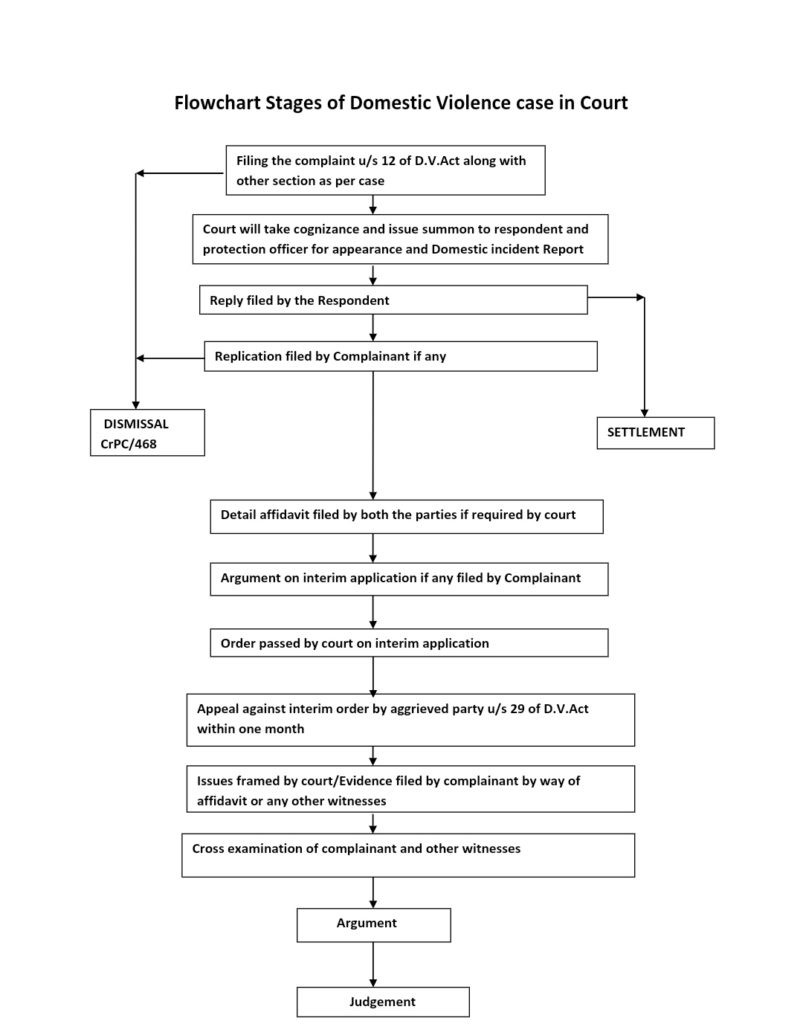
Lifecycle Stages of a Domestic Violence Case under PWDV Act
Listed below are a reasonably laid-out sequence of events in a Domestic Violence Case filed under PWDV Act, 2005. The rules related to the Act are here.
Note: Take a thorough look at the below infographic to understand the various remedies available for an aggrieved person under this law.
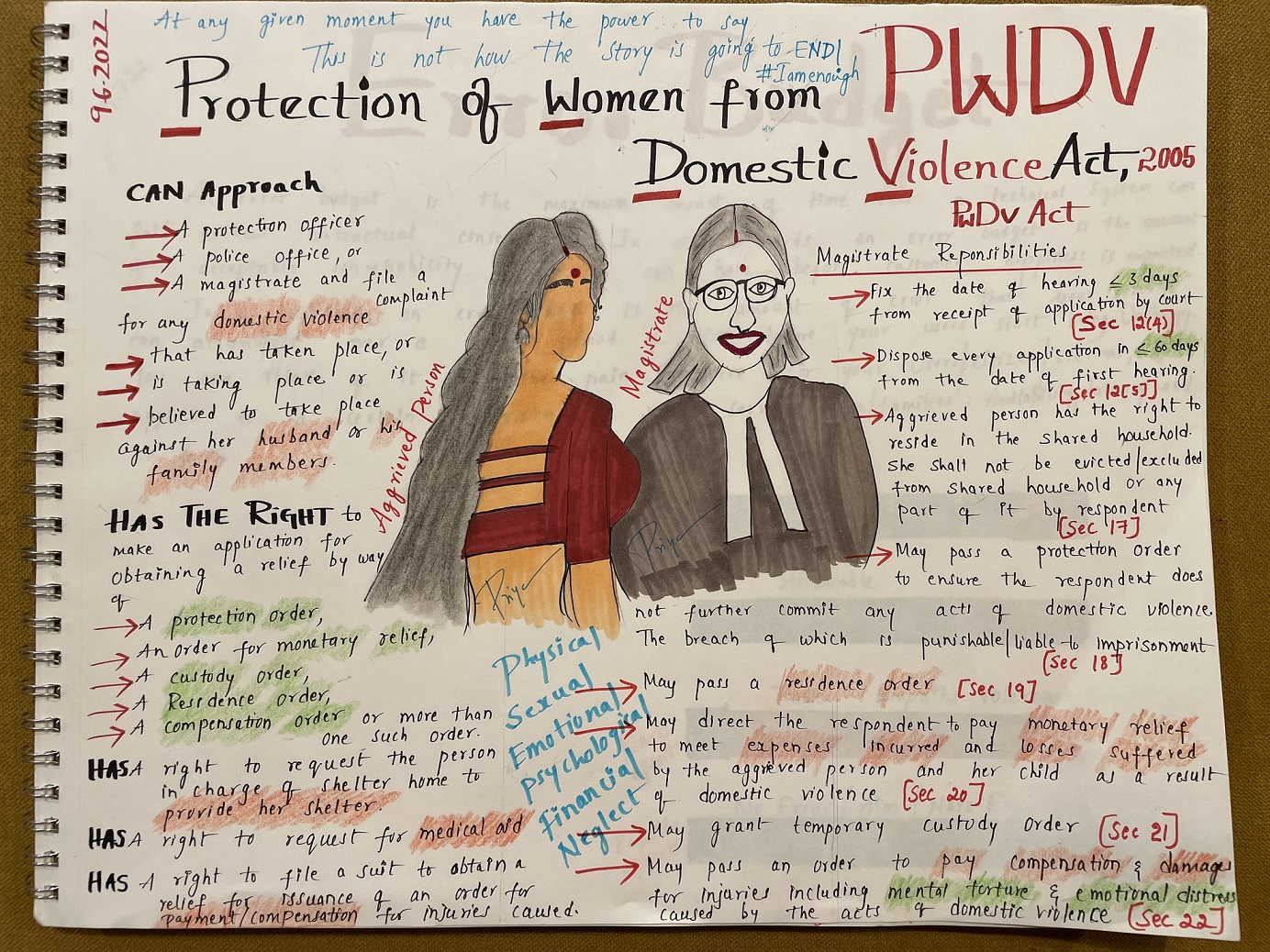
Copyright (c) Holders:
Content: Suprajaa Rajan
Infographic: Padma Priya Jupally #IAmEnough
Other Life Cycles: 498A IPC Case Lifecycle || Maintenance Case u/s 125 CrPC Lifecycle. Index of all life cycles is here. Looking for Domestic Violence case-laws? go here!
Before Entering Into Court
- First step is that the aggrieved person/AP [read sec 2(a)] or a Protection Officer or any other person on behalf of the aggrieved person [AP] will file an application under sec 12(1) to the Magistrate seeking one or more reliefs under this Act.
Key Highlights
- This Act is a CIVIL Act, meaning there are civil reliefs that can be claimed by AP and there is no penal punishment given under this Act. Only one exception to this is, when a person disobeys or violates a protection or interim protection order issued by the Magistrate. [read sec 31]
- Magistrate will take up the application and order the Protection Officer [read sec 2(n)] to conduct mediation at court-appointed mediation center to see the possibility of a compromise and also to fill 3 ready-made forms called as Domestic Incident Reports (DIR forms).
- Protection Officer, who is the District Welfare Officer, will issue a notice to all the people named and identified in the application.
- Purpose: Mentioned as above.
- What happens there: Lot of emotional drama, oral diarrhoea, convincing words followed by intermittent threats of 498A IPC case by the so-called Protection Officer/other service providers.
- What to do: Keep your calmest best self and don’t overreact, nor let parents over-react. If you are capable and confident, ensure a audio/video recording of the session is made discreetly. If you have doubts, DO NOT DO IT. More valuable tips here.
- Apart from husband, other family members who are implicated in this case, may become liable to the reliefs mentioned in the Act, based on the Complainant proving their acts of domestic violence. Maintenance component, under Monetary Reliefs alone, is the whole and sole responsibility of husband.
- There are various reliefs [AP] may seek under the various sections. Do no worry about property getting taken over or similar issues. No ‘ownership transfer’ of any such property takes place. Only temporary residence may be ordered which one can oppose and offer similar alternative accommodation. Many idiots hope and try to extort money/property via Domestic Violence complaint. They remain idiotic fools.
Focus Areas
- At this point in time, focus should be
- to attend the proceedings with Protection Officer
- to enjoy (record, if possible) the melodrama at mediation center and let it fail (just say, no compromise with liars, when my family was falsely implicated in the case)
- to not worry about what is captured in the DIR Forms 1-5; they are not equivalent to FIR in case of a criminal matter.
- to let the case move back to Court (there ends the matter with Protection Officer)
- PO will send the mediation report along with earlier duly-prepared DIR forms.
- PO to ensure the AP files the mandatory affidavit prescribed in the Apex Court judgment of Rajnesh Vs Neha, which mandates that the deponent of the affidavit disclosed their income, assets and liabilities.
After Entering Into Court (APPEARANCE AND FOR COUNTER stages)
- Now Court issues a notices to all the respondents ([read sec 2(a)]: proper term for accused people in a Domestic Violence Case) to attend court proceedings on a specific date. The stage is called APPEARANCE.
Key Highlights
- All respondents to attend court on the first appearance date and give attendance and collect the ‘accused copies’ of Domestic Violence Complaint, Affidavit under 297 CrPC, DIR forms and mediation report from the Court Bench Clerk. One set will be given per respondent.
- Till this point, no need of engaging an advocate. Court gives next date, the business of which will be FOR COUNTER. The written statement of our objects otherwise a counter, is to be prepared and submitted to the court on next date of appearance or earlier, with Bench Clerk.
- One may engage a lawyer to plead the case for you here on wards. If you know Law + Case Facts + Court Procedure, one may let court know, you would like to argue the case, on your own, as Party-in-person.
- It is perfectly OKAY, if there are no DIR reports on the record of the case. It is the mandatory duty of the Protection Officer u/s 9(1)(b) and the duty of the Service Provider u/s 10(2)(a), as applicable, to record/make the DIRs. If they have not done their duty, dispute this fact in your Written Statement. The consequence is that the Presiding Officer (Magistrate) will pass an order to PO/Service Provider to make such DIRs, since it is the Magistrate duty under the proviso to Sec 12(1). But the Case will NOT become invalid and the case will be perfectly maintainable. There is no provision of filing Discharge petition u/s 239 CrPC in a DVC, so don’t waste time and money in this.
Focus Areas
- At this point in time, focus should be
- to prepare a Counter/written statement document based on whether the [AP] can prove the allegation laid out in the Domestic Violence Complaint.
- to deny clearly all those allegations that are absurd, untruths, improbable and baseless, and mention ‘the petitioner is put to strict proof of same’. As settled principle of law, whoever alleges something have the burden of proving the same.
- to state/submit those facts that can not be denied by Complainant. Rest all facts/evidences are to be secured and need not be shared with lawyer as well.
- to submit/file the written statement/Counter on the next date prescribed by court. Unless it benefits us in a tangible way, do not skip/seek dates.
- to ensure respondent (first the AP and then the respondent, in that sequence) file the mandatory affidavit prescribed in the Apex Court judgment of Rajnesh Vs Neha, which mandates that the deponent of the affidavit disclosed their income, assets and liabilities, within 4 weeks of the Income affidavit filed by the AP.
- to seek mediation facility, if the respondent so desires to settle the matter with the AP.
EXAMINATION Stage
After Written Statement is filed generally, the next stage is the EXAMINATION. Naturally, it would begin examination of the complainant. The Court frames the issues at this Stage of the case. (read O14 R1 of CPC)
Additionally, if the AP filed an application u/s 23 of the PWDV Act seeking interim/ex-parte reliefs, then that application will be picked up by the Court. Scroll down to the relevant section (INTERIM Orders Stage) on this page.
Key Highlights
- The respondents can file a petition u/s 205 CrPC (with grounds such as age factor, distance to travel, medical/health issues, unavailable in India etc), through your advocate, and seek exemption from personal appearance in the Court.
- This Stage has two parts involving the AP as well as the respondent.
- AP has to file an affidavit stating the facts and such affidavit is brought on record of the case/Court after administering Oath to the AP. This is called as Affidavit-in-Chief or Chief-Examination-Affidavit. By doing so, the AP submits herself to the Court as Prosecution Witness-1 (PW-1). Prosecution has to give a list of Prosecution witnesses to the Court and a copy to be given to the Respondent (advocate).
- After AP file Chief Examination Affidavit (which is more or less replica of the same facts mentioned in the Sec 12 Application) and Respondent gets an opportunity to Cross-Examine the AP (who is now arrayed as PW-1). Read various other techniques respondents can use here.
- If need arises, the respondent can re-examine the witness, as provided by Evidence Act 1872.
- Once cross-examination of the PW-1 finishes, Chief examination of next prosecution witness begins, if any available from Prosecution side.
- Once chief and cross of all prosecution witnesses finishes, the Court gives permission for Respondent side, to submit themselves for Examination.
- Similar to what happened to Prosecution witnesses, if Respondents want to submit themselves for Prosecution’s examination, they have to give a list of Respondent witnesses to the Court and a copy to be given to the Prosecution (advocate).
- Then the Chief Examination of DW-1 (Defence Witness/Respondent Witness-1) is finished (or affidavit is filed), followed by the Cross-examination of DW-1. This continues for all DWs.
- During this Stage, the parties can adduce evidence in support of their stand and get them marked as Exhibits on the record of the Court.
ARGUMENTS Stage
After completion of examination of Prosecution and Respondent Witnesses and bring on record all the Evidence from both the parties, the Court opens for Arguments Stage.
Key Highlights
- The Prosecution team submits their oral arguments in support of their Sec 12 application, relying on the averments in the Chief-Examination Affidavit and prays to the Court to allow their application.
- The Respondent team submits their oral arguments against the Sec 12 application, relying on the Cross Examination of the Prosecution witnesses and prays to the Court to dismiss the application.
- Both parties have opportunity to submit Written Arguments after concluding Oral arguments. This is a best practice but rarely followed in Courts.
- Once both parties conclude their Oral (and/or Written) Arguments, the Court reserves it’s judgment. The case is now ‘Reserved for Judgment‘.
- Once the judgment is reserved, no more activity is possible from either parties.
JUDGMENT Stage
The Court takes time to draft the judgment with reasons for the decision taken and pronounces the same in the Open Court, in the presence of both the parties. The court passes appropriate order/judgement. The court may decide the matter in three manners.
- Grant all relief sought by complainant
- Grant some of the reliefs and deny rest of the reliefs
- Dismiss the complaint entirely without any relief.
Next steps
- The Prosecution and the Respondent teams have a remedy of Appeal u/s 29 of the Act at Sessions Court, challenging the decision of the Trial Court, within 30 days.
INTERIM Orders Stage
The AP may file an application u/s 23, seeking Interim orders on the available reliefs under this Act. Such interim applications are to be disposed of in summary manner meaning, no evidence is to be taken on record and only the application/written statement/counter and relevant affidavits are the only things that need to be considered. Both parties will be given an opportunity to submit their arguments/hearing, after which the Court will pass an Order.
If such interim orders were obtained by AP by committing the offence of perjury upon the Court, do not hesitate to file an application u/s 340 CrPC in the same Court, right after such judicial order is passed.
Ready Reference:
Key Contributor:
Ms. Suprajaa Rajan (B.Com., LL.B.)
Cell: 

Amit Agarwal and others Vs Sanjay Aggarwal and others on 31 May, 2016
In this judgment, Punjab & Haryana HC held that “Complaint under DV Act not maintainable after divorce”.
Citations: [
Other Source links:
Reproduced in accordance with Section 52(q) of the Copyright Act 1957 (India) from main.sci.gov.in/judgments, judis.nic.in, lobis.nic.in, indiacode.nic.in and other Indian High Court and District Court Websites such as ecourts.gov.in
Kusum Lata Sharma Vs State and Anr on 2 September, 2011
This is the landmark judgment from Delhi High Court which held that “A mother who is being maltreated and harassed by her son would be an “aggrieved person”. If the said harassment is caused through the female relative of the son i.e. his wife, the said female relative will fall within the ambit of the “respondent‟. This phenomenon of the daughters-in-law harassing their mothers-in-law especially who are dependent is not uncommon in the Indian society.”
From Paras 9 and 10,
9. As a matter of fact, para ‘4(i)’ clarifies that even those women who are sisters, widows, mothers, single woman or living with the abuser are entitled to legal protection under the proposed legislation. A mother who is being maltreated and harassed by her son would be an “aggrieved person”. If the said harassment is caused through the female relative of the son i.e. his wife, the said female relative will fall within the ambit of the ‘respondent’. This phenomenon of the daughters-in-law harassing their mothers-in-law especially who are dependent is not uncommon in the Indian society.
10. In view of the authoritative pronouncement of the Hon’ble Supreme Court, para ‘4’ of the Statement of Objects and Reasons cannot be stated to have excluded a female relative of the male partner or a respondent and thus, a mother-in-law being an “aggrieved person” can file a complaint against the daughter-in-law as a respondent.
Citations : [2011 DMC 3 1], [2011 CRIMES 4 548], [2011 DLT 181 775], [2011 DRJ 126 298], [2011 ILR SUPP DELHI 4 435], [2012 RCR CRIMINAL 1 924], [2011 SCC ONLINE DEL 3710], [2011 AIC 106 846], [2011 AD DELHI 6 576]
Other Sources :
https://indiankanoon.org/doc/1272794/
https://www.casemine.com/judgement/in/56090db1e4b014971117a40b
Poonam Vs V.P.Sharma on 25 February, 2014
In this judgment, Delhi High Court held that “the provisions under the D.V.Act can be invoked only when the domestic relationship is in existence. Where the domestic relationship ceased, the provisions under the D.V.Act cannot be invoked, basis this judgment here.”
Contention is from Para 11,
The contention of the petitioner has been that when she can move the jurisdiction of the court under Section 125 Cr.P.C., nothing prevents her from invoking the jurisdiction of the court under D.V.Act. It s further contended that the expression used under Section 2 (f) ‘at any point of time lived together’ also includes a divorced wife.
Ramu Singh Tomar & Ano. v. Smt. Bhuri Bai on 15 February, 2017
In this judgment from Madhya Pradesh High Court, it was held that “monetary relief is not restricted to maintenance only. In fact it is the monetary relief to meet the expenses and losses suffered. However, as the monetary relief can be granted towards loss of earnings, medical expenses, for expenses incurred and losses suffered by the aggrieved person, therefore, it cannot be said that the lump sum amount of Rs. 15,000 so awarded by the Appellate Court was only by way of Maintenance Amount.”
Harbans Lal Malik Vs Payal Malik on 29 July, 2010
This is the Delhi High Court judgment from Shri. Shiv Narayan Dhingra, affirming that in a DV case, respondent can be other family member other than husband and are liable for relief mentioned under Monetary Relief u/s 20 of PWDV Act.
Punch Statement:
The girl and the parents of the girl knew it very well that they had selected a person for marriage with whom the girl was going to live abroad and the matrimonial home and the shared household was going to be outside India. This act of marrying a person settled abroad is a voluntary act of the girl. If she had not intended to enjoy the fat salary which boys working abroad get and the material facilities available abroad, she could have refused to marry him and settled for a boy having moderate salary within India. After having chosen a person living abroad, putting the responsibility, after failure of marriage, on the shoulders on his parents and making them criminals in the eyes of law because matrimonial ties between the two could not last for long, does not sound either legally correct or morally correct. How can the parents of a boy who is working abroad, living abroad, an adult, free to take his own decisions, be arrayed as criminals or respondents if the marriage between him and his wife failed due to any reason whatsoever after few years of marriage. If the sin committed by such parents of boy is that they facilitated the marriage, then this sin is equally committed by parents of the girl. If such marriage fails then parents of both bride and groom would have to share equal responsibility. The responsibility of parents of the groom cannot be more. Shelter of Indian culture and joint family cannot be taken to book only relatives of boy. A woman’s shared household in India in such cases is also her parents’ house where she lived before marriage and not her in-laws’ house where she did not live after marriage.
Another one here:
I am surprised that the Courts below did not give weight to the judgment of New Jersey where parties lived for 7 ½ years but assumed jurisdiction under Domestic Violence Act because of the pure temporary residence (as pleaded by her) of wife in Delhi who is otherwise resident of Hissar. The Court of ASJ wanted that the order of the Court of MM should be honoured by the US while the Court here would not honour a decree of Court of USA where the husband and wife lived for 7 ½ years.
Anita Tambe Vs Anand Tambe on 28 February, 2018
This is the judgment from Bombay High Court, in a case of DV filed after twenty seven years of the dissolution of marriage.
From Para 11,
In Zuveria Abdul Majid Patni vs. Atif Iqbal Mansoori and Another, the domestic violence took place between January 2006 and 06-9-2007 on which date first information report under Sections 498A and 406 of the Indian Penal Code was lodged by the wife against her husband and his relatives. It is in the context of these facts, that the Hon’ble Apex Court observes that even if it is accepted that during the pendency of the special leave petition the wife obtained ex parte “khula” (divorce) under the Muslim Personal Law from the Mufti on 09-5-2008, the petition under Section 12 of the DV Act is maintainable.
From Para 14,
Concededly, there is no interaction whatsoever between the petitioner wife and the respondent husband since the dissolution of marriage, not a single instance of domestic violence is pleaded in the petition the theme of which is that the petitioner wife is living at the mercy of her elder brother. Even if it is assumed, arguendo, that the limitation prescribed under Section 468 of the Criminal Procedure Code is not applicable, it is trite law, that any initiation of the proceedings under the statute must be done within a reasonable period. Even if the utmost latitude is given to the petitioner wife and it is assumed that she was subjected to domestic violence prior to the dissolution of marriage, the institution of the petition under Section 12 of the DV Act after twenty seven years of the dissolution of marriage is, as observed supra, a gross abuse of the statutory provisions.
Citations:
Indiankanoon.org link: https://indiankanoon.org/doc/175316050/
Reproduced in accordance with Section 52(q) of the Copyright Act 1957 (India) from judis.nic.in, lobis.nic.in, indiacode.nic.in and other Indian High Court and District Court Websites such as ecourts.gov.in

