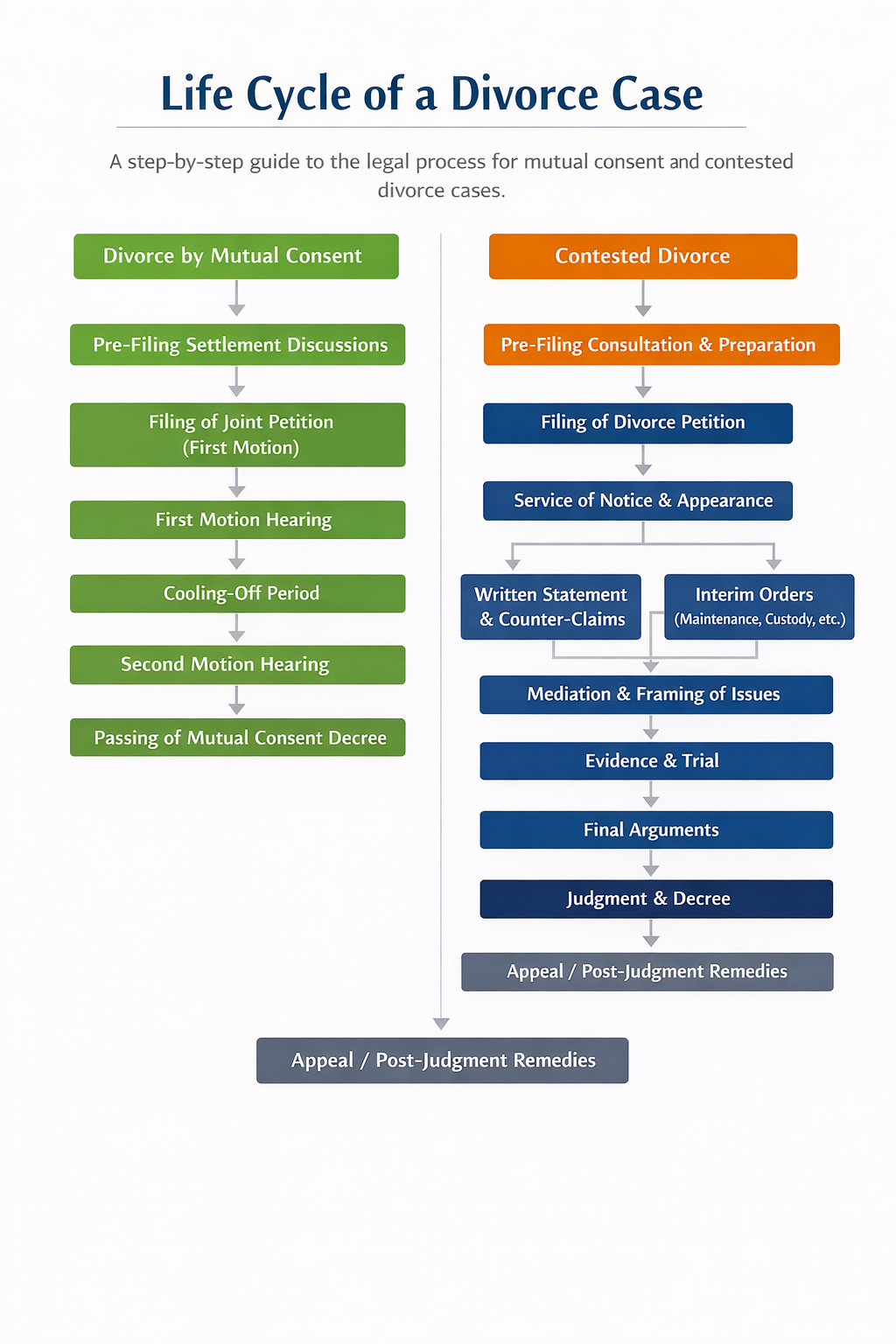
A divorce case follows a structured legal pathway, and understanding each stage enables individuals to approach the process with preparedness and clarity.
Here is a Detailed Step-by-Step Guide to Divorce by Mutual Consent and Contested Divorce in India.

Divorce is a formal legal process through which a valid marriage is dissolved by a court of law. The procedure follows a structured framework under personal laws and procedural statutes. In India, divorce proceedings are primarily governed by personal laws such as the Hindu Marriage Act, 1955, the Special Marriage Act, 1954, and procedural provisions under the Code of Civil Procedure, 1908.
This article explains the complete life cycle of a divorce case. It focuses on two major types of divorce proceedings: divorce by mutual consent and contested divorce.
Types of Divorce Cases
1. Divorce by Mutual Consent
Divorce by mutual consent arises when both spouses agree to dissolve the marriage. They mutually decide that they can no longer live together harmoniously. Section 13B of the Hindu Marriage Act, 1955 provides for divorce by mutual consent.
Both parties must agree on key issues before filing the petition. These issues include child custody, maintenance, alimony, and division of property.
The agreement must reflect free will and absence of coercion. Courts encourage this method because it reduces emotional and financial strain.
This process is generally faster than contested divorce proceedings.
2. Contested Divorce
A contested divorce occurs when one spouse files for divorce without the consent of the other spouse. The petitioner must prove legally recognised grounds for divorce. Section 13 of the Hindu Marriage Act, 1955 lists grounds such as cruelty, adultery, desertion, conversion, mental disorder, and others.
The respondent may oppose the petition and deny the allegations. The matter then proceeds through evidence, trial, and judicial determination.
Contested divorces often require detailed examination of facts and legal arguments.
1. Stage One: Pre-Filing Consultation and Legal Preparation
The divorce process usually begins with legal consultation. A spouse consults an advocate to understand rights, obligations, and potential outcomes.
The lawyer evaluates the facts to determine whether grounds for divorce exist.
At this stage, parties gather essential documents. These documents include the marriage certificate, proof of residence, identity documents, and evidence supporting allegations. Financial documents such as income statements and property records are also collected.
In mutual consent cases, spouses negotiate settlement terms before filing.In contested cases, the petitioner prepares factual pleadings and supporting material.
Legal preparation ensures clarity and reduces procedural delays.
2. Stage Two: Filing of the Divorce Petition
The formal process begins when the petitioner files a divorce petition before the competent Family Court. Jurisdiction depends on place of marriage, last residence together, or current residence of the respondent.
The petition contains material facts of the marriage. It states the date of marriage, details of children, and grounds for divorce. It also specifies relief sought, including dissolution of marriage, custody, maintenance, and litigation expenses.
In mutual consent divorce, both parties jointly file a petition under Section 13B. In contested divorce, only one spouse files the petition citing statutory grounds.
After scrutiny, the court registers the case and assigns a case number. The court then issues notice to the respondent.
3. Stage Three: Service of Notice and Appearance
The court ensures proper service of notice upon the respondent. Service of notice guarantees adherence to principles of natural justice. The respondent must receive an opportunity to present a defence.
The notice specifies the next hearing date. The respondent must appear personally or through legal counsel.Failure to appear may result in ex-parte proceedings.
Proper service validates further proceedings in the case.
4. Stage Four: Filing of Written Statement and Counter-Claims
In contested divorce cases, the respondent files a written statement. The written statement responds to each allegation in the petition. The respondent may admit, deny, or explain specific claims.The respondent may also raise counter-claims seeking independent relief. Counter-claims may include restitution of conjugal rights or custody rights.
In mutual consent cases, both parties submit affidavits confirming voluntary agreement. The court verifies that consent is genuine and informed.
This stage defines the scope of dispute between parties.
5. Stage Five: Interim Applications and Temporary Relief
During pendency of the case, parties may seek interim relief. Section 24 of the Hindu Marriage Act allows maintenance pendente lite and litigation expenses. Either spouse may apply for interim financial support.
Courts may also pass temporary custody orders in the best interest of the child. Interim protection orders ensure stability during litigation.
The court evaluates financial capacity and needs before granting interim relief. These orders remain effective until final judgment.
6. Stage Six: Mediation and Reconciliation Efforts
Family Courts often refer parties to mediation or conciliation. Section 9 of the Family Courts Act encourages settlement efforts. Mediation promotes amicable resolution without prolonged litigation. A neutral mediator facilitates constructive dialogue. Parties may resolve disputes regarding custody and property during mediation.
If mediation succeeds, parties record settlement terms before the court.
If mediation fails, the case proceeds to trial.
7. Stage Seven: Framing of Issues
In contested divorce, the court frames issues for determination. Issues identify disputed questions of fact and law. Each issue requires evidence and adjudication. For example, the court may frame an issue on whether cruelty occurred. The court may also frame issues regarding entitlement to maintenance.
Framing of issues narrows the scope of trial.
It provides procedural clarity to both parties.
8. Stage Eight: Evidence and Trial
The trial stage begins with the petitioner presenting evidence. Evidence may include documents, photographs, medical reports, or electronic records.
Witnesses may testify in support of allegations.
The respondent cross-examines the petitioner’s witnesses. Cross-examination tests credibility and factual accuracy.After the petitioner closes evidence, the respondent presents defence evidence. The petitioner may cross-examine defence witnesses.
The court records all testimonies systematically. The trial ensures procedural fairness and evidentiary scrutiny.
9. Stage Nine: Final Arguments
After completion of evidence, the court schedules final arguments. Advocates summarise factual findings and legal provisions. They cite relevant precedents to strengthen submissions.
The judge evaluates oral and written arguments carefully. The court may raise clarificatory questions during arguments. Final arguments provide an opportunity to persuade the court.
10. Stage Ten: Judgment and Decree
After considering pleadings, evidence, and arguments, the court delivers judgment. The judgment explains reasoning and legal conclusions. If grounds are proved, the court grants a decree of divorce. The decree formally dissolves the marriage. The court also decides maintenance, custody, and property disputes.
In mutual consent cases, the court grants decree after second motion confirmation. The decree becomes effective upon pronouncement.
11. Post-Judgment Remedies and Appeal
An aggrieved party may file an appeal before a higher court. Appeals must comply with statutory limitation periods. The appellate court reviews legal and procedural correctness. Parties may also seek modification of custody or maintenance orders. Courts entertain modification applications upon change in circumstances.
Conclusion
A divorce case follows a structured and legally regulated life cycle.
Divorce by mutual consent offers a cooperative and time-efficient resolution.
Contested divorce involves detailed judicial examination and trial.
Each stage safeguards fairness, transparency, and due process.
Understanding the procedure empowers individuals to approach the process confidently.
Proper legal guidance and informed decision-making significantly improve outcomes.
Other Life Cycles: 498A IPC Case Lifecycle || Maintenance Case u/s 125 CrPC Lifecycle. Index of all life cycles is here.
Key Contributor:
Mrs Suprajaa Rajan B.Com, LL.B., LL.M.
+91-9606345150
Views: 1,647