Baseless case against Secretary to Government LV Subrahmanyam was quashed by AP High Court.
Citations: [
Other Source links:
Baseless case against Secretary to Government LV Subrahmanyam was quashed by AP High Court.
Citations: [
Other Source links:
After failure at Delhi High Court here, Supreme Court dismissed the SLP summarily. Sad!
Basing on the Pooja Saxena case here, Parents of women who were alleged to have committed the crime of giving dowry were let free.
Citations: [2016 SCC ONLINE DEL 2130], [2016 DLT CN B 229 30]
Other Source links:
https://indiankanoon.org/doc/134987777/
https://www.casemine.com/judgement/in/5728e42ee56109277ee48517
https://www.quickcompany.in/judgements/judgement-7b760d46-8b0b-48bd-9a45-794161ac3e2c
Because of the allegation of Dowry giving are made by married women, husbands are resorting to these kind of hyperbolic tricks which fall flat on their face. Instead of hitting at the root cause, peripheral aspects are stroked only to be later quashed like this.
Citations: [2013 KCCR 4 3137], [2013 AKR 4 454], [2014 ILR KAR 199], [2013 SCC ONLINE KAR 5387], [2013 AIR KANT R 4 45]
Other Source links:
https://www.casemine.com/judgement/in/56094831e4b01497112656fb
https://indiankanoon.org/doc/140258661/
https://www.legitquest.com/case/viral-goda-viral-dhulia-others-v-virag-r-dhulia-another/DDF53
https://www.lawyerservices.in/Mrs-Viral-Goda–Viral-Dhulia-and-Others-Versus-Virag-R-Dhulia-and-Another-2013-07-25
Upon filing SLP before Supreme Court, it was dismissed summarily with the following Order.
Delay condoned.
Heard. We find no merit in the case.
The special leave petition is dismissed with cost of Rs.20,000/- to be paid in favour of respondent no. 2 within eight weeks.
https://indiankanoon.org/doc/148303036/
Justice K C Bhanu from AP High Court has held as follows:
From Para 2,
2. Petitioner is an accused in C.C. No. 224/1995. Chinna Chowk Police laid a charge-sheet against him, his parents and three sisters for an offence punishable under Section 498-A of the Indian Penal Code and for offences punishable under Sections 3 and 4 of the Dowry Prohibition Act, for short, hereinafter to be referred to as “the Act”. A single charge under Sections 3 and 4 of the Act was framed against petitioner and A-2. After conclusion of trial and before judgment, the learned Magistrate framed separate charges under Sections 3 and 4 of the Act against petitioner and A-2 and recalled P.Ws. 1 to 3 and cross-examination them. During their cross-examination, P.Ws. 1 to 3 admitted that they had given Rs. 1 lakh as dowry and presented gold jewels worth Rs. 50,000/- to the petitioner and his father. At that stage, petitioner filed Crl. M.P. No. 4073/1998 before the Trial Court under Section 319, Cr.P.C, to implead P.Ws. 1 to 4 as accused for the offence under Sections 3 and 4 of the Act, to be tried along with the other accused in the case, since both the giver and taker of dowry are equally liable for punishment under the Act. The learned Magistrate dismissed that application against which petitioner filed Crl. R.P. No. 15/1999 before the Sessions Court. The learned Sessions Judge has dismissed the revision holding that P.Ws. 1 to 4 cannot be tried as accused in the same trial as they are protected under Section 7(3) of the Act. It is as against the order of dismissal of the revision, A-1 filed the present petitioner to quash the said order.
From Para 7,
7. A plain reading of the above provision would go to show that giving or taking of dowry as well as abetment of giving or taking of dowry is an offence punishable under the Act. On the basis of the statements made before the Court by P.Ws. 1 to 3 admitting that they gave dowry, can they be tried as accused in the same trial, is the question.
From Para 10,
10. If P.Ws. 1 to 4, who were examined as witnesses, are added as accused and arrayed in the list, of the accused persons, the proceedings in respect of them shall have to be commenced afresh and thewitnesses reheard. It means they have to give evidence against themselves, which is not permissible under law. Clause (3) of Article 20 of the Constitution provides that no person accused of any offenceshall be compelled to be a witness against himself. This protection is available to the person accused ofan offence not merely with respect to the evidence to be given in the Court-room in the course of trial butis also available to him at the previous stages, if an accusation has been made against him which might, in the normal course, result in his prosecution. It follows that the protection is available to a person againstwhom the formal accusation has been made though the actual trial may not have commenced as yet andif such an accusation relates to the commission of an offence which in the normal course may result in prosecution. In view of the above provisions, the witnesses cannot be compelled to give evidence against themselves. Therefore, P.Ws. 1 to 4, cannot be arrayed as accused along with petitioner and others in the same proceedings. If the Court wants to proceed against the persons of giving dowry, then it has to resort to the provision under Section 7 of the Act. Section 7(1)(b) of the Act provides that no Court shall take cognizance of an offence under this Act except upon its own knowledge, or a police report of the facts which constitute such offence, or a complaint by the person aggrieved by the offence or other relative of such person or by any recognized welfare institution or organization.
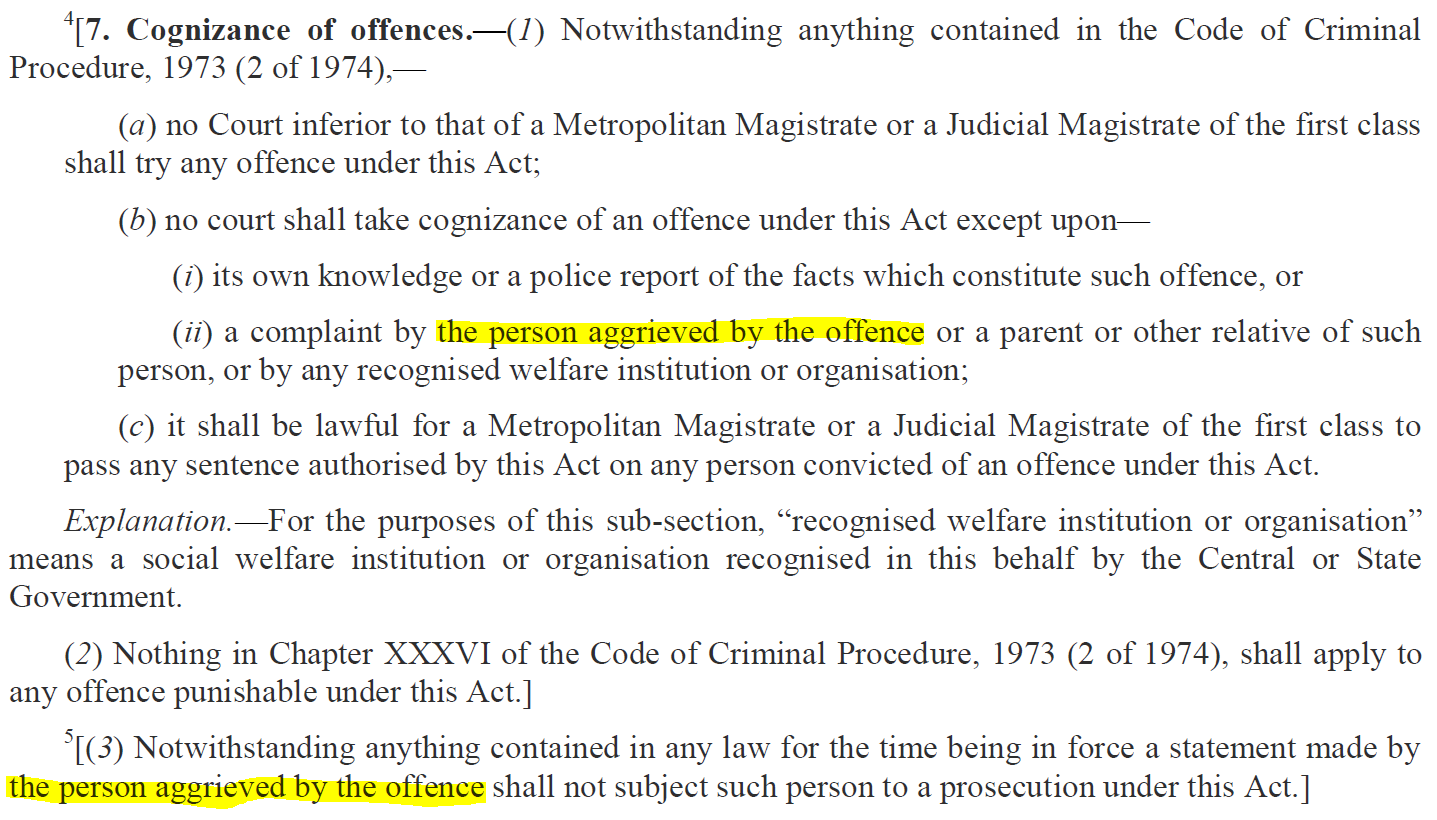
Further Section 7(3) of the Act provides that notwithstanding anything contained in any law for the timebeing in force, a statement made by the person aggrieved by the offence shall not subject such person to a prosecution under this Act.
Fundamental mistake in this case is, why police are NOT booking the Dowry givers asmushas Dowry takers in the FIR? Because in some States, Police circulars were issues precluding the Dowry givers from prosecution. So Police themselves decided that Dowry givers are not to be booked, which is totally contrary to what is said in Section 3(1).
Citations: [2004 DMC 2 49], [2003 ALD 2 91], [2003 ALT CRI 2 253]
Other Source links:
https://www.casemine.com/judgement/in/5608f83ce4b0149711141d5d
https://indiankanoon.org/doc/91122848/
Justice NN Tiwari had held as follows (without any legal basis):
From Para 6,
6. Learned Counsel for the complainant, on the other hand, submitted that the ground for assailing the impugned order by the petitioner is wholly misconceived and baseless. From the allegations made in the complaint, it is evident that the accused persons were demanding dowry and torturing the complainant for not bringing the dowry as desired by them. The petitioner is wrongly interpreting the presents given by the parents of the complainant, as dowry, which does not come within the ambit of Section 3(1) of the Act. It has been submitted that nothing new has come in course of the inquiry or trial or there is nothing in the evidence on record to suggest that any such offence has been committed by the father of the complainant and learned Court below considering the provisions of law including the provisions of Section 7(3) of the Act has rightly rejected the petitioner’s petition.
From Para 10,
10. The petitioner has sought prosecution on the basis of the statement of giving dowry by the father of the complainant. From perusal of the statement made in the complaint, I find no such incriminating statement of voluntarily giving dowry for marriage. The statement regarding giving presents ‘UPHAR’ does not come within the ambit of definition of dowry. Moreover, the father of the complainant is an aggrieved person from whom dowry was being demanded. Such aggrieved person is protected under Section 7(3) from prosecution under the Act.
Citations: [2008 SCC ONLINE JHAR 385], [2009 AIR JHAR R 1 856], [2009 CRI LJ NOC 614 159], [2009 JLJR 1 432]
Other Source links:
https://www.casemine.com/judgement/in/56ea832d607dba377ff107fd
https://www.lawyerservices.in/Ram-Gopal-Sah-Versus-State-Of-Jharkhand-2008-12-03
After losing out (didn’t lose the case but didn’t get opportunity to argue in-person) in an earlier attempt here, I decided to take Writ Petition route as I am (along with my parents!) one of the affected person of this biased implementation of a convoluted interpretation of section 7(3) of Dowry Prohibition Act 1961 (amended in 1986). Also, decided to decentralize my PIL prayers.
So picked up this prayer from earlier attempt and worked on writing the WP.
Issue a Writ, Order or Direction, more particularly one in the nature of Writ of Mandamus to Respondents, such that there is no ambiguity to them whether to prosecute the Dowry givers under section 3 of DP Act read with section 7 of DP Act and no discrimination is made between Dowry Giver and Dowry Taker, under Section 3(1) of DP Act, in similar fashion as that of made by Bangladesh.
Key Point
Shouldn’t all Dowry givers be booked and prosecuted as per section 3 of Dowry Prohibition Act 1961 (as amended from time to time) or not?
Arguments – Counter Arguments
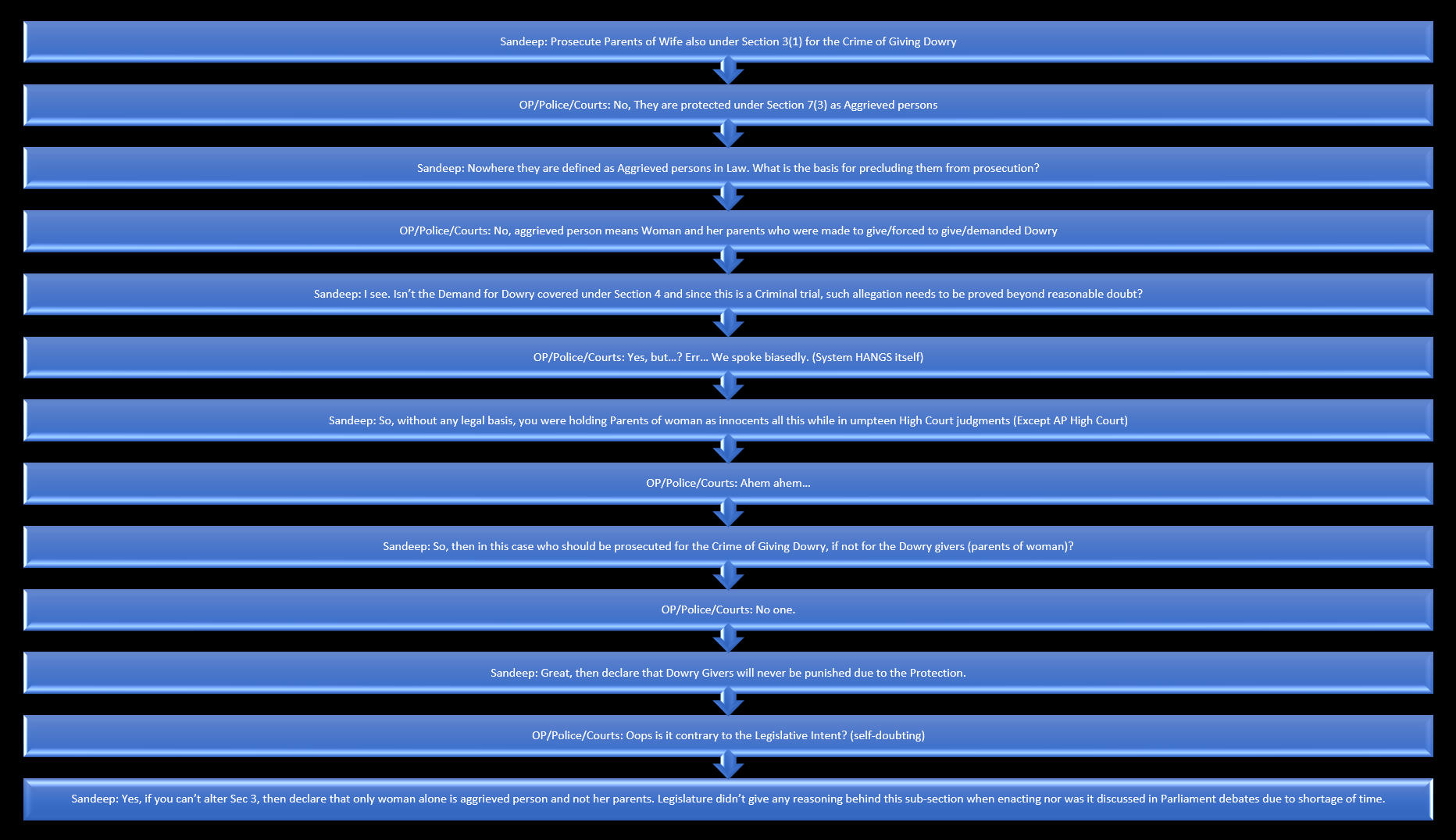
Another simple point from the Bare Act itself.
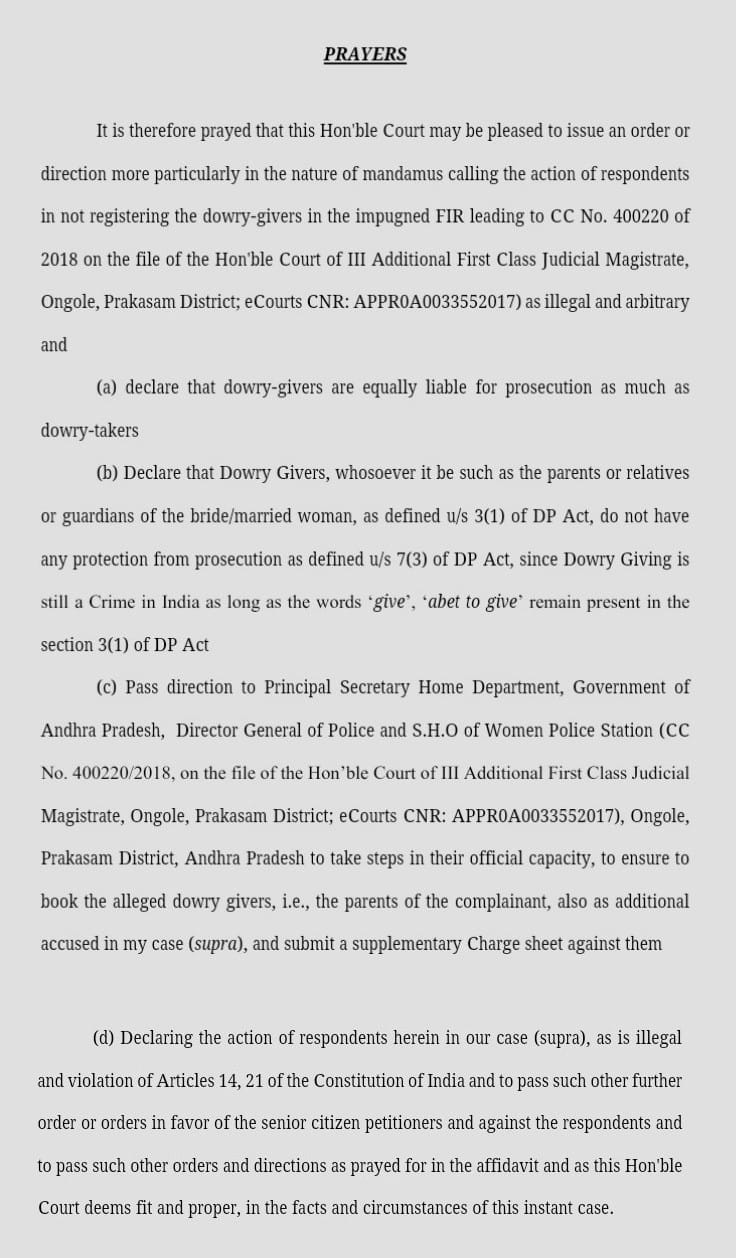
Prayer
Prosecute Dowry Givers u/s 3(1) without protecting them u/s 7(3) = Article 14 and 21 compliance
Alternatively, strike down words ‘Gives’ and ‘abets to give’ from section 3(1) = ultra-vires to Article 14 and 21 compliance and contrary to legislative intent
Either-way, I win!
Full prayers from the Writ Petitions:
All the cited case laws are listed here.
ACTION STARTS:
WP (in the name of my parents, and not in my name) is filed on 14-09-2021. WP No. 20594 of 2021 (WPSR 27260/2021). Here is the affidavit.
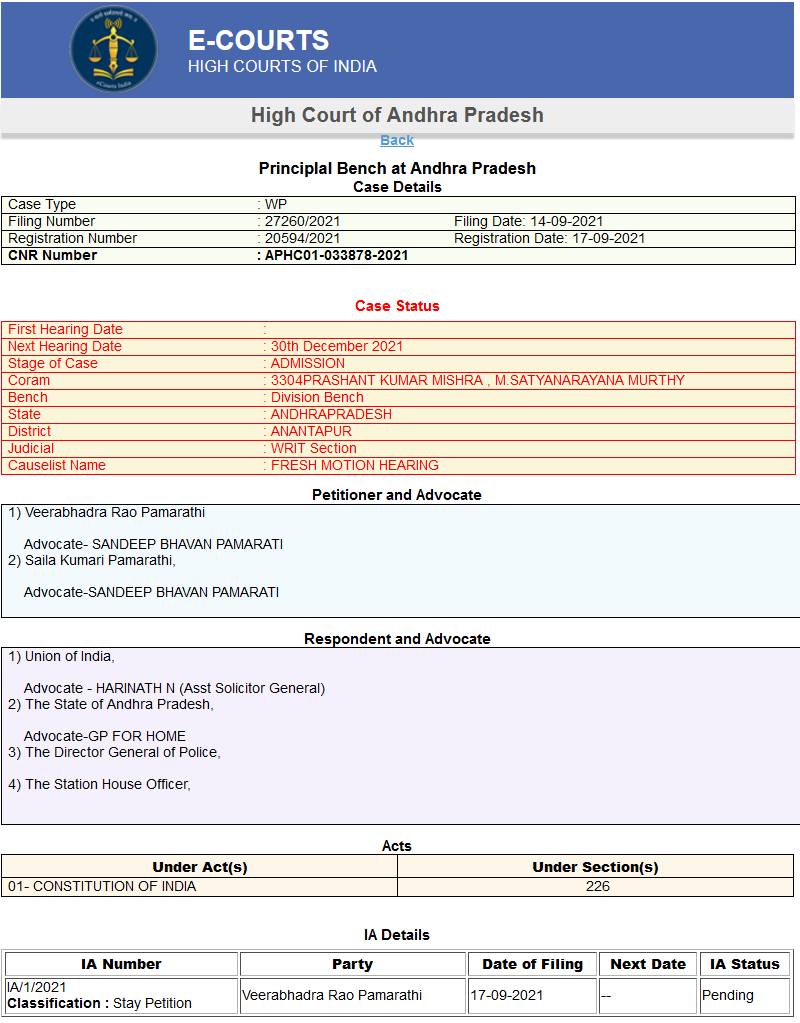
Case Details

Filed a memo with additional information on 17-09-2021:
Order Passed on 20-09-2021
Initial hearing before admission on 20-09-2021. Notices issued to the Respondents. Government Advocates take notice and sought 4 weeks time to file Counters.
Next Date of Hearing : 13-12-2021
Since the petitioner is questioning the vires of the Dowry Prohibition Act, Registry is directed to post the matter before the appropriate Bench as per roster.
Next Date of Hearing : 16-12-2021
On the request made by Ms. Sridevi Jampani, learned counsel for the petitioners, post this case after two weeks.
Next Date of Hearing : 30-12-2021
Due to COVID-19 situation, the Court-1 took up only part of the Causelist and rest of the cases, including mine, was not listed. No future date known.
Next Date of Hearing : 13-06-2022
Since 4 months, not a single listing was possible. Frankly, not asked/mentioned/represented appropriately by the advocate. Will wait out the Vacation period for High Court and then get the advocate changed to… myself. Hence filed the NOC obtained from previous advocate and my vakalat. (Expense: Rs.300/-)
Next Date of Hearing : 14-06-2022
I am the new Advocate for this Writ Petition.
Updated on eCourts Website…
 ‘
‘
Updated on eCourts app…
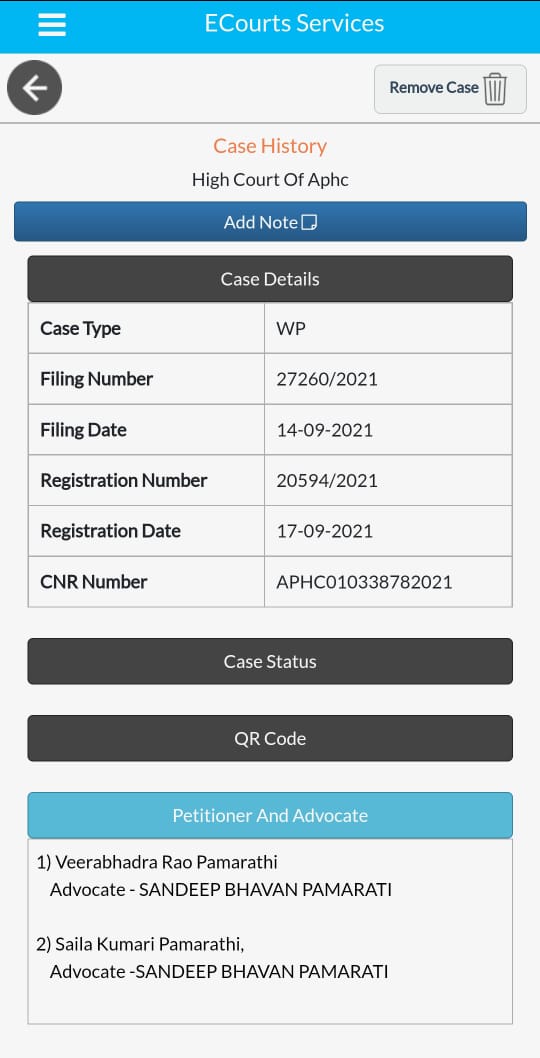
Updated on AP High Court Case Status website…
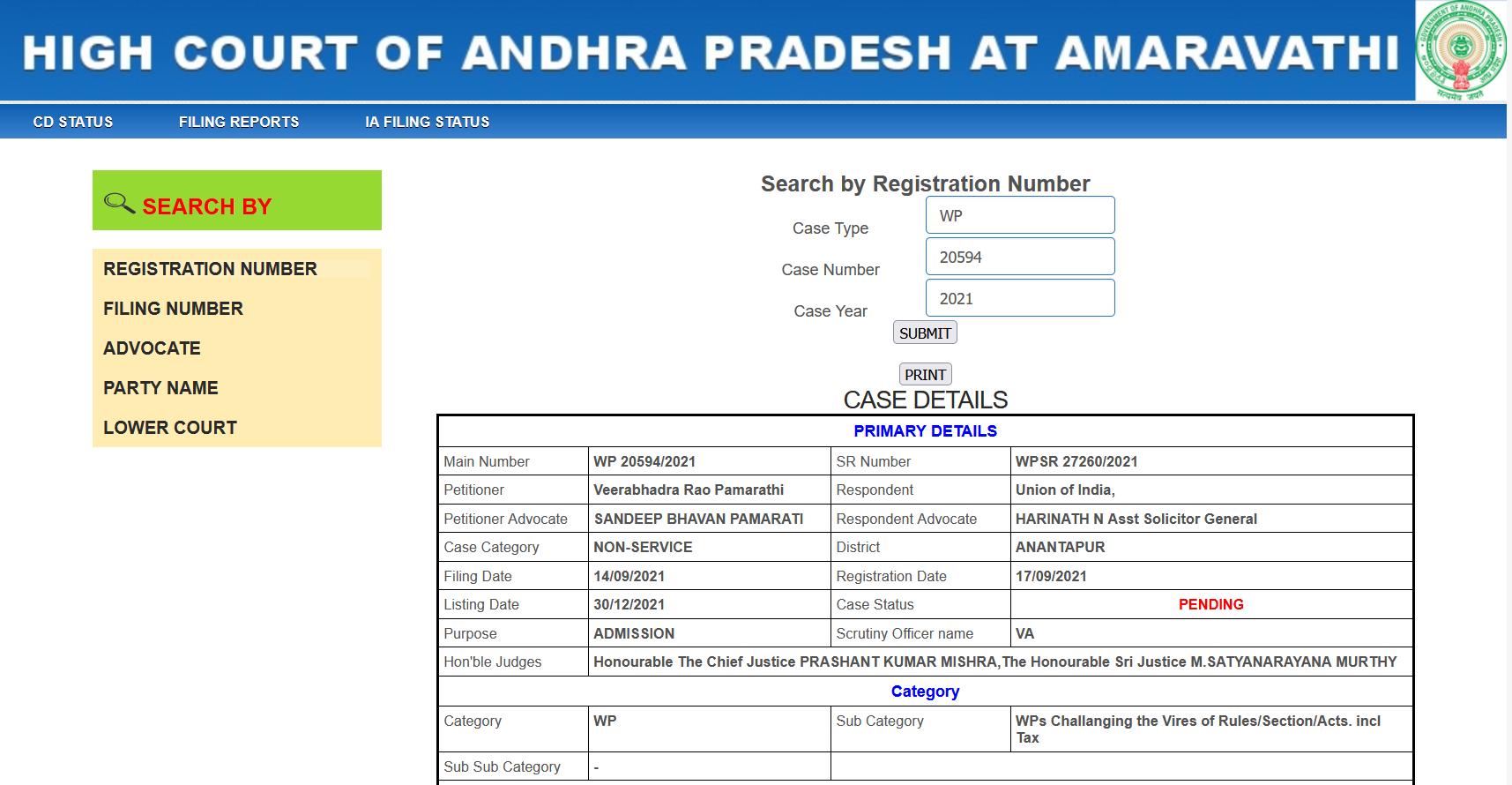
Next Date of Hearing : 23-06-2022
I went and appeared before Court 1 today. Got a Court slip filled and ready. Gathered up courage (my first time facing a High Court judge, that too Chief Justice!) and stepped up to the mike. Cleared my throat and uttered few words.
Next Date of Hearing : 26-07-2022
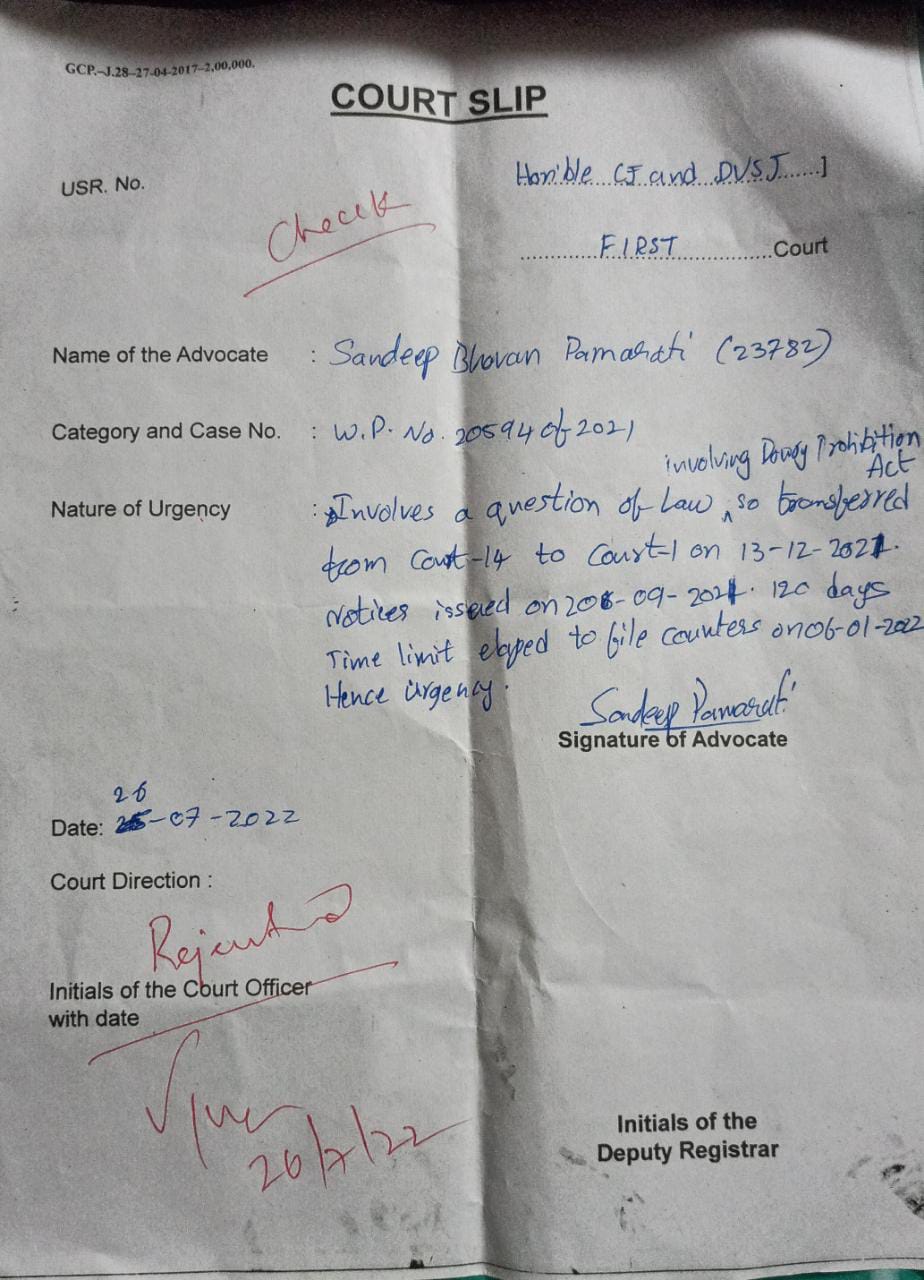
Going to take a different plea for urgency.
On Next Date of Hearing : 26-07-2022
I went and appeared before Court 1 today. Got a Court slip filled and ready.
Next Date of Hearing : 05-08-2022
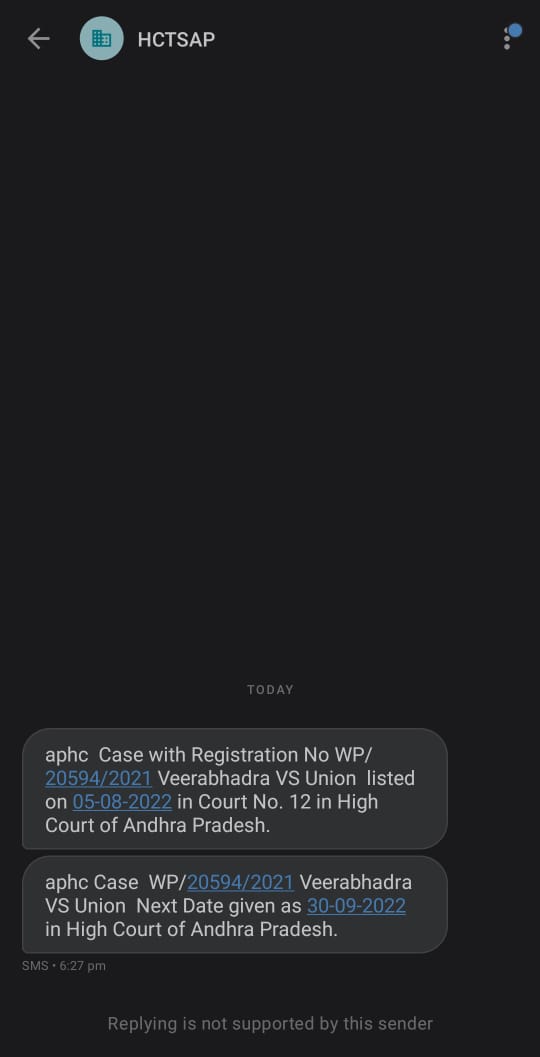
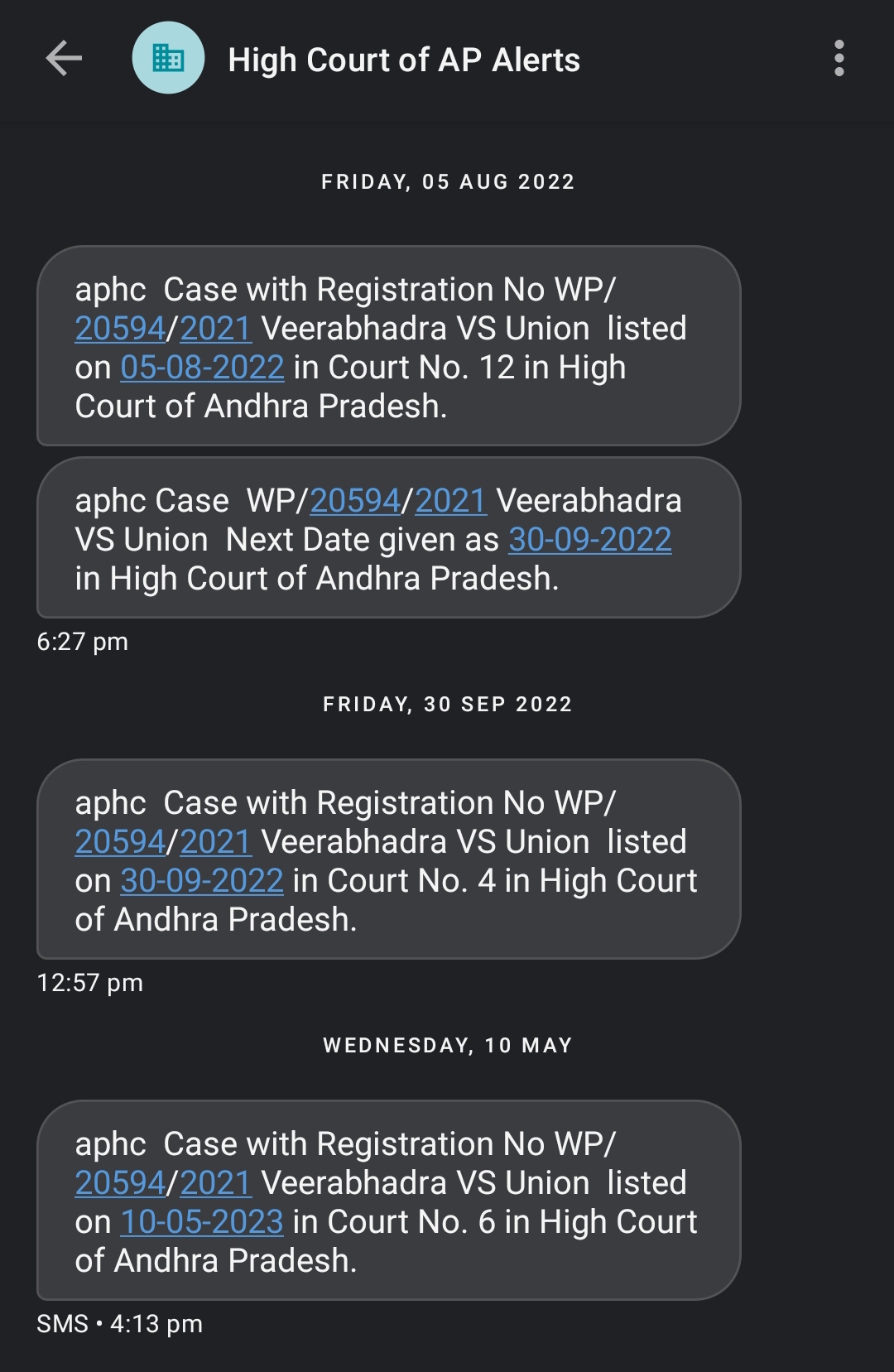
Since I was not in a habit of checking the listing of my cases (officially just two; for one, CJ doesn’t see urgency, for another, File not available at AP HC), I totally missed to appear before the Court in which this case got listed miraculously. Also since it was my 40th birthday, I had reached my home town in the morning of 5th August.
See the time at which I received the SMSs (I got them after the business of the Court ended)
[Note: Filed RTI application to AP HC, asking for the number of Writs for which Counter was NOT filed within 120 days. Interesting reply awaited!]
Here is the order passed. Not sure if Counter is filed by the Respondent No.1 (Union of India)
Next Date of Hearing : 30-09-2022
The matter came before Justice AV Sesha Sai and Justice D Venkata Ramana. Just before lunch, the case was called up and I and Sridevi madam pushed for admission of case and disposal of IA.No. 1 which is stay petition. The case was directed to be listed after vacation.
Next Date of Hearing : 10-05-2023
The previous couple weeks went in roaming around couple of high-headed posting clerks in Criminal Posting Section. I had to move a Court slip the previous day for the case to be listed today. Thanks to those who helped me.
The Division bench comprised Justice U Durga Prasad Rao and Justice T. Mallikarjuna Rao. When my name was called out, I was trembling. For fear of sabotaging everything that I worked on for over 5 years. The short interaction went fine, as follows.
UDPR J(smiling): So husband is seeking prosecution of In-law?
Sandeep: No your honor, his parents are seeking prosecution of the parents of their daughter-in-law
UDPR J: Those giving dowry are to be prosecuted by law under Dowry Prohibition Act 1961?
Sandeep: Yes your honor
UDPR J: Is there any case law on this aspect?
Sandeep: Yes your honor, the case laws are annexed
Other side was directed to come prepared on next date (Section 3, 4 of DP Act) and next date was granted for 15-06-2023. Finally for Counters and for hearing (and disposal, hopefully!). No stay was granted on Trial Court proceedings.
As usual the SMS Alert came at 4.15 PM
Next Date of Hearing : 15-06-2023
Again 3 weeks of time is given.
Next Date of Hearing : 5-07-2023
The Petition was not listed. Reason: The Judges were busy with interviewing the prospective Junior Civil Judges!!!
Next Date of Hearing : 25-07-2023
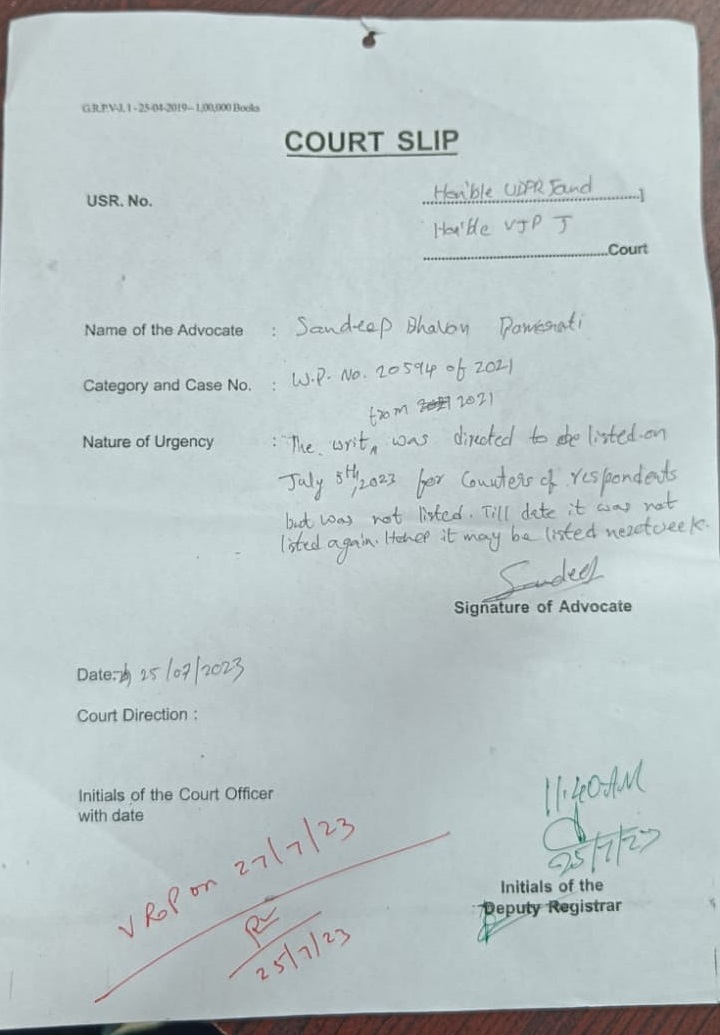
After waiting for the petition to be listed for over 2 weeks, I mentioned the matter before the Division Bench. It was directed to be listed on 27 July 2023. Yipieeeee!
Next Date of Hearing : 27-07-2023
Again 2 more weeks of time given, on Respondent’s request and the judge denied stay on trial Court proceedings. But Judge said since there is possibility of wide implications, he wants the Respondents to file Counters. Finally. I agreed.
No Order was passed though.
Next Date of Hearing : 11-08-2023
It was directed that the WP be listed on 23-08-2023 (Landing of Vikram on the Lunar south!). Again 2 weeks time given, inspite of saying finally for Counters, thrice. Bench orally indicated that they want to learn the views of Advocate General.
Next Date of Hearing : 23-08-2023
Came rushing to Mangalagiri but the WP was NOT listed. So I decided to mention it on 24-08-2023.
Next Date of Hearing : 24-08-2023
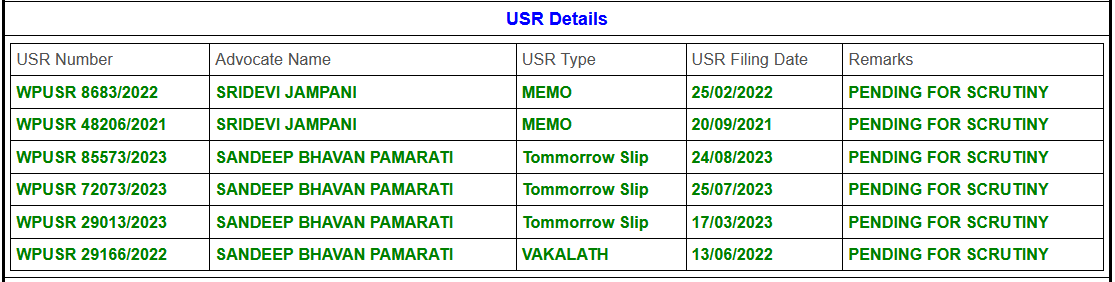
Interesting date… I mentioned the matter (out of list!) and the Bench said we will hear the views of AG today. So I had to wait until item 14 when learned Advocate General (AG) would present his arguments in a matter, after which the bench sought the views of AG. At that moment, a battery of 20+ advocates gathered around the bench. Each of them expressed varied views and they laughed it out. I had to keep my cool. The matter is listed (compulsory) for 08 Sep 2023.
List of mentions…
Next Date of Hearing : 08-09-2023
Due to change in roster, this case got transferred to Court-1. I mentioned the case before Court-1 and it was directed to be listed shortly.
Final Outcome : 26-09-2023
The case is dismissed. Awaiting Order copy. Judges raised these points…
I – There can be only two possibilities: Dowry giving is a crime or not
J – No, Why only two?
J – Have you followed Sakiri Vasu Vs State of UP
I – Yes, sent representations to SHO, DGP, Home Secretary
J – Nope, that is not sufficient compliance
I – My prayer is to interpret the provisions of DP Act and declare that Dowry giving is a crime
J – We do not do that kind of declaring a provision.
I – You can do that on a petition, such as this.
J – Nope
I – Three is no protection to dowry givers even u/s 7(3) of DP Act
J – They are aggrieved persons
Final Judgment
Next Steps
Justice K C Bhanu from AP High Court has held as follows in one of the shortest and cleanest Judgments I have read:
From Para 5,
5. Under Section 3 of the Act if any person, after the commencement of this Act gives or takes or abets the giving or taking of dowry, he shall be punishable. It does not contemplate a demand or coercion or threat made by one person to another for the purpose of giving or taking dowry. Therefore, this provision makes it clear that giving or taking of dowry by any person is an offence. But Section 7(3) of the Act reads that notwithstanding anything contained in any law for the time being in force, a statement made by the person aggrieved by the offence shall not subject such person to a prosecution under this Act. Therefore, Section 3 of the Act is controlled by cl. (3) of Section 7 of the Act. Ordinarily, the person aggrieved by the offence is the person directly affected or injured. The person aggrieved by the offence is the accused in C.C.No.95 of 2010 on the file of the XIII Additional Chief Metropolitan Magistrate, Hyderabad, but not the complainant or the witnesses. Therefore, statement made by a person aggrieved by the offence is any one of the accused, but not the complainant. Hence, Section 7 (3) of the Act has no application to the present facts of the case. In this view of the matter, the petition is liable to be dismissed.
Citations:
Other Source links:
This is a Delhi High Court judgment where a certain conclusion is made without basis. Just an earlier judgment is cited as support even that one lacks justification. Funny.
From Para 8,
8. It is thus evident that Section 7 (3) is a non obstante clause and will thus prevail on any other law for the time being in force and a statement made by a person aggrieved by the offence under this Act shall not subject him to prosecution under this Act. Thus the decision of this Court in Neera Singh (supra) is an obiter and does not constitute a binding precedent for the reasons that the provisions of DP Act 1961 were not subject matter of the dispute before the Court in the petition under Section 482 Cr.P.C. in Neera Singh’s case and thus, this Court did not take into consideration the provisions under Section 7 (3) of the DP Act.
From Para 9,
9. Further there is no merit in the contention of learned counsel for the Respondent that the Petitioner being the father of the victim girl was not an
“aggrieved person”. Section 7(3) of the DP Act bars cognizance of a complaint against the person aggrieved by the offence. It cannot be said that only “aggrieved person” would be the victim girl. Even the father of the victim girl, who was made to give dowry, would be an aggrieved person. Similar view has been taken in Ram Gopal Sah v. State of Jharkhand, II (2009) DMC 844.
No one explains how/why should the Dowry giving criminals (as per Sec 3(1) should be protected from prosecution along with their daughter, who can be considered an aggrieved person!!!
Citations: [2012 AD DEL 3 186], [2012 DMC 2 134], [2012 SCC ONLINE DEL 1261]
Other Source links:
https://indiankanoon.org/doc/160230226/
https://www.legitquest.com/case/yashpal-kumar-v-bhola-nath-khanna-another/73202
https://www.casemine.com/judgement/in/56090e75e4b014971117c483
Justice Dhingra held as follows
From Para 4,
4. A perusal of Domestic Violence Act shows that Domestic Violence Act does not create any additional right in favour of wife regarding maintenance. It only enables the Magistrate to pass a maintenance order as per the rights available under existing laws. While, the Act specifies the duties and functions of protection officer, police officer, service providers, magistrate, medical facility providers and duties of Government, the Act is silent about the duties of husband or the duties of wife. Thus, maintenance can be fixed by the Court under Domestic Violence Act only as per prevalent law regarding providing of maintenance by husband to the wife. Under prevalent laws i.e. Hindu Adoption & Maintenance Act, Hindu Marriage Act, Section 125 Cr.P.C – a husband is supposed to maintain his un-earning spouse out of the income which he earns. No law provides that a husband has to maintain a wife, living separately from him, irrespective of the fact whether he earns or not. Court cannot tell the husband that he should beg, borrow or steal but give maintenance to the wife, more so when the husband and wife are almost equally qualified and almost equally capable of earning and both of them claimed to be gainfully employed before marriage. If the husband was BSc. and Masters in Marketing Management from Pondicherry University, the wife was MA (English) & MBA. If the husband was working as a Manager abroad, the wife with MBA degree was also working in an MNC in India. Under these circumstances, fixing of maintenance by the Court without there being even a prima facie proof of the husband being employed in India and with clear proof of the fact that the passport of the husband was seized, he was not permitted to leave country, (the bail was given with a condition that he shall keep visiting Investigating Officer as and when called) is contrary to law and not warranted under provisions of Domestic Violence Act.
From Para 5,
5. We are living in an era of equality of sexes. The Constitution provides equal treatment to be given irrespective of sex, caste and creed. An unemployed husband, who is holding an MBA degree, cannot be treated differently to an unemployed wife, who is also holding an MBA degree. Since both are on equal footing one cannot be asked to maintain other unless one is employed and other is not employed. As far as dependency on parents is concerned, I consider that once a person is grown up, educated he cannot be asked to beg and borrow from the parents and maintain wife. The parents had done their duty of educating them and now they cannot be burdened to maintain husband and wife as both are grown up and must take care of themselves.
From Para 6,
6. It must be remembered that there is no legal presumption that behind every failed marriage there is either dowry demand or domestic violence. Marriages do fail for various other reasons. The difficulty is that real causes of failure of marriage are rarely admitted in Courts. Truth and honesty is becoming a rare commodity, in marriages and in averments made before the Courts.
Citations: [2010 DRJ 118 385], [2010 DLT 171 644], [2010 RCR CRI 7 1287], [2010 AD DEL 7 615], [2011 CIVCC 1 209], [2010 DMC 2 574], [2010 SCC ONLINE DEL 2912], [2011 ILR DEL 1 58],
Other Source links: https://www.casemine.com/judgement/in/56090d69e4b0149711179b26
Bad Behavior has blocked 4153 access attempts in the last 7 days.

