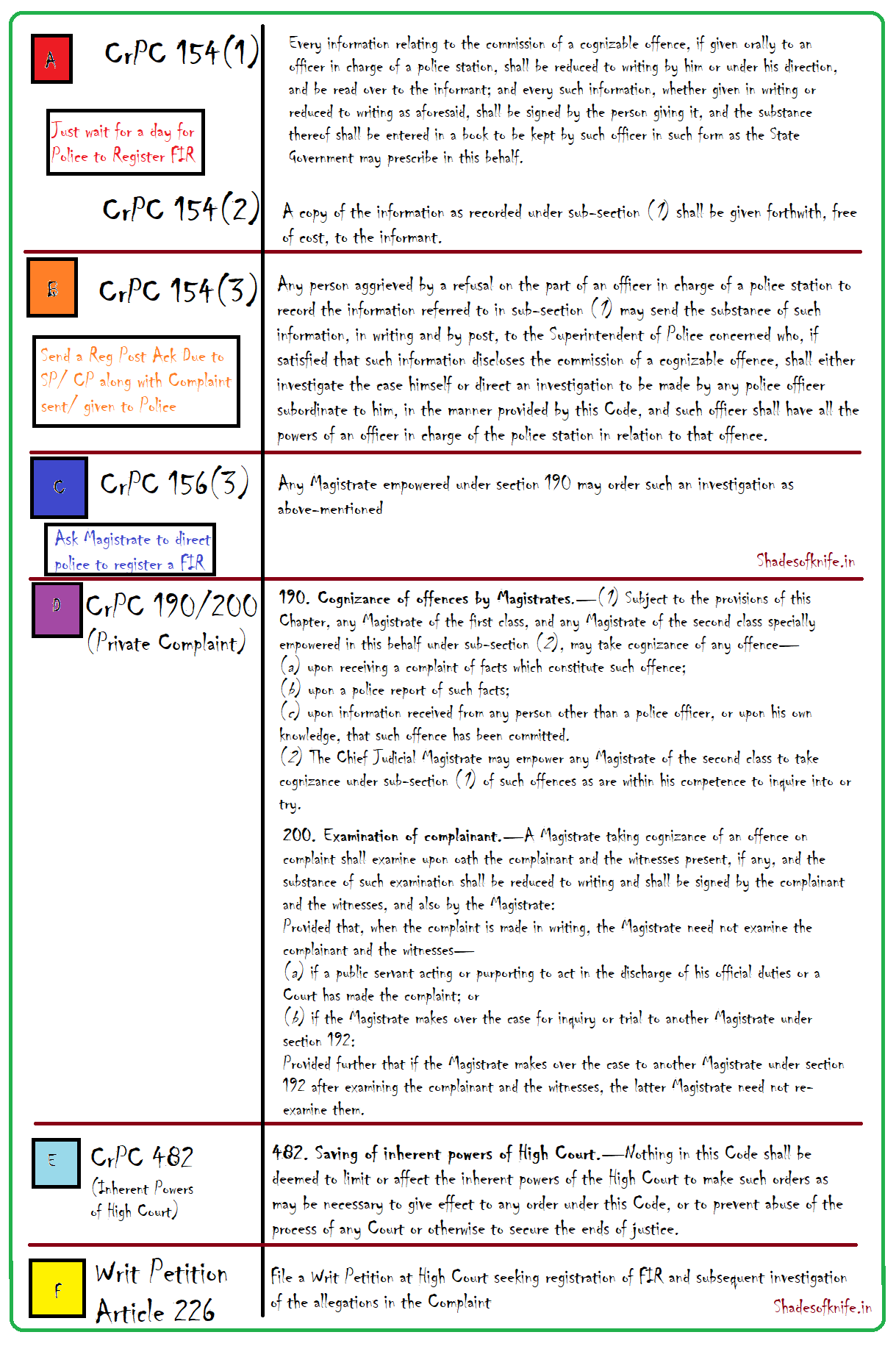
Awareness of law involved in the case laid against you is crucial to handle and take charge of your case yourself. The following are some of the general reliefs one can invoke in Andhra Pradesh for sure. They may apply to other states also. List of High Courts is here.
BNSS is available here.
Note: If you need some reliefs from Police High-handedness, go here.
Always remember Article 21 of Constitution of India
Article 21 is what powers Fair treatment of accused during criminal trials. It provides for fair investigation, Fair trial and Fair Judgment. Any violation of Article 21 gives you liberty to invoke Article 226 at High Court and Article 32 at Supreme Court to seek Writ Reliefs. Case laws are available in chronological order here.
It reads as follows:
21. Protection of life and personal liberty.—No person shall be deprived of his life or personal liberty except according to procedure established by law.
Engagement of Advocates
As per Section 32 of Advocates Act 1961, you can appear in your own case.
If a victim wants to engage a private advocate to prosecute their case, yes you can, but only to assist the PP. The sections to back this aspect are to read
- Sec 225 CrPC
- Proviso to Sec 24(8) CrPC
- Sec 301 CrPC
- and finally Sec 302 CrPC. In that Order. (Can only assist the Government Pleader/Assistant Public Prosecutor)
Hope this helps clarify the legal position to those of us who filed/intend to file Criminal cases against OP. This is explained in this case law here. The landmark case law from Apex Court is available on my site here.
Engagement of a third-party other than Advocates
As per again Section 32 of Advocates Act 1961, you can appear in some one else’s case, subject to certain conditions.
- You must be a non-advocate
- You must have some relationship due to which the accused/defendant trusts you
- You may be permitted by a Court, an authority or any person
- You may be permitted to appear in any particular case; as a corollary, may not be permitted in all cases or for all clients
- Prior Court permission is necessary (via a Petition; sample here)
This is laid out by the Legendary Jurist Sri V.R. Krishna Iyer in this celebrated case law here.
Terminating the services of Advocates (through issuing a termination letter discharging existing Advocate from case who earlier filed vakalatnama and communicating the same to advocate)
You have complete freedom to terminate the services of your Advocate and engage another one. Just be cautiously about the local procedures which can differ from High Court to High Court. It means, in some High Courts, there is no need of any No-Objection-Certification (NOC) from your current Advocate before you engage another. Like in Karnataka. But not so in Andhra Pradesh, wherein it is unwritten rule to obtain NOC so as to avoid unpleasant situations/conversations/interactions between you and your advocates (or between the earlier and current Advocates). Nevertheless Supreme Court has laid down a landmark case law here. Use it judiciously. Also take a look at other similar case laws here.
First Appearance in Court
Once the case documents are sent to Court via a Charge sheet or Closure report as mandated u/s 173 CrPC, Court Filing Section staff gives is a case number and list it in the causelist (daily timetable of work) before a competent Magistrate/ Judge.
On your first appearance day in the Court, Court staff will ask questions to identify you and your purpose of attending the Court. Next question is if you have engaged an advocate or need time for this purpose. Finally, case will be adjourned to a future date and each accused person will be given a set of copy of the above case documents which were submitted into Court by Police as mandated u/s 207 CrPC.
And once an Anticipatory Bail is granted, it protected the grantee/accused until the end of trial and there is no need to obtain Regular Bail, after Charge sheet is filed by Police into the Court. Case law here.
Exemption from Personal Appearance in Court
If you do not want to appear even on first appearance for certain obvious and unavoidable reasons, take help from this case law here and here and You can seek exemption for self or other accused from appearing in the Court in a case u/s 205 CrPC of CrPC 205. Vital Case laws are available here. For single-day relief, see Absent Petition below.
Provision u/s 173 CrPC to demand documents from IO to be submitted to Court and to obtain a copy of prosecution documents
Section 173(7) reads as follows:
(7) Where the police officer investigating the case finds it convenient so to do, he may furnish to the accused copies of all or any of the documents referred to in sub-section (5).
How to use it:
If you are good terms with IO, then he/she may find it convenient to furnish to the accused copies of all or any of the documents. Be courteous to IO to make use of this.
Note: Otherwise, as mentioned above, Court will anyways, provide a copy of the entire bunch of prosecution documents to each accused on first appearance.
Section 173(6) reads as follows:
(6) If the police officer is of opinion that any part of any such statement is not relevant to the subject-matter of the proceedings or that its disclosure to the accused is not essential in the interests of justice and is inexpedient in the public interest, he shall indicate that part of the statement and append a note requesting the Magistrate to exclude that part from the copies to be granted to the accused and stating his reasons for making such request.
How to use it:
If you have submitted any documents/made a statement that IO records during inquiry (supposedly u/s 41A CrPC), and such documents are missing in the bunch of documents procured via above section or u/s 207 CrPC, then submit to the Court that such left-out/excluded documents be brought on record of Court. The case law is here.
Even if such seeking of documents is objected to for any legal reason, one can seek for inspection of such documents as held in here.
Protest Petition
After Police file a final report ( be it a Charge sheet or a Closure report), Court notifies the informant/complainant about the same and invites any objections to the same. The informant/complainant can file a protest petition into the Court and object to section/accused removal from Charge sheet or Closure report itself can be objected to. Couple of Landmark judgments are here.
Limited Authority of Registry or Filing Section/Office attached to a Court
A Registry attached to a High Court or a Filing Section attached to a District/Magistrate Court has a limited set of functions on the administration of Justice and authority and they certainly can not exercise judicial function as held by Supreme Court here. Use this judgment, as appropriate, to ensure Court staff perform only their duties and nothing beyond that.
Time-bound disposal provisions in Various Enactments
Check this page here for various provision available in the gender-biased laws which specify time limits for disposal of cases.
Use of Interrogatories in Civil and Criminal cases
Carefully designed Interrogatories are a tool to extract helpful information from OP. Read more info here.
Code of Civil Procedure (CPC) Order XI – Discovery and Inspection (read with Sec 30) has the necessary Rules to be following to file an application for delivery of interrogatories in a Civil case like DVC, HMA24 etc.
Code of Criminal Procedure (CrPC) Section 287 provides a similar provision in Criminal cases in which a commission is issued.
Case laws here.
Usage of Rule 37 of Criminal Rules of Practice and Circular Orders, 1990 (High Court of A.P.)
If you are going to fight your case on your own as Party-in-person, make good use of Rule 37 of the Criminal Rules of Practice and Circular Orders, 1990 (High Court of A.P.), which allows you to represent your co-accused, most probably, your parents or family members.
Same Rules apply to folks in Telangana State too. Some case laws here.
Absent Petition
You can seek exemption for self or other accused from appearing in the Court on a particular singular date in a case u/s 317 CrPC.
You can send your duly-filled, stamped and signed absent petitions to the Office of Superintendent of the Court where your case is going on, well in advance, with a cover letter to place your Absent petition on the Bench.
Non-bailable Warrants (NBWs) for arrest
It is highly possible that trial courts may issue NBWs at the drop of the hat. Despite having bail for the said accused already. So to overcome this issue, once has to file a Recall petition seeking recall of the NBW. Use these judgments here, to tide over this menace.
The general procedure is issue summons first, then bailable warrants and finally non-bailable warrants for arrest of accused. As per BNSS, such serving of these instruments is permissible through electronic means too as per this decision.
In case NBWs are issued and petition for recall of the same (u/s 70(2) CrPC) are refused/dismissed, you can file Revision at the Appellate Court (u/s 397 CrPC). Use these judgments here
Speedy Trial
Our right to Fair and Speedy Trial arises from Article 21 (read with Article 227) . The case laws are here. A landmark judgment is here which also refers to section 483 CrPC. Article 227 also is a remedy.
Arrest unnecessary adjournments
Tareeq pe tareeq epidemic can easily be addressed taking help u/s 309(2) CrPC which is amended by Act 5 of 2009, s. 21 (w.e.f. 1-11-2010). Read the Landmark judgment which insisted on the importance, utility and urgent need of Trial/Session Courts to use the 4th Proviso to this sub-section here (2013). A 2017 reportable decision here. Also Read the other judgments here (included AP HC case law).
Also if prosecution fails to bring the witnesses to Court for examination, Courts can deny granting adjournments as held here.
Also if prosecution or defence try to delay Cross-examination of a witness, Courts can at max defer to 3 days as held here and can also levy heavy fines as held in this tagline here.
It is held by the Apex Court here that, Chief Examination & Cross-Examination Of Witness Must Be Recorded On The Same Day Or Following Day. Another similar case law here.
Recording of Prosecution Evidence
This is a part of the broader Examination Stage, wherein Prosecution brings forward all their Witnesses and Evidences necessary to convict the accused persons. This is mandated u/s 273 CrPC. While the rule says, all evidence taken in the course of the trial or other proceeding shall be taken in the presence of the accused, there is one exception to it, that is, when the attendance of accused is dispensed with (under any of sections 205 or 317), then the prosecution evidence can be recorded by the Court, in the absence of the accused, but in the presence of the pleader of the accused. And such evidence of prosecution may be recorded, when the accused joins the proceedings, virtually through video conferencing. Supporting case law here.
Time-barred Litigation
Time-barred litigation should be attacked using the provision u/s 468 of CrPC.
Register a complaint against Public Servant (No sanction from Government required!!!)
If any Public servant (read as Judge, Magistrate or Police) does something to violate their duty as prescribed u/s 197 CrPC, they are liable for criminal prosecution u/s 166A IPC. Read full details here. Karnataka High Court clearly explains this here.
Discharge Petition
If the prosecution documents do not have any basis to connect you to the allegation listed in Charge sheet by Police, this is one opportunity to find the grounds and file a Discharge Petition and come out the case. Check out the landmark case laws here. Especially, B S Neelakanta judgment.
Case Calendar
The common frustration defence has with Prosecution in a false case is, absconding of the prosecution witnesses from Cross-examination. For obvious reasons, false case filers generally, do not appear for Cross examination. To tackle such scenarios, you can use the Supreme Court judgment to force the Trial judge to come up with case calendar for the entire case, which is available here.
Only 6 months Stay on Proceedings
It is common knowledge that one party goes to higher courts seeking to stay proceedings in lower court. Supreme Court has restricting this behavior of endless stay on proceedings which is impacting the disposal of cases in timely manner in this judgment here.
During Cross examination of Lying witnesses
Make good use of this set of legal weapons from Indian Evidence Act 1872.
59. Proof of facts by oral evidence. –– All facts, except the contents of documents or electronic records, may be proved by oral evidence.
60. Oral evidence must be direct. –– Oral evidence must, in all cases whatever, be direct; that is to say ––
if it refers to a fact which could be seen, it must be the evidence of a witness who says he saw it;
if it refers to a fact which could be heard, it must be the evidence of a witness who says he heard it;
if it refers to a fact which could be perceived by any other sense or in any other manner, it must be the evidence of a witness who says he perceived it by that sense or in that manner;
if it refers to an opinion or to the grounds on which that opinion is held, it must be the evidence of the person who holds that opinion on those grounds:
Provided that the opinions of experts expressed in any treatise commonly offered for sale, and the grounds on which such opinions are held, may be proved by the production of such treatises if the author is dead or cannot be found, or has become incapable of giving evidence, or cannot be called as a witness without an amount of delay or expense which the Court regards as unreasonable.
Provided also that, if oral evidence refers to the existence or condition of any material thing other than a document, the Court may, if it thinks fit, require the production of such material thing for its inspection.
61. Proof of contents of documents. –– The contents of documents may be proved either by primary or by secondary evidence.
101. Burden of proof. –– Whoever desires any Court to give judgment as to any legal right or liability dependent on the existence of facts which he asserts, must prove that those facts exist. When a person is bound to prove the existence of any fact, it is said that the burden of proof lies on that person.
106. Burden of proving fact especially within knowledge. –– When any fact is especially within the knowledge of any person, the burden of proving that fact is upon him.
132. Witness not excused from answering on ground that answer will criminate. –– A witness shall not be excused from answering any question as to any matter relevant to the matter in issue in any suit or in any civil or criminal proceeding, upon the ground that the answer to such question will criminate, or may tend directly or indirectly to criminate, such witness, or that it will expose, or tend directly or indirectly to expose, such witness to a penalty or forfeiture of any kind:
Proviso. –– Provided that no such answer, which a witness shall be compelled to give, shall subject him to any arrest or prosecution, or be proved against him in any criminal proceeding, except a prosecution for giving false evidence by such answer.
138. Order of examinations. –– Witnesses shall be first examined-in-chief, then (if the adverse party so desires) cross-examined, then (if the party calling him so desires) re-examined.
The examination and cross-examination must relate to relevant facts, but the cross-examination need not be confined to the facts to which the witness testified on his examination-in-chief. A landmark judgment is available here.
146. Questions lawful in cross-examination. –– When a witness is cross-examined, he may, in addition to the questions hereinbefore referred to, be asked any questions which tend––
(1) to test his veracity,
(2) to discover who he is and what is his position in life, or
(3) to shake his credit, by injuring his character, although the answer to such questions might tend directly or indirectly to criminate him, or might expose or tend directly or indirectly to expose him to a penalty or forfeiture:
Provided that in a prosecution for an offence under section 376, 3[section 376A, section 376AB section 376B, section 376C, section 376D, section 376DA, section 376DB] or section 376E of the Indian Penal Code (45 of 1860) or for attempt to commit any such offence, where the question of consent is an issue, it shall not be permissible to adduce evidence or to put questions in the cross-examination of the victim as to the general immoral character, or previous sexual experience, of such victim with any person for proving such consent or the quality of consent.
155. Impeaching credit of witness. –– The credit of a witness may be impeached in the following ways by the adverse party, or, with the consent of the Court, by the party who calls him: ––
(1) By the evidence of persons who testify that they, from their knowledge of the witness, believe him to be unworthy of credit;
(2) By proof that the witness has been bribed, or has accepted the offer of a bribe, or has received any other corrupt inducement to give his evidence;
(3) By proof of former statements inconsistent with any part of his evidence which is liable to be contradicted;
Explanation. –– A witness declaring another witness to be unworthy of credit may not, upon his examination-in-chief, give reasons for his belief, but he may be asked his reasons in cross-examination, and the answers which he gives cannot be contradicted, though, if they are false, he may afterwards be charged with giving false evidence.
159. Refreshing memory. –– A witness may, while under examination, refresh his memory by referring to any writing made by himself at the time of the transaction concerning which he is questioned, or so soon afterwards that the Court considers it likely that the transaction was at that time fresh in his memory.
The witness may also refer to any such writing made by any other person, and read by the witness within the time aforesaid, if when he read it he knew it to be correct.
When witness may use copy of document to refresh memory. –– Whenever a witness may refresh his memory by reference to any document, he may, with the permission of the Court, refer to a copy of such document:
Provided the Court be satisfied that there is sufficient reason for the non-production of the original. An expert may refresh his memory by reference to professional treatises.
160. Testimony to facts stated in document mentioned in section 159. ––A witness may also testify to facts mentioned in any such document as is mentioned in section 159, although he has no specific recollection of the facts themselves, if he is sure that the facts were correctly recorded in the document.
Objections raised by Prosecution or Court during the Examination/Evidence Stage:
It is possible that either the Prosecution or the Court may raise objections to the questions put to the Prosecution witnesses during Cross Examination stage. Use this judgment here to get the questions and deposition recorded properly.
Prosecution witnesses absent for the Examination/Evidence Stage:
Cr.P.C. (u/s 284 and 285 onwards) provides for issuing commissions which will go to the place where the prosecution witness resides and record the deposition. Use this sample here to tighten the screws of the lying (and absenting) complainant.
Arguments
Then comes the crucial stage of Arguments. You can submit oral arguments before the Court and also file written arguments which must be made part of the case record/bundle. This is covered under section 314 of Cr.P.C. and the Trial Courts must not refuse them to be brought on record of case. Check these cases here.
Perjury is nearby
Let the OP lie in Court. Just ensure you have the truth (hint: evidences) with you. Perjury will be awaiting just in case an illegal order gets to be passed. Here are the Case laws.
Contempt Jurisdiction to the rescue
If no order gets passed due to Perjury, let the Contempt jurisdiction take care of falsifications, material concealments, forgeries etc. Again do let the OP lie and cheat, which comes to them naturally. You can get punishment and fine levied upon the OP under the following provisions. Few case here.
- Article 129 of the Constitution of India (At Supreme Court)
- Article 142 of the Constitution of India (At Supreme Court)
- Article 215 of the Constitution of India (At High Courts)
- Contempt of Courts Act 1971 (here is the Act)
Compensation
Delay in Pronouncing Judgments
Sometimes, Courts take enormous amount of time in pronouncing the Judgments after reserving the same. Supreme Court gave directions that can be used by us. One such landmark judgment is here. This tag here has some more judgments.
Obtaining copy of the Judgment/Order for free
Order passed under
- Section 204(3) CrPC: Summon (in a summons-case) or Warrant (in a warrants-case) issued u/s 204(1) shall be accompanied by a copy of such complaint. (Also obtain the list of prosecution witnesses !!)
- Section 248(1) CrPC: Acquittal Order after Trail
- Section 249 CrPC: Discharge from a non-cognizable or a compoundable case, if the complainant is absent
- Section 252 CrPC: Conviction Order in case of guilty plea.
- Section 256 CrPC: Acquittal Order in case of non-appearance or death of complainant
- Section 257 CrPC: Acquittal Order in case of withdrawal of complaint
- Section 258 CrPC: Acquittal or Discharge of an accused due to stoppage of proceedings by Magistrate
- Section 24 of PWDV Act 2005: Court to give copies of order free of cost.
Certified copies of Docket Order
If you want to obtain certified copies of the docket order in any case, no Court can deny because the docket order is very much part of Court record. If the Copy or/and Filing sections rerutn your copy application (CA) by giving an objection like, a permission petition has to be filed, take help from this case laws here.
Reasoned Orders/Judgments
The hallmark of a judicial pronouncement is the quality of reasons given against each issue/charge framed at the beginning of the decision. This decision here is just one which emphasizes the same.
Remedies against Malicious Prosecution in India
Check out this page here.
MASTER SITEMAP here.
Post Views: 1,078