web analytics

Menu

Skip to content
Shades of Knife
  • Home
  • True Colors of a Vile Wife
  • Need Inspiration?
  • Blog Updates
  • SOK Gallery
  • Vile News Reporter
  • About Me
  • Contact Me

Shades of Knife

True Colors of a Vile Wife

BNSS Sec 70 – Proof of service in such cases and when serving officer not present

Posted on February 28 by ShadesOfKnife

70. Proof of service in such cases and when serving officer not present.—
(1) When a summons issued by a Court is served outside its local jurisdiction, and in any case where the officer who has served a summons is not present at the hearing of the case, an affidavit, purporting to be made before a Magistrate, that such summons has been served, and a duplicate of the summons purporting to be endorsed (in the manner provided by section 64 or section 66) by the person to whom it was delivered or tendered or with whom it was left, shall be admissible in evidence, and the statements made therein shall be deemed to be correct unless and until the contrary is proved.
(2) The affidavit mentioned in this section may be attached to the duplicate of the summons and returned to the Court.
(3) All summons served through electronic communication under sections 64 to 71 (both inclusive) shall be considered as duly served and a copy of such summons shall be attested and kept as a proof of service of summons.


BNSS is here.

Post Views: 108
Posted in Bare Acts or State Amendments or Statutes or GOs or Notifications issued by Central or State Governments | Tagged BNSS Sec 70 - Proof of service in such cases and when serving officer not present | Leave a comment

BNSS Sec 530 – Trial and proceedings to be held in electronic mode

Posted on February 28 by ShadesOfKnife

530. Trial and proceedings to be held in electronic mode.—
All trials, inquires and proceedings under this Sanhita, including—
(i) issuance, service and execution of summons and warrant;
(ii) examination of complainant and witnesses;
(iii) recording of evidence in inquiries and trials; and
(iv) all appellate proceedings or any other proceeding,
may be held in electronic mode, by use of electronic communication or use of audio-video electronic means.


BNSS is here.

Post Views: 442
Posted in Bare Acts or State Amendments or Statutes or GOs or Notifications issued by Central or State Governments | Tagged BNSS Sec 530 - Trial and proceedings to be held in electronic mode | Leave a comment

State of Maharashtra Vs Satish Ramteke on 12 Feb 2026

Posted on February 28 by Suprajaa Rajan

A single Judge of Bombay High Court at Nagpur bench held that serving of summons through WhatsApp is valid.

From Para 2,

2. From the order it reflects that the case was posted for recording evidence of prosecution as the case being part heard. It is mentioned in the order
that the summons report was filed before the Court which discloses that summons is served through mobile phone to the witnesses. Witnesses namely Gunjal Prabhakar Kharabe and Dnyeshwar Sitaram Munde are absent. Service of summons through mobile phone to the witnesses is not allowed. Therefore, due to non-service of the summons by legal mode case is delayed and in that circumstances, the Special Judge has imposed the cost on the concerned Constable.

From Para 6,

6. From the impugned order, it reveals that as the summons was served through the mobile phone and therefore, the cost is imposed by the Special Court. Admittedly, there is amended provision in view of Section 70 of BNSS which deals with proof of service in such cases when serving officer not present. The sub-Section (3) specifically states that all summons served through electronic communication under sections 64 to 71 shall be considered as duly served and a copy of such electronic summons shall be attested and kept as a proof of service of summons as well as Section 530 of the BNSS also deals with the aspect of trial and proceedings to be held in electronic mode

State of Maharashtra Vs Satish Ramteke on 12 Feb 2026

Citations: [2026:BHC-NAG:2733]

Other Sources:


Index of such remedies from Judiciary are here.

Post Views: 244
Posted in High Court of Bombay Judgment or Order or Notification | Tagged 1-Judge Bench Decision BNSS Sec 530 - Trial and proceedings to be held in electronic mode BNSS Sec 70 - Proof of service in such cases and when serving officer not present State of Maharashtra Vs Satish Ramteke Summons Served - Whatsapp | Leave a comment

Life Cycle Stages of a Restitution of Conjugal Rights Case

Posted on February 27 by Suprajaa Rajan

A Step-by-Step Guide Under Section 9 of the Hindu Marriage Act, 1955 : Understanding the procedural journey of a Restitution of Conjugal Rights case under Section 9 of Hindu Marriage Act helps spouses navigate matrimonial litigation with clarity and preparedness.

Restitution of Conjugal Rights is a matrimonial remedy available under Section 9 of the Hindu Marriage Act, 1955. This provision allows an aggrieved spouse to seek a court order directing the other spouse to resume cohabitation.

The court grants relief only if it finds that one spouse has withdrawn from the society of the other without reasonable cause. This article explains the complete life cycle of a Restitution of Conjugal Rights case in a structured manner.

1. Legal Foundation of Restitution of Conjugal Rights

Section 9 of the Hindu Marriage Act, 1955 governs this remedy. The petitioner must prove withdrawal from marital society. The withdrawal must lack reasonable excuse.

The court examines whether the marriage remains legally valid. The court also verifies that no legal ground bars relief.

This remedy aims to preserve marriage rather than dissolve it.

2. Stage One: Pre-Filing Consultation and Case Assessment

The process begins with detailed consultation with a matrimonial lawyer. The lawyer evaluates whether the facts satisfy Section 9 requirements.

The petitioner must establish three essential elements:

  • A valid subsisting marriage.

  • Withdrawal by the respondent from marital society.

  • Absence of reasonable cause for such withdrawal.

The petitioner collects supporting documents before filing. These documents may include marriage certificate, communication records, and proof of separation.

Legal preparation strengthens the petition and reduces procedural objections.

3. Stage Two: Filing of Petition Before Family Court

The petitioner files a petition before the competent Family Court. Jurisdiction depends on residence of parties or place of marriage.

The petition contains material facts of the marriage. It specifies the date of marriage and details of separation. It clearly states how the respondent withdrew without reasonable cause. The petitioner prays for a decree directing restitution of conjugal rights.

After scrutiny, the court registers the petition and issues notice.

4. Stage Three: Service of Notice to the Respondent

The court ensures proper service of notice upon the respondent. Service of notice guarantees compliance with principles of natural justice.

The notice specifies the date of first hearing. The respondent must appear personally or through counsel. If the respondent fails to appear, the court may proceed ex parte.

Proper service validates subsequent proceedings.

5. Stage Four: Filing of Written Statement

The respondent files a written statement in response to the petition. The written statement addresses each allegation made by the petitioner. The respondent may deny withdrawal from marital society. The respondent may also assert reasonable cause for separation.

Common defences include cruelty, harassment, or apprehension of harm. The burden shifts to the respondent to prove reasonable excuse.

This stage defines the core dispute between the parties.

6. Stage Five: Reconciliation and Mediation Efforts

Family Courts prioritise reconciliation in matrimonial matters. The court may refer the parties to mediation or counseling. The judge may personally attempt settlement during hearings. The objective is restoration of marital harmony.

If reconciliation succeeds, the parties resume cohabitation. If reconciliation fails, the matter proceeds to trial.

This stage reflects the restorative intent of Section 9.

7. Stage Six: Framing of Issues

If disputes remain, the court frames issues for adjudication. Issues identify disputed questions of fact and law.

Typical issues may include:

  • Whether the respondent withdrew from marital society.

  • Whether such withdrawal lacked reasonable cause.

  • Whether the petitioner is entitled to decree under Section 9.

Framing of issues narrows the scope of trial. It guides the evidence stage systematically.

8. Stage Seven: Evidence and Trial

The petitioner presents evidence first. The petitioner may submit oral testimony and documentary proof. Witnesses may testify regarding separation and conduct of parties. The respondent has the right to cross-examine the petitioner.

After petitioner’s evidence, the respondent presents defence evidence. The respondent may produce documents and witnesses. The petitioner may cross-examine defence witnesses. The Court records all testimonies carefully.

The trial ensures fairness and evidentiary scrutiny.

9. Stage Eight: Final Arguments

After completion of evidence, the court schedules final arguments. Both parties present legal submissions through their advocates. The petitioner argues absence of reasonable cause. The respondent argues justification for withdrawal.

Counsel may rely on judicial precedents interpreting Section 9. The court evaluates facts and legal principles carefully.

Final arguments assist the court in reaching a reasoned decision.

10. Stage Nine: Judgment and Decree

The court delivers judgment after analysing pleadings and evidence. The judgment contains findings on each framed issue. If satisfied, the court grants a decree of restitution of conjugal rights.The decree directs the respondent to resume cohabitation. If the court finds reasonable cause for withdrawal, it dismisses the petition.

The decree is enforceable under civil procedure mechanisms.

11. Enforcement of Decree

The decree does not compel physical force for cohabitation. The law does not permit forced marital relations. The decree operates through attachment of property under execution proceedings. Non-compliance may result in attachment of respondent’s property.

However, courts prioritise voluntary compliance over coercive enforcement.

12. Consequences of Non-Compliance

Non-compliance has important legal consequences. If no cohabitation occurs for one year after decree, either party may seek divorce. Section 13(1A) of the Hindu Marriage Act provides this ground. Thus, restitution proceedings may indirectly lead to divorce.

This provision balances reconciliation with eventual finality.

13. Appeal and Post-Judgment Remedies

An aggrieved party may file an appeal before the appropriate appellate court. Appeals must comply with limitation periods under applicable law. The appellate court reviews legal and factual findings.The court may affirm, modify, or set aside the decree.

Parties may also seek review under limited circumstances.

Conclusion

A Restitution of Conjugal Rights case follows a structured judicial pathway. The remedy aims to preserve marriage rather than dissolve it.Each procedural stage ensures fairness, reconciliation, and legal scrutiny. Understanding the life cycle empowers individuals to approach the process responsibly.

Proper legal advice and timely action significantly influence the outcome of such proceedings.


Other Life Cycles: 498A IPC Case Lifecycle || Maintenance Case u/s 125 CrPC Lifecycle. Index of all life cycles is here.


Key Contributor:
Mrs Suprajaa Rajan B.Com, LL.B., LL.M.
+91-9606345150

Post Views: 1,298
Posted in Legal Procedure | Tagged Hindu Marriage Act HM Act 9 - Restitution of conjugal right Matrimonial dispute Matrimonial law Matrimonial Litigation India RCR coverted into Divorce | Leave a comment

Arrest Procedure in 498A cases after Arnesh Kumar

Posted on February 26 by Suprajaa Rajan

Understanding the legal safeguards that protect personal liberty in matrimonial criminal proceedings.

Arrest in matrimonial disputes under Section 498A of the Indian Penal Code was once routine and immediate. Complaints often led to mechanical arrests of husbands and relatives.

The legal landscape changed significantly after the Supreme Court’s landmark ruling in:

Arnesh Kumar v. State of Bihar

In this case, the judgment reshaped arrest jurisprudence in matrimonial offences and reinforced constitutional protection under Article 21.

This article explains the law thereafter, the procedural safeguards under the Code of Criminal Procedure, 1973, and what accused persons must know.

I. The Legal Position Before Arnesh Kumar

Indian Penal Code

Section 498A IPC is cognizable, non-bailable and non-compoundable. Since the offence is cognizable, police had wide discretion to arrest without warrant. Accordingly, in practice, arrest often followed immediately after FIR registration.

Courts observed misuse through mechanical implication of elderly parents, married sisters living separately and distant relatives. This raised serious concerns regarding the abuse of process.

II. The Turning Point: Arnesh Kumar Judgment

In Arnesh Kumar, the Supreme Court held that:

  • Arrest is not mandatory in every 498A case.

  • Police must justify necessity of arrest under Section 41 CrPC.

  • Failure to comply may invite departmental action.

The Court emphasised that personal liberty cannot be curtailed casually. Additionally, this ruling applies not only to 498A but to all offences punishable up to seven years.

III. Section 41 CrPC – When Can Police Arrest?

Code of Criminal Procedure, 1973

Under Section 41(1)(b) CrPC, police may arrest only if they believe it is necessary to:

  • Prevent further offence

  • Ensure proper investigation

  • Prevent tampering of evidence

  • Prevent inducement or threat to witnesses

  • Ensure presence in court

Police must record reasons in writing and the arrest cannot be automatic.

IV. Section 41A CrPC – Notice of Appearance

Instead of immediate arrest, police must ordinarily issue:

Notice under Section 41A CrPC

The accused must:

  • Appear before the Investigating Officer and,

  • Cooperate with investigation

If the accused complies, arrest should not follow unless justified by fresh reasons.

V. Checklist Police Must Follow

After Arnesh Kumar, police must:

  • Assess necessity of arrest
  • Record written reasons
  • Issue 41A notice
  • Avoid mechanical detention
  • Forward reasons to Magistrate

The Magistrate must independently examine whether arrest is justified.

VI. What Happens If Police Violate These Safeguards?

If arrest occurs without compliance:

  • Accused may seek immediate bail

  • Courts may criticise investigative conduct

  • Departmental action may follow

  • Compensation may be claimed in extreme cases

Violation of procedure can strengthen defence during trial.

VII. Protection for Relatives and Senior Citizens

Courts frequently reiterate that distant relatives cannot be arrested without specific allegations. General and omnibus accusations are insufficient grounds for custodial arrest. High Courts often intervene under Section 482 CrPC to prevent abuse.

VIII. Practical Steps If You Receive 41A Notice

If you receive a Section 41A notice:

  1. Do not ignore it.

  2. Consult legal counsel immediately.

  3. Appear as required.

  4. Cooperate with investigation.

  5. Preserve documentary evidence.

Non-compliance may weaken your position.

IX. Anticipatory Bail Still Remains Important

Even after Arnesh Kumar, anticipatory bail remains a vital safeguard.

Where there is:

  • Risk of arbitrary arrest

  • Threat of custodial harassment

  • Multiple accused family members

Filing under Section 438 CrPC ensures additional protection.

Read also : Anticipatory Bail in Matrimonial Offences – Complete Guide

X. Judicial Approach After Arnesh Kumar

Post-2014, courts increasingly:

  • Scrutinise arrest memos

  • Examine compliance with Section 41

  • Criticise routine detention

  • Emphasise proportionality

The guiding principle remains: Arrest is an exception, not the rule.

Conclusion

The decision in Arnesh Kumar v. State of Bihar, hence, marked a watershed moment in matrimonial criminal jurisprudence. Altogether, it restored balance between protection of complainants and preservation of personal liberty.

Section 498A remains a serious offence. However, arrest cannot be mechanical or punitive. Police must undeniably demonstrate necessity. Magistrates must exercise independent scrutiny.

Understanding arrest procedure subsequently empowers accused persons to assert their constitutional rights lawfully and strategically.


Frequently Asked Questions

No. They must comply with Section 41 CrPC and consider issuing notice under Section 41A.

No. Arrest is permissible where statutory conditions are satisfied.

It applies to offences punishable up to seven years.

Courts may treat such arrest as illegal and grant relief.


Index of Legal Strategies and Defence is here.


Key Contributor :

Mrs. Suprajaa Rajan B.Com., LL.B., LL.M.

+91-9606345150


Post Views: 1,260
Posted in Legal Procedure | Tagged 498A arrest procedure Arnesh Kumar Vs State Of Bihar and Anr Criminal Procedure CrPC 438 - Anticipatory Bail Matrimonial Criminal Law Matrimonial law Section 41 CrPC Section 41A Notice | Leave a comment

Pradeep Bhardwaj Vs Priya on 15 July 2025

Posted on February 25 by Suprajaa Rajan

This judgment addresses the Supreme Court’s power to dissolve a marriage under Article 142 of the Constitution where the marriage has irretrievably broken down. The Court examined whether prolonged separation, failed mediation, and complete loss of marital bond justify dissolution, even when statutory grounds such as cruelty are not established.

The Court also considered the impact of acquittal in criminal proceedings under Sections 498A/406 IPC and the welfare of the minor child. The decision reflects the Court’s evolving approach toward dead marriages that survive only on paper.

“21. There are two main considerations which have weighed heavily with this Court while considering the rival contentions. Firstly, that the appellant-husband has been acquitted in the case of cruelty preferred by the respondent against him and his family members. Secondly, it is an admitted fact that the parties have been living separately since October 2009, i.e. almost for the past sixteen years.”

“22. It has been consistently held by this Court that the institution of marriage is rooted in dignity, mutual respect and shared companionship, and when these foundational aspects are irreparably lost, forcing a couple to remain legally bound serves no beneficial purpose.”

“23. In the present case, it is apparent that due to complete detachment and the prolonged estrangement, there has been an irretrievable breakdown of the marital bond, which cannot be mended by any means.”

“24. It is as clear as a day that in the case at hand, the continuance of marriage shall only fuel animosity and litigation between the parties, which runs contrary to the ethos of matrimonial harmony envisioned by the law.”

“25. This Court finds it a fit case to exercise its power under Article 142 of the Constitution and grant the relief of divorce to the parties on the ground of irretrievable breakdown of marriage.”

Decision

The Supreme Court allowed the appeal.

The Court:

  • Set aside the High Court’s judgment.

  • Granted divorce under Article 142 on the ground of irretrievable breakdown.

  • Enhanced monthly maintenance to Rs. 15,000/- for the wife and minor son.


Pradeep Bharadwaj Vs Priya on 15 Jul 2025


Citation : 2025 INSC 852

Other Sources :


Index of Divorce Judgments is here. 


Key Contributor :

Mrs. Suprajaa Rajan B.Com., LL.B., LL.M.

+91-9606345150

Post Views: 116
Posted in Supreme Court of India Judgment or Order or Notification | Tagged Acquitted in IPC 498A Article 142 - Enforcement of decrees and orders of Supreme Court and orders as to discovery etc CrPC 125 or BNSS 144 - Maintenance Granted divorce under hindu marriage act Hindu Marriage Act Irretrievable Breakdown of Marriage Long Separation divorce Maintenance Enhancement | Leave a comment

Hitesh Bhatnagar Vs Deepa Bhatnagar on 18 Apr 2011

Posted on February 24 by Suprajaa Rajan

The Supreme Court examined whether consent given at the time of filing a joint petition continues to bind the parties until decree, or whether it can be withdrawn at any stage before the court passes the final order.

The appellant argued that once the statutory period of 18 months had expired without formal withdrawal, the court had no option but to grant divorce. The respondent contended that mutual consent must subsist till the date of decree and that she had validly withdrawn her consent before the second motion.

The judgment clarified the nature of mutual consent as a jurisdictional requirement and reaffirmed earlier precedents on the subject. It also considered whether Article 142 of the Constitution could be invoked to dissolve the marriage on the ground of irretrievable breakdown.

“13. The appellant contends that the Additional District Judge, Gurgaon, was bound to grant divorce if the consent was not withdrawn within a period of 18 months in view of the language employed in Section 13B(2) of the Act. We find no merit in the submission made by the appellant in the light of the law laid down by this Court in Sureshta Devi’s case (supra).”

“14. The language employed in Section 13B(2) of the Act is clear. The Court is bound to pass a decree of divorce declaring the marriage of the parties before it to be dissolved with effect from the date of the decree, if the following conditions are met:
a. A second motion of both the parties is made not before 6 months from the date of filing of the petition as required under sub-section (1) and not later than 18 months;
b. After hearing the parties and making such inquiry as it thinks fit, the Court is satisfied that the averments in the petition are true; and
c. The petition is not withdrawn by either party at any time before passing the decree;”

“15. In other words, if the second motion is not made within the period of 18 months, then the Court is not bound to pass a decree of divorce by mutual consent. Besides, from the language of the Section, as well as the settled law, it is clear that one of the parties may withdraw their consent at any time before the passing of the decree. The most important requirement for a grant of a divorce by mutual consent is free consent of both the parties.”

“16. In the present fact scenario, the second motion was never made by both the parties as is a mandatory requirement of the law, and as has been already stated, no Court can pass a decree of divorce in the absence of that. The non-withdrawal of consent before the expiry of the said eighteen months has no bearing.”

“18. We are not inclined to entertain this submission of the appellant since the facts in that case are not akin to those that are before us.”

“25. It is settled law that this Court grants a decree of divorce only in those situations in which the Court is convinced beyond any doubt that there is absolutely no chance of the marriage surviving and it is broken beyond repair.”

Decision

The Supreme Court dismissed the appeal.

The Court held that:

  • Mutual consent must continue till the decree of divorce.

  • Either party may withdraw consent at any time before the decree.

  • The 18-month period does not bar withdrawal of consent.

  • Article 142 cannot be used to override statutory requirements in ordinary circumstances.


Hitesh bhatnagar Vs Deepa bhatnagar on 18 Apr 2011


Citation :(2011) 5 SCC 234

Other Sources :


Index of Divorce Judgements is here. 


Key Contributor :

Mrs. Suprajaa Rajan B.Com., LL.B., LL.M.

+91-9606345150

Post Views: 102
Posted in Supreme Court of India Judgment or Order or Notification | Tagged 2-Judge (Division) Bench Decision Family Courts Act family law Hindu Marriage Act Hitesh Bhatnagar Vs Deepa Bhatnagar Mutual Consent Divorce Section 13B HMA Withdrawal of consent | Leave a comment

Anticipatory Bail in Matrimonial Offences – Complete Guide

Posted on February 24 by Suprajaa Rajan

Strategic legal protection to safeguard your liberty before arrest in matrimonial criminal proceedings.

Matrimonial disputes frequently escalate into criminal complaints under provisions such as Section 498A IPC, the Dowry Prohibition Act, or allied offences. In many cases, accused individuals face the threat of immediate arrest.

Anticipatory bail serves as a critical safeguard. It protects personal liberty while the investigation proceeds.

This guide explains the legal framework, judicial principles, procedure, and strategic considerations involved in seeking anticipatory bail in matrimonial cases.

I. What Is Anticipatory Bail?

Anticipatory bail is pre-arrest protection granted by a Court under:

Code of Criminal Procedure, 1973. Specifically under Section 438 CrPC. It allows a person to seek bail in anticipation of arrest, even before police take them into custody. Unlike regular bail, anticipatory bail prevents detention itself.

II. Why Is Anticipatory Bail Crucial in Matrimonial Cases?

Offences commonly invoked include:

  • Section 498A IPC (Cruelty)

  • Section 406 IPC (Criminal breach of trust)

  • Sections 3 & 4 of the Dowry Prohibition Act

These offences are:

  • Cognizable

  • Non-bailable

Arrest can severely impact:

  • Employment

  • Passport status

  • Reputation

  • Elderly parents and relatives

Therefore, immediate pre-arrest strategy becomes essential.

III. Supreme Court Safeguards Against Arbitrary Arrest

The landmark judgment in Arnesh Kumar v. State of Bihar transformed arrest jurisprudence in 498A cases.

The Supreme Court held:

  • Police cannot automatically arrest the accused.

  • They must satisfy conditions under Section 41 CrPC.

  • Notice under Section 41A CrPC should ordinarily precede arrest.

This decision strengthened the constitutional protection of personal liberty under Article 21.

Read also : “Arrest Procedure in 498A Cases After Arnesh Kumar”

IV. When Should You Apply for Anticipatory Bail?

You should apply immediately if:

  • FIR has been registered.

  • Police have issued a notice.

  • There is apprehension of arrest.

  • Multiple family members are named without specific allegations.

Delay may weaken your legal position. Early filing signals cooperation and preparedness.

V. Which Court Has Jurisdiction?

Application may be filed before:

  • Sessions Court

  • High Court

Generally, the Sessions Court is approached first unless exceptional circumstances justify direct High Court intervention.

VI. What Factors Do Courts Consider?

Courts evaluate:

  • Nature and gravity of allegations
  • Specificity of accusations
  • Role attributed to each accused
  • Possibility of absconding
  • Likelihood of tampering with evidence
  • Criminal antecedents

Vague and omnibus allegations often strengthen the case for anticipatory bail. Courts increasingly recognise that matrimonial disputes sometimes involve exaggerated complaints.

VII. Conditions Imposed by Courts

Anticipatory bail orders may include:

  • Cooperation with investigation

  • No contact with complainant

  • No tampering with evidence

  • Travel restrictions

Violation of conditions can lead to cancellation of bail.

VIII. Protection for Parents and Relatives

Courts frequently observe misuse through mechanical implication of:

  • Elderly parents

  • Married sisters living separately 

  • Distant relatives

Where allegations lack specific overt acts, courts are inclined to grant protection.

IX. Common Mistakes to Avoid

  • Ignoring police notice
  • Filing incomplete application
  • Suppressing facts
  • Adopting aggressive or retaliatory approach

Strategic transparency strengthens credibility before the Court.

X. Can Anticipatory Bail Be Cancelled?

Yes. Anticipatory bail can be cancelled if :

  • Conditions are violated

  • False information was provided

  • Accused obstructs investigation

Courts retain the power to cancel protection.

XI. Strategic Considerations in Matrimonial Cases

Anticipatory bail must align with broader litigation strategy, especially where parallel proceedings exist:

  • Domestic Violence cases

  • Maintenance proceedings

  • Divorce petitions

Coordinated legal planning prevents contradictions across cases.

Conclusion

Anticipatory bail in matrimonial offences is not merely a procedural remedy. It is a constitutional shield against unnecessary arrest.

Courts recognise the need to balance protection of genuine victims with safeguards against abuse of process. Early, structured legal action significantly improves the likelihood of securing protection.

Liberty once lost is difficult to restore. Strategic defence must begin before arrest.


Index of Legal Strategies and Defence is here. 

Frequently Asked Questions

No. It depends on facts and judicial discretion.

Yes, if allegations are general and lack specificity.

Usually yes, unless exempted by the Court.

Yes. Courts may consider bona fide settlement while granting protection.

Post Views: 386
Posted in Legal Procedure | Tagged 498A arrest procedure CrPC 438 - Anticipatory Bail Dowry Case bail legal strategy and defence | Leave a comment

Legal Strategies and Defence – A practical legal guide

Posted on February 23 by Suprajaa Rajan

This provides structured legal strategy and practical guidance for individuals facing criminal and matrimonial proceedings. Each guide below explains the legal position, procedural safeguards, and immediate steps required to protect your rights at every stage of litigation.


  1. Matrimonial Criminal Litigation – The Complete Defence Guide here.
  2. Matrimonial Criminal Litigation – The Complete Prosecution Strategy Guide here. 
  3. Falsely accused under Section 498A IPC here.
  4. Anticipatory Bail in Matrimonial Offences here.
  5. Arrest procedure in 498A cases after Arnesh Kumar here.
  6. Quashing of FIR under Section 482 CrPC here.
  7. Speedy Trial Rights in Matrimonial Litigation here.
  8. How to Defend Excessive Maintenance Claims in Matrimonial Cases here.
  9. False Domestic Violence Allegations – Legal Defence Strategy in India here.
  10. Can You Travel Abroad After an FIR Is Registered? – Legal Position Explained here.
  11. How to Prepare for Police Interrogation? – Legal Rights and Practical Guidance here.
  12. What to Do After Chargesheet Is Filed – Defence Strategy here.
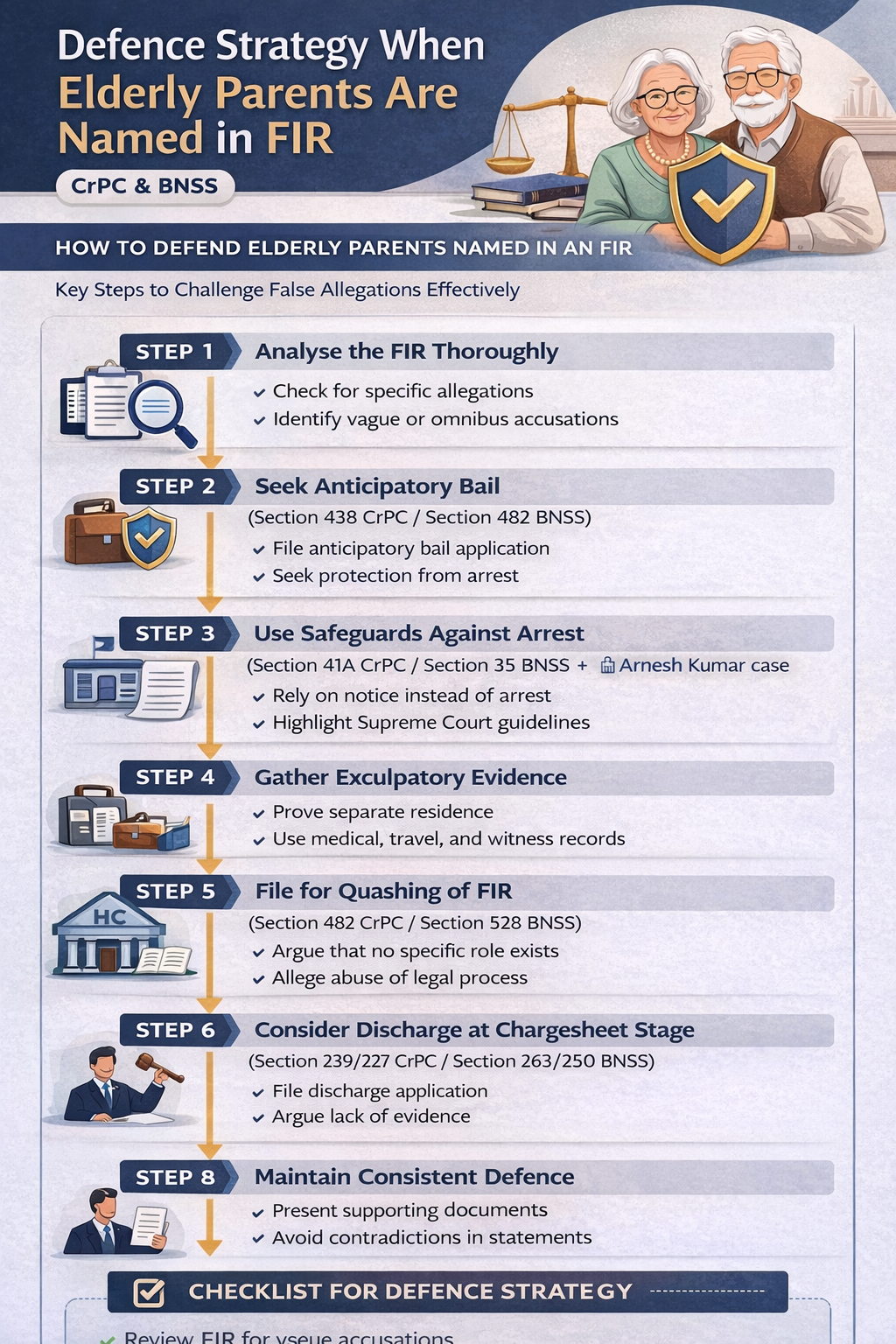
  13. Defence Strategy When Elderly Parents Are Named in FIR here.
  14. When to File Defamation for False Allegations – Legal Strategy here.
  15. How Courts Quash Omnibus Allegations in Matrimonial FIRs – Case Study here.
  16. Myth vs Reality: Bail in 498A Cases – Legal Position Explained here.
  17. When Can Court Cancel Exemption Under Section 205 CrPC – Explained here.
  18. Strategic Divorce Filing After Criminal Complaint – A Legal Perspective here.
  19. How to Seek Compensation for False Arrest in India? here.
  20. What to Say (and Not Say) During Investigation – A Practical Legal Guide here.
  21. Reducing Maintenance – Legal Grounds and Strategy here.
  22. Cross-Examination Strategy in 498A Trials – Defence Tactics That Can Change the Outcome here.
  23. How to Challenge Ex Parte Orders in Criminal and Matrimonial Proceedings – Legal Remedies here.
  24. Compromise-Based Quashing in Matrimonial Cases – Complete Legal Strategy here.
  25. Top 10 Mistakes Accused Make in Matrimonial Cases – And How to Avoid Them here.
  26. How to Protect Digital Evidence in Matrimonial Disputes – A Practical Legal Guide here.
  27. Bail Conditions – How to Avoid Cancellation of Bail here.
  28. Second Anticipatory Bail Application – Is It Legally Possible? Complete Strategy here.
  29. How to Protect Reputation During Criminal Litigation? A Complete Legal & Practical Strategy here.
  30. How to Handle Hostile Witnesses in Criminal Trials – Complete Defence Strategy here.
  31. How to File a Complaint Against an Advocate in India – A First-Timer’s Complete Guide here.
  32. Objections a Defence Advocate Can Raise When the Prosecution Produces Documentary Evidence – Complete Trial Strategy Guide here.
  33. Warning Signs of Escalating Matrimonial Litigation – Early Red Flags Every Spouse Should Recognize here. 


Post Views: 205
Posted in Legal Procedure | Leave a comment

What To Do If You Are Falsely Accused Under Section 498A IPC

Posted on February 23 by Suprajaa Rajan

Introduction

Being named in an FIR under Section 498A of the Indian Penal Code can be legally and emotionally overwhelming. The provision deals with cruelty by a husband or his relatives toward a married woman. It is cognizable and non-bailable, which means arrest is legally permissible without a warrant.

However, courts have repeatedly recognised that vague and omnibus allegations should not automatically result in arrest or prosecution.

If you believe the complaint is false or exaggerated, you must act strategically and immediately. This guide explains the precise legal steps you should take.

I. Understand the Nature of Section 498A IPC

Indian Penal Code :

Section 498A defines cruelty as:

  • Wilful conduct likely to drive a woman to suicide, or

  • Harassment in connection with unlawful dowry demands.

Mere marital discord, incompatibility, or trivial disputes do not automatically amount to statutory cruelty.

II. Do Not Panic or Engage in Direct Confrontation

Avoid contacting the complainant to “settle” the issue emotionally. Any communication may later be produced as evidence.

Do not:

  • Threaten

  • Argue

  • Attempt private coercive settlement

Instead, consult a criminal law practitioner immediately.

III. Secure Anticipatory Bail Without Delay

If arrest appears imminent, file for anticipatory bail under:

Code of Criminal Procedure, 1973

Specifically under Section 438 CrPC.

The Supreme Court in Arnesh Kumar v. State of Bihar held that automatic arrests in 498A cases violate personal liberty. Police must comply with Section 41 and 41A CrPC safeguards before arrest.

Anticipatory bail protects you from custodial detention during investigation.

Read also : “Anticipatory Bail in Matrimonial Offences – Complete Guide”

IV. Collect and Preserve Documentary Evidence

Your defence begins with documentation.

Secure:

  • WhatsApp chats and emails

  • Call records

  • Bank transactions

  • Proof of financial transfers

  • Travel history

  • Medical records

  • Photographs and CCTV footage

  • Witness details

Preserve electronic evidence in original format. Do not tamper with devices.

V. Evaluate Grounds for Quashing the FIR

If the complaint contains:

  • Vague allegations

  • No specific date or incident

  • General accusations against distant relatives

  • No specific dowry demand

You may approach the High Court under Section 482 CrPC seeking quashing.

The Supreme Court in State of Haryana v. Bhajan Lal laid down categories where criminal proceedings may be quashed, especially when allegations do not disclose a prima facie offence or appear mala fide.

Read also : “File a Discharge or Quash petition”

VI. Challenge Illegal Arrest or Procedural Violations

If police arrest without complying with Section 41 CrPC safeguards, you may:

  • Seek immediate bail

  • Move for departmental action

  • File writ petition for violation of Article 21 rights

Personal liberty remains constitutionally protected.

VII. Avoid Counter-Litigation in Anger

Filing multiple retaliatory complaints may weaken your credibility.

Instead, take structured legal action such as:

  • Defamation proceedings (in appropriate cases)

  • Petition for restitution or divorce

  • Application for discharge at charge stage

Each step must align with long-term strategy.

VIII. Understand the Investigation Process

After FIR registration:

  1. Police record statements under Section 161 CrPC

  2. Evidence is collected

  3. Charge sheet may be filed before Magistrate

If evidence is weak, you may seek discharge before trial begins.

Read also : “Lifecycle stages of a Section 498A IPC case”

IX. Protect Elderly Parents and Relatives

Courts frequently criticise the practice of implicating all family members without specific allegations.

If distant relatives are named without overt acts, this strengthens grounds for quashing.

Courts consistently hold that criminal law cannot be used as a tool for matrimonial pressure.

X. Maintain Dignity and Composure

498A litigation often accompanies:

  • Domestic Violence proceedings

  • Maintenance claims

  • Divorce petitions

Coordinate defence strategy across all proceedings. Fragmented legal responses create contradictions.

Conclusion

A false accusation under Section 498A IPC demands calm, structured, and legally sound action. Panic or retaliation worsens the situation.

Indian courts recognise misuse concerns. They insist on procedural safeguards and evidentiary scrutiny. Early anticipatory bail, evidence preservation, and strategic litigation under Section 482 CrPC can prevent prolonged harassment.

Criminal law must protect genuine victims. It must not become an instrument of coercion in matrimonial disputes.


Frequently Asked Questions

No. After Arnesh Kumar, police must justify arrest under Section 41 CrPC.

Yes. High Courts exercise inherent powers under Section 482 CrPC where allegations fail to disclose an offence.

It is generally non-compoundable, but courts may quash proceedings in case of genuine settlement.

Courts discourage prosecution based on vague or omnibus statements.

Post Views: 544
Posted in Legal Procedure | Tagged bhajan lal principles CrPC 438 - Anticipatory Bail Dowry Case Law False 498A case Quashing of FIR Section 498A IPC | Leave a comment

Post navigation

  • Older posts
  • Newer posts

Search within entire Content of “Shades of Knife”

My Legal X Timeline

Advocate Sandeep Pamarati 🇮🇳💪👨🏻‍🎓 Follow

AP High Court Advocate with M Tech (CS) || 12 years in 'Software Industry' as Solution Architect || Blogs at https://t.co/29CB9BzK4w || #TDPTwitter

SandeepPamarati
Retweet on Twitter Advocate Sandeep Pamarati 🇮🇳💪👨🏻‍🎓 Retweeted
besurataansane Sameer @besurataansane ·
15 Jun

Mamata wanted to dislodge him as PM

Uddhav backstabbed him

Kejriwal lived under a delusion that he was Modiji’s competitor

All 3 lost their CM chair - they are not even MLAs/MLC today 😂😂

PM @narendramodi ji is “Destiny’s Child” - he is protected by Mahakal

Reply on Twitter 2066553667705282749 Retweet on Twitter 2066553667705282749 244 Like on Twitter 2066553667705282749 638 X 2066553667705282749
Retweet on Twitter Advocate Sandeep Pamarati 🇮🇳💪👨🏻‍🎓 Retweeted
factcheckapgov FactCheck.AP.Gov.in @factcheckapgov ·
15 Jun

డిఎస్సీ 2025 స్పోర్ట్స్ కోటా నియామకాలపై ప్రజల్లో అపోహలు కలిగించేందుకు ఒక యూట్యూబ్ ఛానెల్ ప్రసారం చేసిన ఇంటర్వ్యూను ప్రభుత్వం తీవ్రంగా ఖండిస్తున్నది. కమ్మకులానికి చెందిన వారు టెట్ రాయకపోయినా స్పోర్ట్స్ కోటాలో డిఎస్సీ పోస్టులు ఇచ్చారనే తప్పుడు ప్రచారం కులాల మధ్య చిచ్చుపెట్టేదిగా

Reply on Twitter 2066550398111056194 Retweet on Twitter 2066550398111056194 69 Like on Twitter 2066550398111056194 161 X 2066550398111056194
Retweet on Twitter Advocate Sandeep Pamarati 🇮🇳💪👨🏻‍🎓 Retweeted
augadhbhudeva Augadh @augadhbhudeva ·
12h

Iron Man Of India Sardar Vallabhbhai Patel

The World Said
“India Can Never Be One Nation.”

He Said — “Watch Me”.

Sardar Vallabhbhai Patel
Iron Man of India
Born 1875 Nadiad Gujarat

Poor Farmers Family. No Money For Law School.
He Borrowed Books. Gave Exams.
Saved His Own

Reply on Twitter 2066895391145234733 Retweet on Twitter 2066895391145234733 23 Like on Twitter 2066895391145234733 31 X 2066895391145234733
Retweet on Twitter Advocate Sandeep Pamarati 🇮🇳💪👨🏻‍🎓 Retweeted
muchatlu_ ముచ్చట్లు @muchatlu_ ·
24h

📢 స్టాన్‌ఫర్డ్ విద్యార్థులకు సుందర్ పిచాయ్ కీలక సందేశం

🔸 స్టాన్‌ఫర్డ్ యూనివర్సిటీ 2026 స్నాతకోత్సవ వేడుకలో మాట్లాడిన సుందర్ పిచాయ్, టెక్నాలజీ కంటే జీవిత నిర్ణయాలు, ఆలోచనా విధానంపైనే ప్రధానంగా దృష్టి పెట్టారు.

🔸 మొదటి సూత్రంగా ఆశావాదాన్ని ఎంచుకోవాలని సూచించారు. పరిస్థితులు మన

Reply on Twitter 2066722676639735960 Retweet on Twitter 2066722676639735960 32 Like on Twitter 2066722676639735960 115 X 2066722676639735960
Load More

Recent Posts

  • Cruelty as a Criminal Offence Explained June 12, 2026
  • Bail Compliance Undertaking Format – Draft, Legal Requirements & Sample Template June 12, 2026
  • Warning Signs of Escalating Matrimonial Litigation – Early Red Flags Every Spouse Should Recognize June 12, 2026
  • Objections a Defence Advocate Can Raise When the Prosecution Produces Documentary Evidence – Complete Trial Strategy Guide June 5, 2026
  • How to File a Complaint Against an Advocate in India – A First-Timer’s Complete Guide June 5, 2026

Most Read Posts

  • Reply to Section 41A CrPC Notice – Format with Legal Explanation (4,916 views)
  • Anu Aggarwal Vs Sushant Aggarwal on 20 Jan 2026 (3,437 views)
  • Umme Farva Vs State of U.P. and Anr on 14 Jan 2026 (3,303 views)
  • Charge Sheet and Final Report Explained (2,745 views)
  • Regular Bail Application Format (Section 437/439 CrPC) (2,131 views)
  • Neha Lal Vs Abhishek Kumar on 20 Jan 2026 (1,960 views)
  • Arrest Procedure in 498A cases after Arnesh Kumar (1,889 views)
  • Discharge Application Format in 498A Case – Draft, Procedure & Sample Template (1,724 views)
  • Can You Travel Abroad After an FIR Is Registered? – Legal Position Explained (1,638 views)
  • Atul Kumar Bajpai Vs State of UP and Anr on 17 Sep 2025 (1,506 views)

Tags

Reportable Judgement or Order (433)2-Judge (Division) Bench Decision (411)Legal Procedure Explained - Interpretation of Statutes (381)Landmark Case (381)1-Judge Bench Decision (362)Catena of Landmark Judgments Referred/Cited to (293)Work-In-Progress Article (215)3-Judge (Full) Bench Decision (101)Sandeep Pamarati (92)Article 21 - Protection of life and personal liberty (80)Issued or Recommended Guidelines or Directions or Protocols to be followed (71)Perjury Under 340 CrPC (66)Absurd Or After Thought Or Baseless Or False Or General Or Inherently Improbable Or Improved Or UnSpecific Or Omnibus Or Vague Allegations (61)Reprimands or Setbacks to YCP Govt of Andhra Pradesh (49)Summary Post (47)CrPC 482 - Quash (43)HM Act 13 - Divorce Granted to Husband (42)Legal Terrorism (41)Not Authentic copy hence to be replaced (40)Divorce granted on Cruelty ground (40)

Categories

Supreme Court of India Judgment or Order or Notification (752)Bare Acts or State Amendments or Statutes or GOs or Notifications issued by Central or State Governments (328)High Court of Andhra Pradesh Judgment or Order or Notification (186)High Court of Delhi Judgment or Order or Notification (164)High Court of Bombay Judgment or Order or Notification (112)High Court of Karnataka Judgment or Order or Notification (93)Legal Procedure (77)High Court of Madras Judgment or Order or Notification (70)High Court of Allahabad Judgment or Order or Notification (61)LLB Study Material (59)General Study Material (56)High Court of Punjab & Haryana Judgment or Order or Notification (52)Assorted Court Judgments or Orders or Notifications (50)High Court of Kerala Judgment or Order or Notification (46)Prakasam DV Cases (46)Judicial Activism (for Public Benefit) (45)District or Sessions or Magistrate Court Judgment or Order or Notification (44)High Court of Madhya Pradesh Judgment or Order or Notification (38)High Court of Gujarat Judgment or Order or Notification (28)High Court of Calcutta Judgment or Order or Notification (27)

Recent Comments

  • The Divorce Law Firm on Life Cycle Stages of a Divorce case
  • The Divorce Law Firm on Life Cycle Stages of a Divorce case
  • ShadesOfKnife on Sandeep Pamarati Vs Ungrateful Knife (IPC 498A Case)
  • KONURU VINAYKUMAR on Sandeep Pamarati Vs Ungrateful Knife (IPC 498A Case)
  • ShadesOfKnife on Lifecycle Stages of a Section 498A IPC Case

Archives of SoK

  • June 2026 (7)
  • May 2026 (24)
  • April 2026 (33)
  • March 2026 (42)
  • February 2026 (30)
  • January 2026 (21)
  • December 2025 (2)
  • November 2025 (3)
  • October 2025 (17)
  • September 2025 (12)
  • August 2025 (5)
  • July 2025 (10)
  • June 2025 (15)
  • May 2025 (3)
  • April 2025 (10)
  • March 2025 (7)
  • February 2025 (8)
  • January 2025 (1)
  • December 2024 (3)
  • November 2024 (4)
  • October 2024 (16)
  • September 2024 (15)
  • August 2024 (14)
  • July 2024 (11)
  • June 2024 (18)
  • May 2024 (13)
  • April 2024 (9)
  • March 2024 (23)
  • February 2024 (15)
  • January 2024 (11)
  • December 2023 (11)
  • November 2023 (9)
  • October 2023 (13)
  • September 2023 (12)
  • August 2023 (15)
  • July 2023 (17)
  • June 2023 (11)
  • May 2023 (6)
  • April 2023 (5)
  • March 2023 (10)
  • February 2023 (9)
  • January 2023 (12)
  • December 2022 (12)
  • November 2022 (8)
  • October 2022 (13)
  • September 2022 (17)
  • August 2022 (10)
  • July 2022 (21)
  • June 2022 (27)
  • May 2022 (23)
  • April 2022 (32)
  • March 2022 (17)
  • February 2022 (6)
  • January 2022 (2)
  • December 2021 (7)
  • November 2021 (7)
  • October 2021 (6)
  • September 2021 (10)
  • August 2021 (31)
  • July 2021 (45)
  • June 2021 (17)
  • May 2021 (17)
  • April 2021 (18)
  • March 2021 (58)
  • February 2021 (14)
  • January 2021 (50)
  • December 2020 (35)
  • November 2020 (68)
  • October 2020 (67)
  • September 2020 (28)
  • August 2020 (41)
  • July 2020 (20)
  • June 2020 (36)
  • May 2020 (40)
  • April 2020 (38)
  • March 2020 (26)
  • February 2020 (43)
  • January 2020 (35)
  • December 2019 (34)
  • November 2019 (4)
  • October 2019 (18)
  • September 2019 (57)
  • August 2019 (33)
  • July 2019 (12)
  • June 2019 (18)
  • May 2019 (5)
  • April 2019 (19)
  • March 2019 (58)
  • February 2019 (11)
  • January 2019 (90)
  • December 2018 (97)
  • November 2018 (43)
  • October 2018 (31)
  • September 2018 (73)
  • August 2018 (47)
  • July 2018 (143)
  • June 2018 (92)
  • May 2018 (97)
  • April 2018 (59)
  • March 2018 (8)

Blogroll

  • Daaman Promoting Harmony 0
  • Fight against Legal Terrorism Fight against Legal Terrorism along with MyNation Foundation 0
  • Good Morning Good Morning News 0
  • Insaaf India Insaaf Awareness Movement 0
  • MyNation Hope Foundation Wiki 0
  • MyNation.net Equality, Justice and Harmony 0
  • Sarvepalli Legal 0
  • Save Indian Family Save Indian Family Movement 0
  • SIF Chandigarh SIF Chandigarh 0
  • The Male Factor The Male Factor 0
  • Unitedmen Foundation a dedicated community forged with the mission to unite men facing legal challenges in marital disputes. 0
  • Vaastav Foundation The Social Reality 0
  • Vinayak my2centsworth – This blog is for honest law abiding men, married or planning to get married 0
  • Voice4india Indian Laws, Non-profits, Environment 0
  • Writing Law Writing Law by Ankur 0

RSS Cloudflare Status

  • Scheduled Workers Platform Configuration Maintenance June 22, 2026
    THIS IS A SCHEDULED EVENT Jun 22, 12:00 - 13:00 UTC Jun 10, 20:16 UTC Scheduled - On 2026-06-22 from 12:00-13:00 UTC, Cloudflare will be performing scheduled maintenance on the data store responsible for Workers platform configuration. During this maintenance window, customers will be unable to make configuration changes for up to 3 minutes. This […]
  • TXL (Berlin) on 2026-06-19 June 19, 2026
    THIS IS A SCHEDULED EVENT Jun 19, 00:00 - 05:00 UTC Jun 16, 15:41 UTC Scheduled - We will be performing scheduled maintenance in TXL (Berlin) datacenter on 2026-06-19 between 00:00 and 05:00 UTC.Traffic might be re-routed from this location, hence there is a possibility of a slight increase in latency during this maintenance window […]
  • Zero Trust Underlying Storage Maintenance June 18, 2026
    THIS IS A SCHEDULED EVENT Jun 18, 12:00 - 13:00 UTC Jun 12, 00:38 UTC Scheduled - Cloudflare has scheduled maintenance for the backend storage system supporting Cloudflare One Client (WARP) / Zero Trust device management. Services will continue to operate normally. During a brief window of up to 3 minutes, device-related settings will be […]

RSS List of Spam Server IPs from Project Honeypot

  • 172.234.163.154 | SD June 16, 2026
    Event: Bad Event | Total: 6,096 | First: 2025-11-07 | Last: 2026-06-16
  • 181.95.65.163 | S June 16, 2026
    Event: Bad Event | Total: 323 | First: 2026-06-09 | Last: 2026-06-16
  • 121.78.246.104 | SD June 16, 2026
    Event: Bad Event | Total: 487 | First: 2026-06-11 | Last: 2026-06-16
Owned and Operated by Advocate Sandeep Pamarati
Proudly powered by WordPress
Theme: Flint by Star Verte LLC

Bad Behavior has blocked 723 access attempts in the last 7 days.

pixel