web analytics

Menu

Skip to content
Shades of Knife
  • Home
  • True Colors of a Vile Wife
  • Need Inspiration?
  • Blog Updates
  • SOK Gallery
  • Vile News Reporter
  • About Me
  • Contact Me

Shades of Knife

True Colors of a Vile Wife

Speedy Trial Rights in Matrimonial Litigation

Posted on March 4 by Suprajaa Rajan

Speedy Trial Rights – Understanding the constitutional guarantee against prolonged criminal and matrimonial proceedings accordingly. 

Litigation arising out of matrimonial disputes often extends for years, undeniably. Criminal complaints under Section 498A IPC, proceedings under the Domestic Violence Act, and maintenance claims under Section 125 CrPC frequently remain pending for prolonged periods.

However, the right to a speedy trial is not merely procedural. It is a constitutional guarantee flowing from Article 21 of the Constitution of India.

This article explains the scope, judicial interpretation, remedies, and strategic use of speedy trial rights in matrimonial criminal litigation.

I. Constitutional Foundation of Speedy Trial

The Supreme Court in Hussainara Khatoon v. State of Bihar recognised that the right to speedy trial is implicit in Article 21.

The Court held that, “A procedure that keeps an accused under prolonged uncertainty violates the guarantee of personal liberty.”

The principle applies equally to matrimonial criminal cases.

II. Applicability in Matrimonial Litigation

Speedy trial rights become relevant in:

  • Criminal complaints under Section 498A IPC

  • Proceedings under Section 406 IPC

  • Cases under the Protection of Women from Domestic Violence Act, 2005

  • Maintenance proceedings under Section 125 CrPC

  • Parallel divorce proceedings impacting criminal defence

Prolonged pendency may undeniably result in:

  • Social stigma

  • Financial burden

  • Career disruption

  • Travel restrictions

  • Psychological distress

Thus, courts recognise that delay itself may amount to prejudice.

III. Judicial Tests for Determining Delay

In A.R. Antulay v. R.S. Nayak, the Supreme Court laid down guiding factors to assess violation of speedy trial rights.

Courts consider:

  • Length of delay
  • Reasons for delay
  • Conduct of the accused
  • Prejudice caused

There is no fixed time limit as such. Each case is assessed on facts.

IV. Can Delay Lead to Quashing?

Yes, in appropriate cases.

Where delay is:

  • Inordinate

  • Unexplained

  • Attributable to prosecution

  • Causing serious prejudice

High Courts may exercise inherent powers under Section 482 CrPC to quash proceedings.

However, mere passage of time is insufficient. The delay must defeat justice.

V. Delay in 498A Trials

Matrimonial criminal cases often suffer delay due to:

  • Repeated adjournments

  • Non-appearance of witnesses

  • Mediation attempts

  • Parallel civil litigation

  • Transfer petitions

Courts have repeatedly emphasised that matrimonial disputes should not become instruments of prolonged harassment.

In Pankaj Kumar v. State of Maharashtra, the Supreme Court reiterated that oppressive delay can violate Article 21.

VI. Speedy Trial in Domestic Violence & Maintenance Proceedings

Proceedings under the Protection of Women from Domestic Violence Act, 2005 are intended to be summary in nature.

Similarly, Section 125 CrPC proceedings aim at immediate relief. Additionally, unjustified delay defeats the object of these provisions.

Respondents may seek:

  • Expedited hearing

  • Time-bound cross-examination

  • Closure of evidence where complainant delays

Hence, courts increasingly discourage unnecessary adjournments.

VII. Remedies Available for Delay

If proceedings are unduly delayed, the accused may:

  • File application for expeditious trial
  • Seek day-to-day hearing
  • Oppose adjournments
  • Approach High Court under Section 482 CrPC
  • Seek discharge where delay impacts fairness

In extreme cases, delay may result in:

  • Quashing of proceedings

  • Reduction of sentence

  • Acquittal due to prejudice

VIII. When Delay Is Attributable to the Accused

The right to speedy trial is reciprocal.

If delay is caused by:

  • Repeated exemption applications

  • Non-cooperation

  • Filing frivolous petitions

  • Seeking adjournments

Undoubtedly, courts will reject speedy trial claims.

Clearly, clean conduct strengthens constitutional argument.

IX. Strategic Importance in Matrimonial Defence

Speedy trial rights become strategically relevant when:

  • Allegations are weak

  • Complainant avoids cross-examination

  • Prosecution witnesses remain absent

  • Case lingers without progress

Also, an application highlighting prejudice may pressure prosecution to proceed diligently.

Delay can weaken prosecution case due to:

  • Fading memory

  • Unavailable witnesses

  • Documentary inconsistencies

However, strategic balance is essential.

X. Practical Checklist for Accused Persons

If your matrimonial criminal case is pending for several years insignificantly:

  • Track hearing dates
  • Maintain record of adjournments
  • Identify cause of delay
  • File written objection to repeated adjournments
  • Seek High Court intervention if necessary

Documenting delay strengthens your case eventually.

XI. Key Judicial Principles

  • Speedy trial is a fundamental right.
  • No rigid time limit exists.
  • Delay must cause prejudice.
  • Conduct of parties is relevant.
  • Courts balance societal interest with individual liberty by all means.

XII. Conclusion

The right to speedy trial, thus, protects individuals from endless criminal litigation. In matrimonial disputes, where personal relationships and reputations are at stake, delay compounds injury.

Also, courts recognise that justice delayed may become justice denied. However, relief depends on facts, conduct, and demonstrable prejudice.

Invoking Article 21 strategically can prevent criminal process from becoming prolonged punishment significantly.


Index of Legal Strategies and Defence is here. 


Frequently Asked Questions

No statutory limit exists, but unreasonable delay may violate Article 21.

Not automatically. Prejudice must be demonstrated.

Yes. Courts often issue directions for expeditious disposal.

Settlement may lead to quashing, rendering speedy trial issue redundant.


Key Contributor :

Mrs. Suprajaa Rajan B.Com., LL.B., LL.M.

+91-9606345150

Post Views: 241
Posted in Legal Procedure | Tagged Article 21 - Protection of life and personal liberty Criminal Procedure Matrimonial Criminal Law Matrimonial dispute Matrimonial Litigation India Right to Liberty Right to Speedy Trial | Leave a comment

Amit Bajpai Vs State of U.P. and Anr on 15 Dec 2023

Posted on March 4 by Suprajaa Rajan

The Allahabad High Court held that when a party files an application under Section 340 Cr.P.C. alleging false affidavit, the Family Court must decide that application before proceeding with the maintenance case under Section 125 Cr.P.C. The Court ruled that failure to do so vitiates the maintenance order if it relies on the disputed affidavit. The High Court set aside the maintenance order and directed the Family Court to first decide the perjury application within a fixed time frame.

“It is further submitted by learned counsel for the revisionist that the learned Family Court without deciding the application filed by the revisionist under Section 340 Cr.P.C. has proceeded with the case and decided the application filed by opposite party no.2 under Section 125 Cr.P.C. and maintenance has been awarded on relying the false affidavit filed by opposite party no.2.”

“Learned counsel for the opposite party no.2 and learned A.G.A. for the State do not dispute the aforesaid legal position.”

“In view of above the criminal revision is allowed. The judgement and order dated 14.06.2023 passed by Additional Principal Judge, Family Court, Court No.-1, Kanpur Nagar in Case No.- 502 of 2020 is set aside.”

“Learned Principal Judge, Family Court, Court No.-1/court concerned is directed to decide the application filed by revisionist under Section 340 Cr.P.C. which was registered as Misc. Application No. 473 of 2022 within a period of three months from the date of production of certified copy of this order, and thereafter the application filed by opposite party no.2 under Section 125 Cr.P.C. expeditiously, without granting undue adjournments to either of the parties unless there is any legal impediments.”

Decision

The High Court allowed the criminal revision.

  • It set aside the maintenance order.
  • It directed the Family Court to first decide the Section 340 Cr.P.C. application.
  • It ordered that the maintenance case proceed only thereafter.

Amit Bajpai Vs State of UP on 15 Dec 2023


Citation :2023:AHC:238266

Other Sources :


Index of Perjury Judgements is here. 


Key Contributor :

Mrs. Suprajaa Rajan B.Com.,LL.B.,LL.M.

+91-9606345150


Post Views: 274
Posted in High Court of Allahabad Judgment or Order or Notification | Tagged Amit Bajpai Vs State of UP and Anr Cases where Perjury Proceedings were initated maintenance order set aside Section 125 CrPC Section 340 CrPC | Leave a comment

Dr.Praveen R Vs Dr.Arpitha on 31 Aug 2021

Posted on March 3 by ShadesOfKnife

The Karnataka High Court held that when a court records a specific finding that a party suppressed material facts on oath, it cannot dismiss a perjury application as premature merely because the main case remains pending. The Court ruled that allegations of false evidence affect the purity of judicial proceedings and require prompt consideration. It set aside the Family Court’s order and remitted the matter for fresh consideration.

The following paragraphs form the foundation of the Court’s decision.

Para 4(a):

“…If these IT Returns are taken into consideration, the respondent is having income and she is also earning income… She has not filed any counter to the objections filed by the petitioner and also with respect to these IT Returns. In fact, by filing a complaint she has admitted that she has filed Income Tax Returns… Under such circumstances, she has suppressed the fact that she was earning income…”

Para 4(b):

“…when the Court below has recorded a specific finding as to the income of the respondent from the medical profession that too on the basis of undisputed IT Returns for the relevant period; when it has also recorded a specific finding that the respondent has suppressed the fact that she was earning income; that being the position, the application of petitioner for initiating action for the offence of perjury, could not have been turned down as being premature merely because main matter is still pending…”

Para 4(c):

“…act of perjury is treated as a heinous offence in all civilized societies; consideration of complaints with regard to the same cannot be deferred or delayed; otherwise there is all possibility of the fountain of justice being polluted.”

Para 4(e):

“…applications of the kind need to be considered on merits at the earliest point of time so that a loud message goes to the unscrupulous section of the litigant public as to what would befall the perjuring parties.”

Decision

The High Court allowed the writ petition.

  • It set aside the Family Court’s order.
  • It remitted the matter for fresh consideration of the perjury application.
  • It directed that the main matrimonial case remain in abeyance until such consideration.

All contentions remained open.


Praveen R Vs Arpitha on 31 Aug 2021


Citation :2021:KHC:33333

Other Sources :


Index of Perjury Judgements is here. 


Key Contributor :

Mrs. Suprajaa Rajan B.Com., LL.B, LL.M.

+91-9606345150


Post Views: 79
Posted in High Court of Allahabad Judgment or Order or Notification | Tagged Cases where Perjury Proceedings were initated false affidavit Hindu Marriage Act HMA Sec 24 income suppression | Leave a comment

Quashing of FIR Under Section 482 CrPC

Posted on March 3 by Suprajaa Rajan

Understanding the scope, grounds, and judicial principles governing quashing of criminal proceedings.

Criminal prosecution can severely affect personal liberty, reputation, and professional life. However, not every FIR discloses a legally sustainable offence. In such situations, the law provides a constitutional safeguard.

The remedy lies under:

Code of Criminal Procedure, 1973

Specifically, Section 482 CrPC, which preserves the inherent powers of the High Court to:

  • Prevent abuse of process of law

  • Secure the ends of justice

  • Quash criminal proceedings where continuation is unjustified

This article explains the legal framework, judicial tests, landmark precedents, and strategic considerations for filing a quashing petition in brief.

Steps under Quashing FIR

I. What Is Section 482 CrPC?

Section 482 states that nothing in the Code shall limit the inherent powers of the High Court.

These powers are extraordinary in nature and must be exercised:

  • Sparingly

  • With caution

  • Only in rare and exceptional cases

Nevertheless, it is not an appellate power. In fact, it is a supervisory and preventive jurisdiction.

II. When Can FIR Be Quashed?

The Supreme Court laid down guiding principles in:

State of Haryana v. Bhajan Lal

This judgment identified illustrative categories where quashing may be justified.

Key Grounds for Quashing:

  • Allegations do not disclose a cognizable offence
  • FIR is manifestly attended with mala fide intent
  • Allegations are absurd or inherently improbable
  • There is no legal evidence supporting prosecution
  • Proceedings amount to abuse of process
  • Dispute is purely civil in nature
  • Parties have settled the dispute (in appropriate cases)

III. Quashing in Matrimonial Offences (498A Cases)

Quashing petitions frequently arise in complaints under:

  • Section 498A IPC

  • Section 406 IPC

  • Section 34 IPC

Courts have repeatedly cautioned against mechanical implication of relatives.

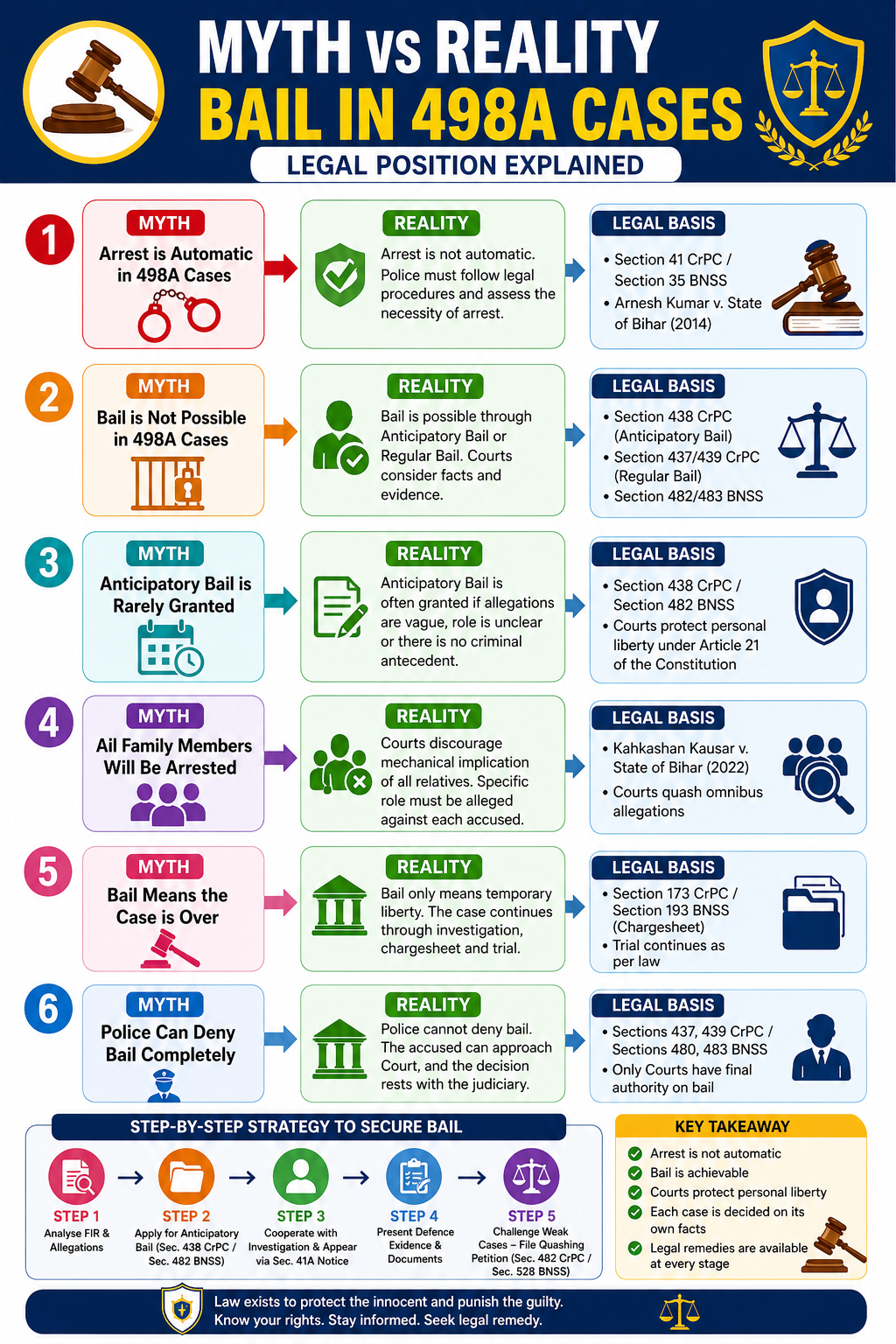
In Arnesh Kumar v. State of Bihar, the Supreme Court addressed misuse in matrimonial litigation and emphasised procedural safeguards.

High Courts often quash proceedings where:

  • Allegations are omnibus

  • No specific role is attributed

  • Distant relatives reside separately

  • Complaint lacks prima facie material

IV. Settlement-Based Quashing

Even though Section 498A IPC is non-compoundable, courts permit quashing where matrimonial disputes are amicably resolved.

In Gian Singh v. State of Punjab, the Supreme Court held that High Courts may quash non-compoundable offences if the dispute is personal and continuation would serve no purpose.

Similarly, in Narinder Singh v. State of Punjab, guidelines were laid down for compromise-based quashing.

The principle: criminal law should not be used as a weapon once parties have settled significantly.

V. Can FIR Be Quashed After Chargesheet?

Yes. Quashing is maintainable even after filing of chargesheet under Section 173 CrPC.

However, courts are more cautious once investigation is complete.

The test becomes:

  • Whether materials collected disclose a prima facie case

  • Whether continuation would amount to injustice

In case the evidence supports trial, courts may refuse interference.

VI. Procedure for Filing Quashing Petition

A petition under Section 482 CrPC is filed before the jurisdictional High Court.

Typical Components:

  • Copy of FIR
  • Chargesheet (if filed)
  • Relevant documents
  • Affidavit
  • Grounds invoking Bhajan Lal principles

Notice is issued to:

  • State

  • Complainant

High Court may:

  • Issue interim stay

  • Grant protection from coercive steps

  • Dismiss petition

  • Quash FIR entirely

  • Quash proceedings partially against specific accused

VII. Judicial Caution: What Courts Will Not Do

High Courts will not:

  • Conduct mini-trials

  • Examine disputed facts

  • Evaluate credibility of witnesses

  • Weigh evidence

If allegations disclose prima facie offence, trial must proceed. In any case, section 482 is not a substitute for trial.

VIII. Strategic Considerations Before Filing

Filing a premature petition may weaken credibility.

Consider:

  • Stage of investigation

  • Strength of allegations

  • Documentary contradictions

  • Settlement possibilities

  • Parallel civil proceedings

Thus strategic timing is undoubtedly crucial.

IX. Common Mistakes in Quashing Petitions

  • Raising factual disputes requiring evidence
  • Filing without examining FIR carefully
  • Over-reliance on defence documents
  • Ignoring Supreme Court precedents
  • Filing multiple repetitive petitions

Subsequently, courts may impose costs for frivolous petitions.

X. Recent Judicial Approach

Courts increasingly:

  • Protect distant relatives in 498A cases

  • Scrutinise omnibus allegations

  • Encourage settlement in matrimonial disputes

  • Emphasise that criminal law should not become harassment

However, courts remain strict where allegations show serious cruelty or violence.

Conclusion

Section 482 CrPC ,thus, acts as a constitutional safety valve against misuse of criminal process. Additionally, it ensures that criminal law does not become a tool of oppression.

However, it is an extraordinary remedy. Courts exercise it with restraint. A well-structured petition grounded in settled principles significantly improves prospects.

The guiding test remains:

Does continuation of prosecution serve justice — or defeat it?

Therefore, when proceedings lack legal foundation or arise from matrimonial vendetta, inherent powers of the High Court restore balance.


Index of Legal Strategies and Defence is here. 


Frequently Asked Questions

Not automatic. Court examines genuineness and societal impact.

Yes. Proceedings may be quashed selectively.

No. It terminates proceedings before trial.

Often exempted unless court directs otherwise.


Key Contributor:

Mrs. Suprajaa Rajan B.Com., LL.B., LL.M.

+91-9606345150


Post Views: 515
Posted in Legal Procedure | Tagged abuse of process Criminal law CrPC 482 – IPC 498A Quashed Matrimonial Litigation India Quashing of FIR Section 482 CrPC | Leave a comment

BNSS 379 – Procedure in cases mentioned in section 215

Posted on March 3 by ShadesOfKnife

379. Procedure in cases mentioned in section 215.—
(1) When, upon an application made to it in this behalf or otherwise, any Court is of opinion that it is expedient in the interests of justice that an inquiry should be made into any offence referred to in clause (b) of sub-section (1) of section 215, which appears to have been committed in or in relation to a proceeding in that Court or, as the case may be, in respect of a document produced or given in evidence in a proceeding in that Court, such Court may, after such preliminary inquiry, if any, as it thinks necessary,—
(a) record a finding to that effect;
(b) make a complaint thereof in writing;
(c) send it to a Magistrate of the first class having jurisdiction;
(d) take sufficient security for the appearance of the accused before such Magistrate, or if the alleged offence is non-bailable and the Court thinks it necessary so to do, send the accused in custody to such Magistrate; and
(e) bind over any person to appear and give evidence before such Magistrate.
(2) The power conferred on a Court by sub-section (1) in respect of an offence may, in any case where that Court has neither made a complaint under sub-section (1) in respect of that offence nor rejected an application for the making of such complaint, be exercised by the Court to which such former Court is subordinate within the meaning of sub-section (4) of section 215.
(3) A complaint made under this section shall be signed,—
(a) where the Court making the complaint is a High Court, by such officer of the Court as the Court may appoint;
(b) in any other case, by the presiding officer of the Court or by such officer of the Court as the Court may authorise in writing in this behalf.
(4) In this section, “Court” has the same meaning as in section 215.


Entire BNSS is here.

Post Views: 120
Posted in Bare Acts or State Amendments or Statutes or GOs or Notifications issued by Central or State Governments | Tagged BNSS 379 - Procedure in cases mentioned in section 215 Perjury Under 340 CrPC | Leave a comment

Shailendra Sharma and Ors Vs Indus Residency Pvt Ltd and Ors on 07 Jan 2026

Posted on March 3 by ShadesOfKnife

A single judge of Madhya Pradesh Hugh Court at Jabalpur Bench held as follows,

From Para 8,

8. A police officer cannot directly register a crime for offence under Section 215 B.N.S.S. once the offence is committed in or in relation to a proceeding in the Court. As per Section 379 B.N.S.S., the Court has to cause preliminary enquiry and then can make a complaint in writing. However, in the present case, the Court has not made any enquiry, nor recorded any prima-facie satisfaction and has simply directed the police authorities to carry out an investigation and submit a report before the Court. Though the Court in its discretion could have directed the police authorities to investigate the matter and to furnish report before the Court, but the discretion to register FIR should not have been left at the discretion of the police authorities. It was for the Court to have applied its mind after receiving the preliminary enquiry report of the police authorities.

Shailendra Sharma and Ors Vs Indus Residency Pvt Ltd and Ors on 07 Jan 2026


Citations: [2026:MPHC-JBP:1337]

Other Sources:


Index of Perjury judgments is here.

Post Views: 70
Posted in High Court of Madhya Pradesh Judgment or Order or Notification | Tagged 1-Judge Bench Decision BNSS 379 - Procedure in cases mentioned in section 215 Legal Procedure Explained - Interpretation of Statutes Perjury Under 340 CrPC Shailendra Sharma and Ors Vs Indus Residency Pvt Ltd and Ors | Leave a comment

BNSS Sec 393 – Language and contents of judgment

Posted on February 28 by ShadesOfKnife

393. Language and contents of judgment.—
(1) Except as otherwise expressly provided by this Sanhita, every judgment referred to in section 392,—
(a) shall be written in the language of the Court;
(b) shall contain the point or points for determination, the decision thereon and the reasons for the decision;
(c) shall specify the offence (if any) of which, and the section of the Bharatiya Nyaya Sanhita, 2023 (45 of 2023) or other law under which, the accused is convicted, and the punishment to which he is sentenced;
(d) if it be a judgment of acquittal, shall state the offence of which the accused is acquitted and direct that he be set at liberty.
(2) When the conviction is under the Bharatiya Nyaya Sanhita, 2023 (45 of 2023) and it is doubtful under which of two sections, or under which of two parts of the same section, of that Sanhita the offence falls, the Court shall distinctly express the same, and pass judgment in the alternative.
(3) When the conviction is for an offence punishable with death or, in the alternative, with imprisonment for life or imprisonment for a term of years, the judgment shall state the reasons for the sentence awarded, and, in the case of sentence of death, the special reasons for such sentence.
(4) When the conviction is for an offence punishable with imprisonment for a term of one year or more, but the Court imposes a sentence of imprisonment for a term of less than three months, it shall record its reasons for awarding such sentence, unless the sentence is one of imprisonment till the rising of the Court or unless the case was tried summarily under the provisions of this Sanhita.
(5) When any person is sentenced to death, the sentence shall direct that he be hanged by the neck till he is dead.
(6) Every order under section 136 or sub-section (2) of section 157 and every final order made under section 144, section 164 or section 166 shall contain the point or points for determination, the decision thereon and the reasons for the decision.


BNSS is here.

Post Views: 207
Posted in Bare Acts or State Amendments or Statutes or GOs or Notifications issued by Central or State Governments | Tagged BNSS Sec 393 - Language and contents of judgment CrPC Sec 354 - Language and contents of judgment | Leave a comment

Praveen Kumar Singh Vs State of UP and Anr on 17 Feb 2026

Posted on February 28 by ShadesOfKnife

A single judge of Allahabad High Court held as follows,

From Para 4,

4. Learned counsel for the revisionist submits that the revisionist had filed written submissions before the trial court specifically alleging that opposite party no. 2 was living in adultery with one Rocky @ Tarun. However, the trial court did not consider the said allegation on the ground that no certificate under Section 65-B of the Indian Evidence Act had been filed in support of the electronic evidence.

From Para 7,

7. On considering the facts and circumstances of the case, the submissions advanced by learned counsel for revisionist and learned A.G.A., as well as perusal of the record and the order passed by the trial court, it appears that the WhatsApp chats annexed by the revisionist were not accepted solely on the ground that a certificate under Section 65-B of the Indian Evidence Act had not been submitted. However, Section 14 of the Family Courts Act provides that a Family Court may receive as evidence any report, statement, document, information, or matter that may, in its opinion, assist it in effectively dealing with a dispute, whether or not such evidence would otherwise be relevant or admissible under the Indian Evidence Act, 1872. Moreover, while adjudicating matrimonial disputes, the Family Court may lay down its own procedure.

Praveen Kumar Singh Vs State of UP and Anr on 17 Feb 2026


Citations: [2026:AHC:34917]

Other Sources:

https://lawtrend.in/family-court-must-consider-whatsapp-chat-indicating-adultery-even-without-section-65-b-certificate-allahabad-hc-sets-aside-maintenance/


Index

Post Views: 207
Posted in High Court of Allahabad Judgment or Order or Notification | Tagged 1-Judge Bench Decision BNSS Sec 393 - Language and contents of judgment BSA Sec 63 - Admissibility of electronic records Evidence Act 65B - Admissibility of electronic records Family Courts Act Sec 14 - Application of Indian Evidence Act 1872 Praveen Kumar Singh Vs State of UP and Anr | Leave a comment

Vishnu Dutt Sharma Vs Manju Sharma on 27 Feb 2009

Posted on February 28 by Suprajaa Rajan

The Supreme Court examined whether a court exercising appellate jurisdiction can grant a decree of divorce on a ground not expressly enumerated in the statute. The matter required interpretation of Section 13 HMA and consideration of the constitutional limits on judicial law-making.

The Court analysed whether irretrievable breakdown, though recognised in certain judicial pronouncements, could operate as an independent ground for divorce in the absence of legislative incorporation. The judgment reaffirmed the principle of separation of powers and clarified that courts cannot expand statutory grounds through judicial innovation.

Important Extracts from the Judgment:

High Court Findings (Paras 13 & 17):

“On a reading of the entire evidence, it is not possible to conclude that the appellant has been able to establish that the respondent treated him with cruelty.”

“To grant divorce to the appellant despite this only on the ground of irretrievable breakdown would not, in the view of this Court, be doing justice to the respondent.”

On Findings of Fact:

“We are not inclined to interfere with the finding of fact of both the courts below that it was the appellant who treated the respondent with cruelty, rather than the other way around.”

On Irretrievable Breakdown Not Being a Statutory Ground:

“On a bare reading of Section 13 of the Act, reproduced above, it is crystal clear that no such ground of irretrievable breakdown of the marriage is provided by the legislature for granting a decree of divorce. This Court cannot add such a ground to Section 13 of the Act as that would be amending the Act, which is a function of the legislature.”

“If we grant divorce on the ground of irretrievable breakdown, then we shall by judicial verdict be adding a clause to Section 13 of the Act to the effect that irretrievable breakdown of the marriage is also a ground for divorce.”

“In our opinion, this can only be done by the legislature and not by the Court.”

On Mutual Consent:

“Had both parties been willing we could, of course, have granted a divorce by mutual consent as contemplated by Section 13B of the Act, but in this case the respondent is not willing to agree to a divorce.”

Decision

The Supreme Court dismissed the appeal.

The Court held that:

  • The appellant failed to establish cruelty.

  • Irretrievable breakdown is not a statutory ground under Section 13 HMA.

  • The judiciary cannot legislate by adding new grounds for divorce.

  • Only Parliament can amend the statute to include such a ground.


Vishnu Dutt Sharma Vs Manju Sharma on 27 Feb 2009


Citation :

Other Sources :


Index of Divorce Judgements is here.


Key Contributor : 

Mrs. Suprajaa Rajan B.Com., LL.B., LL.M.

+91-9606345150


Post Views: 64
Posted in Supreme Court of India Judgment or Order or Notification | Tagged Divorce by mutual consent Divorce granted on Cruelty ground divorce under hindu marriage act family law Mutual Consent Divorce section 13 HMA | Leave a comment

Sandeep Bhavan Pamarati Vs Anuradha Kovi (Divorce petition)

Posted on February 28 by ShadesOfKnife

After losing the Nullity petition here, I filed a divorce petition before Family Court, Ongole, Prakasam District, AP, seeking Decree of Divorce of my marriage under Section 13 of Hindu Marriage Act.


Now to serve the notice on the unavailable OP…

Post Views: 121
Posted in Sandeep Pamarati | Tagged HM Act 13 - Divorce Sandeep Bhavan Pamarati Vs Anuradha Kovi (Divorce petition) | Leave a comment

Post navigation

  • Older posts
  • Newer posts

Search within entire Content of “Shades of Knife”

My Legal X Timeline

Advocate Sandeep Pamarati 🇮🇳💪👨🏻‍🎓 Follow

AP High Court Advocate with M Tech (CS) || 12 years in 'Software Industry' as Solution Architect || Blogs at https://t.co/29CB9BzK4w || #TDPTwitter

SandeepPamarati
Retweet on Twitter Advocate Sandeep Pamarati 🇮🇳💪👨🏻‍🎓 Retweeted
besurataansane Sameer @besurataansane ·
15 Jun

Mamata wanted to dislodge him as PM

Uddhav backstabbed him

Kejriwal lived under a delusion that he was Modiji’s competitor

All 3 lost their CM chair - they are not even MLAs/MLC today 😂😂

PM @narendramodi ji is “Destiny’s Child” - he is protected by Mahakal

Reply on Twitter 2066553667705282749 Retweet on Twitter 2066553667705282749 244 Like on Twitter 2066553667705282749 638 X 2066553667705282749
Retweet on Twitter Advocate Sandeep Pamarati 🇮🇳💪👨🏻‍🎓 Retweeted
factcheckapgov FactCheck.AP.Gov.in @factcheckapgov ·
15 Jun

డిఎస్సీ 2025 స్పోర్ట్స్ కోటా నియామకాలపై ప్రజల్లో అపోహలు కలిగించేందుకు ఒక యూట్యూబ్ ఛానెల్ ప్రసారం చేసిన ఇంటర్వ్యూను ప్రభుత్వం తీవ్రంగా ఖండిస్తున్నది. కమ్మకులానికి చెందిన వారు టెట్ రాయకపోయినా స్పోర్ట్స్ కోటాలో డిఎస్సీ పోస్టులు ఇచ్చారనే తప్పుడు ప్రచారం కులాల మధ్య చిచ్చుపెట్టేదిగా

Reply on Twitter 2066550398111056194 Retweet on Twitter 2066550398111056194 69 Like on Twitter 2066550398111056194 161 X 2066550398111056194
Retweet on Twitter Advocate Sandeep Pamarati 🇮🇳💪👨🏻‍🎓 Retweeted
augadhbhudeva Augadh @augadhbhudeva ·
11h

Iron Man Of India Sardar Vallabhbhai Patel

The World Said
“India Can Never Be One Nation.”

He Said — “Watch Me”.

Sardar Vallabhbhai Patel
Iron Man of India
Born 1875 Nadiad Gujarat

Poor Farmers Family. No Money For Law School.
He Borrowed Books. Gave Exams.
Saved His Own

Reply on Twitter 2066895391145234733 Retweet on Twitter 2066895391145234733 23 Like on Twitter 2066895391145234733 31 X 2066895391145234733
Retweet on Twitter Advocate Sandeep Pamarati 🇮🇳💪👨🏻‍🎓 Retweeted
muchatlu_ ముచ్చట్లు @muchatlu_ ·
23h

📢 స్టాన్‌ఫర్డ్ విద్యార్థులకు సుందర్ పిచాయ్ కీలక సందేశం

🔸 స్టాన్‌ఫర్డ్ యూనివర్సిటీ 2026 స్నాతకోత్సవ వేడుకలో మాట్లాడిన సుందర్ పిచాయ్, టెక్నాలజీ కంటే జీవిత నిర్ణయాలు, ఆలోచనా విధానంపైనే ప్రధానంగా దృష్టి పెట్టారు.

🔸 మొదటి సూత్రంగా ఆశావాదాన్ని ఎంచుకోవాలని సూచించారు. పరిస్థితులు మన

Reply on Twitter 2066722676639735960 Retweet on Twitter 2066722676639735960 32 Like on Twitter 2066722676639735960 115 X 2066722676639735960
Load More

Recent Posts

  • Cruelty as a Criminal Offence Explained June 12, 2026
  • Bail Compliance Undertaking Format – Draft, Legal Requirements & Sample Template June 12, 2026
  • Warning Signs of Escalating Matrimonial Litigation – Early Red Flags Every Spouse Should Recognize June 12, 2026
  • Objections a Defence Advocate Can Raise When the Prosecution Produces Documentary Evidence – Complete Trial Strategy Guide June 5, 2026
  • How to File a Complaint Against an Advocate in India – A First-Timer’s Complete Guide June 5, 2026

Most Read Posts

  • Reply to Section 41A CrPC Notice – Format with Legal Explanation (4,916 views)
  • Anu Aggarwal Vs Sushant Aggarwal on 20 Jan 2026 (3,437 views)
  • Umme Farva Vs State of U.P. and Anr on 14 Jan 2026 (3,303 views)
  • Charge Sheet and Final Report Explained (2,744 views)
  • Regular Bail Application Format (Section 437/439 CrPC) (2,131 views)
  • Neha Lal Vs Abhishek Kumar on 20 Jan 2026 (1,958 views)
  • Arrest Procedure in 498A cases after Arnesh Kumar (1,888 views)
  • Discharge Application Format in 498A Case – Draft, Procedure & Sample Template (1,723 views)
  • Can You Travel Abroad After an FIR Is Registered? – Legal Position Explained (1,638 views)
  • Atul Kumar Bajpai Vs State of UP and Anr on 17 Sep 2025 (1,506 views)

Tags

Reportable Judgement or Order (433)2-Judge (Division) Bench Decision (411)Legal Procedure Explained - Interpretation of Statutes (381)Landmark Case (381)1-Judge Bench Decision (362)Catena of Landmark Judgments Referred/Cited to (293)Work-In-Progress Article (215)3-Judge (Full) Bench Decision (101)Sandeep Pamarati (92)Article 21 - Protection of life and personal liberty (80)Issued or Recommended Guidelines or Directions or Protocols to be followed (71)Perjury Under 340 CrPC (66)Absurd Or After Thought Or Baseless Or False Or General Or Inherently Improbable Or Improved Or UnSpecific Or Omnibus Or Vague Allegations (61)Reprimands or Setbacks to YCP Govt of Andhra Pradesh (49)Summary Post (47)CrPC 482 - Quash (43)HM Act 13 - Divorce Granted to Husband (42)Legal Terrorism (41)Not Authentic copy hence to be replaced (40)Divorce granted on Cruelty ground (40)

Categories

Supreme Court of India Judgment or Order or Notification (752)Bare Acts or State Amendments or Statutes or GOs or Notifications issued by Central or State Governments (328)High Court of Andhra Pradesh Judgment or Order or Notification (186)High Court of Delhi Judgment or Order or Notification (164)High Court of Bombay Judgment or Order or Notification (112)High Court of Karnataka Judgment or Order or Notification (93)Legal Procedure (77)High Court of Madras Judgment or Order or Notification (70)High Court of Allahabad Judgment or Order or Notification (61)LLB Study Material (59)General Study Material (56)High Court of Punjab & Haryana Judgment or Order or Notification (52)Assorted Court Judgments or Orders or Notifications (50)High Court of Kerala Judgment or Order or Notification (46)Prakasam DV Cases (46)Judicial Activism (for Public Benefit) (45)District or Sessions or Magistrate Court Judgment or Order or Notification (44)High Court of Madhya Pradesh Judgment or Order or Notification (38)High Court of Gujarat Judgment or Order or Notification (28)High Court of Calcutta Judgment or Order or Notification (27)

Recent Comments

  • The Divorce Law Firm on Life Cycle Stages of a Divorce case
  • The Divorce Law Firm on Life Cycle Stages of a Divorce case
  • ShadesOfKnife on Sandeep Pamarati Vs Ungrateful Knife (IPC 498A Case)
  • KONURU VINAYKUMAR on Sandeep Pamarati Vs Ungrateful Knife (IPC 498A Case)
  • ShadesOfKnife on Lifecycle Stages of a Section 498A IPC Case

Archives of SoK

  • June 2026 (7)
  • May 2026 (24)
  • April 2026 (33)
  • March 2026 (42)
  • February 2026 (30)
  • January 2026 (21)
  • December 2025 (2)
  • November 2025 (3)
  • October 2025 (17)
  • September 2025 (12)
  • August 2025 (5)
  • July 2025 (10)
  • June 2025 (15)
  • May 2025 (3)
  • April 2025 (10)
  • March 2025 (7)
  • February 2025 (8)
  • January 2025 (1)
  • December 2024 (3)
  • November 2024 (4)
  • October 2024 (16)
  • September 2024 (15)
  • August 2024 (14)
  • July 2024 (11)
  • June 2024 (18)
  • May 2024 (13)
  • April 2024 (9)
  • March 2024 (23)
  • February 2024 (15)
  • January 2024 (11)
  • December 2023 (11)
  • November 2023 (9)
  • October 2023 (13)
  • September 2023 (12)
  • August 2023 (15)
  • July 2023 (17)
  • June 2023 (11)
  • May 2023 (6)
  • April 2023 (5)
  • March 2023 (10)
  • February 2023 (9)
  • January 2023 (12)
  • December 2022 (12)
  • November 2022 (8)
  • October 2022 (13)
  • September 2022 (17)
  • August 2022 (10)
  • July 2022 (21)
  • June 2022 (27)
  • May 2022 (23)
  • April 2022 (32)
  • March 2022 (17)
  • February 2022 (6)
  • January 2022 (2)
  • December 2021 (7)
  • November 2021 (7)
  • October 2021 (6)
  • September 2021 (10)
  • August 2021 (31)
  • July 2021 (45)
  • June 2021 (17)
  • May 2021 (17)
  • April 2021 (18)
  • March 2021 (58)
  • February 2021 (14)
  • January 2021 (50)
  • December 2020 (35)
  • November 2020 (68)
  • October 2020 (67)
  • September 2020 (28)
  • August 2020 (41)
  • July 2020 (20)
  • June 2020 (36)
  • May 2020 (40)
  • April 2020 (38)
  • March 2020 (26)
  • February 2020 (43)
  • January 2020 (35)
  • December 2019 (34)
  • November 2019 (4)
  • October 2019 (18)
  • September 2019 (57)
  • August 2019 (33)
  • July 2019 (12)
  • June 2019 (18)
  • May 2019 (5)
  • April 2019 (19)
  • March 2019 (58)
  • February 2019 (11)
  • January 2019 (90)
  • December 2018 (97)
  • November 2018 (43)
  • October 2018 (31)
  • September 2018 (73)
  • August 2018 (47)
  • July 2018 (143)
  • June 2018 (92)
  • May 2018 (97)
  • April 2018 (59)
  • March 2018 (8)

Blogroll

  • Daaman Promoting Harmony 0
  • Fight against Legal Terrorism Fight against Legal Terrorism along with MyNation Foundation 0
  • Good Morning Good Morning News 0
  • Insaaf India Insaaf Awareness Movement 0
  • MyNation Hope Foundation Wiki 0
  • MyNation.net Equality, Justice and Harmony 0
  • Sarvepalli Legal 0
  • Save Indian Family Save Indian Family Movement 0
  • SIF Chandigarh SIF Chandigarh 0
  • The Male Factor The Male Factor 0
  • Unitedmen Foundation a dedicated community forged with the mission to unite men facing legal challenges in marital disputes. 0
  • Vaastav Foundation The Social Reality 0
  • Vinayak my2centsworth – This blog is for honest law abiding men, married or planning to get married 0
  • Voice4india Indian Laws, Non-profits, Environment 0
  • Writing Law Writing Law by Ankur 0

RSS Cloudflare Status

  • Scheduled Workers Platform Configuration Maintenance June 22, 2026
    THIS IS A SCHEDULED EVENT Jun 22, 12:00 - 13:00 UTC Jun 10, 20:16 UTC Scheduled - On 2026-06-22 from 12:00-13:00 UTC, Cloudflare will be performing scheduled maintenance on the data store responsible for Workers platform configuration. During this maintenance window, customers will be unable to make configuration changes for up to 3 minutes. This […]
  • TXL (Berlin) on 2026-06-19 June 19, 2026
    THIS IS A SCHEDULED EVENT Jun 19, 00:00 - 05:00 UTC Jun 16, 15:41 UTC Scheduled - We will be performing scheduled maintenance in TXL (Berlin) datacenter on 2026-06-19 between 00:00 and 05:00 UTC.Traffic might be re-routed from this location, hence there is a possibility of a slight increase in latency during this maintenance window […]
  • Zero Trust Underlying Storage Maintenance June 18, 2026
    THIS IS A SCHEDULED EVENT Jun 18, 12:00 - 13:00 UTC Jun 12, 00:38 UTC Scheduled - Cloudflare has scheduled maintenance for the backend storage system supporting Cloudflare One Client (WARP) / Zero Trust device management. Services will continue to operate normally. During a brief window of up to 3 minutes, device-related settings will be […]

RSS List of Spam Server IPs from Project Honeypot

  • 172.234.163.154 | SD June 16, 2026
    Event: Bad Event | Total: 6,096 | First: 2025-11-07 | Last: 2026-06-16
  • 181.95.65.163 | S June 16, 2026
    Event: Bad Event | Total: 323 | First: 2026-06-09 | Last: 2026-06-16
  • 121.78.246.104 | SD June 16, 2026
    Event: Bad Event | Total: 487 | First: 2026-06-11 | Last: 2026-06-16
Owned and Operated by Advocate Sandeep Pamarati
Proudly powered by WordPress
Theme: Flint by Star Verte LLC

Bad Behavior has blocked 726 access attempts in the last 7 days.

pixel