web analytics

Menu

Skip to content
Shades of Knife
  • Home
  • True Colors of a Vile Wife
  • Need Inspiration?
  • Blog Updates
  • SOK Gallery
  • Vile News Reporter
  • About Me
  • Contact Me

Shades of Knife

True Colors of a Vile Wife

Author: Suprajaa Rajan

Second Anticipatory Bail Application – Is It Legally Possible? Complete Strategy

Posted on May 19 by Suprajaa Rajan

Anticipatory bail often becomes the first line of defence in criminal litigation, especially in sensitive matters involving:

  • Matrimonial disputes
  • Section 498A prosecutions
  • Financial offences
  • Family disputes
  • Property-related criminal complaints
  • Allegations involving multiple accused

However, an important question frequently arises after the first anticipatory bail application is rejected:

Can an accused file a second anticipatory bail application?

The short answer is:

Yes—but not automatically, and not on identical grounds.

Indian courts do permit a second anticipatory bail application, but only under legally sustainable circumstances such as change in circumstances, emergence of new facts, procedural developments, fresh evidence, or material changes in investigation.

Therefore, understanding when a second anticipatory bail application is maintainable—and how to strategically prepare it—can make the difference between liberty and custody.

This article explains the legal framework, maintainability principles, strategic grounds, judicial approach, drafting strategy, and defence tactics, with references to both the Code of Criminal Procedure, 1973 (CrPC) and the Bharatiya Nagarik Suraksha Sanhita, 2023 (BNSS).
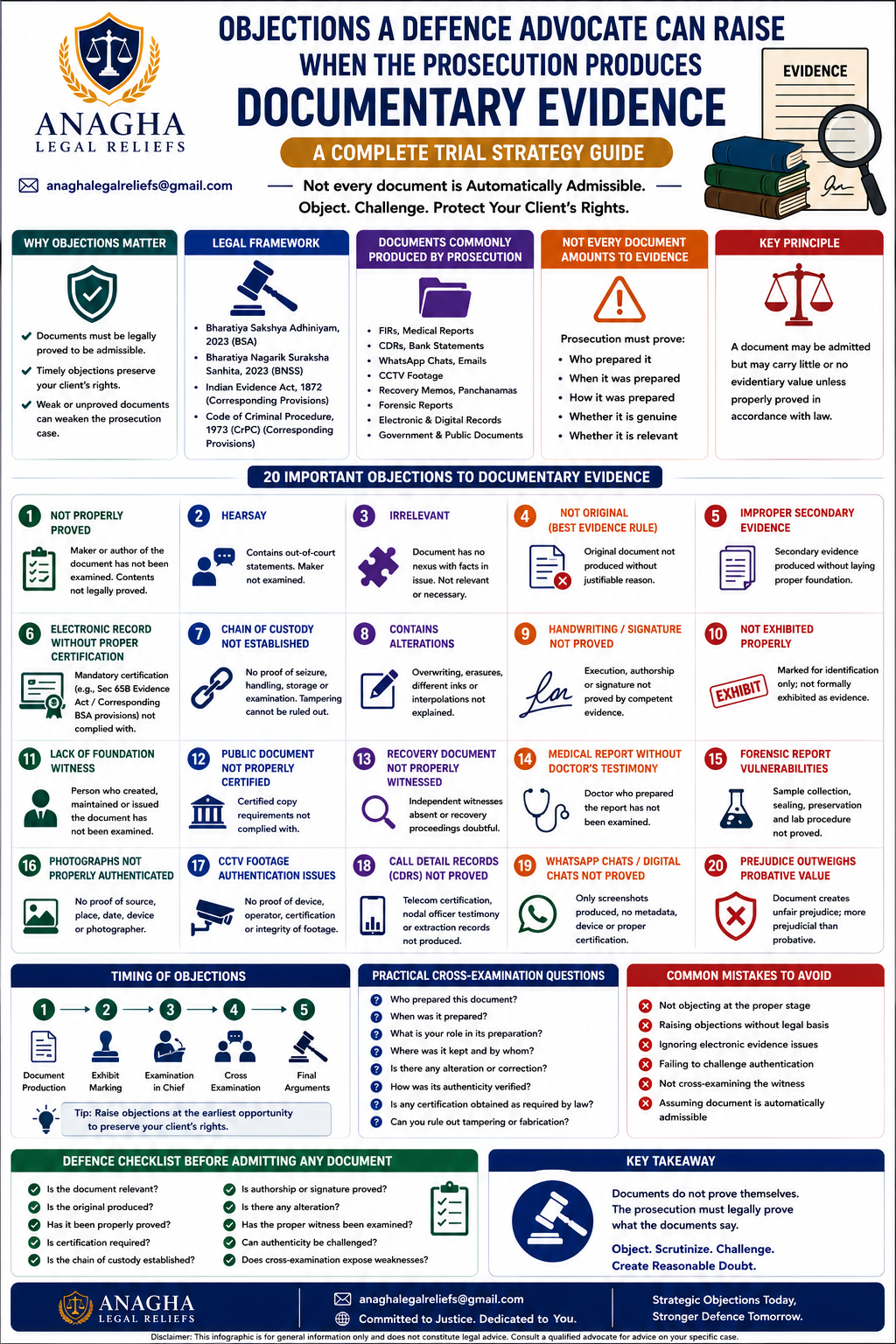
What Is Anticipatory Bail?

Anticipatory bail protects a person from arrest in a non-bailable offence.

It allows the accused to seek pre-arrest protection when they reasonably apprehend arrest.

Relevant provisions include:

Under CrPC

  • Section 438 CrPC

Under BNSS

  • Section 482 BNSS

Courts granting anticipatory bail may impose conditions such as:

  • Cooperation with investigation
  • Appearance before investigating officer
  • Non-interference with witnesses
  • Travel restrictions
  • Preservation of evidence

What Happens If the First Anticipatory Bail Application Is Rejected?

The first anticipatory bail application may be rejected by:

  • Sessions Court
  • High Court

Common reasons include:

  • Serious allegations
  • Incomplete investigation
  • Need for custodial interrogation
  • Lack of cooperation
  • Weak documentation
  • Premature filing

However, rejection of the first application does not permanently bar future applications.

That said, a second application cannot become an appeal in disguise.

The accused must demonstrate something legally new.

Is a Second Anticipatory Bail Application Maintainable?

Yes.

A second anticipatory bail application is maintainable if there is a substantial change in circumstances after the earlier rejection.

Courts generally ask:

“What has changed since the previous rejection?”

If nothing material has changed, the second application may fail at the threshold.

Therefore, maintainability depends on fresh grounds—not repetition of old arguments.

Legal Basis for Successive Bail Applications

Although Section 438 CrPC (Section 482 BNSS) does not expressly mention successive applications, Indian courts recognise the principle that liberty may be reconsidered when circumstances materially change.

This principle also aligns with broader bail jurisprudence under:

  • Section 437 CrPC (Section 480 BNSS)
  • Section 439 CrPC (Section 483 BNSS)

Therefore, successive bail applications are not prohibited—but they require justification.

What Qualifies as “Change in Circumstances”?

This is the most critical question.

A second anticipatory bail application usually succeeds only when new developments arise.

Ground 1: Filing of Chargesheet

One of the strongest grounds.

Relevant provisions:

  • Section 173 CrPC (Section 193 BNSS) – Police report

Once the investigation is complete and the chargesheet is filed:

  • Custodial interrogation may become unnecessary
  • Evidence may already be collected
  • The prosecution’s need for arrest may weaken

Therefore, filing of chargesheet often becomes a valid fresh ground.

Ground 2: Cooperation With Investigation

If the earlier rejection was based on non-cooperation, subsequent cooperation may change the situation.

Examples:

  • Appearance before investigating officer
  • Production of documents
  • Joining investigation
  • Responding to notices

Relevant notice provision:

  • Section 41A CrPC (Section 35 BNSS)

Documented cooperation significantly improves credibility.

Ground 3: New Documentary Evidence

Fresh evidence may change the court’s view.

Examples:

  • Bank records
  • Travel documents
  • Digital chats
  • Medical records
  • Residence proof
  • Employment records

Such evidence may:

  • Contradict allegations
  • Show false implication
  • Prove separate residence
  • Disprove presence at the alleged incident

Ground 4: Co-Accused Granted Bail

If similarly placed co-accused obtain protection, parity becomes relevant.

Examples:

  • Parents granted bail
  • Siblings granted bail
  • Co-accused discharged from similar allegations

Parity is not automatic, but it strengthens the case.

Ground 5: Settlement Negotiations or Mediation

In matrimonial disputes, settlement developments may materially change the case.

Examples:

  • Mediation initiated
  • Settlement terms recorded
  • Mutual consent divorce filed
  • Partial settlement payments made

Courts may consider these developments.

Ground 6: Delay in Arrest Despite FIR

If substantial time passes after FIR registration and the accused remains available, the prosecution’s urgency may weaken.

Questions courts may consider:

  • Why was arrest not made earlier?
  • Was the accused available throughout?
  • Was there any attempt to abscond?

Delay can support a fresh application.

Ground 7: False or General Allegations Revealed During Investigation

Sometimes investigation itself weakens the prosecution.

Examples:

  • No recovery required
  • No independent witness support
  • Omnibus allegations against relatives
  • Separate residence confirmed

This may justify a fresh attempt.

Grounds That Usually Do NOT Work

Courts usually reject second applications based on:

  • Same facts
  • Same documents
  • Same legal arguments
  • Mere change of lawyer
  • Emotional pleas
  • Generic “I am innocent” claims

Repetition is not strategy.

Can You File Before the Same Court?

Possibly—but strategy matters.

Before Sessions Court

A second application before the Sessions Court may be maintainable if:

  • Fresh circumstances arise after rejection

Before High Court

If Sessions Court rejects relief, the accused may approach the High Court.

Relevant provision:

  • Section 438 CrPC (Section 482 BNSS)

The High Court independently examines maintainability.

Strategic Timing for the Second Application

Timing can determine success.

A strong sequence may look like:

Step 1 – First application rejected.

Step 2 – Accused joins investigation.

Step 3 – Documents collected.

Step 4 – Chargesheet filed.

Step 5 – Settlement or mediation begins.

Step 6 – Second anticipatory bail filed.

This creates a stronger narrative.

How to Draft a Strong Second Anticipatory Bail Application

The second application must clearly disclose:

Prior Rejection

Never suppress previous rejection.

Mention:

  • Date
  • Court
  • Case number

Transparency builds credibility.

Fresh Circumstances

Clearly identify:

  • What changed
  • When it changed
  • How it affects custodial necessity

This section often decides the case.

Documentary Support

Attach:

  • Chargesheet
  • Attendance proofs
  • Notice replies
  • Settlement records
  • Medical documents
  • Residence proof

Documents matter more than allegations.

Bail Conduct and Availability

Show:

  • Stable residence
  • No absconding
  • No witness interference
  • Full cooperation

Conduct influences discretion.

Special Strategy in Matrimonial Cases

In matrimonial prosecutions such as:

  • Section 498A IPC cases
  • Dowry allegations
  • Domestic violence-linked complaints

The following fresh grounds often become effective:

Separate Residence Proof

Parents or siblings living separately.

Return of Stridhan

Property already returned.

Mediation Proceedings

Settlement underway.

No Recovery Required

Custodial interrogation no longer necessary.

Family Members Already Protected

Parity argument strengthens.

Common Mistakes in Second Bail Applications

Avoid:

Hiding Previous Rejection

Courts treat suppression seriously.

Copy-Paste Drafting

Every fresh application must show fresh grounds.

Filing Too Early

Without change in circumstances.

Filing Without Documents

Assertions alone rarely work.

Emotional Arguments Without Legal Basis

Liberty requires legal structure.

What If the Second Application Is Also Rejected?

Further remedies may still exist depending on circumstances:

  • Fresh application after later developments
  • Regular bail after appearance
  • Interim protection in exceptional situations
  • Quashing or other strategic remedies

However, repeated applications without new grounds may harm credibility.

Practical Checklist Before Filing

Before filing a second anticipatory bail application, ensure:

  • Previous rejection order obtained
  • Fresh circumstances identified
  • Chargesheet status verified
  • Investigation cooperation documented
  • Notices responded to
  • Documentary evidence collected
  • Settlement developments recorded
  • Co-accused orders reviewed
  • Draft clearly distinguishes old and new grounds

Judicial Approach

Courts generally protect personal liberty—but they also guard against abuse of successive applications.

Courts look for:

  • Genuine change in circumstances
  • Procedural fairness
  • Reduced custodial necessity
  • Documentary credibility
  • Consistent conduct

Courts discourage:

  • Forum shopping
  • Repetitive litigation
  • Suppression of prior orders

Therefore, credibility becomes as important as legal merit.

Conclusion

A rejected anticipatory bail application is not necessarily the end of the road.

Indian criminal law allows a second anticipatory bail application—but only when:

  • Facts materially change
  • Investigation progresses
  • New evidence emerges
  • Cooperation improves
  • Settlement developments occur
  • Custodial necessity weakens

By:

  • Acting strategically
  • Preserving documents
  • Demonstrating cooperation
  • Drafting with precision
  • Filing at the right time

an accused can significantly improve the chances of securing pre-arrest protection.

In criminal litigation, a second bail application succeeds not because it is repeated—but because the circumstances are no longer the same.


Related Legal Concepts

  • Anticipatory Bail Strategy in Matrimonial Cases
  • How to Reply to Section 41A Notice
  • Bail Conditions – How to Avoid Cancellation
  • Compromise-Based Quashing in Matrimonial Cases
  • What Happens After Chargesheet


Index of Legal Strategies and Defence is here. 


Key Contributor : 

Mrs. Suprajaa Rajan B.Com., LL.B., LL.M.

+91-9606345150

Posted in Legal Procedure | Tagged Anticipatory bail CrPC 438 - Anticipatory Bail Legal Strategies and Defence legal strategy Pre-Arrest bail | Leave a comment

Ann Saurabh Dutt Vs Lieutenant Colonel Saurabh Iqbal Bahadur Dutt on 12 May 2026 – Judgement Summary

Posted on May 18 by Suprajaa Rajan

The Supreme Court of India in Ann Saurabh Dutt Vs Lieutenant Colonel Saurabh Iqbal Bahadur Dutt, held that a professionally qualified woman cannot be branded “cruel” or accused of “desertion” merely because she chooses to pursue her career and create a safe environment for her child.

Allowing the appeal in part, the Supreme Court strongly criticised the reasoning adopted by the Family Court and the High Court, describing it as “pedantic,” “regressive,” “ultra-conservative,” and rooted in patriarchal assumptions. The Court held that a woman’s professional identity, autonomy, and decision to balance career with motherhood cannot be construed as matrimonial misconduct.

“3. We are well into the 21st Century, and yet an attempt by a qualified woman to pursue her professional career and to secure a safe and stable environment for the upbringing of her child has been treated as an act of cruelty and desertion by the Courts below.”

“4. The reasoning which permeates the impugned judgments appears to be founded upon deeply entrenched archaic societal assumptions that a wife’s professional identity is subject to an implied spousal veto;…”

“22. Merely because the wife decided to reside at Ahmedabad with the primary intention to provide a safer environment and better health care to her daughter… branding such conduct as constituting cruelty or desertion was atrocious to say the least.”

“26. The expectation that the wife could not even think of pursuing her career in Dentistry, is indicative of regressive and feudalistic mindset.”

“29. We are convinced that he has an attitude of domineering and control, which must have been the probable cause for the appellant taking the steps for gaining independence and pursuing her career goals.”

Decision of the Court

Accordingly, the Supreme Court passed the following directions:

In the wife’s appeal

  • Findings of cruelty and desertion under Section 13 of the Hindu Marriage Act, 1955 were expunged and set aside.
  • The decree of divorce was not disturbed, considering the respondent had remarried and the wife did not seek restoration of marriage.
  • The divorce decree was directed to be treated as one passed on the ground of irretrievable breakdown of marriage.

In the husband’s petition

  • The husband’s plea seeking prosecution of the wife for perjury under Section 195 CrPC [Section 379 BNSS] read with Section 340 CrPC was rejected.
  • The Court found the petition motivated by personal vendetta and lacking legal merit.

Thus, the wife’s appeal was partly allowed, while the husband’s special leave petition was dismissed.


Ann Saurabh Dutt Vs Lieutenant Colonel Saurabh Iqbal on 12 May 2026

Citation : 2026 INSC 475

Other Sources :


Index of Divorce Judgments is here. 


Key Contributor :

Mrs. Suprajaa Rajan B.Com., LL.B., LL.M.

+91-9606345150


Posted in Supreme Court of India Judgment or Order or Notification | Tagged BNSS 379 - Procedure in cases mentioned in section 215 CrPC 195 - Prosecution for contempt of lawful authority of public servants or for offences against public justice and for offences relating to documents given in evidence CrPC 340 read with CrPC 195 Divorce Not granted on Cruelty ground HM Act Sec 13 - Divorce Irretrievable Breakdown of Marriage | Leave a comment

Application for Addition of Relevant Documents to Case Record – Format, Procedure & Sample Draft

Posted on May 13 by Suprajaa Rajan

A practical guide to placing important documents on record to assist the court in arriving at a just and informed decision.

In criminal litigation, facts alone rarely decide a case. Documents, electronic records, medical papers, financial records, public documents, and contemporaneous correspondence often become crucial in proving innocence, establishing defence, impeaching credibility, or clarifying disputed facts. Therefore, whenever relevant material has not yet become part of the judicial record, a party may file an Application for Addition of Relevant Documents to Case Record.

This application enables the court to formally take relevant documents on record and consider them at the appropriate stage of proceedings.

This article explains the legal framework, practical grounds, drafting strategy, and provides a ready-to-use sample format with copy-to-clipboard functionality.

I. Legal Framework

The power to receive documents and permit their production arises from various procedural provisions, depending upon the stage of proceedings.

Under the Code of Criminal Procedure, 1973

  • Section 91 CrPC – Summons to produce document or other thing
  • Section 173 CrPC – Police report and accompanying documents
  • Section 207 CrPC – Supply of documents to accused
  • Section 243 CrPC – Evidence for defence before Magistrate
  • Section 233 CrPC – Entering upon defence before Sessions Court
  • Section 311 CrPC – Power of court to summon material witness or evidence

Corresponding Provisions under BNSS, 2023

  • Section 94 BNSS – Summons to produce document or other thing
  • Section 193 BNSS – Final police report and documents
  • Section 230 BNSS – Supply of police papers
  • Section 263 BNSS – Defence evidence before Magistrate
  • Section 255 BNSS – Defence evidence before Sessions Court
  • Section 349 BNSS – Power to summon material evidence

Thus, courts possess wide powers to receive material evidence whenever such evidence is necessary for a just decision.

II. What is an Application for Addition of Documents?

An application for addition of documents is a formal request made before the court seeking permission to:

  • Place additional documents on judicial record
  • Mark documents for identification or evidence
  • Bring subsequent developments on record
  • Produce omitted or newly discovered documents
  • Ensure complete adjudication of disputed facts

Importantly, this application does not determine admissibility by itself. Instead, it seeks formal production and consideration of relevant material.

III. When Should This Application Be Filed?

You may file this application when:

  • Important documents were inadvertently omitted earlier
  • New documents became available after filing
  • Investigation ignored relevant material
  • Subsequent events require documentary proof
  • Electronic evidence needs to be placed on record
  • Defence documents become necessary before charge, trial, or argument

Therefore, timely filing can materially strengthen the case.

IV. What Documents Can Be Added?

Depending on the facts, the application may relate to:

  • Medical records
  • Bank statements
  • Call detail records
  • Email or WhatsApp communications
  • Photographs or videos
  • CCTV footage
  • Government records
  • Property documents
  • Travel records
  • Employment records
  • Digital evidence with appropriate certification

Thus, documentary evidence often becomes the backbone of effective litigation strategy.

V. Why is This Application Important?

Filing this application helps to:

  • Place crucial evidence before the court
  • Prevent incomplete adjudication
  • Support defence or prosecution strategy
  • Preserve documentary evidence for future stages
  • Avoid procedural objections later

Moreover, documents placed on record at the right stage can significantly influence charge, discharge, bail, cross-examination, and final arguments.

VI. Essential Elements of the Application

Before drafting, you should include:

  • Case title and case number
  • Stage of proceedings
  • Description of documents sought to be produced
  • Reason for non-production earlier (if applicable)
  • Relevance of each document
  • Prayer for taking documents on record

These elements make the application precise, legally sustainable, and court-friendly.

VII. Drafting Strategy

While drafting:

  • Describe each document clearly
  • Explain relevance to the issues in dispute
  • Avoid filing unnecessary or repetitive papers
  • Mention if documents are newly discovered
  • Annex a proper list of documents

A well-drafted application demonstrates procedural diligence and strategic preparation.

VIII. Sample Draft Format – Application for Addition of Relevant Documents to Case Record


Sample Draft – Application for Addition of Relevant Documents to Case Record

BEFORE THE HONOURABLE COURT OF [COURT NAME] AT [CITY]

Case No.: [____]

In the matter of:

State / Complainant
…Applicant

Versus

[Name of Accused / Respondent]
…Respondent


APPLICATION FOR TAKING ADDITIONAL RELEVANT DOCUMENTS ON RECORD

Most Respectfully Submitted:

1. That the present case is pending before this Hon’ble Court and is presently fixed for [mention stage].

2. That the Applicant seeks permission to place certain relevant documents on record for proper adjudication of the present proceedings.

3. The documents sought to be produced are as follows:

(a) [Document 1]
(b) [Document 2]
(c) [Document 3]

4. These documents are material and necessary for effective adjudication of the issues involved in the present case.

5. The documents could not be placed on record earlier due to [mention reason, if applicable].

6. No prejudice shall be caused to the opposite party if the present application is allowed.

PRAYER

In view of the above, it is most respectfully prayed that this Hon’ble Court may be pleased to take the annexed documents on record in the interest of justice.


Place: [City]
Date: [Date]


Counsel for the Applicant
[Signature]

✔ Draft Copied Successfully!


IX. Common Mistakes to Avoid

Avoid:

  • Filing irrelevant or bulky documents
  • Not explaining the relevance of documents
  • Omitting annexure details
  • Filing without pagination or indexing
  • Waiting until final arguments without justification

Instead, focus on relevance, timing, and procedural clarity.

Conclusion

An Application for Addition of Relevant Documents to Case Record is a vital procedural tool that ensures the court decides the case on a complete and accurate factual foundation. Therefore, by placing relevant material on record at the right stage, a litigant can substantially strengthen the case and avoid procedural disadvantages.


Index of All Legal templates and Drafting is here. 


Disclaimer

These templates are provided for educational and informational purposes. Every case depends on specific facts and procedural posture. Professional legal advice should be obtained before filing any application.


Key Contributor :

Mrs.Suprajaa Rajan B.Com., LL.B., LL.M.

+91-9606345150


Posted in Legal Procedure | Tagged Additional documents application CrPC 173 - Report of Police Officer on Completion of Investigation CrPC 207 - Supply to the accused of copy of police report and other documents CrPC 243 - Evidence for defence CrPC 311 - Power to summon material witness or examine person present CrPC 91 - Seek Unmarked and Unexhibited Prosecution Documents Legal Drafting and Formats Legal templates | Leave a comment

Application to Police for Fair Investigation – Format, Procedure & Sample Draft

Posted on May 9 by Suprajaa Rajan

A practical legal remedy to ensure that investigation is conducted objectively, impartially, and in accordance with law.

In criminal proceedings, the investigation forms the foundation of the entire case. Therefore, it must be conducted fairly, independently, and without bias. However, there are instances where the investigation may appear one-sided, influenced, delayed, or lacking in objectivity. In such situations, an affected person can submit an Application to Police for Fair Investigation to the concerned authorities.

This application serves as a formal request to ensure that the investigation adheres to statutory safeguards, constitutional principles, and established judicial standards.

I. Legal Framework Governing Investigation

The duty to conduct a fair investigation arises from both statutory provisions and constitutional mandates:

Under the Code of Criminal Procedure, 1973

  • Section 154 CrPC – Registration of FIR
  • Section 156 CrPC – Police power to investigate
  • Section 157 CrPC – Procedure for investigation
  • Section 173 CrPC – Submission of final report

Corresponding Provisions under BNSS, 2023

  • Section 173 BNSS – Information in cognizable cases
  • Section 175 BNSS – Power of police to investigate
  • Section 176 BNSS – Procedure for investigation
  • Section 193 BNSS – Final report

Additionally, the requirement of a fair investigation flows from Article 21 of the Constitution, which guarantees right to life and personal liberty.

II. What is an Application for Fair Investigation?

An application for fair investigation is a written representation submitted to police authorities requesting that:

  • Investigation be conducted objectively
  • Relevant evidence be properly considered
  • All parties be heard fairly
  • No undue pressure or influence be exercised
  • Proper procedure be followed

Importantly, this application does not interfere with investigation but seeks lawful and unbiased conduct of the process.

III. When Should You File This Application?

You may file this application when:

  • Investigation appears biased or one-sided
  • Your version is not being recorded
  • Important evidence is being ignored
  • There is undue delay in investigation
  • Police are acting under external influence or pressure
  • You are being harassed or targeted unfairly

Therefore, timely action helps ensure procedural fairness and accountability.

IV. Where Should You Submit This Application?

You can submit the application to:

  • Station House Officer (SHO)
  • Investigating Officer (IO)
  • Superintendent of Police (SP)
  • Deputy Commissioner of Police (DCP)
  • Senior supervisory authorities

In serious cases, the issue may also be raised before the Magistrate.

V. Why is This Application Important?

Filing this application helps to:

  • Create a formal record of grievance
  • Ensure compliance with legal procedure
  • Prevent miscarriage of justice
  • Strengthen future remedies (quashing, discharge, trial defence)
  • Demonstrate cooperation with the investigation

Thus, it becomes a strategic safeguard in criminal litigation.

VI. Essential Elements of the Application

Before drafting, you should include:

  • Details of FIR or complaint
  • Name and designation of police authority
  • Clear narration of grievance
  • Specific instances of unfair conduct
  • Request for impartial investigation
  • Undertaking to cooperate

These elements ensure the application is structured, clear, and effective.

VII. Drafting Strategy

While drafting:

  • Maintain a respectful and professional tone
  • Focus on facts, not allegations or emotions
  • Avoid making personal accusations
  • Clearly request fair and unbiased investigation
  • Support claims with documents where possible

This enhances the credibility and seriousness of the application.

VIII. Sample Draft Format – Application to Police for Fair Investigation


Sample Draft – Application for Fair Investigation

To
The Station House Officer / Superintendent of Police
[Police Station / District]
[City]

Subject: Application Seeking Fair and Impartial Investigation

Respected Sir/Madam,

I respectfully submit that I am concerned with the investigation in FIR No. [____] registered at [Police Station].

It is submitted that the investigation in the present matter is not being conducted in a fair and impartial manner.

My version of facts has not been properly recorded and relevant material evidence submitted by me has not been duly considered.

Further, certain aspects of the case are being overlooked, which may affect the fairness of the investigation.

I respectfully submit that I am a law-abiding citizen and am willing to fully cooperate with the investigation.

I therefore request that necessary directions may kindly be issued to ensure that the investigation is conducted fairly, objectively, and in accordance with law.

I request that my representation be taken on record and considered appropriately.


Thanking you.


Yours faithfully,
[Name]
[Address]
[Contact Details]
[Signature]

Date: [____]
Place: [____]

✔ Draft Copied Successfully!

IX. Common Mistakes to Avoid

Avoid:

  • Making vague allegations without specifics
  • Using aggressive or accusatory language
  • Failing to mention concrete instances
  • Not supporting claims with documents
  • Ignoring proper authority hierarchy

Instead, focus on clarity, documentation, and procedural correctness.

Conclusion

An Application to Police for Fair Investigation is, thus, an essential tool to ensure that criminal proceedings are conducted with integrity, impartiality, and adherence to law. Therefore, by proactively raising concerns and placing them on record, a person can safeguard their rights and promote a just investigative process.


Index of All Legal templates and Drafting is here. 


Disclaimer

These templates are provided for educational and informational purposes. Every case depends on specific facts and procedural posture. Professional legal advice should be obtained before filing any application.


Key Contributor :

Mrs.Suprajaa Rajan B.Com., LL.B., LL.M.

+91-9606345150


Posted in Legal Procedure | Tagged BNSS Code of Criminal Procedure CrPC 156 - Police Officer's Power to Investigate Cognizable Case CrPC Sec 154 - Registration of an FIR Legal templates and drafting police complaint documents | Leave a comment

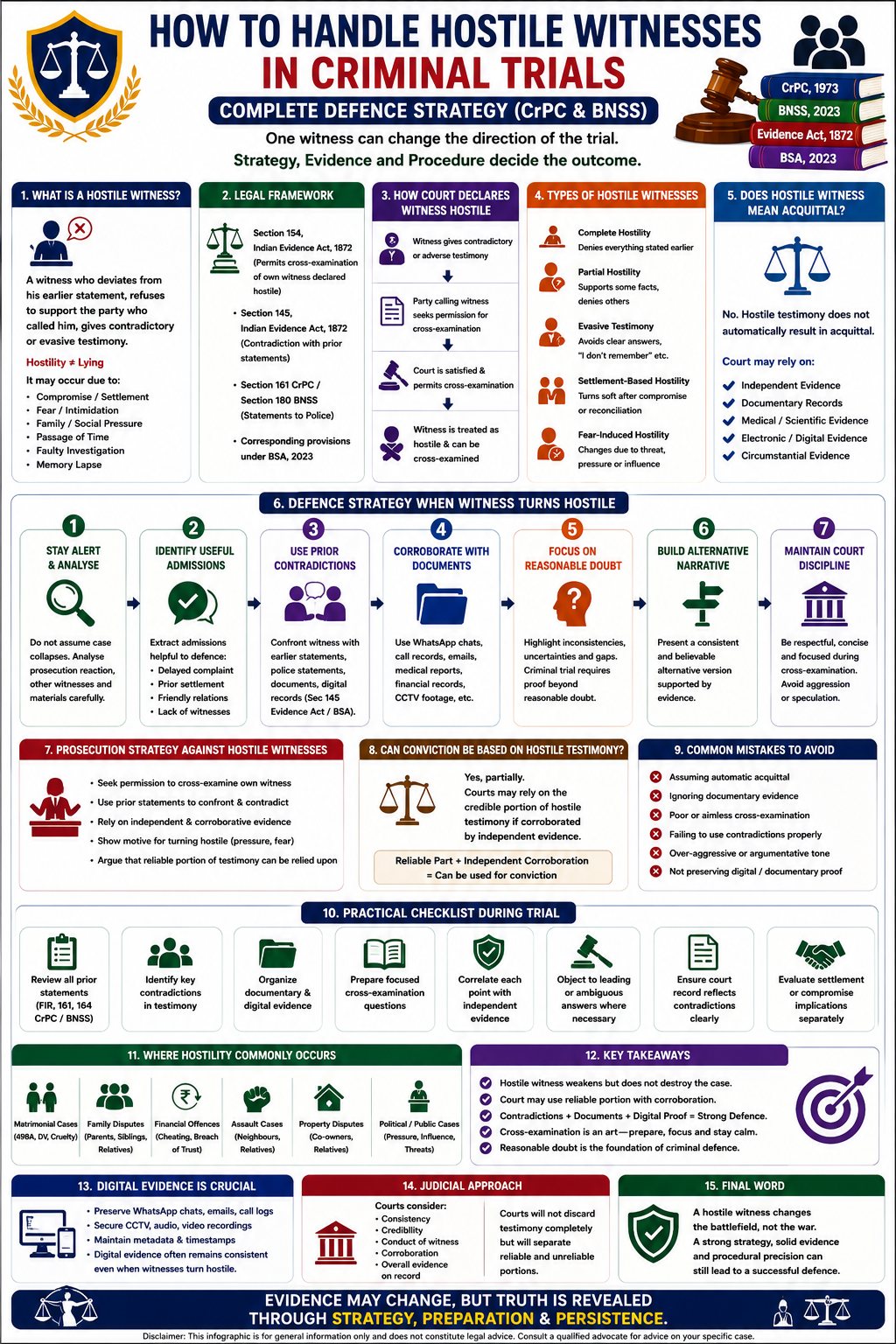
Bail Conditions – How to Avoid Cancellation of Bail

Posted on May 8 by Suprajaa Rajan

Obtaining bail is often the first major legal relief in criminal litigation. Whether the accused secures anticipatory bail, regular bail, interim bail, or default bail, the grant of bail does not end legal responsibility. In fact, the real challenge begins after bail is granted.

Many accused persons mistakenly believe:

“Once I get bail, the risk is over.”

Legally, that assumption can be dangerous.

Courts may cancel bail if the accused violates conditions, misuses liberty, interferes with investigation, intimidates witnesses, or attempts to obstruct justice.

Therefore, understanding bail conditions and how to avoid cancellation of bail becomes critical for every accused person, family member, and defence lawyer.

This article explains the legal framework, common bail conditions, cancellation grounds, compliance strategy, defence tactics, and practical safeguards, with references to both the Code of Criminal Procedure, 1973 (CrPC) and the Bharatiya Nagarik Suraksha Sanhita, 2023 (BNSS).

What Does Bail Actually Mean?

Bail is the conditional release of an accused person during:

  • Investigation
  • Inquiry
  • Trial
  • Appeal

The court allows liberty while ensuring:

  • Presence during proceedings
  • Cooperation with investigation
  • Protection of evidence
  • Fair administration of justice

However, bail is conditional liberty—not unconditional freedom.

Types of Bail Where Conditions May Apply

Conditions may be imposed in:

Anticipatory Bail

  • Section 438 CrPC (BNSS Section 482)

Regular Bail

  • Section 437 CrPC (BNSS Section 480) – Magistrate
  • Section 439 CrPC (BNSS Section 483) – Sessions Court/High Court

Default Bail

  • Section 167(2) CrPC (BNSS Section 187)

Suspension of Sentence Bail

  • Section 389 CrPC (BNSS Section 430)

Each form of bail may carry specific conditions.

Why Courts Impose Bail Conditions

Courts impose conditions to ensure that the accused:

  • Appears when required
  • Cooperates with investigation
  • Does not tamper with evidence
  • Does not threaten witnesses
  • Does not repeat alleged offences
  • Does not flee jurisdiction

Courts balance:

Personal liberty vs administration of justice

Common Bail Conditions

Although conditions vary by case, courts frequently direct:

Condition 1: Appear Before Investigating Officer

Particularly in anticipatory bail matters.

Examples:

  • Weekly appearance
  • Appearance on specific dates
  • Appearance when called

Failure may be treated as non-cooperation.

Practical Tip

Always maintain:

  • Attendance proof
  • Signed appearance records
  • Written communication with investigating officer

Condition 2: Cooperate With Investigation

Courts often direct:

“The accused shall cooperate with investigation.”

This may include:

  • Responding to notices
  • Producing documents
  • Giving specimen signatures
  • Providing electronic devices where lawfully required

Relevant notice provision:

  • Section 41A CrPC (BNSS Section 35)

Ignoring notices may trigger cancellation attempts.

Condition 3: Do Not Influence Witnesses

Courts routinely prohibit:

  • Direct contact
  • Threats
  • Pressure
  • Financial inducement
  • Settlement coercion

Even indirect contact through relatives may create problems.

Condition 4: Do Not Tamper With Evidence

Examples include:

  • Deleting chats
  • Destroying documents
  • Altering devices
  • Influencing documentary records

Digital evidence preservation is increasingly important.

Condition 5: Travel Restrictions

Courts may require:

  • Passport surrender
  • Prior permission for foreign travel
  • Travel disclosure

Especially in:

  • Economic offences
  • NRI matrimonial disputes
  • Fraud allegations

Condition 6: Attend Court Regularly

Courts expect:

  • Personal appearance where required
  • Compliance with exemptions

Relevant provision:

  • Section 205 CrPC (BNSS Section 227) – Exemption from personal appearance

Repeated absence can create complications.

Condition 7: Maintain Good Conduct

Courts may direct:

  • No similar offence
  • No unlawful activity
  • No breach of peace

Fresh criminal allegations may trigger cancellation proceedings.

Can Bail Be Cancelled?

Yes.

Bail can be cancelled if liberty is misused.

Relevant provisions:

Magistrate Bail Cancellation

  • Section 437(5) CrPC (BNSS Section 480(5))

Sessions Court/High Court Bail Cancellation

  • Section 439(2) CrPC (BNSS Section 483(2))

These courts may direct:

Arrest and custody of the accused.

Therefore, compliance after bail becomes essential.

Common Grounds for Bail Cancellation

Ground 1: Non-Cooperation With Investigation

Examples:

  • Ignoring notices
  • Missing appearances
  • Refusing lawful cooperation

Defence Strategy

Always:

  • Reply in writing
  • Preserve acknowledgments
  • Inform counsel immediately

Ground 2: Threatening Witnesses

Examples:

  • Calls
  • WhatsApp messages
  • Social media posts
  • Third-party pressure

Even emotional messages may be misinterpreted.

Defence Strategy

After bail:

  • Avoid direct communication
  • Use lawyers for settlement discussions
  • Preserve communication records

Ground 3: Tampering With Evidence

Examples:

  • Deleting messages
  • Altering files
  • Removing financial records

Courts take digital tampering seriously.

Defence Strategy

Preserve:

  • Devices
  • Chats
  • Emails
  • Cloud backups

Ground 4: Absconding

Examples:

  • Changing address without intimation
  • Leaving jurisdiction secretly
  • Switching off phones continuously

Defence Strategy

Always update:

  • Address
  • Phone number
  • Email

Maintain availability.

Ground 5: Repeating Similar Conduct

Examples:

  • Fresh harassment allegations
  • New criminal complaints
  • Violent confrontations

Defence Strategy

Maintain strict personal discipline.

Ground 6: Violation of Specific Bail Conditions

Examples:

  • Failure to deposit passport
  • Missing mandatory attendance
  • Violating travel restrictions

Defence Strategy

Maintain a compliance calendar.

Special Risk in Matrimonial Cases

In matrimonial litigation, bail cancellation applications commonly allege:

  • Threats to complainant
  • Settlement pressure
  • Contact through relatives
  • Social media harassment
  • Financial coercion
  • Return of stridhan disputes

These allegations may be exaggerated.

Therefore, accused persons must act cautiously.

Practical Post-Bail Compliance Strategy

Step 1: Read the Bail Order Carefully

Do not rely on verbal explanations.

Read:

  • Every condition
  • Every reporting requirement
  • Every travel restriction

Keep digital and printed copies.

Step 2: Create a Bail Compliance File

Maintain:

  • Bail order
  • Attendance proofs
  • Investigation notices
  • Replies
  • Court attendance records

Documentation defeats false allegations.

Step 3: Maintain Controlled Communication

If communication is unavoidable:

Use:

  • Email
  • Lawyer correspondence
  • Recorded written communication

Avoid:

  • Emotional phone calls
  • Voice notes
  • Informal intermediaries

Step 4: Preserve Digital Conduct

Do not:

  • Delete chats
  • Remove call logs
  • Change devices carelessly

Instead:

  • Create backups
  • Preserve originals
  • Maintain metadata

Step 5: Seek Permission Before Travel

If the bail order restricts travel:

Apply before:

  • Domestic relocation
  • Foreign travel
  • Extended absence

Never assume permission.

Step 6: Inform Counsel About Every Development

Inform your lawyer immediately if:

  • Police call you
  • Witness contacts you
  • New allegations arise
  • Settlement discussions begin

Early response prevents escalation.

What to Do If Someone Files for Bail Cancellation

Do not panic.

Take immediate action:

Collect Compliance Records

Produce:

  • Attendance records
  • Call logs
  • Emails
  • Travel permissions
  • Investigation replies

Challenge False Allegations

Demonstrate:

  • No contact
  • No tampering
  • No evasion

Show Consistent Conduct

Highlight:

  • Regular appearances
  • Cooperation
  • Stable residence
  • No fresh offences

Courts value conduct.

Can Bail Conditions Be Modified?

Yes.

If conditions become impractical, seek modification.

Examples:

  • Frequent police attendance
  • Passport restrictions
  • Medical limitations
  • Employment-related travel

Apply before the same court or appropriate superior court.

Common Mistakes After Bail

Avoid:

Assuming Bail Means Total Freedom

Bail remains conditional.

Ignoring Investigation Calls

Non-cooperation creates risk.

Emotional Contact With Complainant

Messages may become evidence.

Informal Settlement Pressure

Can be portrayed as intimidation.

Missing Court Dates

Repeated absence creates adverse perception.

Social Media Commentary

Public posts may backfire.

Practical Bail Compliance Checklist

After securing bail, ensure:

  • Bail order copied and reviewed
  • Conditions explained clearly
  • Attendance calendar created
  • Passport compliance completed
  • Digital evidence preserved
  • No direct witness contact
  • Travel restrictions understood
  • Lawyer updated regularly

Judicial Approach

The Courts generally protect liberty—but only when liberty is responsibly exercised.

Courts look for:

  • Cooperation
  • Transparency
  • Consistency
  • Respect for process

Courts act strictly against:

  • Intimidation
  • Delay tactics
  • Evidence destruction
  • Abuse of judicial protection

Your conduct after bail often influences the entire trial.

Conclusion

Securing bail is a major relief—but keeping bail intact requires discipline.

Many accused lose strategic advantage not because of weak legal arguments, but because of careless post-bail conduct.

By:

  • Understanding every bail condition
  • Maintaining written compliance
  • Avoiding emotional reactions
  • Preserving digital evidence
  • Respecting court directions

you can significantly reduce the risk of cancellation.

In criminal litigation, bail protects liberty—but disciplined conduct protects bail.


Index of Legal Strategies and Defence is here. 


Key Contributor : 

Mrs. Suprajaa Rajan B.Com., LL.B., LL.M.

+91-9606345150

Posted in Legal Procedure | Tagged BNSS CrPC 167 - Default Bail CrPC 167(2) - Default or Statutory Bail CrPC 389 - Suspension of sentence pending the appeal; release of appellant on bail CrPC 438 - Anticipatory Bail CrPC 439 - Special powers of High Court or Court of Session regarding bail Legal Strategies and Defence Regular Bail Orders u/s 437 | Leave a comment

Life Cycle Stages of a Criminal Writ Petition Before a High Court

Posted on May 7 by Suprajaa Rajan

A Step-by-Step Guide to Criminal Writ Proceedings Under Indian Law

Understanding the procedural journey of a criminal writ petition helps individuals protect their fundamental rights, challenge illegal actions, and seek urgent judicial intervention from the High Court.

A criminal writ petition is an extraordinary constitutional remedy that a person may invoke when illegal detention, abuse of criminal process, violation of procedural safeguards, or infringement of fundamental rights occurs.

Unlike regular criminal trials, criminal writ petitions arise directly under the constitutional jurisdiction of the High Courts under Article 226 of the Constitution of India and, in appropriate cases, under Article 227 of the Constitution of India.

Although the power flows from the Constitution, the issues raised in such petitions often involve provisions of the Code of Criminal Procedure, 1973 (CrPC) and the Bharatiya Nagarik Suraksha Sanhita, 2023 (BNSS).

The following stages explain the complete life cycle of a criminal writ petition before a High Court.

1. Legal Foundation of Criminal Writ Jurisdiction

First, it is important to understand the legal foundation of criminal writ proceedings.

High Courts exercise writ jurisdiction under Article 226 of the Constitution of India to protect legal and fundamental rights. Additionally, High Courts exercise supervisory jurisdiction under Article 227 of the Constitution of India over subordinate courts and tribunals.

A person may file a criminal writ petition in situations involving:

  • Illegal arrest or detention
  • Violation of procedural safeguards
  • Abuse of criminal investigation
  • Failure of police authorities to act
  • Threat to personal liberty under Article 21
  • Illegal issuance of lookout notices or coercive action
  • Failure to follow mandatory criminal procedure

For instance, petitions may involve violations relating to arrest under Section 41 CrPC / Section 35 BNSS, notice of appearance under Section 41A CrPC / Section 35(3) BNSS, search and seizure, remand, or investigation.

Therefore, writ jurisdiction acts as an immediate constitutional safeguard.

2. Stage One: Cause of Action or Violation of Rights

Typically, a criminal writ petition begins when a person experiences an illegal action by police, investigating agencies, or other public authorities.

For example, the grievance may involve illegal detention, unlawful summons, harassment during investigation, refusal to register an FIR, or violation of procedural safeguards.

The aggrieved person first identifies the violation and gathers relevant documents, notices, FIR copies, summons, remand orders, or communication records.

Therefore, identifying the cause of action forms the foundation of the writ petition.

3. Stage Two: Legal Consultation and Case Assessment

Next, the aggrieved person consults a legal practitioner experienced in criminal and constitutional litigation.

At this stage, the lawyer evaluates whether the grievance requires a writ remedy or an alternative statutory remedy.

For example, the lawyer may examine whether relief could arise through:

  • FIR registration under Section 154 CrPC / Section 173 BNSS
  • Anticipatory bail under Section 438 CrPC / Section 482 BNSS
  • Regular bail under Section 439 CrPC / Section 483 BNSS
  • Production of a detained person under Section 97 CrPC / Section 104 BNSS

If immediate constitutional intervention becomes necessary, the lawyer prepares for writ proceedings.

4. Stage Three: Drafting of Criminal Writ Petition

After assessing the facts, the legal team drafts the criminal writ petition.

The petition generally includes:

  • Details of parties
  • Facts leading to the violation
  • Relevant constitutional rights violated
  • Relevant criminal law provisions
  • Grounds for invoking writ jurisdiction
  • Interim relief sought
  • Final relief sought

Additionally, the petitioner annexes supporting documents such as FIR copies, notices, complaint copies, remand orders, call records, or medical records.

A properly drafted petition significantly strengthens the case.

5. Stage Four: Filing Before the High Court Registry

Once the petition is ready, the petitioner files it before the Registry of the jurisdictional High Court.

The Registry scrutinises the petition for procedural compliance, court fees, formatting requirements, affidavits, and annexures.

If defects appear, the Registry returns the matter for correction.

Once compliance is complete, the Registry assigns a writ petition number and lists the matter before the appropriate bench.

Thus, the petition formally enters the judicial system.

6. Stage Five: Urgent Mentioning and Listing

In urgent matters involving personal liberty, illegal detention, or coercive police action, the petitioner may seek urgent listing.

For example, habeas corpus petitions involving unlawful detention may require immediate listing.

Similarly, petitions challenging illegal arrest under Section 41 CrPC / Section 35 BNSS may also require urgent hearing.

After hearing the urgency submissions, the High Court may list the matter on priority.

Therefore, urgent mentioning plays a crucial role in criminal writ proceedings.

7. Stage Six: Preliminary Hearing and Admission

Next, the High Court conducts a preliminary hearing.

At this stage, the petitioner’s counsel explains the urgency, constitutional violation, and statutory breaches.

The court examines whether the petition discloses a prima facie case.

For example, the court may examine violations involving:

  • Arrest procedure under Section 41 CrPC / Section 35 BNSS
  • Notice procedure under Section 41A CrPC / Section 35 BNSS
  • FIR registration under Section 154 CrPC / Section 173 BNSS
  • Investigation procedure under Section 156 CrPC / Section 175 BNSS

If the court finds merit, it admits the petition.

8. Stage Seven: Issuance of Notice to Respondents

After admission, the High Court issues notice to the respondents.

The respondents may include:

  • State Government
  • Police authorities
  • Investigating agencies
  • Magistrates or subordinate authorities, where legally permissible
  • Other affected parties

The notice directs the respondents to file their reply within a specified period.

This stage ensures compliance with principles of natural justice.

9. Stage Eight: Interim Protection or Interim Orders

Meanwhile, the petitioner may seek interim protection.

Depending on the facts, the High Court may pass interim directions such as:

  • No coercive steps
  • Stay of arrest
  • Protection from harassment
  • Production of detainee
  • Protection of evidence
  • Direction to follow procedural safeguards

For instance, the court may direct compliance with arrest safeguards under Section 41 CrPC / Section 35 BNSS.

In urgent cases, interim protection may determine the immediate outcome.

10. Stage Nine: Filing of Counter Affidavit and Rejoinder

Subsequently, the respondents file their counter affidavit.

The respondents justify their actions by relying on investigation records, statutory powers, or procedural compliance.

After that, the petitioner may file a rejoinder to rebut factual or legal assertions.

This stage helps the court understand the complete factual matrix.

11. Stage Ten: Final Hearing and Arguments

After pleadings conclude, the High Court hears final arguments.

The petitioner demonstrates constitutional violations, abuse of power, or procedural irregularities.

Conversely, the respondents defend the legality of their actions.

Both parties rely on constitutional principles, statutory provisions, and judicial precedents.

At this stage, the court examines whether state action violates due process or personal liberty.

12. Stage Eleven: Final Judgment and Writ Directions

Finally, the High Court delivers its judgment.

Depending on the facts, the court may:

  • Quash illegal proceedings
  • Direct registration of FIR
  • Order fresh investigation
  • Stay coercive action
  • Release an illegally detained person
  • Set aside unlawful notices
  • Direct compliance with procedural safeguards
  • Award costs in appropriate cases

For instance, the court may direct authorities to comply with investigation procedures under Section 173 CrPC / Section 193 BNSS or arrest safeguards under Section 41 CrPC / Section 35 BNSS.

Thus, the writ remedy ensures accountability.

13. Stage Twelve: Compliance, Contempt, or Further Challenge

After the judgment, authorities must comply with the writ directions.

If authorities fail to comply, the petitioner may initiate contempt proceedings before the High Court.

Additionally, an aggrieved party may challenge the judgment before the Supreme Court through:

  • Special Leave Petition under Article 136, or
  • Other constitutional remedies, where applicable.

Therefore, post-judgment remedies ensure continued judicial oversight.

Conclusion

Criminal writ petitions play a vital role in protecting personal liberty, procedural fairness, and constitutional rights.

Therefore, High Courts follow a structured process that balances urgent intervention with judicial scrutiny.

Understanding the life cycle of a criminal writ petition helps individuals seek timely constitutional remedies against illegal criminal action.

Ultimately, writ jurisdiction remains one of the strongest safeguards against misuse of criminal law.


Other Life Cycles: DV Case Lifecycle || Maintenance Case u/s 125 CrPC Lifecycle. Index is here.


Key Contributor :

Mrs. Suprajaa Rajan B.Com., LL.B., LL.M.

+91-9606345150


Posted in Legal Procedure | Tagged Article 226 Constitution Article 227 - Power of superintendence over all courts by the High Court CrPC 41A - Notice of appearance before police officer Life Cycle stages Life Cycle stages of a criminal writ petition | Leave a comment

Representation for Deletion of Name from FIR – Format, Procedure & Sample Draft

Posted on May 7 by Suprajaa Rajan

A practical legal remedy to seek deletion of an incorrectly implicated person’s name during investigation.

In criminal investigations, it is not uncommon for individuals to be wrongly named in a First Information Report (FIR) due to family disputes, business conflicts, mistaken identity, exaggerated allegations, or omnibus accusations. However, mere naming in an FIR does not automatically establish criminal liability. The investigating agency is duty-bound to conduct an independent, fair, and evidence-based investigation.

Therefore, when a person has been falsely implicated or unnecessarily arrayed as an accused, a Representation for Deletion of Name from FIR can be submitted to the Investigating Officer, Station House Officer (SHO), or supervisory police authorities, requesting objective consideration of exculpatory material.

This article explains the legal framework, strategic considerations, drafting approach, and provides a ready-to-use sample format with copy-to-clipboard functionality.

I. Legal Framework

Investigation and determination of involvement are governed by:

Under the Code of Criminal Procedure, 1973

  • Section 154 CrPC – Registration of FIR
  • Section 157 CrPC – Investigation procedure
  • Section 161 CrPC – Examination of witnesses
  • Section 169 CrPC – Release of accused when evidence is insufficient
  • Section 173 CrPC – Final police report/charge sheet

Corresponding Provisions under BNSS, 2023

  • Section 173 BNSS – Information in cognizable cases
  • Section 176 BNSS – Investigation
  • Section 180 BNSS – Examination of witnesses
  • Section 189 BNSS – Release when evidence is deficient
  • Section 193 BNSS – Final report of police officer

Thus, the investigating agency has a continuing duty to exclude persons against whom no credible material exists.

II. What is a Representation for Deletion of Name from FIR?

A representation for deletion of name is a formal written request submitted during investigation, requesting the police to:

  • Conduct an objective evaluation of available evidence
  • Consider documents, electronic records, alibi, or other defence material
  • Exclude an innocent person from the array of accused
  • File the final report only against persons against whom evidence exists

Importantly, this representation does not seek quashing of the FIR. Instead, it seeks fair investigation at the police stage itself.

III. When Should This Representation Be Filed?

You may file this representation when:

  • You are falsely implicated due to family or matrimonial disputes
  • Your name is included through general or omnibus allegations
  • You were not present at the alleged place of occurrence
  • Documentary evidence clearly disproves involvement
  • Electronic records establish location, communication, or alibi
  • The complaint names multiple family members without specific allegations

Therefore, early intervention during investigation can prevent unnecessary arrest, charge sheet, or trial.

IV. Why is This Representation Important?

Filing a representation helps to:

  • Place defence documents on record at the earliest stage
  • Demonstrate cooperation with the investigation
  • Highlight absence of specific allegations
  • Reduce the risk of arbitrary arrest
  • Strengthen future proceedings such as anticipatory bail, discharge, or quashing

Moreover, such representations often become important defence documents in later litigation.

V. What Material Should Be Attached?

Depending on the facts, you may annex:

  • Travel records
  • Employment attendance records
  • CCTV footage
  • Medical records
  • Phone location data
  • Emails, chats, or digital communication
  • Property or financial documents
  • Prior complaints showing mala fide intent

Therefore, documentary support significantly strengthens the representation.

VI. Essential Elements of the Representation

Before drafting, you should include:

  • Name, address, and contact details
  • FIR details and police station details
  • Brief background of the allegations
  • Specific grounds showing false implication
  • Documentary evidence supporting innocence
  • Request for objective investigation and deletion of name

These elements make the representation clear, professional, and persuasive.

VII. Drafting Strategy

While drafting:

  • Use fact-based and respectful language
  • Avoid attacking the complainant personally
  • Highlight absence of overt acts or specific allegations
  • Refer to documentary material wherever available
  • Clearly express willingness to cooperate

A strategically drafted representation often creates a strong foundation for future defence remedies.

VIII. Sample Draft Format – Representation for Deletion of Name from FIR


Sample Draft – Representation for Deletion of Name from FIR

To
The Station House Officer / Investigating Officer
[Name of Police Station]
[District/City]

Subject: Representation Seeking Deletion of Name from FIR

Respected Sir/Madam,

I respectfully submit that my name has been mentioned in FIR No. [____] registered at your police station for alleged offences under Sections [____].

I submit that I am innocent and have been falsely implicated in the present matter due to [brief reason such as family dispute/business rivalry/mistaken identity].

No specific role, overt act, or direct allegation has been attributed to me in relation to the alleged incident.

I respectfully submit that documentary material enclosed herewith clearly establishes my non-involvement in the alleged occurrence.

The enclosed documents include [briefly mention documents such as travel records, attendance records, medical documents, electronic records, etc.].

I am fully willing to cooperate with the investigation and to appear before the Investigating Officer as and when required.

I therefore respectfully request that an independent and objective investigation may kindly be conducted and my name may not be included in the final report in the absence of incriminating material.

This representation may kindly be taken on record and considered in accordance with law.


Thanking you.


Yours faithfully,
[Name]
[Address]
[Contact Details]
[Signature]

Date: [____]
Place: [____]

✔ Draft Copied Successfully!


IX. Common Mistakes to Avoid

Avoid:

  • Filing a representation without supporting documents
  • Making emotional or personal allegations
  • Waiting until charge sheet is filed
  • Ignoring notices from the Investigating Officer
  • Seeking deletion without offering cooperation

Instead, focus on documents, timelines, and objective facts.

Conclusion

A Representation for Deletion of Name from FIR is a valuable pre-trial defence tool that can prevent innocent individuals from facing unnecessary prosecution. Therefore, by presenting credible documents, factual clarification, and cooperative conduct, an accused can seek fair consideration during investigation itself.


Index of All Legal templates and Drafting is here. 


Disclaimer

These templates are provided for educational and informational purposes. Every case depends on specific facts and procedural posture. Professional legal advice should be obtained before filing any application.


Key Contributor :

Mrs.Suprajaa Rajan B.Com., LL.B., LL.M.

+91-9606345150


Posted in Legal Procedure | Tagged CrPC 157 - Procedure for Investigation Preliminary Inquiry CrPC 161 - Examination of Witnesses By Police CrPC 173 - Report of Police Officer on Completion of Investigation CrPC Sec 154 - Registration of an FIR Deletion for name from FIR Matrimonial Litigation India matrimonial offences | Leave a comment

Reply to Bail Cancellation Application – Format, Procedure & Sample Draft

Posted on May 7 by Suprajaa Rajan

A practical guide to defending an application seeking cancellation of bail and protecting personal liberty.

Once a court grants bail, the accused obtains a valuable protection of personal liberty. However, the prosecution, complainant, or an aggrieved party may subsequently file an application seeking cancellation of bail on grounds such as alleged misuse of liberty, non-compliance with conditions, witness intimidation, or changed circumstances. In such situations, filing a well-drafted reply to the bail cancellation application becomes critical.

A properly prepared reply not only rebuts the allegations but also demonstrates continued compliance, bona fide conduct, and absence of any supervening circumstances warranting cancellation.

This article explains the legal framework, grounds of opposition, drafting strategy, and provides a ready-to-use sample format with copy-to-clipboard functionality.

I. Legal Framework

Cancellation of bail is governed by the following provisions:

Under the Code of Criminal Procedure, 1973

  • Section 437(5) CrPC – Power of Magistrate to direct arrest and commit to custody
  • Section 439(2) CrPC – Power of Sessions Court or High Court to cancel bail

Corresponding Provisions under BNSS, 2023

  • Section 480(5) BNSS – Powers relating to cancellation of bail
  • Section 483(3) BNSS – Powers of Sessions Court and High Court regarding bail

Thus, while courts retain the power to cancel bail, such power must be exercised judicially, cautiously, and only upon compelling circumstances.

II. When is a Bail Cancellation Application Filed?

A bail cancellation application is commonly filed on allegations that the accused has:

  • Violated bail conditions
  • Failed to appear before court
  • Attempted to influence witnesses
  • Tampered with evidence
  • Committed another offence during bail
  • Misused liberty granted by the court

However, mere allegations or dissatisfaction with the bail order are not sufficient. The applicant must show subsequent misconduct or supervening circumstances.

III. When Should You File a Reply?

You should file a reply immediately when:

  • Notice of bail cancellation is received
  • The complainant files allegations of misuse
  • The prosecution alleges non-cooperation
  • New facts are being projected to seek custody

Therefore, prompt filing protects both liberty and procedural rights.

IV. Grounds to Oppose Bail Cancellation

A reply may highlight:

  • Full compliance with all bail conditions
  • Regular appearance before court or Investigating Officer
  • No contact with witnesses or complainant
  • No attempt to influence investigation
  • False, exaggerated, or retaliatory allegations
  • Absence of any supervening circumstances

Therefore, the defence should focus on conduct after grant of bail, not the merits of the original case.

V. Key Factors Considered by Courts

While deciding cancellation, courts generally examine:

  • Conduct of the accused after bail
  • Nature of alleged violation
  • Documentary proof of misconduct
  • Possibility of absconding
  • Risk of tampering with evidence
  • Public interest and fairness of trial

Consequently, documentary proof of compliance often plays a decisive role.

VI. Essential Elements of the Reply

Before drafting, you should include:

  • Details of the original bail order
  • Date of grant of bail
  • Summary of allegations in cancellation application
  • Point-wise rebuttal
  • Details of compliance with bail conditions
  • Undertaking to continue cooperation

These elements make the reply structured, factual, and persuasive.

VII. Drafting Strategy

While drafting:

  • Respond paragraph-wise to allegations
  • Use facts and records, not emotional arguments
  • Highlight continued compliance
  • Avoid attacking the complainant personally
  • Focus on absence of misuse of liberty

A strong reply demonstrates discipline, credibility, and respect for the judicial process.

VIII. Sample Draft Format – Reply to Bail Cancellation Application


Sample Draft – Reply to Bail Cancellation Application

BEFORE THE HONOURABLE COURT OF [COURT NAME] AT [CITY]

Criminal Misc. Application No.: [____]

In the matter of:

[Name of Applicant/Complainant/State]
…Applicant

Versus

[Name of Accused]
…Respondent/Accused


REPLY ON BEHALF OF RESPONDENT TO APPLICATION SEEKING CANCELLATION OF BAIL

Most Respectfully Submitted:

1. That the present reply is being filed in response to the application seeking cancellation of bail granted to the Respondent vide order dated [____].

2. At the outset, it is respectfully submitted that the allegations made in the present application are false, baseless, and devoid of material particulars.

3. The Respondent has strictly complied with all conditions imposed by this Hon’ble Court and has regularly appeared before the concerned authorities as and when required.

4. The Respondent has neither attempted to influence any witness nor tampered with any evidence.

5. No supervening circumstance has arisen after grant of bail that would justify cancellation of the liberty already granted by this Hon’ble Court.

6. The present application appears to have been filed with an ulterior motive and does not disclose any legally sustainable ground for cancellation of bail.

7. The Respondent undertakes to continue complying with all conditions imposed by this Hon’ble Court.

PRAYER

In view of the above, it is most respectfully prayed that this Hon’ble Court may be pleased to dismiss the present application seeking cancellation of bail in the interest of justice.


Place: [City]
Date: [Date]


Counsel for the Respondent
[Signature]

✔ Draft Copied Successfully!


IX. Common Mistakes to Avoid

Avoid:

  • Giving a vague or generic denial
  • Ignoring specific allegations raised by the applicant
  • Arguing the merits of the original criminal case
  • Failing to produce proof of compliance
  • Using aggressive or accusatory language

Instead, focus on documented compliance, factual rebuttal, and judicial discipline.

Conclusion

A Reply to Bail Cancellation Application is often the last line of defence against loss of personal liberty. Therefore, a carefully drafted reply supported by facts, compliance records, and legal principles can effectively demonstrate that no circumstance exists to justify cancellation of bail.


Index of All Legal templates and Drafting is here. 


Disclaimer

These templates are provided for educational and informational purposes. Every case depends on specific facts and procedural posture. Professional legal advice should be obtained before filing any application.


Key Contributor :

Mrs.Suprajaa Rajan B.Com., LL.B., LL.M.

+91-9606345150


Posted in Legal Procedure | Tagged Bail Cancellation CrPC 439 - Special powers of High Court or Court of Session regarding bail legal drafting Legal templates and drafting | Leave a comment

How to Protect Digital Evidence in Matrimonial Disputes – A Practical Legal Guide

Posted on May 6 by Suprajaa Rajan

In modern matrimonial litigation, digital evidence often speaks louder than oral allegations. WhatsApp chats, emails, call logs, bank alerts, social media posts, photographs, location records, video calls, and cloud backups frequently become decisive in disputes involving:

  • Cruelty allegations
  • Dowry harassment complaints
  • Domestic violence proceedings
  • Maintenance disputes
  • Child custody battles
  • Adultery-related allegations
  • Financial concealment claims
  • False implication defences

In many cases, the party who preserves digital evidence properly gains a significant strategic advantage.

However, digital evidence is fragile. Messages can disappear, devices can fail, accounts can be deleted, metadata can change, and improper handling can destroy evidentiary value.

Therefore, understanding how to protect digital evidence in matrimonial disputes becomes essential for litigants, family members, and legal practitioners.

This article explains the complete strategy for identifying, preserving, authenticating, producing, and defending digital evidence, with references to the Code of Criminal Procedure, 1973 (CrPC), the Bharatiya Nagarik Suraksha Sanhita, 2023 (BNSS), the Indian Evidence Act, 1872, and the Bharatiya Sakshya Adhiniyam, 2023 (BSA).

What Is Digital Evidence?

Digital evidence includes any information stored, transmitted, or generated electronically.

Common examples include:

  • WhatsApp chats
  • SMS messages
  • Emails
  • Call recordings
  • Video recordings
  • CCTV footage
  • GPS location history
  • UPI/payment alerts
  • Banking app notifications
  • Social media posts
  • Cloud backups
  • Google timeline records
  • Screenshots
  • Photographs with metadata
  • Audio notes
  • Video call records

In matrimonial disputes, these records often reveal:

  • Communication patterns
  • Financial conduct
  • Residence history
  • Threats or harassment
  • Reconciliation attempts
  • Settlement discussions
  • Contradictions in allegations

Why Digital Evidence Matters in Matrimonial Cases

Digital evidence frequently helps establish:

Cruelty or Harassment

Messages may show:

  • Threats
  • Abusive language
  • Emotional manipulation
  • Coercive demands

False Allegations

Chats may reveal:

  • Friendly communication after alleged incidents
  • Settlement pressure
  • Contradictory statements

Financial Disputes

Bank records may show:

  • Transfers
  • Shared expenses
  • Hidden income
  • Asset diversion

Custody Disputes

Location records and communication logs may establish:

  • Parenting involvement
  • Travel history
  • Daily caregiving

Thus, digital evidence often shapes the narrative before trial even begins.

Legal Framework

Investigation and Document Production

Production of Documents

  • Section 91 CrPC (BNSS Section 94)

Courts may summon:

  • Phone records
  • Bank records
  • Emails
  • Server logs
  • Cloud data

Investigation Statements

  • Section 161 CrPC (BNSS Section 180)

Digital records may be examined during investigation.

Police Report

  • Section 173 CrPC (BNSS Section 193)

Electronic material may form part of the chargesheet.

Electronic Evidence Under Evidence Law

Under Indian Evidence Act

  • Section 65B

Under Bharatiya Sakshya Adhiniyam, 2023

  • Electronic records provisions under BSA

Electronic evidence generally requires proper certification where applicable.

Therefore, preservation must begin early.

Step 1: Identify Relevant Digital Evidence Immediately

The first mistake many litigants make is waiting too long.

The moment matrimonial conflict escalates, identify relevant digital records.

Create a checklist:

Communication

  • WhatsApp chats
  • SMS
  • Emails
  • Telegram/Signal chats

Financial

  • UPI records
  • Bank alerts
  • Wallet transactions

Media

  • Photos
  • Videos
  • Audio notes

Location

  • Google timeline
  • Ride-sharing records
  • Travel bookings

Social Media

  • Posts
  • Stories
  • Direct messages

Early identification prevents accidental loss.

Step 2: Preserve Original Devices

One of the most important rules:

Never discard the original device.

Preserve:

  • Mobile phones
  • Laptops
  • Tablets
  • External drives
  • Memory cards

Why?

Because courts often prefer original sources.

Metadata may include:

  • Date
  • Time
  • Device information
  • Location
  • File creation history

Changing devices without backups can destroy critical evidence.

Step 3: Do Not Delete Anything

Many people delete chats out of anger or fear.

This can be disastrous.

Never delete:

  • Messages
  • Photos
  • Audio notes
  • Call logs
  • Contact histories

Even “embarrassing” messages may later support your defence.

Preservation always comes before interpretation.

Step 4: Create Multiple Backups

Create secure backups immediately.

Use:

Local Backup

  • External hard drive
  • Encrypted USB drive

Cloud Backup

Examples include:

Google Drive,
iCloud, or
Microsoft OneDrive

Offline Export

Export:

  • Chat histories
  • Emails
  • Call logs

Multiple backups reduce accidental loss.

Step 5: Export Chats Properly

For messaging platforms:

Export complete chats.

Do not:

  • Crop screenshots
  • Forward selected messages only
  • Edit content

Instead:

  • Export with timestamps
  • Include media where relevant
  • Preserve contact details

Incomplete screenshots often invite challenge.

Step 6: Preserve Metadata

Metadata often becomes more valuable than the content itself.

Metadata may prove:

  • Exact creation time
  • Device source
  • GPS location
  • Editing history

Do not:

  • Compress files repeatedly
  • Rename files unnecessarily
  • Edit screenshots

Original metadata strengthens authenticity.

Step 7: Record Chain of Custody

Document:

  • When evidence was collected
  • Who accessed it
  • Where it was stored
  • When backups were created

This becomes crucial if authenticity is challenged later.

Step 8: Capture Social Media Evidence Correctly

If social media content may disappear:

Preserve:

  • Profile URLs
  • Screenshots
  • Screen recordings
  • Time and date stamps

Include:

  • Username
  • Profile picture
  • Post date
  • Comments

Anonymous screenshots are weaker.

Step 9: Preserve Financial Digital Trails

Save:

  • Net banking screenshots
  • Transaction IDs
  • UPI receipts
  • Wallet statements
  • Credit card statements

Financial evidence often defeats exaggerated maintenance claims.

Step 10: Obtain Service Provider Records Where Necessary

If records become disputed, seek production through court.

Apply under:

  • Section 91 CrPC (Section 94 BNSS)

Possible records include:

  • Call detail records
  • Tower location
  • Email server logs
  • Banking records
  • Telecom records

Independent records often carry high credibility.

Step 11: Prepare Electronic Evidence Certification

Where certification becomes necessary:

Prepare:

  • Device details
  • Source details
  • Extraction method
  • Storage details

Certification should align with applicable evidence law.

Improper certification may delay admissibility.

Step 12: Use Digital Evidence Strategically During Cross-Examination

Digital evidence is most powerful when used at the right stage.

Use it to challenge:

  • Timelines
  • Presence claims
  • Threat allegations
  • Financial assertions
  • Residence disputes

Examples:

Friendly Chats After Alleged Cruelty

May weaken prosecution.

Location Records

May disprove physical presence.

Payment Records

May contradict maintenance claims.

Common Mistakes to Avoid

Avoid:

Selective Screenshots

Incomplete records weaken credibility.

Editing Messages

Manipulation can destroy admissibility.

Sharing Evidence Publicly

Social media disclosure may backfire.

Forwarding Sensitive Evidence

Loss of metadata may occur.

Relying Only on Screenshots

Original files matter.

Factory Resetting Devices

Critical evidence may disappear permanently.

Defence Strategy in False Matrimonial Cases

If defending against false allegations, digital evidence may establish:

Separate Residence

Location history.

Friendly Relations

Post-incident chats.

Settlement Pressure

Recorded negotiations.

Financial Independence

Income transfers and business activity.

False Timelines

Travel records and digital timestamps.

Judicial Approach

Courts increasingly rely on:

  • Electronic communication
  • Digital payment records
  • Location evidence
  • Social media activity
  • Audio and video recordings

However, courts also carefully examine:

  • Authenticity
  • Continuity
  • Source reliability
  • Possibility of manipulation

Therefore, preservation matters as much as content.

Practical Digital Evidence Checklist

Before litigation escalates, ensure:

  • Original device preserved
  • Chats exported
  • Cloud backup created
  • Financial records saved
  • Metadata preserved
  • Social media content archived
  • Chain of custody recorded
  • Service provider records identified
  • Legal certification planned

Conclusion

In matrimonial litigation, digital evidence often becomes the most powerful witness.

A properly preserved digital record can:

  • Support genuine allegations
  • Expose false claims
  • Protect innocent family members
  • Strengthen settlement negotiations
  • Influence bail, trial, maintenance, and quashing proceedings

By:

  • Acting early
  • Preserving originals
  • Creating secure backups
  • Maintaining metadata
  • Using procedural tools strategically

you can significantly strengthen your legal position.

In modern litigation, devices may forget—but properly preserved digital evidence does not.


Index of Legal Strategies and Defence is here. 


Key Contributor : 

Mrs. Suprajaa Rajan B.Com., LL.B., LL.M.

+91-9606345150
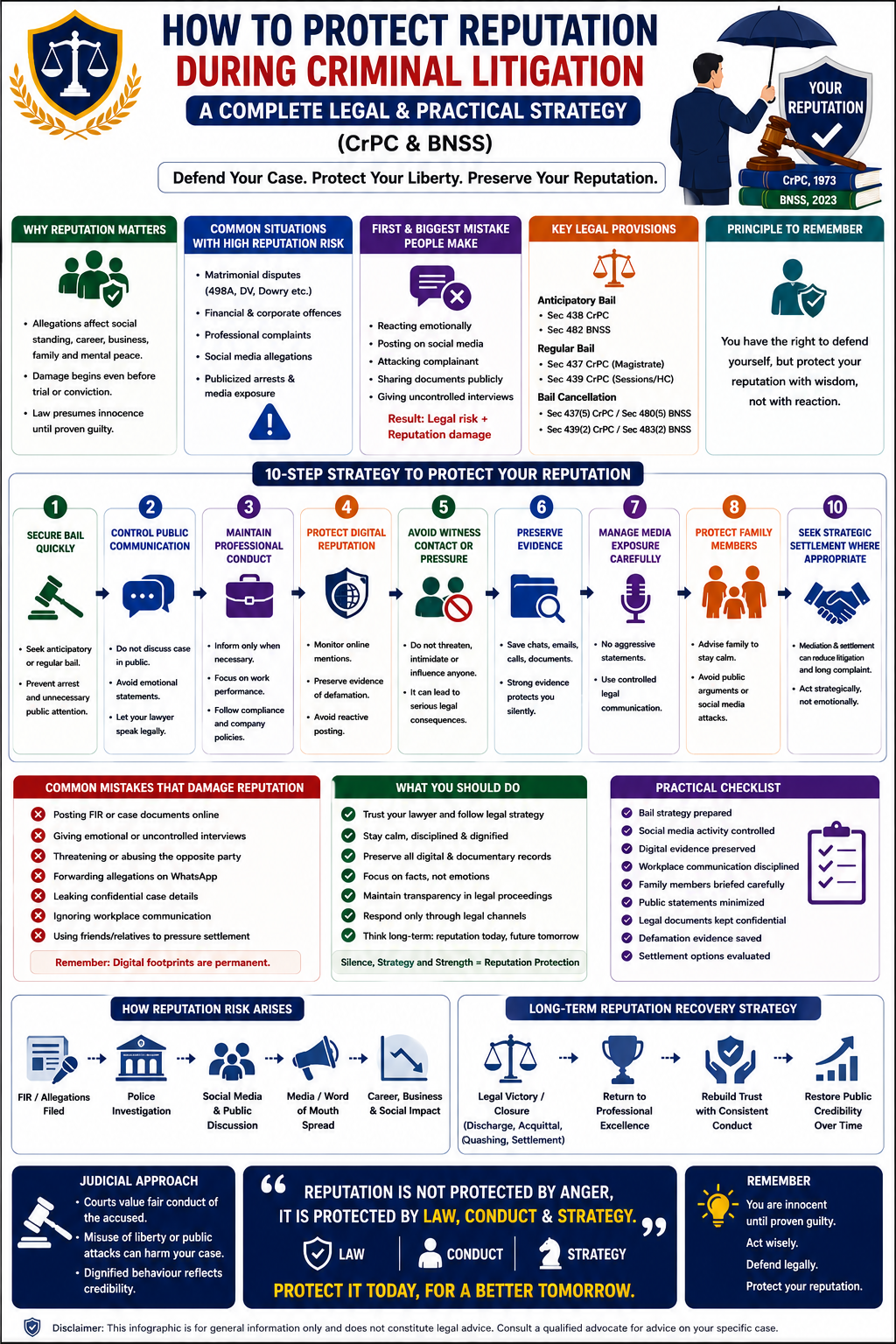

Posted in Legal Procedure | Tagged 498A Defence 498A defence strategy BNSS Code of Criminal Procedure Digital Evidence Legal Strategies and Defence Matrimonial dispute Matrimonial Litigation India | Leave a comment

Top 10 Mistakes Accused Make in Matrimonial Cases – And How to Avoid Them

Posted on May 6 by Suprajaa Rajan

Matrimonial criminal litigation can become emotionally exhausting, financially draining, and legally complex. Complaints involving allegations of cruelty, dowry harassment, domestic violence, maintenance, breach of trust, child custody, or financial abuse often trigger multiple parallel proceedings.

In such situations, many accused persons unknowingly make strategic mistakes during the early stages of litigation. Unfortunately, these mistakes often strengthen the prosecution’s case, weaken the defence, and create long-term legal complications.

However, most of these errors are entirely avoidable.

Therefore, understanding the top mistakes accused persons make in matrimonial cases—and how to avoid them—can dramatically improve case outcomes.

This article explains the 10 most common strategic mistakes, the legal consequences of each, and the corrective strategy, with references to both the Code of Criminal Procedure, 1973 (CrPC) and the Bharatiya Nagarik Suraksha Sanhita, 2023 (BNSS).

Mistake #1: Ignoring the First Police Notice

One of the biggest mistakes accused persons make is ignoring:

  • Police calls
  • WhatsApp messages from investigating officers
  • Written notices
  • Calls for inquiry

Particularly notices issued under:

  • Section 41A CrPC (Section 35 BNSS) – Notice of appearance before police

Many people assume:

“If I don’t appear, nothing will happen.”

That assumption can be costly.

Ignoring such notices may lead to:

  • Adverse police reports
  • Allegations of non-cooperation
  • Stronger grounds for arrest
  • Difficulty in obtaining bail

What You Should Do Instead

Immediately:

  • Verify authenticity of notice
  • Consult counsel
  • Send a formal written reply
  • Appear through proper legal guidance
  • Maintain proof of cooperation

Mistake #2: Delaying Anticipatory Bail

Many accused wait until:

  • Police pressure increases
  • Arrest becomes imminent
  • Family members panic

By then, valuable time may already be lost.

Anticipatory bail is available under:

  • Section 438 CrPC (Section 482 BNSS)

Delay can create:

  • Urgent arrests
  • Custodial interrogation risks
  • Reduced strategic control

What You Should Do Instead

The moment an FIR or credible complaint surfaces:

  • Assess arrest risk
  • Collect documents
  • File anticipatory bail proactively

Early action often changes the entire trajectory of the case.

Mistake #3: Speaking Emotionally During Police Inquiry

Many accused try to “explain everything” emotionally.

They:

  • Overtalk
  • Volunteer unnecessary facts
  • Make inconsistent statements
  • Admit facts without understanding consequences

These statements may later create contradictions.

Relevant investigation provisions include:

  • Section 161 CrPC (Section 180 BNSS) – Examination during investigation

What You Should Do Instead

During inquiry:

  • Answer only relevant questions
  • Stick to facts
  • Avoid speculation
  • Avoid emotional narratives
  • Speak after legal consultation

In criminal litigation, precision matters more than volume.

Mistake #4: Sending Angry Messages or Threatening Texts

After litigation begins, many accused send:

  • Emotional WhatsApp messages
  • Threatening texts
  • Audio messages
  • Social media posts

These messages often become evidence.

Digital records can support allegations involving:

  • Harassment
  • Intimidation
  • Mental cruelty
  • Threats

What You Should Do Instead

After litigation starts:

  • Keep communication formal
  • Use written legal channels
  • Avoid emotional confrontation
  • Preserve all digital records

Silence is often stronger than reaction.

Mistake #5: Ignoring Documentary Evidence

Many accused assume:

“Truth alone will win.”

Unfortunately, courts decide based on evidence.

Important records include:

  • Bank statements
  • Salary records
  • Medical documents
  • Travel history
  • Property documents
  • Chat records
  • Emails
  • Photographs

What You Should Do Instead

Immediately preserve:

  • Financial records
  • Digital communications
  • Residence proof
  • Employment documents
  • Timeline documents

Evidence collected early often becomes decisive.

Mistake #6: Involving Too Many Unofficial Advisors

Many families rely on:

  • Relatives
  • Friends
  • Social media groups
  • Unverified online advice

Conflicting advice creates confusion.

Common consequences:

  • Missed deadlines
  • Wrong filings
  • Contradictory positions
  • Strategic inconsistency

What You Should Do Instead

Choose:

  • One coordinated legal strategy
  • One litigation roadmap
  • Documented instructions

Consistency builds credibility.

Mistake #7: Hiding Financial Information

In maintenance and domestic violence litigation, some accused conceal:

  • Salary
  • Rental income
  • Investments
  • Business earnings

Courts take a strict view of suppression.

Maintenance proceedings may arise under:

  • Section 125 CrPC (Section 144 BNSS)
  • Alteration under Section 127 CrPC (Section 146 BNSS)

Suppression may result in:

  • Adverse inference
  • Higher maintenance
  • Loss of credibility

What You Should Do Instead

Disclose:

  • Accurate income
  • Genuine liabilities
  • Existing dependents
  • Tax records

Transparency strengthens defence.

Mistake #8: Ignoring Court Summons or Proceedings

Some accused think:

“My lawyer will handle everything.”

They stop attending:

  • Court dates
  • Verification hearings
  • Settlement proceedings

Ignoring summons can trigger:

  • Non-bailable warrants
  • Proclamation proceedings
  • Adverse orders

Relevant provisions include:

  • Section 61 CrPC (Section 66 BNSS) – Summons
  • Section 70 CrPC (Section 75 BNSS) – Warrant

What You Should Do Instead

Track:

  • Every hearing
  • Every compliance direction
  • Every filing deadline

Personal involvement matters.

Mistake #9: Filing Counter-Cases Without Strategy

Many accused immediately file:

  • Defamation complaints
  • Assault complaints
  • Counter FIRs
  • Civil suits

Sometimes these cases are emotionally driven, not strategically planned.

Poorly timed counter-litigation may:

  • Backfire
  • Escalate hostility
  • Harm settlement chances
  • Create contradictory records

What You Should Do Instead

Before filing any counter-action:

  • Assess evidentiary strength
  • Evaluate timing
  • Align with overall defence theory

Strategic litigation always beats reactive litigation.

Mistake #10: Rejecting Settlement Opportunities Too Early

Some accused believe:

“I will fight till the end.”

While trial may be necessary in some cases, many matrimonial disputes resolve more effectively through:

  • Mediation
  • Mutual consent divorce
  • Financial settlement
  • FIR quashing

High Courts may quash proceedings under:

  • Section 482 CrPC (Section 528 BNSS)

Premature rejection of settlement may:

  • Prolong litigation for years
  • Increase legal expenses
  • Affect employment, travel, family peace

What You Should Do Instead

Evaluate:

  • Settlement viability
  • Financial exposure
  • Trial risks
  • Long-term personal goals

Settlement is not weakness—timely settlement is strategy.

Bonus Mistake: Sharing Case Details Publicly

Many accused post:

  • Case updates on social media
  • Screenshots
  • Allegations
  • Personal attacks

This may:

  • Create fresh evidence
  • Damage settlement prospects
  • Affect judicial perception

Better Approach

Keep:

  • Case documents private
  • Communications confidential
  • Strategy limited to legal team

Practical Defence Checklist

If you are facing matrimonial criminal litigation, ensure:

  • Police notices responded to
  • Bail strategy prepared
  • Evidence preserved
  • Digital conduct controlled
  • Financial disclosure organised
  • Court dates tracked
  • Settlement options evaluated
  • Counter-cases strategically assessed

Judicial Approach

Courts increasingly value:

  • Cooperation with investigation
  • Documentary honesty
  • Consistent conduct
  • Genuine settlement efforts
  • Procedural discipline

Conversely, courts scrutinise:

  • Delay tactics
  • Suppression
  • Evasive conduct
  • Emotional escalation

Your conduct outside the courtroom can influence what happens inside it.

Conclusion

In matrimonial criminal litigation, many cases are won—or lost—long before trial begins.

The accused often weaken their own defence by:

  • Acting emotionally
  • Ignoring notices
  • Delaying legal action
  • Mishandling evidence
  • Rejecting strategic solutions

However, by:

  • Acting early
  • Staying disciplined
  • Preserving evidence
  • Following one coherent legal strategy
  • Evaluating settlement intelligently

you can significantly improve your legal position.

In matrimonial litigation, the strongest defence often begins with avoiding preventable mistakes.


Index of Legal Strategies and Defence is here. 


Key Contributor : 

Mrs. Suprajaa Rajan B.Com., LL.B., LL.M.

+91-9606345150
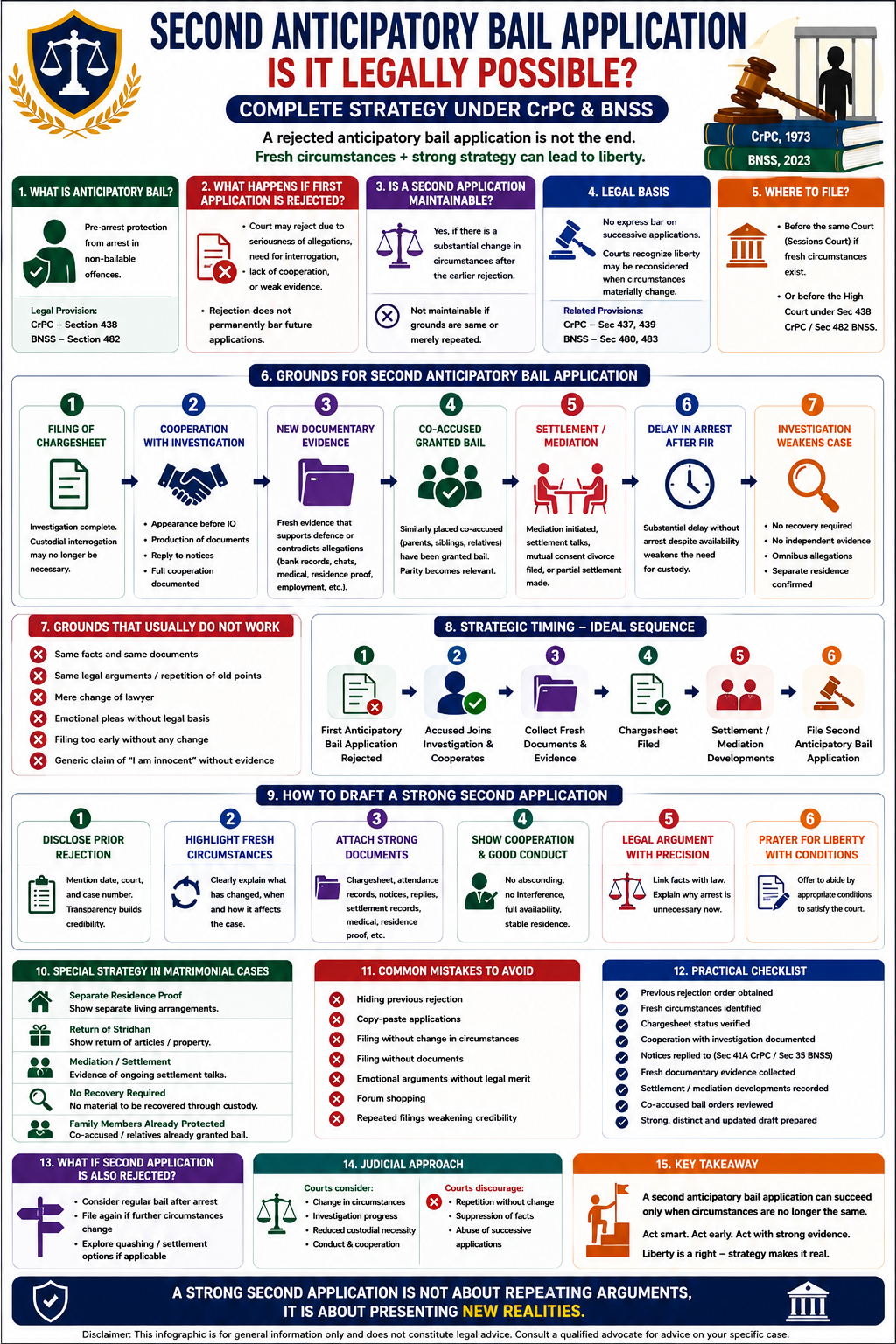

Posted in Legal Procedure | Tagged Anticipatory bail BNSS Code of Criminal Procedure family law Legal Strategies and Defence legal strategy and defence matrimonial offences | Leave a comment

Post navigation

  • Older posts
  • Newer posts

Search within entire Content of “Shades of Knife”

My Legal X Timeline

Advocate Sandeep Pamarati 🇮🇳💪👨🏻‍🎓 Follow

AP High Court Advocate with M Tech (CS) || 12 years in 'Software Industry' as Solution Architect || Blogs at https://t.co/29CB9BzK4w || #TDPTwitter

SandeepPamarati
Retweet on Twitter Advocate Sandeep Pamarati 🇮🇳💪👨🏻‍🎓 Retweeted
futurestacked Future Stacked @futurestacked ·
23 Jun

Your Gmail account is not an email account.

It is the master key to your bank, your crypto, your Apple ID, your PayPal, and every password you have ever saved.

One breach and all your passwords are gone.

Lock it down with these 7 easy steps 👇

Reply on Twitter 2069354786743374317 Retweet on Twitter 2069354786743374317 115 Like on Twitter 2069354786743374317 324 X 2069354786743374317
Retweet on Twitter Advocate Sandeep Pamarati 🇮🇳💪👨🏻‍🎓 Retweeted
thisguyknowsai Brady Long @thisguyknowsai ·
22 Jun

A German psychologist proved in 1885 that cramming erases what you learned within 48 hours. He published the fix in the same book. Almost no school on Earth has adopted it in 140 years.

His name was Hermann Ebbinghaus.

He had no lab. No funding. No colleagues.

He worked alone

Reply on Twitter 2068965021514891696 Retweet on Twitter 2068965021514891696 970 Like on Twitter 2068965021514891696 2850 X 2068965021514891696
Retweet on Twitter Advocate Sandeep Pamarati 🇮🇳💪👨🏻‍🎓 Retweeted
factcheckapgov FactCheck.AP.Gov.in @factcheckapgov ·
22 Jun

ఎంతో ప్రతిష్టాత్మకంగా నిర్వహించి ప్రజల ఆరోగ్యం పట్ల అవగాహన కల్పించిన అంతర్జాతీయ యోగా దినోత్సవం సందర్భంగా రాష్ట్రం లో పలుచోట్ల నిర్వహించిన యోగా కార్యక్రమం పై కొందరు తప్పుడు ప్రచారం చేస్తున్నారు. ఈ కార్యక్రమం కోసం రూ. 600 కోట్లు ఖర్చు అయినట్లు చెప్పడం పూర్తిగా అసత్యం. రాష్ట్రంలో

Reply on Twitter 2068972932827869255 Retweet on Twitter 2068972932827869255 39 Like on Twitter 2068972932827869255 89 X 2068972932827869255
Retweet on Twitter Advocate Sandeep Pamarati 🇮🇳💪👨🏻‍🎓 Retweeted
jaitdp Telugu Desam Party @jaitdp ·
22 Jun

చీఫ్ మినిస్టర్.. టీచర్ అయిన వేళ

అంగన్వాడీ కేంద్రాన్ని సందర్శించిన సీఎం చంద్రబాబు కాసేపు టీచర్‌గా మారి, పిల్లల అభ్యసనం ఎలా ఉందో తెలుసుకున్నారు. ఇంగ్లీష్ ఆల్ఫాబెట్స్ చెప్పమని సీఎం అడిగేసరికి పిల్లలు చక్కగా చెప్పారు.
#ChandrababuNaidu
#AndhraPradesh

Reply on Twitter 2068873963246399922 Retweet on Twitter 2068873963246399922 75 Like on Twitter 2068873963246399922 314 X 2068873963246399922
Load More

Recent Posts

  • Checklist Before Filing Quashing Petition – Complete Practical Guide June 25, 2026
  • Affidavit of Cooperation with Investigation – Format, Legal Requirements & Sample Draft June 25, 2026
  • Vijay R. Nair Vs Lijitha on 12 Jun 2026 June 24, 2026
  • Pavul Yesu Dhasan Vs Registrar SHRC of TN and Ors on 30 Apr 2025 June 18, 2026
  • Manoj Kumar Vs Nita Bharti on 17 Mar 2026 June 17, 2026

Most Read Posts

  • Reply to Section 41A CrPC Notice – Format with Legal Explanation (4,949 views)
  • Anu Aggarwal Vs Sushant Aggarwal on 20 Jan 2026 (3,489 views)
  • Umme Farva Vs State of U.P. and Anr on 14 Jan 2026 (3,377 views)
  • Charge Sheet and Final Report Explained (2,823 views)
  • Regular Bail Application Format (Section 437/439 CrPC) (2,201 views)
  • Neha Lal Vs Abhishek Kumar on 20 Jan 2026 (2,006 views)
  • Arrest Procedure in 498A cases after Arnesh Kumar (1,939 views)
  • Discharge Application Format in 498A Case – Draft, Procedure & Sample Template (1,783 views)
  • Can You Travel Abroad After an FIR Is Registered? – Legal Position Explained (1,702 views)
  • Atul Kumar Bajpai Vs State of UP and Anr on 17 Sep 2025 (1,544 views)

Tags

Reportable Judgement or Order (433)2-Judge (Division) Bench Decision (414)Legal Procedure Explained - Interpretation of Statutes (382)Landmark Case (381)1-Judge Bench Decision (362)Catena of Landmark Judgments Referred/Cited to (293)Work-In-Progress Article (215)3-Judge (Full) Bench Decision (101)Sandeep Pamarati (92)Article 21 - Protection of life and personal liberty (80)Issued or Recommended Guidelines or Directions or Protocols to be followed (71)Perjury Under 340 CrPC (66)Absurd Or After Thought Or Baseless Or False Or General Or Inherently Improbable Or Improved Or UnSpecific Or Omnibus Or Vague Allegations (62)Reprimands or Setbacks to YCP Govt of Andhra Pradesh (49)Summary Post (47)CrPC 482 - Quash (44)HM Act Sec 13 - Divorce Granted to Husband (42)Divorce granted on Cruelty ground (42)Legal Terrorism (41)Not Authentic copy hence to be replaced (40)

Categories

Supreme Court of India Judgment or Order or Notification (753)Bare Acts or State Amendments or Statutes or GOs or Notifications issued by Central or State Governments (328)High Court of Andhra Pradesh Judgment or Order or Notification (186)High Court of Delhi Judgment or Order or Notification (164)High Court of Bombay Judgment or Order or Notification (112)High Court of Karnataka Judgment or Order or Notification (93)Legal Procedure (79)High Court of Madras Judgment or Order or Notification (70)High Court of Allahabad Judgment or Order or Notification (61)LLB Study Material (59)General Study Material (56)High Court of Punjab & Haryana Judgment or Order or Notification (52)Assorted Court Judgments or Orders or Notifications (50)High Court of Kerala Judgment or Order or Notification (47)Prakasam DV Cases (46)Judicial Activism (for Public Benefit) (45)District or Sessions or Magistrate Court Judgment or Order or Notification (44)High Court of Madhya Pradesh Judgment or Order or Notification (38)High Court of Gujarat Judgment or Order or Notification (28)High Court of Calcutta Judgment or Order or Notification (27)

Recent Comments

  • eCourts India on Compromise-Based Quashing in Matrimonial Cases – Complete Legal Strategy
  • The Divorce Law Firm on Life Cycle Stages of a Divorce case
  • The Divorce Law Firm on Life Cycle Stages of a Divorce case
  • ShadesOfKnife on Sandeep Pamarati Vs Ungrateful Knife (IPC 498A Case)
  • KONURU VINAYKUMAR on Sandeep Pamarati Vs Ungrateful Knife (IPC 498A Case)

Archives of SoK

  • June 2026 (12)
  • May 2026 (24)
  • April 2026 (33)
  • March 2026 (42)
  • February 2026 (30)
  • January 2026 (21)
  • December 2025 (2)
  • November 2025 (3)
  • October 2025 (17)
  • September 2025 (12)
  • August 2025 (5)
  • July 2025 (10)
  • June 2025 (15)
  • May 2025 (3)
  • April 2025 (10)
  • March 2025 (7)
  • February 2025 (8)
  • January 2025 (1)
  • December 2024 (3)
  • November 2024 (4)
  • October 2024 (16)
  • September 2024 (15)
  • August 2024 (14)
  • July 2024 (11)
  • June 2024 (18)
  • May 2024 (13)
  • April 2024 (9)
  • March 2024 (23)
  • February 2024 (15)
  • January 2024 (11)
  • December 2023 (11)
  • November 2023 (9)
  • October 2023 (13)
  • September 2023 (12)
  • August 2023 (15)
  • July 2023 (17)
  • June 2023 (11)
  • May 2023 (6)
  • April 2023 (5)
  • March 2023 (10)
  • February 2023 (9)
  • January 2023 (12)
  • December 2022 (12)
  • November 2022 (8)
  • October 2022 (13)
  • September 2022 (17)
  • August 2022 (10)
  • July 2022 (21)
  • June 2022 (27)
  • May 2022 (23)
  • April 2022 (32)
  • March 2022 (17)
  • February 2022 (6)
  • January 2022 (2)
  • December 2021 (7)
  • November 2021 (7)
  • October 2021 (6)
  • September 2021 (10)
  • August 2021 (31)
  • July 2021 (45)
  • June 2021 (17)
  • May 2021 (17)
  • April 2021 (18)
  • March 2021 (58)
  • February 2021 (14)
  • January 2021 (50)
  • December 2020 (35)
  • November 2020 (68)
  • October 2020 (67)
  • September 2020 (28)
  • August 2020 (41)
  • July 2020 (20)
  • June 2020 (36)
  • May 2020 (40)
  • April 2020 (38)
  • March 2020 (26)
  • February 2020 (43)
  • January 2020 (35)
  • December 2019 (34)
  • November 2019 (4)
  • October 2019 (18)
  • September 2019 (57)
  • August 2019 (33)
  • July 2019 (12)
  • June 2019 (18)
  • May 2019 (5)
  • April 2019 (19)
  • March 2019 (58)
  • February 2019 (11)
  • January 2019 (90)
  • December 2018 (97)
  • November 2018 (43)
  • October 2018 (31)
  • September 2018 (73)
  • August 2018 (47)
  • July 2018 (143)
  • June 2018 (92)
  • May 2018 (97)
  • April 2018 (59)
  • March 2018 (8)

Blogroll

  • Daaman Promoting Harmony 0
  • Fight against Legal Terrorism Fight against Legal Terrorism along with MyNation Foundation 0
  • Good Morning Good Morning News 0
  • Insaaf India Insaaf Awareness Movement 0
  • MyNation Hope Foundation Wiki 0
  • MyNation.net Equality, Justice and Harmony 0
  • Sarvepalli Legal 0
  • Save Indian Family Save Indian Family Movement 0
  • SIF Chandigarh SIF Chandigarh 0
  • The Male Factor The Male Factor 0
  • Unitedmen Foundation a dedicated community forged with the mission to unite men facing legal challenges in marital disputes. 0
  • Vaastav Foundation The Social Reality 0
  • Vinayak my2centsworth – This blog is for honest law abiding men, married or planning to get married 0
  • Voice4india Indian Laws, Non-profits, Environment 0
  • Writing Law Writing Law by Ankur 0

RSS Cloudflare Status

  • ARN (Stockholm) on 2026-06-25 June 25, 2026
    THIS IS A SCHEDULED EVENT Jun 25, 00:00 - 05:00 UTC Jun 19, 14:18 UTC Scheduled - We will be performing scheduled maintenance in ARN (Stockholm) datacenter on 2026-06-25 between 00:00 and 05:00 UTC.Traffic might be re-routed from this location, hence there is a possibility of a slight increase in latency during this maintenance window […]
  • Issues with granular roles for Cloudflare Tunnel and Mesh June 24, 2026
    Jun 24, 17:30 UTC Resolved - This incident has been resolved. Jun 24, 15:16 UTC Investigating - Cloudflare is investigating permission issues with resource-based granular roles where a subset of users are not being granted access to their scoped Cloudflare Tunnel and Cloudflare Mesh resources.This specifically impacts users attempting to view, configure, or manage individual […]
  • ARN (Stockholm) on 2026-06-24 June 24, 2026
    Jun 24, 05:00 UTC Completed - The scheduled maintenance has been completed. Jun 24, 00:00 UTC In progress - Scheduled maintenance is currently in progress. We will provide updates as necessary. Jun 19, 13:08 UTC Scheduled - We will be performing scheduled maintenance in ARN (Stockholm) datacenter on 2026-06-24 between 00:00 and 05:00 UTC.Traffic might […]

RSS List of Spam Server IPs from Project Honeypot

  • 35.227.38.56 | S June 24, 2026
    Event: Bad Event | Total: 19 | First: 2026-06-24 | Last: 2026-06-24
  • 34.139.125.155 | SD June 24, 2026
    Event: Bad Event | Total: 11 | First: 2026-06-24 | Last: 2026-06-24
  • 77.83.39.38 | S June 24, 2026
    Event: Bad Event | Total: 237 | First: 2026-05-12 | Last: 2026-06-24
Owned and Operated by Advocate Sandeep Pamarati
Proudly powered by WordPress
Theme: Flint by Star Verte LLC

Bad Behavior has blocked 1573 access attempts in the last 7 days.

pixel