web analytics

Menu

Skip to content
Shades of Knife
  • Home
  • True Colors of a Vile Wife
  • Need Inspiration?
  • Blog Updates
  • SOK Gallery
  • Vile News Reporter
  • About Me
  • Contact Me

Shades of Knife

True Colors of a Vile Wife

Author: Suprajaa Rajan

Legal Strategies and Defence – A practical legal guide

Posted on February 23 by Suprajaa Rajan

Facing a criminal complaint, matrimonial dispute, FIR, arrest threat, trial, or court proceedings can be overwhelming. Every stage of litigation requires a different legal approach.

This Legal Strategies & Defence Guide provides practical legal information, procedural guidance, and defence strategies to help individuals understand their rights and take informed decisions.

The guides are arranged according to different stages of a legal dispute — from early warning signs, FIR registration, arrest, bail, investigation, trial, settlement, and post-litigation remedies.

Matrimonial Criminal Litigation – Complete Defence & Strategy Guides

For individuals facing matrimonial disputes, criminal complaints, or allegations arising from marital conflicts.

Explore:

  1. Matrimonial Criminal Litigation – The Complete Defence Guide here.
    Understand defence strategy, legal rights, evidence preparation, and practical steps when facing matrimonial criminal proceedings.
  2. Matrimonial Criminal Litigation – The Complete Prosecution Strategy Guide here. 
    Understand how complainants approach matrimonial criminal cases and the legal framework involved.
  3. Falsely Accused Under Section 498A IPC – Legal Defence Strategy here. 
    Learn the steps to protect yourself against false or exaggerated allegations.
  4. False Domestic Violence Allegations – Legal Defence Strategy in India here. 
    Understand available remedies and defence planning against misuse of domestic violence proceedings.
  5. Top 10 Mistakes Accused Make in Matrimonial Cases – And How to Avoid Them here.
    Avoid common errors that can negatively impact your defence.
  6. How Courts Quash Omnibus Allegations in Matrimonial FIRs – Case Study here. 
    Understand how courts examine vague and general allegations.
  7. Myth vs Reality: Bail in 498A Cases – Legal Position Explained here.
    Understand practical bail considerations in matrimonial offences.
  8. Defence Strategy When Elderly Parents Are Named in FIR here.
    Learn how elderly family members can protect themselves when unnecessarily implicated.

Arrest Protection & Bail Strategy

For individuals facing arrest, police action, or criminal proceedings.

Explore:

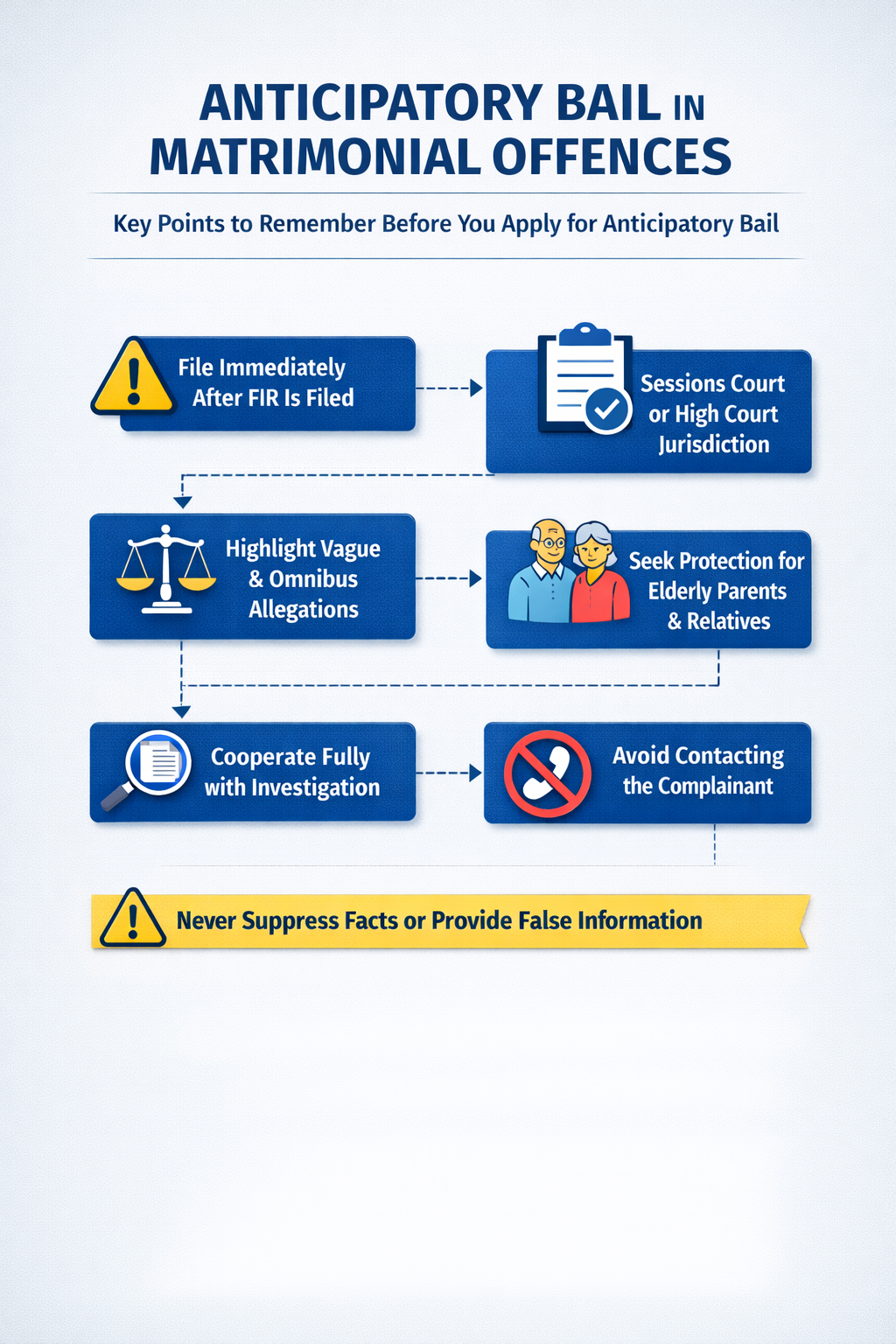
9. Anticipatory Bail in Matrimonial Offences – Complete Guide here.
Understand pre-arrest protection, procedure, and strategy.

10. Arrest Procedure in 498A Cases After Arnesh Kumar here.
Learn arrest safeguards and important legal protections.

11. Second Anticipatory Bail Application – Is It Legally Possible? Complete Strategy here.
Understand when a second bail application may be considered.

12. Bail Conditions – How to Avoid Cancellation of Bail here.
Learn how to comply with bail conditions and avoid cancellation.

13. How to Prepare for Police Interrogation? – Legal Rights and Practical Guidance here.
Understand what to do and what to avoid during investigation.

14. Can You Travel Abroad After an FIR Is Registered? – Legal Position Explained here.
Understand travel restrictions, court permissions, and practical steps.

15. Passport Implications in 498A Cases – A Complete Practical Guide here.

Understand how FIRs, bail conditions, court permissions, and pending criminal proceedings can affect passport renewal, travel abroad, and immigration decisions.

FIR, Investigation & Chargesheet Defence Strategy

For individuals dealing with police complaints and criminal proceedings.

Explore:

16. Quashing of FIR Under Section 482 CrPC – Explained here. 
Understand when High Courts can stop criminal proceedings.

17. Checklist Before Filing Quashing Petition – Complete Practical Guide here.
A step-by-step preparation guide before approaching the High Court.

18. Compromise-Based Quashing in Matrimonial Cases – Complete Legal Strategy here. 
Understand how settlement may help resolve matrimonial criminal cases.

19. What to Do After Chargesheet Is Filed – Defence Strategy here.
Learn the next steps after investigation is complete.

20. Speedy Trial Rights in Matrimonial Litigation here.
Understand your right to timely proceedings.

Investigation, Evidence & Trial Defence Strategy

For individuals whose matters have progressed to court proceedings.

Explore:

21. What to Say (and Not Say) During Investigation – A Practical Legal Guide here. 
Learn how communication during investigation can affect your case.

22. Cross-Examination Strategy in 498A Trials – Defence Tactics That Can Change the Outcome here. 
Understand how witness examination impacts trial results.

23. How to Handle Hostile Witnesses in Criminal Trials – Complete Defence Strategy here.
Learn how courts evaluate witnesses who change testimony.

24. Objections a Defence Advocate Can Raise When the Prosecution Produces Documentary Evidence – Complete Trial Strategy Guide here.
Understand how documentary evidence can be challenged.

Court Remedies & Procedural Challenges

For challenging unfair proceedings or seeking legal remedies.

Explore:

25. How to Challenge Ex Parte Orders in Criminal and Matrimonial Proceedings – Legal Remedies here. 
Learn available options against orders passed without your presence.

26. When Can Court Cancel Exemption Under Section 205 CrPC – Explained here. 
Understand when personal appearance exemption may be withdrawn.

27. How to Seek Compensation for False Arrest in India? here. 
Understand legal remedies available after wrongful arrest.

28. When to File Defamation for False Allegations – Legal Strategy here. 
Learn when false allegations may justify defamation proceedings.

29. Petition Prayers Are Not Final Outcomes – Understanding Legal Strategy Before Making Decisions here.

Understand why allegations and prayers are only requests — and how final court outcomes depend on legal evaluation.

Maintenance & Financial Dispute Strategy

For cases involving financial claims and maintenance disputes.

Explore:

30. How to Defend Excessive Maintenance Claims in Matrimonial Cases here. 
Understand legal grounds to challenge unreasonable maintenance demands.

31. Reducing Maintenance – Legal Grounds and Strategy here. 
Learn when maintenance amounts may be modified.

32. Strategic Divorce Filing After Criminal Complaint – A Legal Perspective here. 
Understand timing and strategy behind divorce proceedings.

Settlement & Resolution Strategy

For individuals looking for practical ways to resolve disputes.

Explore:

33. Compromise-Based Quashing in Matrimonial Cases – Complete Legal Strategy here. 
Understand settlement-based closure of criminal proceedings.

34. Warning Signs of Escalating Matrimonial Litigation – Early Red Flags Every Spouse Should Recognise here. 
Identify early indicators before disputes become prolonged litigation.

35. How to Protect Reputation During Criminal Litigation – Complete Legal & Practical Strategy here.
Learn how to protect professional and personal reputation during legal proceedings.

Digital Evidence & Reputation Protection

Modern litigation often depends heavily on digital records.

Explore:

36. How to Protect Digital Evidence in Matrimonial Disputes – A Practical Legal Guide here.
Learn how to preserve chats, emails, recordings, and online evidence.

37. How to Protect Reputation During Criminal Litigation – Complete Legal & Practical Strategy here.
Understand digital reputation management and responsible legal communication.

Advocate Complaints & Professional Ethics

For clients facing issues with legal representation.

Explore:

38. How to File a Complaint Against an Advocate in India – A First-Timer’s Complete Guide here.
Understand the process, documents required, and disciplinary mechanism.


Need Legal Strategy for Your Situation?

Every case depends on its facts, evidence, and procedural stage.

A timely legal strategy can help you:

  • Protect your rights
  • Avoid procedural mistakes
  • Preserve important evidence
  • Make informed decisions
  • Prepare effectively for litigation

Posted in Legal Procedure | Leave a comment

What To Do If You Are Falsely Accused Under Section 498A IPC

Posted on February 23 by Suprajaa Rajan

Introduction

Being named in an FIR under Section 498A of the Indian Penal Code can be legally and emotionally overwhelming. The provision deals with cruelty by a husband or his relatives toward a married woman. It is cognizable and non-bailable, which means arrest is legally permissible without a warrant.

However, courts have repeatedly recognised that vague and omnibus allegations should not automatically result in arrest or prosecution.

If you believe the complaint is false or exaggerated, you must act strategically and immediately. This guide explains the precise legal steps you should take.

I. Understand the Nature of Section 498A IPC

Indian Penal Code :

Section 498A defines cruelty as:

  • Wilful conduct likely to drive a woman to suicide, or

  • Harassment in connection with unlawful dowry demands.

Mere marital discord, incompatibility, or trivial disputes do not automatically amount to statutory cruelty.

II. Do Not Panic or Engage in Direct Confrontation

Avoid contacting the complainant to “settle” the issue emotionally. Any communication may later be produced as evidence.

Do not:

  • Threaten

  • Argue

  • Attempt private coercive settlement

Instead, consult a criminal law practitioner immediately.

III. Secure Anticipatory Bail Without Delay

If arrest appears imminent, file for anticipatory bail under:

Code of Criminal Procedure, 1973

Specifically under Section 438 CrPC.

The Supreme Court in Arnesh Kumar v. State of Bihar held that automatic arrests in 498A cases violate personal liberty. Police must comply with Section 41 and 41A CrPC safeguards before arrest.

Anticipatory bail protects you from custodial detention during investigation.

Read also : “Anticipatory Bail in Matrimonial Offences – Complete Guide”

IV. Collect and Preserve Documentary Evidence

Your defence begins with documentation.

Secure:

  • WhatsApp chats and emails

  • Call records

  • Bank transactions

  • Proof of financial transfers

  • Travel history

  • Medical records

  • Photographs and CCTV footage

  • Witness details

Preserve electronic evidence in original format. Do not tamper with devices.

V. Evaluate Grounds for Quashing the FIR

If the complaint contains:

  • Vague allegations

  • No specific date or incident

  • General accusations against distant relatives

  • No specific dowry demand

You may approach the High Court under Section 482 CrPC seeking quashing.

The Supreme Court in State of Haryana v. Bhajan Lal laid down categories where criminal proceedings may be quashed, especially when allegations do not disclose a prima facie offence or appear mala fide.

Read also : “File a Discharge or Quash petition”

VI. Challenge Illegal Arrest or Procedural Violations

If police arrest without complying with Section 41 CrPC safeguards, you may:

  • Seek immediate bail

  • Move for departmental action

  • File writ petition for violation of Article 21 rights

Personal liberty remains constitutionally protected.

VII. Avoid Counter-Litigation in Anger

Filing multiple retaliatory complaints may weaken your credibility.

Instead, take structured legal action such as:

  • Defamation proceedings (in appropriate cases)

  • Petition for restitution or divorce

  • Application for discharge at charge stage

Each step must align with long-term strategy.

VIII. Understand the Investigation Process

After FIR registration:

  1. Police record statements under Section 161 CrPC

  2. Evidence is collected

  3. Charge sheet may be filed before Magistrate

If evidence is weak, you may seek discharge before trial begins.

Read also : “Lifecycle stages of a Section 498A IPC case”

IX. Protect Elderly Parents and Relatives

Courts frequently criticise the practice of implicating all family members without specific allegations.

If distant relatives are named without overt acts, this strengthens grounds for quashing.

Courts consistently hold that criminal law cannot be used as a tool for matrimonial pressure.

X. Maintain Dignity and Composure

498A litigation often accompanies:

  • Domestic Violence proceedings

  • Maintenance claims

  • Divorce petitions

Coordinate defence strategy across all proceedings. Fragmented legal responses create contradictions.

Conclusion

A false accusation under Section 498A IPC demands calm, structured, and legally sound action. Panic or retaliation worsens the situation.

Indian courts recognise misuse concerns. They insist on procedural safeguards and evidentiary scrutiny. Early anticipatory bail, evidence preservation, and strategic litigation under Section 482 CrPC can prevent prolonged harassment.

Criminal law must protect genuine victims. It must not become an instrument of coercion in matrimonial disputes.


Frequently Asked Questions

No. After Arnesh Kumar, police must justify arrest under Section 41 CrPC.

Yes. High Courts exercise inherent powers under Section 482 CrPC where allegations fail to disclose an offence.

It is generally non-compoundable, but courts may quash proceedings in case of genuine settlement.

Courts discourage prosecution based on vague or omnibus statements.

Posted in Legal Procedure | Tagged bhajan lal principles CrPC Sec 438 - Anticipatory Bail Dowry Case Law False 498A case Quashing of FIR Section 498A IPC | Leave a comment

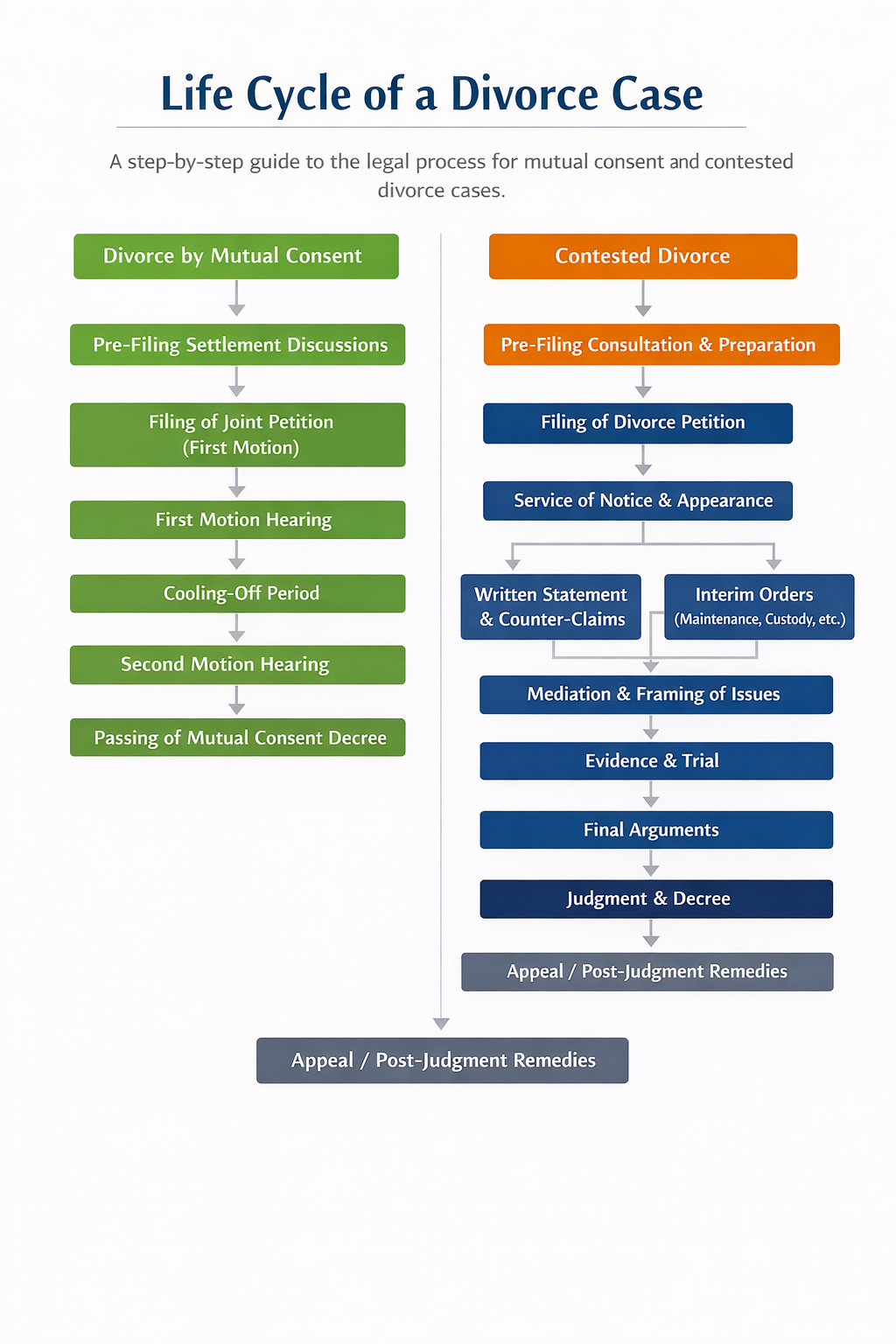
Life Cycle Stages of a Divorce case

Posted on February 19 by Suprajaa Rajan

A divorce case follows a structured legal pathway, and understanding each stage enables individuals to approach the process with preparedness and clarity.

Here is a Detailed Step-by-Step Guide to Divorce by Mutual Consent and Contested Divorce in India.

Divorce is a formal legal process through which a valid marriage is dissolved by a court of law. The procedure follows a structured framework under personal laws and procedural statutes. In India, divorce proceedings are primarily governed by personal laws such as the Hindu Marriage Act, 1955, the Special Marriage Act, 1954, and procedural provisions under the Code of Civil Procedure, 1908.

This article explains the complete life cycle of a divorce case. It focuses on two major types of divorce proceedings: divorce by mutual consent and contested divorce.

Types of Divorce Cases

1. Divorce by Mutual Consent

Divorce by mutual consent arises when both spouses agree to dissolve the marriage. They mutually decide that they can no longer live together harmoniously. Section 13B of the Hindu Marriage Act, 1955 provides for divorce by mutual consent.

Both parties must agree on key issues before filing the petition. These issues include child custody, maintenance, alimony, and division of property.
The agreement must reflect free will and absence of coercion. Courts encourage this method because it reduces emotional and financial strain.
This process is generally faster than contested divorce proceedings.

2. Contested Divorce

A contested divorce occurs when one spouse files for divorce without the consent of the other spouse. The petitioner must prove legally recognised grounds for divorce. Section 13 of the Hindu Marriage Act, 1955 lists grounds such as cruelty, adultery, desertion, conversion, mental disorder, and others.

The respondent may oppose the petition and deny the allegations. The matter then proceeds through evidence, trial, and judicial determination.
Contested divorces often require detailed examination of facts and legal arguments.

1. Stage One: Pre-Filing Consultation and Legal Preparation

The divorce process usually begins with legal consultation. A spouse consults an advocate to understand rights, obligations, and potential outcomes.
The lawyer evaluates the facts to determine whether grounds for divorce exist.

At this stage, parties gather essential documents. These documents include the marriage certificate, proof of residence, identity documents, and evidence supporting allegations. Financial documents such as income statements and property records are also collected.

In mutual consent cases, spouses negotiate settlement terms before filing.In contested cases, the petitioner prepares factual pleadings and supporting material.

Legal preparation ensures clarity and reduces procedural delays.

2. Stage Two: Filing of the Divorce Petition

The formal process begins when the petitioner files a divorce petition before the competent Family Court. Jurisdiction depends on place of marriage, last residence together, or current residence of the respondent.

The petition contains material facts of the marriage. It states the date of marriage, details of children, and grounds for divorce. It also specifies relief sought, including dissolution of marriage, custody, maintenance, and litigation expenses.

In mutual consent divorce, both parties jointly file a petition under Section 13B. In contested divorce, only one spouse files the petition citing statutory grounds.

After scrutiny, the court registers the case and assigns a case number. The court then issues notice to the respondent.

3. Stage Three: Service of Notice and Appearance

The court ensures proper service of notice upon the respondent. Service of notice guarantees adherence to principles of natural justice. The respondent must receive an opportunity to present a defence.

The notice specifies the next hearing date. The respondent must appear personally or through legal counsel.Failure to appear may result in ex-parte proceedings.

Proper service validates further proceedings in the case.

4. Stage Four: Filing of Written Statement and Counter-Claims

In contested divorce cases, the respondent files a written statement. The written statement responds to each allegation in the petition. The respondent may admit, deny, or explain specific claims.The respondent may also raise counter-claims seeking independent relief. Counter-claims may include restitution of conjugal rights or custody rights.

In mutual consent cases, both parties submit affidavits confirming voluntary agreement. The court verifies that consent is genuine and informed.

This stage defines the scope of dispute between parties.

5. Stage Five: Interim Applications and Temporary Relief

During pendency of the case, parties may seek interim relief. Section 24 of the Hindu Marriage Act allows maintenance pendente lite and litigation expenses. Either spouse may apply for interim financial support.

Courts may also pass temporary custody orders in the best interest of the child. Interim protection orders ensure stability during litigation.

The court evaluates financial capacity and needs before granting interim relief. These orders remain effective until final judgment.

6. Stage Six: Mediation and Reconciliation Efforts

Family Courts often refer parties to mediation or conciliation. Section 9 of the Family Courts Act encourages settlement efforts. Mediation promotes amicable resolution without prolonged litigation. A neutral mediator facilitates constructive dialogue. Parties may resolve disputes regarding custody and property during mediation.

If mediation succeeds, parties record settlement terms before the court.
If mediation fails, the case proceeds to trial.

7. Stage Seven: Framing of Issues

In contested divorce, the court frames issues for determination. Issues identify disputed questions of fact and law. Each issue requires evidence and adjudication. For example, the court may frame an issue on whether cruelty occurred. The court may also frame issues regarding entitlement to maintenance.

Framing of issues narrows the scope of trial.
It provides procedural clarity to both parties.

8. Stage Eight: Evidence and Trial

The trial stage begins with the petitioner presenting evidence. Evidence may include documents, photographs, medical reports, or electronic records.
Witnesses may testify in support of allegations.

The respondent cross-examines the petitioner’s witnesses. Cross-examination tests credibility and factual accuracy.After the petitioner closes evidence, the respondent presents defence evidence. The petitioner may cross-examine defence witnesses.

The court records all testimonies systematically. The trial ensures procedural fairness and evidentiary scrutiny.

9. Stage Nine: Final Arguments

After completion of evidence, the court schedules final arguments. Advocates summarise factual findings and legal provisions. They cite relevant precedents to strengthen submissions.

The judge evaluates oral and written arguments carefully. The court may raise clarificatory questions during arguments. Final arguments provide an opportunity to persuade the court.

10. Stage Ten: Judgment and Decree

After considering pleadings, evidence, and arguments, the court delivers judgment. The judgment explains reasoning and legal conclusions. If grounds are proved, the court grants a decree of divorce. The decree formally dissolves the marriage. The court also decides maintenance, custody, and property disputes.

In mutual consent cases, the court grants decree after second motion confirmation. The decree becomes effective upon pronouncement.

11. Post-Judgment Remedies and Appeal

An aggrieved party may file an appeal before a higher court. Appeals must comply with statutory limitation periods. The appellate court reviews legal and procedural correctness. Parties may also seek modification of custody or maintenance orders. Courts entertain modification applications upon change in circumstances.

Conclusion

A divorce case follows a structured and legally regulated life cycle.
Divorce by mutual consent offers a cooperative and time-efficient resolution.
Contested divorce involves detailed judicial examination and trial.

Each stage safeguards fairness, transparency, and due process.
Understanding the procedure empowers individuals to approach the process confidently.
Proper legal guidance and informed decision-making significantly improve outcomes.


Other Life Cycles: 498A IPC Case Lifecycle || Maintenance Case u/s 125 CrPC Lifecycle. Index of all life cycles is here.


Key Contributor:
Mrs Suprajaa Rajan B.Com, LL.B., LL.M.
+91-9606345150

Posted in Legal Procedure | Tagged HM Act Sec 13 - Divorce HM Act Sec 13B - Divorce by Mutual Consent Life Cycle Stages of a Divorce case Life Cycles of Various case types | 2 Comments

Post navigation

  • Newer posts

Search within entire Content of “Shades of Knife”

My Legal X Timeline

Advocate Sandeep Pamarati 🇮🇳💪👨🏻‍🎓 Follow

AP High Court Advocate with M Tech (CS) || 12 years in 'Software Industry' as Solution Architect || Blogs at https://t.co/29CB9BzK4w || #TDPTwitter

SandeepPamarati
Retweet on Twitter Advocate Sandeep Pamarati 🇮🇳💪👨🏻‍🎓 Retweeted
rtvnewsnetwork RTV @rtvnewsnetwork ·
3 Aug

తిరుమల..

తిరుమలలో జాతీయ జెండాను ప్రదర్శించవద్దని అడ్డుకున్న విజిలెన్స్..!

శ్రీవారి ఆలయం వద్ద జాతీయ జెండాతో వచ్చిన యాత్రికుడు..

జెండా తొలగించాలని విజిలెన్స్ సిబ్బంది ఆదేశం...
నిరాకరించడంతో జెండా తీసివేసినట్లు సమాచారం..

ఘటనపై భక్తుల నుంచి ఆగ్రహం..

వీడియో సోషల్ మీడియాలో

Reply on Twitter 2084100188193317099 Retweet on Twitter 2084100188193317099 69 Like on Twitter 2084100188193317099 387 X 2084100188193317099
Retweet on Twitter Advocate Sandeep Pamarati 🇮🇳💪👨🏻‍🎓 Retweeted
kanekoathegreat KanekoaTheGreat @kanekoathegreat ·
2 Aug

RFK Jr. blasts CNN's Dana Bash over COVID:

BASH: "You're the HHS security and you're leading to vaccine hesitancy."

KENNEDY: "Do you see your job as ending vaccine hesitancy or telling the truth?"

BASH: "The truth is that there is study after study."

KENNEDY: "You're

Reply on Twitter 2084032302464860218 Retweet on Twitter 2084032302464860218 2201 Like on Twitter 2084032302464860218 9885 X 2084032302464860218
Retweet on Twitter Advocate Sandeep Pamarati 🇮🇳💪👨🏻‍🎓 Retweeted
capitallens_ Pratham @capitallens_ ·
3 Aug

Reality Check 🤐

A men tested 1 batch of Everest Garam Masala in lab costing ₹28,000.

After testing, the results that came will shock you:

Azoxystrobin (Pesticide used in Masala):

Limit~ 0.1 mg/kg
Actual~ 0.200 mg/kg
Difference~ 2x

Means according to FSSAI standards limits

Reply on Twitter 2084166590602563711 Retweet on Twitter 2084166590602563711 1692 Like on Twitter 2084166590602563711 5420 X 2084166590602563711
Retweet on Twitter Advocate Sandeep Pamarati 🇮🇳💪👨🏻‍🎓 Retweeted
sailu_jsp Sailu🦚 @sailu_jsp ·
3 Aug

అదే Kalyan గారు అధికారంలోకి వచ్చిన 24 నెలలలో ఈ కళాకారుల కోసం ప్రత్యేకంగా "WoodBanks" ఏర్పాటుచేశారు👏🏻🙏🏻

"మీ దయ వలన అంకుడు కర్రకు ఐతే ఎటువంటి ఇబ్బంది లేకుండా అయ్యింది Sir '"🙏🏻😊

:- AP హస్తకళా ప్రదర్శన మహోత్సవంలో

మన Hon'ble @APDeputyCMO శ్రీ @PawanKalyan గారితో కళాకారులు ❣️

Reply on Twitter 2084209810027979069 Retweet on Twitter 2084209810027979069 97 Like on Twitter 2084209810027979069 300 X 2084209810027979069
Load More

Recent Posts

  • Ishwar Chand Sharma and Ors Vs State of U.P. on 29 May 2026 July 26, 2026
  • Prabhakar Yeshwant Masram and Anr Vs Sou Tula Namdeorao Jaipurkar and Anr on 21 Jul 2026 July 26, 2026
  • Shikha Lall Vs Prince Agarwal on 7 Nov 2024 July 21, 2026
  • Pranjal Poddar and Ors Vs Shivani Gupta on 21 Apr 2026 July 21, 2026
  • Sharad Kumar Pandey Vs Mamta Pandey on 1 Sep 2010 July 21, 2026

Most Read Posts

  • Reply to Section 41A CrPC Notice – Format with Legal Explanation (5,148 views)
  • Charge Sheet and Final Report Explained (3,178 views)
  • Regular Bail Application Format (Section 437/439 CrPC) (2,552 views)
  • Arrest Procedure in 498A cases after Arnesh Kumar (2,151 views)
  • Discharge Application Format in 498A Case – Draft, Procedure & Sample Template (2,092 views)
  • Can You Travel Abroad After an FIR Is Registered? – Legal Position Explained (2,061 views)
  • Life Cycle of a Perjury Case (2,040 views)
  • Application for Certified Copy of FIR – Format, Procedure and Sample Draft (1,778 views)
  • Appeal, Revision and Review Explained (1,748 views)
  • Life Cycle Stages of a Restitution of Conjugal Rights Case (1,709 views)

Tags

Reportable Judgement or Order (439)2-Judge (Division) Bench Decision (424)Legal Procedure Explained - Interpretation of Statutes (387)Landmark Case (384)1-Judge Bench Decision (370)Catena of Landmark Judgments Referred/Cited to (298)Work-In-Progress Article (215)3-Judge (Full) Bench Decision (101)Sandeep Pamarati (91)Article 21 - Protection of life and personal liberty (80)Issued or Recommended Guidelines or Directions or Protocols to be followed (71)Perjury Under Section 340 CrPC (70)Absurd Or After Thought Or Baseless Or False Or General Or Inherently Improbable Or Improved Or UnSpecific Or Omnibus Or Vague Allegations (62)Reprimands or Setbacks to YCP Govt of Andhra Pradesh (49)Summary Post (47)CrPC 482 - Quash (44)CrPC 125 or BNSS 144 - Order for Maintenance of Wives Children and Parents (43)HM Act Sec 13 - Divorce Granted to Husband (42)Abuse Or Misuse of Process of Court (42)Divorce Granted on Cruelty ground (42)

Categories

Supreme Court of India Judgment or Order or Notification (760)Bare Acts or State Amendments or Statutes or GOs or Notifications issued by Central or State Governments (329)High Court of Andhra Pradesh Judgment or Order or Notification (187)High Court of Delhi Judgment or Order or Notification (167)High Court of Bombay Judgment or Order or Notification (112)High Court of Karnataka Judgment or Order or Notification (95)Legal Procedure (83)High Court of Madras Judgment or Order or Notification (71)High Court of Allahabad Judgment or Order or Notification (63)LLB Study Material (59)General Study Material (56)High Court of Punjab & Haryana Judgment or Order or Notification (53)Assorted Court Judgments or Orders or Notifications (51)High Court of Kerala Judgment or Order or Notification (47)Judicial Activism (for Public Benefit) (47)Prakasam DV Cases (46)District or Sessions or Magistrate Court Judgment or Order or Notification (44)High Court of Madhya Pradesh Judgment or Order or Notification (38)High Court of Gujarat Judgment or Order or Notification (28)High Court of Telangana Judgment or Order or Notification (28)

Recent Comments

  • vinod gupta on Reply to Section 41A CrPC Notice – Format with Legal Explanation
  • eCourts India on Compromise-Based Quashing in Matrimonial Cases – Complete Legal Strategy
  • The Divorce Law Firm on Life Cycle Stages of a Divorce case
  • The Divorce Law Firm on Life Cycle Stages of a Divorce case
  • ShadesOfKnife on Sandeep Pamarati Vs Ungrateful Knife (IPC 498A Case)

Archives of SoK

  • July 2026 (19)
  • June 2026 (19)
  • May 2026 (24)
  • April 2026 (33)
  • March 2026 (42)
  • February 2026 (30)
  • January 2026 (21)
  • December 2025 (2)
  • November 2025 (3)
  • October 2025 (17)
  • September 2025 (12)
  • August 2025 (5)
  • July 2025 (10)
  • June 2025 (15)
  • May 2025 (3)
  • April 2025 (10)
  • March 2025 (7)
  • February 2025 (8)
  • January 2025 (1)
  • December 2024 (3)
  • November 2024 (4)
  • October 2024 (16)
  • September 2024 (15)
  • August 2024 (14)
  • July 2024 (11)
  • June 2024 (18)
  • May 2024 (13)
  • April 2024 (9)
  • March 2024 (23)
  • February 2024 (15)
  • January 2024 (11)
  • December 2023 (11)
  • November 2023 (9)
  • October 2023 (13)
  • September 2023 (12)
  • August 2023 (15)
  • July 2023 (17)
  • June 2023 (11)
  • May 2023 (6)
  • April 2023 (5)
  • March 2023 (10)
  • February 2023 (9)
  • January 2023 (12)
  • December 2022 (12)
  • November 2022 (8)
  • October 2022 (13)
  • September 2022 (17)
  • August 2022 (10)
  • July 2022 (21)
  • June 2022 (27)
  • May 2022 (23)
  • April 2022 (32)
  • March 2022 (17)
  • February 2022 (6)
  • January 2022 (2)
  • December 2021 (7)
  • November 2021 (7)
  • October 2021 (6)
  • September 2021 (10)
  • August 2021 (31)
  • July 2021 (45)
  • June 2021 (17)
  • May 2021 (17)
  • April 2021 (18)
  • March 2021 (58)
  • February 2021 (14)
  • January 2021 (50)
  • December 2020 (35)
  • November 2020 (68)
  • October 2020 (67)
  • September 2020 (28)
  • August 2020 (41)
  • July 2020 (20)
  • June 2020 (36)
  • May 2020 (40)
  • April 2020 (38)
  • March 2020 (26)
  • February 2020 (43)
  • January 2020 (35)
  • December 2019 (34)
  • November 2019 (4)
  • October 2019 (18)
  • September 2019 (57)
  • August 2019 (33)
  • July 2019 (12)
  • June 2019 (18)
  • May 2019 (5)
  • April 2019 (19)
  • March 2019 (58)
  • February 2019 (11)
  • January 2019 (90)
  • December 2018 (97)
  • November 2018 (43)
  • October 2018 (31)
  • September 2018 (73)
  • August 2018 (47)
  • July 2018 (143)
  • June 2018 (92)
  • May 2018 (97)
  • April 2018 (59)
  • March 2018 (8)

Blogroll

  • Daaman Promoting Harmony 0
  • Fight against Legal Terrorism Fight against Legal Terrorism along with MyNation Foundation 0
  • Good Morning Good Morning News 0
  • Insaaf India Insaaf Awareness Movement 0
  • MyNation Hope Foundation Wiki 0
  • MyNation.net Equality, Justice and Harmony 0
  • Sarvepalli Legal 0
  • Save Indian Family Save Indian Family Movement 0
  • SIF Chandigarh SIF Chandigarh 0
  • The Male Factor The Male Factor 0
  • Unitedmen Foundation a dedicated community forged with the mission to unite men facing legal challenges in marital disputes. 0
  • Vaastav Foundation The Social Reality 0
  • Vinayak my2centsworth – This blog is for honest law abiding men, married or planning to get married 0
  • Voice4india Indian Laws, Non-profits, Environment 0
  • Writing Law Writing Law by Ankur 0

RSS Cloudflare Status

  • EWR (Newark) on 2026-09-02 September 2, 2026
    THIS IS A SCHEDULED EVENT Sep 2, 05:00 - 09:00 UTC Jul 21, 15:30 UTC Scheduled - We will be performing scheduled maintenance in EWR (Newark) datacenter on 2026-09-02 between 05:00 and 09:00 UTC.Traffic might be re-routed from this location, hence there is a possibility of a slight increase in latency during this maintenance window […]
    Cloudflare

RSS List of Spam Server IPs from Project Honeypot

  • 141.98.84.74 | SD August 3, 2026
    Event: Bad Event | Total: 254 | First: 2026-07-13 | Last: 2026-08-03
Owned and Operated by Advocate Sandeep Pamarati and Advocate Suprajaa Rajan
Proudly powered by WordPress
Theme: Flint by Star Verte LLC

Bad Behavior has blocked 472 access attempts in the last 7 days.

pixel