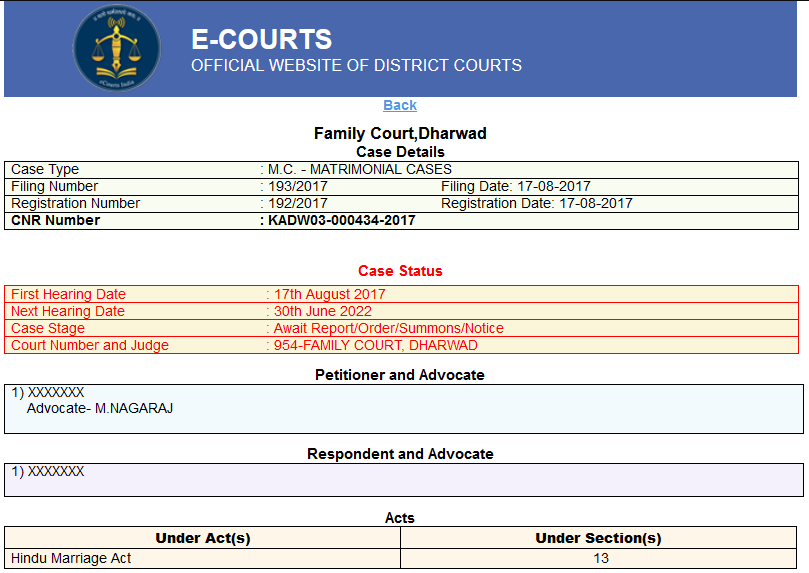
A Single judge of Karnataka High Court (Dharwad bench) held as thus…
(If it feels like biased/pre-judged, I too felt the same)
20. Having heard the learned counsel for the parties, the following issue arises for consideration in this writ petition. Whether, it is permissible for a Family Court to summon the medical records of a spouse on the request of the other spouse, especially when it pertained to records relating to any procedures relating to the reproductive choices of the spouse?
Illogical Reasoning of the Court:
22. Regulation 7.14 of the Regulation, 2002, upon which, reliance was placed is a reflection of this declaration. The said regulation reads as follows : 7.14. The registered medical practitioner shall not disclose the secrets of a patient that have been learnt in the exercise of his/her profession except
i) in a court of law under orders of the Presiding Judge; ii) in circumstances where there is a serious and identified risk to a specific person and / or community ; and iii) notifiable diseases. In case of communicable / notifiable diseases, concerned public health authorities should be informed immediately.
23. As could be seen in Regulation 7.14 of the Regulations, 2002, there is an absolute embargo on the medical practitioner from disclosing the secrets of a patient that comes within the knowledge of the medical practitioner during the discharge of his professional duties.
24. To this embargo, however, there are three exceptions. The first exception, with which we are concerned, is when a presiding Judge passes an order calling upon the medical practitioner to divulge a secret that he is aware of regarding his patient. Thus, unless there is a specific order of a Judge presiding over a Court of law, no medical practitioner can disclose the secrets that he has become privy to during the discharge of his professional duties.
25. Merely because a Court of law possesses that power to direct the medical practitioner to divulge a secret confided with a medical practitioner, that power would not and should not be exercised merely for the asking or routinely. The power to direct a medical practitioner to act in violation of his declaration should be exercised only for strong and compelling reasons and would be more or less be exercised only when an element of public interest was involved.
26. The Courts, therefore, cannot direct medical practitioners to disclose the secrets that they are privy to Divorce proceeding, by their very nature, is adversarial and more often than not a bitter and acrimonious battle, at times initiated to tarnish the reputation of the warring spouse. Thus, the power of the Court to direct the medical practitioners to divulge secrets that are confided to them should be exercised very sparingly and only for exceptional reasons.
27. In order to get over the bar imposed on the medical practitioners to disclose the secrets of the patients to which they are privy, the Courts should not be asked to exercise their power to secure medical records. If this is permitted, it would mean the Medical practitioner is required to divulge the secrets that the patient has disclosed to him contrary to his professional ethics only because an adversary in litigation wishes to use it to non-suit the other.
28. It is to be kept in mind that the medical records of an individual are very private and are not for public consumption. If the medical record of a person is private to him, a direction to his medical practitioner to produce the medical records or divulge any secret that he is privy to it would essentially amount to infringing the fundamental right of privacy guaranteed to an individual, which emanates from the Right to Life granted under Article 21 of Constitution of India.
Conclusions:
40. The Doctor, even if summoned, cannot by the production of medical records, assist the Court in concluding as to whether the wife had voluntary sexual intercourse with a person other than the husband. If the husband can prove that he had no access to his and if he can establish that his wife had or was having any illicit sexual relationship with another person, the same will have to be established by appropriate evidence as provided under the Evidence Act.
41. In any event, the illicit relationship of a spouse cannot be proved by securing his or her private medical records. In fact, if this approach is to be accepted, it would amount to the destruction of the entire concept of Doctor and patient confidentiality and also drag the Doctor into a marital dispute.
Jan 3, 2022, 05:05 IST
https://timesofindia.indiatimes.com/india/medical-records-private-cant-be-used-to-prove-adultery-karnataka-hc/articleshow/88655481.cms
Jan 3, 2022, 05:36 IST
https://timesofindia.indiatimes.com/city/bengaluru/cant-use-medical-records-to-prove-spouses-relationship-dharwad-bench-of-karnataka-hc/articleshow/88655662.cms
A division bench of the Apex Court held as follows:
From Paras 41 and 42,
41. In the facts of this case, having regard to the nature of the allegations contained in the protest petition and the annexures which essentially consisted of affidavits, if the Magistrate was convinced on the basis of the consideration of the final report, the statements under Section 161 of the Code that no prima facie case is made out, certainly the Magistrate could not be compelled to take cognizance by treating the protest petition as a complaint. The fact that he may have jurisdiction in a case to treat the protest petition as a complaint, is a different matter. Undoubtedly, if he treats the protest petition as a complaint, he would have to follow the procedure prescribed under Section 200 and 202 of the Code if the latter Section also commends itself to the Magistrate. In other words, necessarily, the complainant and his witnesses would have to be examined. No doubt, depending upon the material which is made available to a Magistrate by the complainant in the protest petition, it may be capable of being relied on in a particular case having regard to its inherent nature and impact on the conclusions in the final report. That is, if the material is such that it persuades the court to disagree with the conclusions arrived at by the Investigating Officer, cognizance could be taken under Section 190(1)(b) of the Code for which there is no necessity to examine the witnesses under Section 200 of the Code. But as the Magistrate could not be compelled to treat the protest petition as a complaint, the remedy of the complainant would be to file a fresh complaint and invite the Magistrate to follow the procedure under Section 200 of the Code or Section 200 read with Section 202 of the Code. Therefore, we are of the view that in the facts of this case, we cannot support the decision of the High Court. 42. It is true that law mandates notice to the informant/complainant where the Magistrate contemplates accepting the final report. On receipt of notice, the informant may address the court ventilating his objections to the final report. This he usually does in the form of the protest petition.
From Para 45,
45. If a protest petition fulfills the requirements of a complaint, the Magistrate may treat the protest petition as a complaint and deal with the same as required under Section 200 read with Section 202 of the Code. In this case, in fact, there is no list of witnesses as such in the protest petition. The prayer in the protest petition is to set aside the final report and to allow the application against the final report. While we are not suggesting that the form must entirely be decisive of the question whether it amounts to a complaint or liable to be treated as a complaint, we would think that essentially, the protest petition in this case, is summing up of the objections the second respondent against the final report.
Supreme Court , based on Madras HC Advocates Association decision here, initiated Perjury proceedings.
5.3 We do not wish to comment in detail upon the intentionbehind making the aforesaid interpolations. At this juncture, all that is required to be assessed is whether a prima facie case is made out that there is a reasonable likelihood that the offencespecified in Section 340 read with Section 195(1)(b) of the CrPChas been committed, and it is expedient in the interest of justice to take action. From the above discussion, it is evident that the handwritten modification made by the Petitioner in Column 12 ofthe balance sheet dated 19.09.2008 is a significant alteration from the terms as used in the original document. Hence we findthat a prima facie case is made out that the Petitioner has fabricated evidence for the purpose of the SLP proceedings beforethis Court. We further find that prima facie case is also made out against Mr. R.K. Agarwal, for having sworn in his affidavit before this Court as to the veracity of the facts stated and documentsfiled in SLP (Civil) No. 3309/2018, even though he had relied upon the original auditor’s report, which did not contain anyhandwritten interpolation, in his evidence before the Trial Court.
A full bench of Apex Court passed scathing remarks regards litigants who lie with impunity in their affidavits filed into the Court.
This case is also called as Re: Suo Moto Proceedings Against MR. R, KARUPPAN, ADVOCATE Vs Unknown.
From Para 15,
15. Court are entrusted with the powers of dispensation and adjudication of justice of the rival claims of the parties besides determining the criminal liability of the offenders for offences committed against the society. The courts are further expected to do justice quickly and impartially not being biased by any extraneous considerations. Justice dispensation system would be wrecked if statutory restrictions are not imposed upon the litigants, who attempt to mislead the court by filing and relying upon the false evidence particularly in cases, the adjudication of which is depended upon the statement of facts. if the result of the proceedings are to be respected, these issues before the courts must be resolved to the extent possible in accordance with the truth. The purity of proceedings of the court cannot be permitted to be sullied by a party on frivolous, vexatious or insufficient grounds or relying upon false evidence inspired by extraneous considerations or revengeful desire to harass or spite his opponent. Sanctity of the affidavits has to be preserved and protected discouraging the filing of irresponsible statements, without any regard to accuracy.
17. In India, law relating to the offence of perjury is given a statutory definition under Section 191 and Chapter XI of the Indian Penal Code, incorporated to deal with the offences relating to giving false evidence against public justice. The offences incorporated under this Chapter are based upon recognition of the decline of moral values and erosion of sanctity of oath. Unscrupulous litigants are found daily resorting to utter blatant falsehood in the courts which has, to some extent, resulted in polluting the judicial system. It is a fact, though unfortunate, that a general impression is created that most of the witnesses coming in the courts despite taking oath make false statements to suit the interests of the parties calling them. Effective and stern action is required to be taken for preventing the evil of perjury, concededly let lose by vested interest and professional litigants. The mere existence of the penal provisions to deal with perjury would be a cruel joke with the society unless the courts stop to take an evasive recourse despite proof of the commission of the offence under Chapter XI of the Indian Penal Code. If the system is to service, effective action is the need of the time. The present case is no exception to the general practice being followed by many of the litigants in the country.
18. Keeping in view the facts and circumstances of this case, the record of proceedings in Suo Motu Contempt Petition (Criminal) No.5 of 2000 and Writ Petition No.77 of 2001, we are prima facie satisfied that the respondent herein, in his affidavit filed in support of the writ petition (for the purposes of being used in the judicial proceedings, i.e. writ petition), has wrongly made a statement that the age of Dr. Justice A.S. Anand has not been determined by the President of India in terms of-Article 217 of the constitution. We are satisfied that such a statement supported by an affricative of the respondent was known to him to be false which he believed to be false and/or atleast did not believe to be true. It is not disputed that an affidavit is evidence within the meaning of Section 191 of the Indian Penal Code and a person swearing to a false affidavit is guilty of perjury punishable under Section 193 IPC. The respondent herein, being legally bound by an oath to state the truth in his affidavit accompanying the petition is prima facie held to have made a false statement which constitutes an offence of giving false evidence as defined under Section 191 IPC, punishable under Section 193 IPC.
19. With the object of eradicating the evil of perjury, we empower the Registrar General of this Court to depute an officer of the rank of Deputy Registrar or above of the Court to file a complaint under Section 193 of the Indian Penal Code against the respondent herein, before a Magistrate of competent jurisdiction at Delhi. Such officer is directed to file such complaint and take all steps necessary for prosecuting the complaint.
Single bench of Karnataka High Court nailed the perjuror, A medical doctor.
From point c of Para 4,
c) The vehement contention of Mr. Jhadhav, learned Sr. Adv. that a Police investigation is launched against the petitioner-husband for producing copies of IT Returns and other documents of the respondent and therefore, till after its completion, no action for the commission of alleged perjury can be initiated, is bit difficult to countenance, more particularly, when the authenticity of these documents is not disputed even before this Court; in fact the Court below too has recorded a specific finding to this effect; the said Police investigation has nothing to do with perjury allegedly committed by the respondent; act of perjury is treated as a heinous offence in all civilized societies; consideration of complaints with regard to the same cannot be deferred or delayed; otherwise there is all possibility of the fountain of justice being polluted. e) Lastly, heavy reliance placed by Mr. Jhadhav on the decision of Apex Court in V.K.Gupta’s case supra, does not much come to his rescue; there are some observations in the said ruling that recognize greater degree of discretion with the Courts in deciding application of the kind, is true; however, that cannot be construed as a discretion of the Moguls; the sages of law like Lord Halsbury have said that discretion means according to rules of reason & justice; the reason assigned by the Court below for holding petitioner’s subject application to be premature, is unsustainable to say the least; the view of the learned trial Judge that petitioner can move similar application subsequently offends sense of justice; applications of the kind need to be considered on merits at the earliest point of time so that a loud message goes to the unscrupulous section of the litigant public as to what would befall the perjuring parties.
From the decision of the division bench of Supreme Court, this is the concurring opinion of Justice D.P. Wadhwa. Wonderful, indeed!
D.P Wadhwa, J. (concurring)— I agree with the judgment pronounced by my noble and learned sister Ruma Pal, J. I, however, wish to add a few lines.
35. The first information report was lodged within 2-1/2 hours of the occurrence and the case registered against four persons, namely, Shamsher Singh, Jagjit Singh, Amrik Singh and Mittar Pal Singh alias Lovely. These four accused were named in the FIR. While Shamsher Singh surrendered a day following the lodging of the FIR, no steps were taken to apprehend the other named accused. The case was not only investigated by Sub-Inspector Karnail Singh, SHO of the police station concerned but also by Mohinder Singh, DSP, Baldev Sharma, DSP, Sanjeev Gupta, SP (Detective) and B.P Tiwari, DIG (Crime). When challan was put up, it was only against Shamsher Singh. A criminal complaint was filed by the complainant and all the accused were committed to stand their trial in the Court of Session for various offences. In the course of the trial, more than 50 prosecution witnesses were given up having been won over and the case hinged on the statements of seven witnesses which led to the conviction of Shamsher Singh and Jagjit Singh by the trial court, upheld by the High Court and now affirmed by this Court. The questions that arise for consideration are as to why the police did not challan the accused Jagjit Singh and why over 50 witnesses should have been given up. It only shows that the criminal justice system is in doldrums. There has to be honest investigation uninfluenced by any political or other pressure.
36. A criminal case is built on the edifice of evidence, evidence that is admissible in law. For that, witnesses are required whether it is direct evidence or circumstantial evidence. Here are the witnesses who are a harassed lot. A witness in a criminal trial may come from a far-off place to find the case adjourned. He has to come to the court many times and at what cost to his own self and his family is not difficult to fathom. It has become more or less a fashion to have a criminal case adjourned again and again till the witness tires and gives up. It is the game of unscrupulous lawyers to get adjournments for one excuse or the other till a witness is won over or is tired. Not only is a witness threatened, he is abducted, he is maimed, he is done away with, or even bribed. There is no protection for him. In adjourning the matter without any valid cause a court unwittingly becomes party to miscarriage of justice. A witness is then not treated with respect in the court. He is pushed out from the crowded courtroom by the peon. He waits for the whole day and then he finds that the matter is adjourned. He has no place to sit and no place even to have a glass of water. And when he does appear in court, he is subjected to unchecked and prolonged examination and cross-examination and finds himself in a hapless situation. For all these reasons and others a person abhors becoming a witness. It is the administration of justice that suffers. Then appropriate diet money for a witness is a far cry. Here again the process of harassment starts and he decides not to get the diet money at all. High Courts have to be vigilant in these matters. Proper diet money must be paid immediately to the witness (not only when he is examined but for every adjourned hearing) and even sent to him and he should not be left to be harassed by the subordinate staff. If the criminal justice system is to be put on a proper pedestal, the system cannot be left in the hands of unscrupulous lawyers and the sluggish State machinery. Each trial should be properly monitored. Time has come that all the courts, district courts, subordinate courts are linked to the High Court with a computer and a proper check is made on the adjournments and recording of evidence. The Bar Council of India and the State Bar Councils must play their part and lend their support to put the criminal system back on its trail. Perjury has also become a way of life in the law courts. A trial Judge knows that the witness is telling a lie and is going back on his previous statement, yet he does not wish to punish him or even file a complaint against him. He is required to sign the complaint himself which deters him from filing the complaint. Perhaps law needs amendment to clause (b) of Section 340(3) of the Code of Criminal Procedure in this respect as the High Court can direct any officer to file a complaint. To get rid of the evil of perjury, the court should resort to the use of the provisions of law as contained in Chapter XXVI of the Code of Criminal Procedure.
Dr.XXXXX Vs Dr.XXXXX on 24 Mar 2016 – In a ‘Annulment of marriage due to consummation of marriage by wife’ case, High Court granted opportunity to file the Written Statement/Counter.
A division bench of Madras High Court held as follows:
4. In view of the above, it is clear that the writ petition is filed by the individual having no locus to challenge the validity of the Rule and he is not affected, rather if anyone is affected it is the educational institution. Hence, the writ petition deserves to be dismissed on the ground of locus as it is not otherwise a Public Interest Litigation.
Taking delay as ground:
5. That apart, the writ petition has been filed after a lapse of around 12 years to challenge the Rule brought in the year 2010. If it was affecting the educational institution, it is from the date ofbringing the Rules. No justification for the delay in challenging the Rule has been given in the writ petition. Thus, the writ petition suffers from laches as well.
A Single Judge of Karnataka High Court held that a woman having illicit relationship with accused does not constitute the commission of the offence.
3. Learned counsel for the petitioner submits that only allegation against the petitioner – accused No.5 is that, she is having illicit relationship with accused No.1, who is her legally wedded husband. Hence, the allegation made against the petitioner – accused No.5 does not constitute the commission of the offences alleged against the petitioner. Hence, the registration of FIR for the aforesaid offences is impermissible.
6. The only allegation as against the petitioner – accused No.5 is that she is having illicit relationship with the accused No.1 who is the husband of respondent No.3 – informant. This allegation does not constitute the commission of the offences alleged against the petitioner – accused No.5 and itn the absence of any essential ingredients so as to constitute the commission of the said offences, registration of FIR against accused No.5 is without any substance.