web analytics

Menu

Skip to content
Shades of Knife
  • Home
  • True Colors of a Vile Wife
  • Need Inspiration?
  • Blog Updates
  • SOK Gallery
  • Vile News Reporter
  • About Me
  • Contact Me

Shades of Knife

True Colors of a Vile Wife

Author: ShadesOfKnife

Sushila Devi Vs Vikas Kumar Singhal And Ors on 9 Feb 2018

Posted on September 12, 2022 by ShadesOfKnife

A Single judge of Rajasthan High Court held as follows,

On perusal of the certified copy of the order-sheets, it appears that the application under Section 12 of the Act was filed way-back on 08.09.2016. Counsel appeared on behalf of respondents No.1 & 4 on 05.12.2016 and the matter is still pending before the Court of Addl. Chief Judicial Magistrate No.1, Neem Ka Thana, Sikar whereas as per provisions of Section 12(5) of the Act mandates that the Magistrate shall endeavour to dispose of every application made under sub-section 12(1) within a period of sixty days from the date of its first hearing. In the present case, five months have been passed, but no effective proceedings have taken place in the present matter. It appears to be an abuse of process of law, looking to the way in which proceedings are taking place in the court concerned.
In view of above, direction is issued to the Court of Addl. Chief Judicial Magistrate No.1, Neem Ka Thana, Sikar to make every endeavour to conclude the proceedings within two months from the date of receipt of certified copy of this order.

Sushila Devi Vs Vikas Kumar Singhal And Ors on 9 Feb 2018

Other Sources:

https://indiankanoon.org/doc/92995617/


Connects to a PIL here.

Posted in High Court of Rajasthan Judgment or Order or Notification | Tagged 1-Judge Bench Decision Abuse Or Misuse of Process of Court PWDV Act Sec 12(5) - Dispose In 60 Days Sushila Devi Vs Vikas Kumar Singhal And Ors | Leave a comment

Mewa Singh and others Vs Sukhjeet Kaur on 29 April 2013

Posted on September 12, 2022 by ShadesOfKnife

A Single judge of Punjab and Haryana High Court held as follows,

The petitioners are permitted to be represented through a counsel and are not required to be personally present on each and every date of hearing unless until a special order is passed, warranting the appearance of the petitioners ( respondents in the complaint before the Magistrate). Relegating the petitioners to avail the alternative remedy, this petition is held to be not maintainable.
Disposed of with liberty to the petitioners to raise all the pleas before the court of competent jurisdiction. It is expected that the said court will expeditiously dispose of the matter taking into consideration the provisions of Section 12(5) of the Act.

Mewa Singh and others Vs Sukhjeet Kaur on 29 Apr 2013

Other Sources:

https://indiankanoon.org/doc/197445836/


Connects to a PIL here.

Posted in High Court of Punjab & Haryana Judgment or Order or Notification | Tagged 1-Judge Bench Decision Mewa Singh and others Vs Sukhjeet Kaur PWDV Act Sec 12(5) - Dispose In 60 Days | Leave a comment

Kuppusamy Vs Radhika on 21 Jul 2017

Posted on September 12, 2022 by ShadesOfKnife

A Single judge of Madras High Court held as follows,

From Para 5,

5. According to the learned counsel for the petitioner, the respondent filed a petition for Maintenance in M.C.No.36 of 2015 on the file of the Chief Judicial Magistrate Court, Karur and that ex-parte order was passed only in the said case. Subsequently, a petition was filed to set aside the ex-parte order and the proceedings were restored. In such circumstances, the learned counsel for the petitioner also relied upon the provisions under Protection of Women from Domestic Violence Act and particularly, with reference to Section 12 of the Act. As per Section 12(5) of the Act, the learned Magistrate shall make an endeavour to dispose the enquiry within a period of sixty days from the date of its first hearing. It is surprising to note that the respondent is opposing early disposal.

From Para 7,

7. Hence, the Criminal Original petition is allowed and the learned Judicial Magistrate No.I, Karur District, is directed to dispose of the proceedings in D.V.No.1 of 2016 within a period of two months from the date of receipt of a copy of this Order.

Kuppusamy Vs Radhika on 21 Jul 2017

Other Sources:

https://indiankanoon.org/doc/26605471/


Connects to a PIL here.

Posted in High Court of Madras Judgment or Order or Notification | Tagged Kuppusamy Vs Radhika PWDV Act Sec 12(5) - Dispose In 60 Days | Leave a comment

Ayishabi Vs Shahul Hameed on 16 July, 2014

Posted on September 12, 2022 by ShadesOfKnife

A Single judge of Kerala High Court held as follows,

From Para 5,

5. It is an admitted fact that, the petitioner filed M.C.155/2013 before the Judicial First Class Magistrate Court, Malappuram, under Section 12 of the Protection of Women from Domestic Violence Act (hereinafter called the Act), claiming reliefs under Section 18, 19 and 20 of that Act against respondents 1 to 3. It is also mentioned in the petition that, the petitioner also filed Crl.M.P.10228/2013 for interim relief, but that was also adjourned along with main case is the grievance of the petitioner. It is seen from the report that, respondents 1 to 3 appeared and they filed counter also and the matter was referred for mediation and according to the magistrate the mediation report in the case is awaited. But the counsel for the petitioner submitted that, the mediation failed and it is ripe for trial now. It is true that under Section 12(5) of the Act, it is stated that, the magistrate shall take all earnest endeavour to dispose of the case within sixty days of first hearing of the case. But unfortunately, such a mandate could not be fulfilled by the court on account of large pendency of cases before each court. But that cannot be a ground for adjourning the case indefinitely, when the statute mandates for early summary disposal of certain types of cases, which requires urgent attention of the court. Further, even if the court feels that, disposal of the main case will take some time on account of the large pendency of cases before that court, it should have made some attempt to dispose of the interim application filed in that case under Section 23 of the Act, as it is intended to provide interim protection for the aggrieved persons, against any alleged domestic violence in the shared house hold. So under the circumstances, this court feels that, the petition can be disposed of as follows:
The learned magistrate is directed to dispose of M.C.155/2013 pending before that court, as expeditiously as possible at any rate, within three months from the date of receipt of this order.

Ayishabi Vs Shahul Hameed on 16 July, 2014

Other Sources:

https://indiankanoon.org/doc/27041307/


Connects to a PIL here.

Posted in High Court of Kerala Judgment or Order or Notification | Tagged Ayishabi Vs Shahul Hameed PWDV Act Sec 12(5) - Dispose In 60 Days | Leave a comment

Waseem Vs State of UP and Anr on 30 Aug 2022

Posted on September 7, 2022 by ShadesOfKnife

A single judge at Allahabad High Court, held as follows:

From Para 34,

In paragraph No. 4 of the affidavit, it is mentioned that a meeting was convened on 26.8.2022 under the Chairmanship of Additional Chief Secretary (Home), Government of Uttar Pradesh, Lucknow, which was attended by Mr. B.D. Paulson, Secretary, Home Department, Government of U.P. Lucknow, Mr. Tarun Gauba, Secretary Home Department, Government of Uttar Pradesh, Lucknow, Mr. M.K. Bashal, Additional Director General of Police (Crime), U.P. Lucknow, Mr. Prem Prakash, Additional Director General of Police, Prayagraj Zone, Prayagraj (through video conferencing), Mr. Amit Pathak, Deputy Inspector General of Police (Public Grievance) DGP Headquarters, U.P. Lucknow, Mr. Rakesh Kumar Malpani, Special Secretary, Home Department, Dr. A.K. Singh, Special Secretary, Home Department, Mr. Shiv Kumar Pal, Government Advocate, High Court, Allahabad (through video conferencing), Mr. M.C. Chaturvedi, Additional Advocate General, High Court, Allahabad (through video conferencing) and Mr. Ashish Singh, Senior Prosecuting Officer and after due deliberation, following decisions were taken:
(i) Postmortem and injury reports must be typed out and made easily legible and practice of handwritten reports be discontinued.
(ii) During the postmortem examination, there should be DNA and fingerprint sampling and necessary software must be developed for this purpose.
(iii) In cases of gunshot injuries, instead of full body xray, the x-ray should be of the area where the wound is located. However, in such cases where the wound of entry or exit is not apparent, the need of taking x-ray be made mandatory.
(iv) During postmortem examination, the injuries on the dead body should be photographed in colour to highlight the same.
(v) An index be prepared to be appended with each case diary, which is submitted before the Prosecutor/Hon’ble Judges. It should be explored if necessary facility can be provided through CCTNS software.
(vi) A synopsis be prepared of the contents of the report containing the opinion of the investigating officer as encapsulated in the report under Section 173(2) Cr.P.C. An index should also be prepared for convenient perusal and reference. This synopsis be a part of the report under Section 173(2) Cr.P.C.
(vii) The importance of the role of the supervisory officer be emphasized and that the said officer should not function only as a post office. Every investigation must be scrutinized in a microscopic manner and any lacuna or lapse must be pointed out to the investigating officer. Provisions should also be made for training the investigating officer on a regular basis.
(viii) Senior Supervisory Officers must submit the report submitted by the police under Section 173(2) Cr.P.C expeditiously and not hold it back in their custody needlessly. In this context, a letter dated 05.05.2016 had already been issued by the Director General of Police, U.P. Lucknow.
(ix) Before ordering further investigation under Section 173(8), it is desirable to seek permission/give information to the concerned learned court, but the necessity of this step be examined in the light of the relevant and applicable statutory provisions and the judgements and observations passed by Hon’ble Apex Court and Hon’ble High Court. In all cases where the statements of witnesses are recorded using audio/video mode, the relevant material be made part of the case diary by means of compact disc/pen drive.
(x) The font size used for preparing the case diary be increased to a size, which would facilitate easy and legible perusal of the same. For this purpose, the cooperation of NIC be sought to implement the increase in font-size in the records, uploaded on the CCTNS.
(xi) The strict adherence be ensured to the statutory provisions encapsulated in Section 65B IPC and that investigating officer be trained to adopt a sensitive approach in these matters.
(xii) It was emphasized that proper directions be imparted to supervisory officers to ensure that they perform their duty efficiently and diligently. It was informed by the Additional Director General of Police (crime) that in all districts (pan state) training was being imparted in orderly room and by crime meetings. The Additional Chief Secretary (Home), Government of U.P., Lucknow issued directions that action be initiated against those investigating officer who displayed negligence in discharging their duties and thereby impair fair and proper investigation.

(xiii) In every district, the Joint Director (Prosecution) should head a legal cell, which should be established with the aim to educate all investigating officers with the latest amendments in criminal law and the judgements passed by the Hon’ble Apex Court and Hon’ble High Court.
(xiv) Lastly, it was decided that the necessary government order/circular/road-map, which was to be issued covered a vast range and the support and cooperation of technical and other departments was required.

Waseem Vs State of UP and Anr on 30 Aug 2022
Posted in High Court of Allahabad Judgment or Order or Notification | Tagged CrPC 161 - Examination of Witnesses By Police Issued or Recommended Guidelines or Directions or Protocols to be followed Waseem Vs State of UP and Anr | Leave a comment

B.Parvathi Vs State of AP on 7 May, 2020

Posted on September 6, 2022 by ShadesOfKnife

A reasoned judgment on maintainability of IPC 494 upon the Accused No.2 and the merits of discharge petition filed before Trial Court u/s 227 CrPC. It relies on AP State Amendment of 1992. But unfortunately, this judgment is Partly perverse as it goes against A.Subash Babu Vs State of A.P. and Anr on 21 July, 2011 hence NOT to be relied up on.]

In Page 35,

Earlier the offence punishable under Section 494 IPC is a non-cognizable offence. The Legislative Assembly of the State of Andhra Pradesh by way of Andhra Pradesh Second Amendment Act 3 of 1992, amended the first schedule to Central Act 2 of 1974 i.e. the Code of Criminal Procedure, 1973 and made the offence under Section 494 IPC a ‘cognizable’ offence and a ‘non-bailable’ offence. The said Andhra Pradesh Second Amendment Act 3 of 1992 was reserved by the Governor of Andhra Pradesh on the 21.10.1991 for consideration and assent of the President. The Presidential assent was received on 10.02.1992 and the amendment was published on 15.02.1992 in the Andhra Pradesh Gazette Part IV-B (Ext.). Therefore, with effect from 15.02.1992 undoubtedly the offences punishable under Sections 494 and 495 IPC are cognizable offences in the State of Andhra Pradesh. So, the police officer can now register the case under Section 154 Cr.P.C. and can investigate the same under Section 156 Cr.P.C. The bar engrafted under Section 198(1) Cr.P.C. to take cognizance of the case under Section 494 IPC is on the Court and not on the police. So, in view of the fact that it is a cognizable offence, police can register the case on a report lodged with them to that effect and also investigate the case and file final report under Section 173(2) Cr.P.C. Now, the crucial question that arises for consideration is, whether Court can take cognizance of the case on such police report/ charge-sheet filed by the police or not in view of the express bar engrafted under Section 198(1) Cr.P.C. on the Court to take cognizance of the case except upon a complaint filed by the aggrieved party before it.

Perverse portion of the judgment, that goes against A.Subash Babu Vs State of A.P. and Anr on 21 July, 2011

So, only when an allegation relating to the offence under Section 494 IPC is made by the aggrieved person to the Magistrate, then only the Court can take cognizance of the case. Certainly the Court cannot take cognizance of the case for the offence punishable under Section 494 IPC on a police report/charge-sheet filed by the police. Even though offence under Section 494 IPC is made “cognizable” offence as per amendment Act 3 of 1992, there is no corresponding amendment made to Section 198 Cr.P.C. Therefore, the bar under Section 198 Cr.P.C. still subsists. The legal position in this regard is not res nova and it has been clearly well settled.

B.Parvathi Vs State of AP on 7 May, 2020

Citations:

Other Sources:

https://indiankanoon.org/doc/194056755/


Index to Bigamy Judgments under Sections 494 and 495 of IPC is here.

Posted in High Court of Andhra Pradesh Judgment or Order or Notification | Tagged 1-Judge Bench Decision Code of Criminal Procedure (Andhra Pradesh Second Amendment) Act 1992 CrPC 227 - Discharged CrPC 227 - Exercise of Judicial Mind IPC 494 - Marrying again during life-time of husband or wife IPC 494 Compoundable Offence in Andhra Pradesh Perverse Order/Judgment | Leave a comment

Lalita Kumari Vs Govt of U.P. and Ors on 19 Feb 2014

Posted on September 4, 2022 by ShadesOfKnife

The victim Lalita Kumari is recovered.

Lalita Kumari Vs Govt of U.P. and Ors on 19 Feb 2014

The landmark judgment is here.

Posted in Supreme Court of India Judgment or Order or Notification | Tagged 2-Judge (Division) Bench Decision Lalita Kumari Vs Govt.Of U.P. and Ors | Leave a comment

State Bank of India and Anr Vs Ajay Kumar Sood on 16 Aug 2022

Posted on August 25, 2022 by ShadesOfKnife

A division bench of Apex Court held as follows:

From Para 10,

10. The judgment of the Division Bench of the High Court of Himachal Pradesh is incomprehensible. This Court in appeal found it difficult to navigate through the maze of incomprehensible language in the decision of the High Court. A litigant for whom the judgment is primarily meant would be placed in an even more difficult position. Untrained in the law, the litigant is confronted with language which is not heard, written or spoken in contemporary expression. Language of the kind in a judgment defeats the purpose of judicial writing. Judgment writing of the genre before us in appeal detracts from the efficacy of the judicial process. The purpose of judicial writing is not to confuse or confound the reader behind the veneer of complex language. The judge must write to provide an easy-to-understand analysis of the issues of law and fact which arise for decision. Judgments are primarily meant for those whose cases are decided by judges. Judgments of the High Courts and the Supreme Court also serve as precedents to guide future benches. A judgment must make sense to those whose lives and affairs are affected by the outcome of the case. While a judgment is read by those as well who have training in the law, they do not represent the entire universe of discourse. Confidence in the judicial process is predicated on the trust which its written word generates. If the meaning of the written word is lost in language, the ability of the adjudicator to retain the trust of the reader is severely eroded.
11. We are constrained to remit the proceedings back to the High Court for consideration afresh. The judgment of the High Court is simply incomprehensible leaving this Court with no option than to remand the proceedings. The High Court must appreciate the delay and expense occasioned as a consequence and must make an effort to record reasons which are understood by all stake-holders.

From Para 13,

13. Amidst an overburdened judicial docket, a view is sometimes voiced that parties are concerned with the outcome and little else. This view proceeds on the basis that parties value the outcome and not the reasoning which constitutes the foundation. This view undervalues the importance of the judicial function and of the reasons which are critical to it. The work of a judge cannot be reduced to a statistic about the disposal of a case. Every judgment is an incremental step towards consolidation and change. In adhering to precedent, the judgment reflects a commitment to protecting legal principle. This imparts certainty to the law. Each judgment is hence a brick in the consolidation of the fundamental precepts on which a legal order is based. But in incremental steps a judgment addresses the need to evolve and to transform by addressing critical issues which confront human existence. Courts are as much engaged in the slow yet not so silent process of bringing about a social transformation. How good or deficient they are in that quest is tested by the quality of the reasons as much as by the manner in which the judicial process is structured.

From Paras 16, 17 and 18,

16. A judgment culminates in a conclusion. But its content represents the basis for the conclusion. A judgment is hence a manifestation of reason. The reasons provide the basis of the view which the decision maker has espoused, of the balances which have been drawn. That is why reasons are crucial to the legitimacy of a judge’s work. They provide an insight into judicial analysis, explaining to the reader why what is written has been written. The reasons, as much as the final conclusion, are open to scrutiny. A judgment is written primarily for the parties in a forensic contest. The scrutiny is first and foremost by the person for whom the decision is meant – the conflicting parties before the court. At a secondary level, reasons furnish the basis for challenging a judicial outcome in a higher forum. The validity of the decision is tested by the underlying content and reasons. But there is more. Equally significant is the fact that a judgment speaks to the present and to the future. Judicial outcomes taken singularly or in combination have an impact upon human lives. Hence, a judgment is amenable to wider critique and scrutiny, going beyond the immediate contest in a courtroom. Citizens, researchers and journalists continuously evaluate the work of courts as public institutions committed to governance under law. Judgment writing is hence a critical instrument in fostering the rule of law and in curbing rule by the law.
17. Judgment writing is a layered exercise. In one layer, a judgment addresses the concerns and arguments of parties to a forensic contest. In another layer, a judgment addresses stake-holders beyond the conflict. It speaks to those in society who are impacted by the discourse. In the layered formulation of analysis, a judgment speaks to the present and to the future. Whether or not the writer of a judgment envisions it, the written product remains for the future, representing another incremental step in societal dialogue. If a judgment does not measure up, it can be critiqued and criticized. Behind the layers of reason is the vision of the adjudicator over the values which a just society must embody and defend. In a constitutional framework, these values have to be grounded in the Constitution. The reasons which a judge furnishes provides a window – an insight – into the work of the court in espousing these values as an integral element of the judicial function.
18. Many judgments do decide complex questions of law and of fact. Brevity is an unwitting victim of an overburdened judiciary. It is also becoming a victim of the cut-copy-paste convenience afforded by software developers. This Court has been providing headings and sub-headings to assist the reader in providing a structured sequence. Introduced and popularized in judgment writing by Lord Denning, this development has been replicated across jurisdictions.

From Paras 20, 21, 22, 23 and 24,

20. It is also useful for all judgments to carry paragraph numbers as it allows for ease of reference and enhances the structure, improving the readability and accessibility of the judgments. A Table of Contents in a longer version assists access to the reader.
21. On the note of accessibility, the importance of making judgments accessible to persons from all sections of society, especially persons with disability needs emphasis. All judicial institutions must ensure that the judgments and orders being published by them do not carry improperly placed watermarks as they end up making the documents inaccessible for persons with visual disability who use screen readers to access them. On the same note, courts and tribunals must also ensure that the version of the judgments and orders uploaded is accessible and signed using digital signatures. They should not be scanned versions of printed copies. The practice of printing and scanning documents is a futile and time-consuming process which does not serve any purpose. The practice should be eradicated from the litigation process as it tends to make documents as well as the process inaccessible for an entire gamut of citizens.
22. In terms of structuring judgments, it would be beneficial for courts to structure them in a manner such that the “Issue, Rule, Application and Conclusion‟ are easily identifiable. The well-renowned “IRAC‟ method generally followed for analyzing cases and structuring submissions can also benefit judgments when it is complemented by recording the facts and submissions.
23. The “Issue” refers to the question of law that the court is deciding. A court may be dealing with multiple issues in the same judgment. Identifying these issues clearly helps structure the judgment and provides clarity for the reader on the specific issue of law being decided in a particular segment of a judgment. The „Rule‟ refers to the portion of the judgment which distils the submissions of counsel on the applicable law and doctrine for the issue identified. This rule is applied to the facts of the case in which the issue has arisen. The analysis recording the reasoning of a court forms the “Application‟ section.
24. Finally, it is always useful for a court to summarize and lay out the “Conclusion‟ on the basis of its determination of the application of the rule to the issue along with the decision vis-à-vis the specific facts. This allows stakeholders, especially members of the bar as well as judges relying upon the case in the future, to concisely understand the holding of the case.

Finally from Para 27,

27. While we have laid down some broad guidelines, individual judges can indeed have different ways of writing judgments and continue to have variations in their styles of expression. The expression of a judge is an unfolding of the recesses of the mind. However, while recesses of the mind may be inscrutable, the reasoning in judgment cannot be. While judges may have their own style of judgment writing, they must ensure lucidity in writing across these styles.

State Bank of India and Anr Vs Ajay Kumar Sood on 16 Aug 2022
Posted in Supreme Court of India Judgment or Order or Notification | Tagged 2-Judge (Division) Bench Decision Issued or Recommended Guidelines or Directions or Protocols to be followed Judiciary Antics Reportable Judgement or Order State Bank of India and Anr Vs Ajay Kumar Sood | Leave a comment

P Parvathi Vs Pathloth Mangamma on 7 Jul 2022

Posted on August 24, 2022 by ShadesOfKnife

A single judge bench of Telangana High Court passed note-worthy guidelines in disposing Domestic Violence cases.

From Paras 6 and 7,

6. The Protection of Women from Domestic Violence Act, 2005 is a legislation enacted to shield the rights of women which are enshrined and guaranteed under the Constitution of India, besides paving way to deal with the matters connected to and arising out of the family disputes in an effective and efficacious manner.
7. When the provisions contained in the said legislation i.e., The Protection of Women from Domestic Violence Act, 2005 (hereinafter referred to as “the Act of 2005”, for brevity) are looked into, it is very clear that the proceedings that would be conducted are more civil in nature. The protection orders that would be granted under Section 18, the residence orders that would be granted under Section 19, the monetary reliefs that would be granted under Section 20, the custody orders that would be granted under Section 21 and the compensation orders that would be granted under Section 22, would be based on the applications that would be filed by the aggrieved persons, the domestic incident reports and the defence taken by the respondents therein. All those proceedings are civil in nature. No doubt, Section 28 (1) of the Act of 2005 lays down that the proceedings shall be governed by the provisions of Code of Criminal Procedure. However, it is specifically mentioned under Section 28(2) of the Act of 2005 that the Court is empowered to lay down its own procedure for disposal of the applications filed by the aggrieved persons or the Protection Officers. May be due to the fact that the power to deal with the domestic violence cases is given to the Magistrate, the litigant public are under the impression that the proceedings initiated under the Act of 2005 are purely criminal in nature.

Guidelines passed in Paras 12 and 13,

12. It is brought to the notice of this Court by the learned Assistant Public Prosecutor that number of Criminal Petitions are filed before the High Court seeking to quash the proceedings in domestic violence cases, only because the trial Courts are insisting the physical attendance of the respondents in those cases for each and every adjournment.
13. Therefore, before parting with the case, this Court considers it desirable to lay down certain guidelines for the Courts of Judicial Magistrate of First Class, which are empowered to deal with the domestic violence cases, to follow so that the parties would not rush to the High Court.
(1)The Courts of Judicial Magistrate of First Class which are dealing with the cases filed seeking various kinds of reliefs as laid down under Sections 18 to 22 of the Protection of Women from Domestic Violence Act, 2005 should take note of the fact that the proceedings therein are more civil in nature.
(2)When the aggrieved person or a Protection Officer or any other person on behalf of the aggrieved person presents an application seeking one or more reliefs that are enshrined under Sections 18 to 22 of the Protection of Women from Domestic Violence Act, 2005, upon service of notice as required under Section 13 of the said Act and upon making appearance by the opposite party i.e., respondents therein either in person or through their counsel, the Court shall not insist for their personal appearance for each and every adjournment.
(3)The Courts dealing with the cases under the Protection of Women from Domestic Violence Act, 2005 shall not even insist for filing an application under Section 317 Cr.P.C.
(4)The persons against whom the applications are filed seeking relief in domestic violence cases i.e., the respondents, however, shall appear in person if a specific direction is given for their personal appearance by the Court during the course of proceedings.
(5)The points enumerated above does not however apply during the course of proceedings that are conducted under Section 31 of the Protection of Women from Domestic Violence Act, 2005.
(6) Last but most important is that the Courts of Judicial Magistrate of First Class which are empowered to deal with the matters under the Protection of Women from Domestic Violence Act, 2005 shall make all endeavour to dispose of the applications filed for grant of various reliefs that are provided under Sections 18 to 22 of the Protection of Women from Domestic Violence Act, 2005 within a period of sixty (60) days from the date of first hearing, as required under Section 12(5) of the said Act.

P Parvathi Vs Pathloth Mangamma on 7 Jul 2022

Connects to a PIL here.

Posted in High Court of Telangana Judgment or Order or Notification | Tagged Do you know that there is time limit of 60 days to dispose of a Domestic Violence case in India under sec 12(5) of PWDV Act? Issued or Recommended Guidelines or Directions or Protocols to be followed P Parvathi Vs Pathloth Mangamma PIL - Implement the Statutory Time limit of 60 days to Dispose of a Domestic Violence case as prescribed under Sec 12(5) of the Act PWDV Act Sec 12(5) - Dispose In 60 Days | Leave a comment

Do you know that there is time limit of 60 days to dispose of a Domestic Violence case in India under sec 12(5) of PWDV Act?

Posted on August 20, 2022 by ShadesOfKnife

Legislature set a time limit of 60 days for a Domestic Violence case to be disposed as prescribed under sec 12(5) of Protection of Women from Domestic Violence Act, 2005. Here are the Rules made under this Act. But the ground reality is totally different. And I decided to address this issue. Head-on.

NOTE: Since too much thought was going into decide if this matter has to dealt as a WP or a WP(PIL), I decided to do BOTH. First a WP/CrlP, for my individual case and then a WP(PIL) for public benefit.

RESULTS:

Won the individual battle here…
Won the PIL battle too despite it getting dismissed by the Honourables. Read further down this page.


Go here for other cases I dealt with personally…


Law in question (as it stands today):

12. Application to Magistrate.—
(1) An aggrieved person or a Protection Officer or any other person on behalf of the aggrieved person may present an application to the Magistrate seeking one or more reliefs under this Act:
Provided that before passing any order on such application, the Magistrate shall take into consideration any domestic incident report received by him from the Protection Officer or the service provider.
(2) xxxxx
(3) xxxxx
(4) xxxxx
(5) The Magistrate shall Endeavour to dispose of every application made under sub-section (1) within a period of sixty days from the date of its first hearing.


Support/Inspiration from some High Courts:

  • Andhra Pradesh High Court: https://www.shadesofknife.in/naresh-kumar-yalla-vs-state-of-telangana-on-21-jul-2022/
  • Karnataka High Court: https://www.shadesofknife.in/rajamma-h-vs-thimmaiah-v-on-09-jun-2022/
  • Telangana High Court: https://www.shadesofknife.in/p-parvathi-vs-pathloth-mangamma-on-7-jul-2022/ [Guidelines passed]
  • To-do: Find more useful judgments
  • To-do: Contact Chairpersons of State Women Commissions of various States and ask for timely implementation of DV Act.
  • To-do: Find oldest ‘pending’ DVC cases in each of the 13 districts of AP, to emphasize the traversity.

Current Status in AP:

Action Taken:

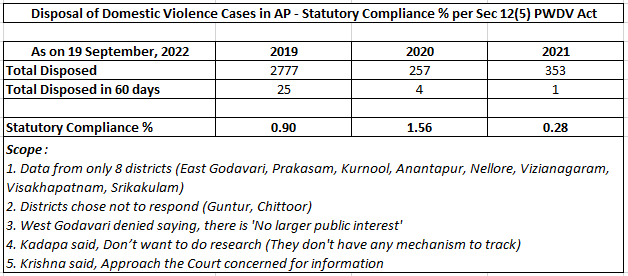
Filed RTI to all 13 District Judge Court Complexes in Andhra Pradesh seeking number of cases closed within 60 working days as prescribed u/s 12(5). If no cases disposed off in 3 years, strike down Sec 12(5) from the Act.

On 2022-06-28:

Sent Reg Posts to all 13 District Judge Courts in AP, asking for information on

  1. how many DV cases were filed in 2019, 2020 and 2021 in their jurisdictional district,
  2. how may were disposed in 2019, 2020 and 2021 in their jurisdictional district, and
  3. how many were disposed within 60 days, in 2019, 2020 and 2021 in their jurisdictional district.

They have 30 days time to reply to me. Will file the PIL in August.

As expected the DV cases closed within statutory 60 days is abysmally low.


Parties:

Petitioner-in-person: Sandeep Pamarati
Respondents: From High Court of Andhra Pradesh, Union of India and State of Andhra Pradesh

    1. High Court of Andhra Pradesh, Represented by the Registrar General
      AP High Court Buildings,
      Nelapadu, Amaravathi,
      Guntur District, Andhra Pradesh
      PIN: 522202
    2. Union of India, Represented by its Secretary,
      Ministry of Law and Justice, Dept. of Legal Affairs,
      A Wing, 4th Floor, Shastri Bhawan,
      Dr. Rajendra Prasad Road, New Delhi, 110001
    3. Union of India, Represented by its Secretary,
      Ministry of Parliamentary Affairs
      Shastri Bhawan, Dr. Rajendra Prasad Road,
      New Delhi, 110001
    4. Union of India, Represented by its Secretary,
      Ministry of Women and Child Development
      Shastri Bhawan, Dr. Rajendra Prasad Road,
      New Delhi, 110001
    5. Union of India, Represented by its Secretary,
      Ministry of Social Justice and Empowerment
      Shastri Bhawan, Dr. Rajendra Prasad Road,
      New Delhi, 110001
    6. State of Andhra Pradesh, Rep. by its Principal Secretary,
      Home Department, AP Secretariat,
      Velagapudi, Amaravathi, Guntur District, 522503
    7. State of Andhra Pradesh, Rep. by Secretary to Government,
      Law (Legislative Affairs and Justice) Department, AP Secretariat,
      Velagapudi, Amaravathi, Guntur District, 522503
    8. State of Andhra Pradesh, Rep. by its Principal Secretary,
      Department of Women Development & Child Welfare
      Office of Special Commissioner, 4th Floor Jampani Towers,
      Lodge Centre, Amaravathi Road, Guntur-522006
    9. National Commission for Women, Rep by Chairperson
      Plot No 21, FC33, Institutional Area,
      Jasola, New Delhi, Delhi 110025
    10. Andhra Pradesh State Commission for Women, Rep by Chairperson
      Flat No. 506, 4th Floor, MGM Capital Building, Dr. YSR Arogya Sri Complex,
      Chinakakani, Mangalagiri, Guntur. Pin : 522503
    11. National Judicial Academy, Rep by The Director,
      Bhadbhada Road, Suraj Nagar PO,
      Bhopal, Madhya Pradesh 462044
    12. A.P. Judicial Academy, Rep by The Director,
      Gandhi Nagar, Nehru Nagar Colony, West Marredpally,
      Secunderabad, Telangana 500026
    13. Law Commission of India, Rep by The Member Secretary,
      Lok Nayak Bhavan, ‘B’ Wing, 2nd & 4th Floor,
      Khan Market, New Delhi -110003
    14. Bar Council of India, Rep by the Secretary,
      21, Rouse Avenue, Institutional Area,
      New Delhi Pin Code – 110002
    15. Bar Council of Andhra Pradesh, Rep by The Secretary
      Ground Floor, A.P. High Court Building,
      Nelapadu, Amaravati, Guntur,  Andhra Pradesh
      PIN: 522 239

Remedy:

File a writ u/Act 226 read with Art 227 seeking direction from High Court of AP to all the Trial Courts in the State which deal with Domestic Violence cases, to mandatorily invoke the time limit of 60 days to dispose of a DV case, as prescribed under sec 12(5), whenever an application for interim reliefs, under sec 23(1), was prayed/sought for also in the spirit of Sec 309 CrPC.

Dilemma: To file WP or WP(PIL)? Why not, both?

Drafting: WP Done in the form of CrlP r/w Art 226 and 227 here. WP(PIL) is pending (u/Art 226 and 227)

Reliefs:

  1. Call for records for the DV cases are disposed in 60 days from Srikakulam, Visakhapatnam, Guntur, Chittoor, West Godavari, Kadapa, Krishna Districts as they did not give data to RTI applications.
  2. Acknowledge the total failure of the implementation of Statutory Compliance of Sec 12(5) of PWDV Act.
  3. Appoint an amicus/LCI to study reasons for this failure in State of AP.
  4. Direct all District Unit Heads to ensure the DV cases are disposed in 60 days (To tackle such scenarios, you can use the Supreme Court judgment to force the Trial judge to come up with case calendar for the entire case, which is available here)
  5. Setup a periodic monitoring mechanism to report the delays in DV case disposal publicly on AP High Court website.


Supporting Case laws:

  1. Mewa Singh and others Vs Sukhjeet Kaur on 29 April 2013 (PHHC: appearance of respondents disposed off)
  2. Ayishabi Vs Shahul Hameed on 16 July, 2014 (KerHC: Dispose within 3 months)
  3. Kuppusamy Vs Radhika on 21 July, 2017 (MadHC: Dispose DVC in 2 months)
  4. Sushila Devi Vs Vikas Kumar Singhal And Ors on 9 Feb 2018 (RajHC: Dispose within 2 months)
  5. Tillottama Kumari Vs State of Bihar and Ors on 16 May 2019 (PatHC: Dispose DVC in 6 weeks)
  6. Maya and Ors Vs State of U.P. and Ors on 19 Mar 2021 (AllHC: Dispose DVC in 2 months)
  7. Suyalaly and Anr Vs Alphin Jeyasingh and Ors on 29 Nov 2021 (MadHC: Dispose within 2 months)
  8. Vani Santhosh Babu Vs Vijaya Laxmi Vani on 3 Mar 2022 (TelHC: Dispose in 60 days)
  9. Rajamma H Vs Thimmaiah V on 09 Jun 2022 (KarHC: Dispose DVC within 2 weeks)
  10. Mrugesh Wasnik Vs Shweta Mrugesh on 22 Jun 2022 (BomHC: Dispose DVC within 3 months)
  11. P Parvathi Vs Pathloth Mangamma on 7 Jul 2022 (TelHC: Directions issued regd appearance of respondents)
  12. Naresh Kumar Yalla Vs State of Telangana on 21 Jul 2022 (TelHC: Dispose DVC in 1 month)
  13. Sandeep Pamarati Vs State of AP and Anr on 29 Sep 2022 (APHC: Disposal of DVC in 60 days/3 months (around 20 working days in a month); my first win AP HC!)

Writ Public Interest Petition:

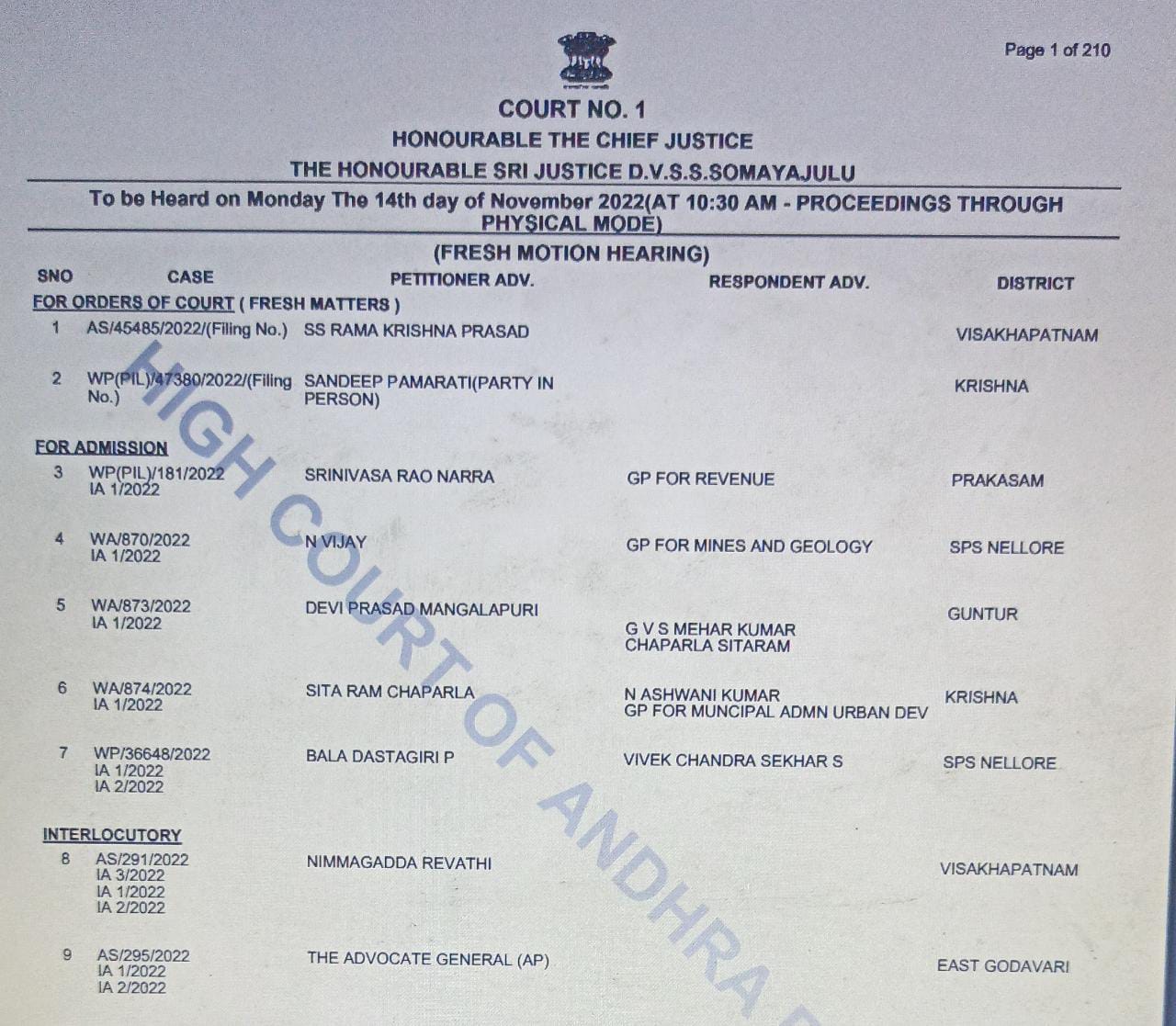
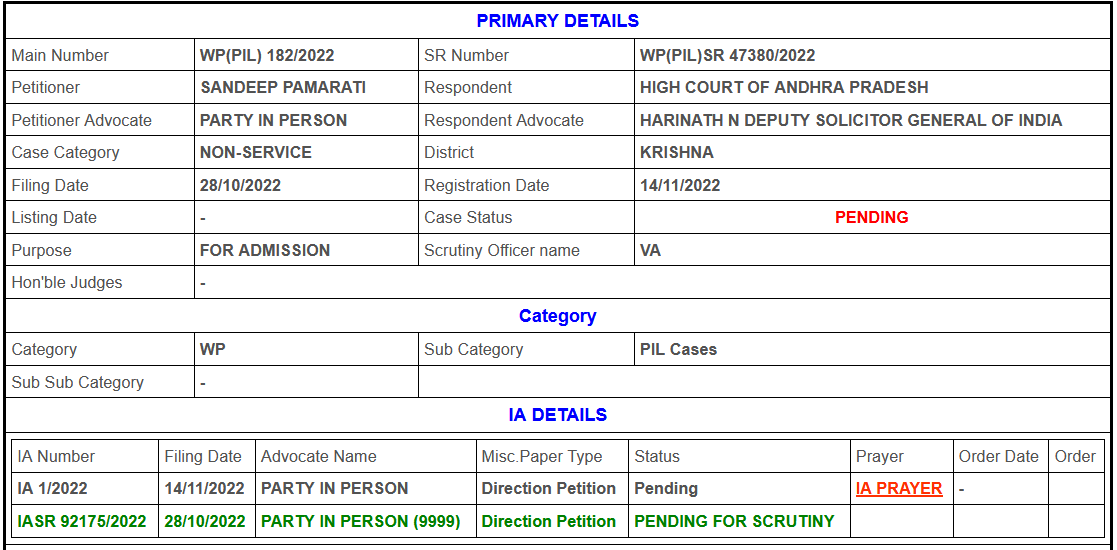
Filed this PIL [WP(PIL)/182/2022] in Oct 2022 but got listed on 14 Nov 2022 before Court-1 of AP HC. Prepared well to argue the matter and hoped to get notices issued to 15 respondents on the petition. But the ;category (For Orders of Court) under which this cases was listed’ and ‘no final WP number given’ made it clear to me that this will be dismissed.

Case status:


I went to podium and began with intro as PIP and then informed there is no personal interest in this PIL and how. That’s all… It was dismissed as not maintainable. Not sure what legal reasons were mentioned in the dismissal order. CJ said, tomorrow I will come with a petition to early dispose another kind of case type. I don’t think this is a legal reason.

Here is the Writ Petition Copy:

2022-10-11 WP(PIL) against APHC and 14 Ors v0.1

Here is the dismissal order.

Sandeep Pamarati Vs High Court of AP and 14 Ors on 14 Nov 2022

Interesting update…

Just after a week from date of the dismissal of my WP-PIL, the following Circular gets issued by AP HC in Nov 2022. Interesting, because earlier circular, issued in Oct 2022, did NOT have a deadline!!! Seems my now-dismissed-PIL is working it’s magic.

2022-Oct-20 Circular:

2022-10-20 CIR_ROC559-20.10.22 Directions for endeavoring to enhance the disposals


…. and then…

2022-Nov-23 Circular:

OPCELL-ROC560-23.11.22

—

The following is the circular forwarded to Anantapur District Judiciary.

2022-11-23 Clearance of Old Cases (ALL those cases instituted prior to 2018)

I AM HAPPY AND SMILING.


MASTER LIST here.
Posted in Judicial Activism (for Public Benefit) | Tagged Do you know that there is time limit of 60 days to dispose of a Domestic Violence case in India under sec 12(5) of PWDV Act? PIL - Implement the Statutory Time limit of 60 days to Dispose of a Domestic Violence case as prescribed under Sec 12(5) of the Act Protection of Women from Domestic Violence Act 2005 PWDV Act Sec 12(5) - Dispose In 60 Days Success Story | Leave a comment

Post navigation

  • Older posts
  • Newer posts

Search within entire Content of “Shades of Knife”

My Legal X Timeline

Advocate Sandeep Pamarati 🇮🇳💪👨🏻‍🎓 Follow

AP High Court Advocate with M Tech (CS) || 12 years in 'Software Industry' as Solution Architect || Blogs at https://t.co/29CB9BzK4w || #TDPTwitter

SandeepPamarati
Retweet on Twitter Advocate Sandeep Pamarati 🇮🇳💪👨🏻‍🎓 Retweeted
hphobiawatch

Hindutva Knight

Verified account @hphobiawatch ·
1 Oct

Our Hero. Their Hero

2

Reply on Twitter 2105521269458502116 Retweet on Twitter 2105521269458502116 3769 Like on Twitter 2105521269458502116 26396 X 2105521269458502116
Retweet on Twitter Advocate Sandeep Pamarati 🇮🇳💪👨🏻‍🎓 Retweeted
dhamimemeforce

Dhami Meme Force

Verified account @dhamimemeforce ·
1 Oct

Aura. Laura

2

Reply on Twitter 2105522699271618842 Retweet on Twitter 2105522699271618842 38 Like on Twitter 2105522699271618842 326 X 2105522699271618842
Retweet on Twitter Advocate Sandeep Pamarati 🇮🇳💪👨🏻‍🎓 Retweeted
hphobiawatch

Hindutva Knight

Verified account @hphobiawatch ·
1 Oct

Ek Sutta do Chaay
Musalman haay haay

Reply on Twitter 2105524889209971190 Retweet on Twitter 2105524889209971190 187 Like on Twitter 2105524889209971190 2439 X 2105524889209971190
Retweet on Twitter Advocate Sandeep Pamarati 🇮🇳💪👨🏻‍🎓 Retweeted
hphobiawatch

Hindutva Knight

Verified account @hphobiawatch ·
1 Oct

"our generation have seen draught in Maharashtra but I promise our next generation won't see the draught"

~CM Devendra Fadnavis

Reply on Twitter 2105529198823821701 Retweet on Twitter 2105529198823821701 74 Like on Twitter 2105529198823821701 752 X 2105529198823821701

Recent Posts

  • Supreme Court: PF and employee share-plan deductions cannot shrink the income used to assess child maintenance September 29, 2026
  • Pradeep Ram Vs State of Jharkhand and Anr on 1 Jul 2019 September 24, 2026
  • Video Conferencing Links of District Judiciary of Andhra Pradesh September 24, 2026
  • Practical Solutions Inc Vs State of Telangana and Ors on 19 Jan 2026 September 24, 2026
  • Md. Mashood and Ors Vs State of UP and Ors on 25 Feb 2026 September 24, 2026

Most Read Posts

  • Appeal, Revision and Review Explained (2,090 views)
  • Anju Garg and Anr Vs Deepak Kumar Garg on 28 Sep 2022 - Judgement Summary (1,666 views)
  • How Courts Quash Omnibus Allegations in Matrimonial FIRs - Case Study (1,563 views)
  • Parvinder Singh Khurana Vs Enforcement of Directorate on 19 May 2026 (1,174 views)
  • Application for Exemption from Personal Appearance During Investigation – Format, Procedure & Sample Draft (1,062 views)
  • Application for Modification of Bail Conditions – Format, Procedure & Sample Draft (928 views)
  • Myth vs Reality: Bail in 498A Cases – Legal Position Explained (927 views)
  • Charul Shukla Vs State of UP and Ors on 25 Mar 2026 - Judgment Summary (903 views)
  • Exemption Application Under Section 205 CrPC – Format, Procedure & Sample Draft (880 views)
  • Representation for Deletion of Name from FIR – Format, Procedure & Sample Draft (866 views)

Tags

Reportable Judgement or Order (446)2-Judge (Division) Bench Decision (431)Legal Procedure Explained - Interpretation of Statutes (389)Landmark Case (387)1-Judge Bench Decision (376)Catena of Landmark Judgments Referred/Cited to (302)Work-In-Progress Article (215)3-Judge (Full) Bench Decision (102)Sandeep Pamarati (92)Article 21 - Protection of life and personal liberty (80)Issued or Recommended Guidelines or Directions or Protocols to be followed (72)Perjury Under Section 340 CrPC (71)Absurd Or After Thought Or Baseless Or False Or General Or Inherently Improbable Or Improved Or UnSpecific Or Omnibus Or Vague Allegations (62)Reprimands or Setbacks to YCP Govt of Andhra Pradesh (49)Summary Post (47)CrPC 482 - Quash (44)CrPC 125 or BNSS 144 - Order for Maintenance of Wives Children and Parents (43)Abuse Or Misuse of Process of Court (43)HM Act Sec 13 - Divorce Granted to Husband (42)Divorce Granted on Cruelty ground (42)

Categories

Supreme Court of India Judgment or Order or Notification (767)Bare Acts or State Amendments or Statutes or GOs or Notifications issued by Central or State Governments (329)High Court of Andhra Pradesh Judgment or Order or Notification (190)High Court of Delhi Judgment or Order or Notification (167)High Court of Bombay Judgment or Order or Notification (112)High Court of Karnataka Judgment or Order or Notification (95)Legal Procedure (85)High Court of Madras Judgment or Order or Notification (71)High Court of Allahabad Judgment or Order or Notification (63)LLB Study Material (59)General Study Material (56)Assorted Court Judgments or Orders or Notifications (54)High Court of Punjab & Haryana Judgment or Order or Notification (53)High Court of Kerala Judgment or Order or Notification (48)Judicial Activism (for Public Benefit) (47)Prakasam DV Cases (46)District or Sessions or Magistrate Court Judgment or Order or Notification (44)High Court of Madhya Pradesh Judgment or Order or Notification (38)High Court of Telangana Judgment or Order or Notification (29)High Court of Calcutta Judgment or Order or Notification (28)

Recent Comments

  • ShadesOfKnife on How to Challenge Ex Parte Orders in Criminal and Matrimonial Proceedings – Legal Remedies
  • pradeep jain on How to Challenge Ex Parte Orders in Criminal and Matrimonial Proceedings – Legal Remedies
  • Lawyer Sonia on Regular Bail Application Format (Section 437/439 CrPC)
  • vinod gupta on Reply to Section 41A CrPC Notice – Format with Legal Explanation
  • eCourts India on Compromise-Based Quashing in Matrimonial Cases – Complete Legal Strategy

Archives of SoK

  • September 2026 (13)
  • August 2026 (6)
  • July 2026 (19)
  • June 2026 (19)
  • May 2026 (24)
  • April 2026 (33)
  • March 2026 (42)
  • February 2026 (30)
  • January 2026 (21)
  • December 2025 (2)
  • November 2025 (3)
  • October 2025 (17)
  • September 2025 (12)
  • August 2025 (5)
  • July 2025 (10)
  • June 2025 (15)
  • May 2025 (3)
  • April 2025 (10)
  • March 2025 (7)
  • February 2025 (8)
  • January 2025 (1)
  • December 2024 (3)
  • November 2024 (4)
  • October 2024 (16)
  • September 2024 (15)
  • August 2024 (14)
  • July 2024 (11)
  • June 2024 (18)
  • May 2024 (13)
  • April 2024 (9)
  • March 2024 (23)
  • February 2024 (15)
  • January 2024 (11)
  • December 2023 (11)
  • November 2023 (9)
  • October 2023 (13)
  • September 2023 (12)
  • August 2023 (15)
  • July 2023 (17)
  • June 2023 (11)
  • May 2023 (6)
  • April 2023 (5)
  • March 2023 (10)
  • February 2023 (9)
  • January 2023 (12)
  • December 2022 (12)
  • November 2022 (8)
  • October 2022 (13)
  • September 2022 (17)
  • August 2022 (10)
  • July 2022 (21)
  • June 2022 (27)
  • May 2022 (23)
  • April 2022 (32)
  • March 2022 (17)
  • February 2022 (6)
  • January 2022 (2)
  • December 2021 (7)
  • November 2021 (7)
  • October 2021 (6)
  • September 2021 (10)
  • August 2021 (31)
  • July 2021 (45)
  • June 2021 (17)
  • May 2021 (17)
  • April 2021 (18)
  • March 2021 (58)
  • February 2021 (14)
  • January 2021 (50)
  • December 2020 (35)
  • November 2020 (68)
  • October 2020 (67)
  • September 2020 (28)
  • August 2020 (41)
  • July 2020 (20)
  • June 2020 (36)
  • May 2020 (40)
  • April 2020 (38)
  • March 2020 (26)
  • February 2020 (43)
  • January 2020 (35)
  • December 2019 (34)
  • November 2019 (4)
  • October 2019 (18)
  • September 2019 (57)
  • August 2019 (33)
  • July 2019 (12)
  • June 2019 (18)
  • May 2019 (5)
  • April 2019 (19)
  • March 2019 (58)
  • February 2019 (11)
  • January 2019 (90)
  • December 2018 (97)
  • November 2018 (43)
  • October 2018 (31)
  • September 2018 (73)
  • August 2018 (47)
  • July 2018 (143)
  • June 2018 (92)
  • May 2018 (97)
  • April 2018 (59)
  • March 2018 (8)

Blogroll

  • Daaman Promoting Harmony 0
  • Fight against Legal Terrorism Fight against Legal Terrorism along with MyNation Foundation 0
  • Good Morning Good Morning News 0
  • Insaaf India Insaaf Awareness Movement 0
  • MyNation Hope Foundation Wiki 0
  • MyNation.net Equality, Justice and Harmony 0
  • Sarvepalli Legal 0
  • Save Indian Family Save Indian Family Movement 0
  • SIF Chandigarh SIF Chandigarh 0
  • The Male Factor The Male Factor 0
  • Unitedmen Foundation a dedicated community forged with the mission to unite men facing legal challenges in marital disputes. 0
  • Vaastav Foundation The Social Reality 0
  • Vinayak my2centsworth – This blog is for honest law abiding men, married or planning to get married 0
  • Voice4india Indian Laws, Non-profits, Environment 0
  • Writing Law Writing Law by Ankur 0

RSS feed: Cloudflare Status Cloudflare Status

  • DEL (New Delhi) on 2026-10-29 October 29, 2026
    Sep 17, 17:11 UTCScheduled - We will be performing scheduled maintenance in DEL (New Delhi) datacenter between 2026-10-29 21:00 and 2026-10-30 01:00 UTC. Traffic might be re-routed from this location, hence there is a possibility of a slight increase in latency during this maintenance window for end-users in the affected region. For PNI / CNI […]
    Cloudflare Status

RSS feed: List of Spam Server IPs from Project Honeypot List of Spam Server IPs from Project Honeypot

  • 105.27.127.194 | SD October 2, 2026
    Event: Bad Event | Total: 135 | First: 2026-01-26 | Last: 2026-10-02
Owned and Operated by Advocate Sandeep Pamarati and Advocate Suprajaa Rajan
Proudly powered by WordPress
Theme: Flint by Star Verte LLC

Bad Behavior has blocked 3883 access attempts in the last 7 days.

pixel