A criminal case does not always have to proceed until trial. In appropriate situations, an accused person may approach the High Court seeking quashing of criminal proceedings to prevent abuse of the legal process and to secure the ends of justice.
However, filing a quashing petition is not a routine appeal against an FIR or chargesheet. High Courts exercise their inherent powers carefully and interfere only when the case falls within recognized legal principles.
Many petitions fail because they are filed:
- Without proper documents
- Without identifying legal grounds
- Without examining maintainability
- Without considering the stage of proceedings
- Without understanding the limits of High Court jurisdiction
Therefore, before filing a quashing petition, a detailed legal and factual checklist is essential.
This article explains the complete checklist before filing a quashing petition, including documents, legal grounds, procedural requirements, strategy, and common mistakes.
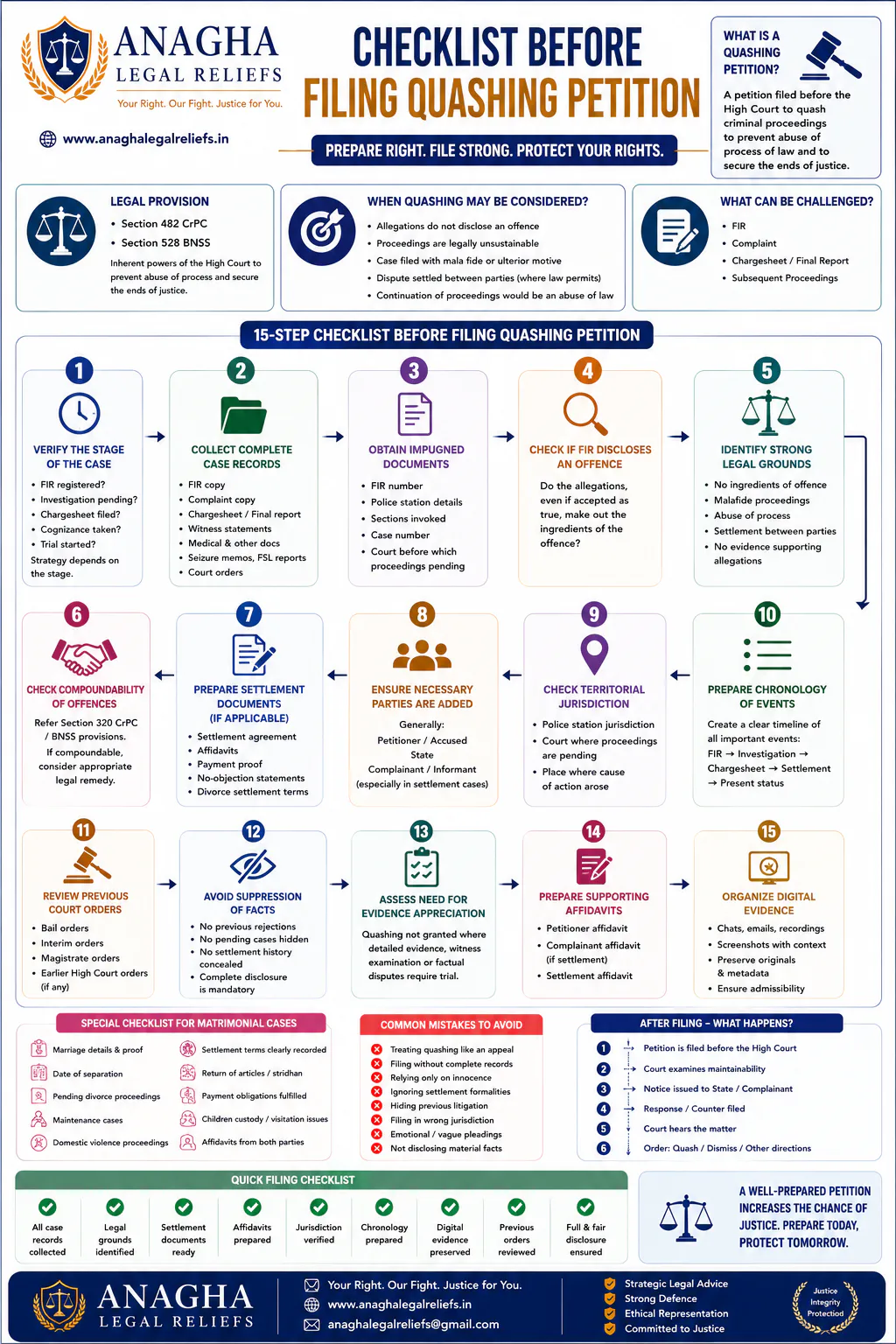
What Is a Quashing Petition?
A quashing petition is an application filed before the High Court requesting it to terminate criminal proceedings.
The High Court may exercise its inherent powers when:
- The allegations do not disclose an offence
- Proceedings are legally unsustainable
- Continuation of the case would amount to abuse of process
- Parties have settled a dispute where law permits
- Criminal proceedings are being misused for personal disputes
Legal Provision for Quashing
Under CrPC
Section 482 CrPC
This provision recognises the inherent powers of the High Court.
Under BNSS
Section 528 BNSS
The BNSS continues the High Court’s inherent power to:
- Prevent abuse of process
- Secure the ends of justice
When Is Quashing Generally Considered?
Quashing may be considered in situations such as:
1. False or Baseless Allegations
Where the FIR or complaint does not disclose any criminal offence.
2. Civil Dispute Given Criminal Colour
Example:
A purely contractual or family dispute is converted into a criminal complaint.
3. Matrimonial Disputes
Common examples:
- 498A IPC matters
- Family disputes
- Settlement after complaint
4. Settlement Between Parties
Where continuation of prosecution serves no purpose.
5. Legal Bar Against Proceedings
Where law prevents continuation of prosecution.
Checklist Before Filing Quashing Petition
1. Verify the Correct Stage of the Case
First determine:
- Is only FIR registered?
- Is investigation pending?
- Is chargesheet filed?
- Has cognizance been taken?
- Has trial started?
The strategy changes depending on the stage.
For example:
An FIR challenge may focus on allegations.
A chargesheet challenge may require examination of investigation material.
2. Collect Complete Case Records
Before approaching the High Court, obtain:
- FIR copy
- Complaint copy
- Chargesheet/final report (if filed)
- Statements recorded during investigation
- Medical documents (if applicable)
- Seizure memos
- Forensic reports
- Court orders
Incomplete records often weaken petitions.
3. Obtain the Impugned Documents
The petition should clearly identify what is being challenged.
Collect:
- FIR number
- Police station details
- Sections invoked
- Case number
- Magistrate court details
Accuracy is critical.
4. Check Whether the FIR Discloses an Offence
One of the strongest grounds.
Ask:
Even if the allegations are accepted as true, do they constitute an offence?
If the answer is no, quashing may be considered.
5. Identify the Legal Grounds Clearly
A strong petition must state specific grounds.
Common grounds include:
Ground 1: No Ingredients of Offence
The complaint lacks essential elements of the alleged offence.
Example:
Section invoked but necessary facts missing.
Ground 2: Malafide Proceedings
The complaint appears motivated by:
- Personal revenge
- Pressure tactics
- Harassment
Ground 3: Abuse of Criminal Process
Criminal law cannot be used as a tool for:
- Civil recovery
- Personal disputes
- Settlement pressure
Ground 4: Settlement Between Parties
Where parties have resolved disputes.
Common in:
- Matrimonial cases
- Business disputes
- Personal disputes
Ground 5: No Evidence Supporting Allegations
Investigation does not support the complaint.
6. Check Whether the Offences Are Compoundable
Before filing quashing:
Examine whether settlement can legally end proceedings.
Relevant provision:
CrPC
Section 320 CrPC
BNSS
Corresponding compounding provisions.
If an offence is compoundable, another remedy may exist.
7. Prepare Settlement Documents (If Applicable)
If parties have settled, collect:
- Settlement agreement
- Affidavits
- Divorce settlement terms (if applicable)
- Payment proof
- No-objection statements
A vague settlement is usually insufficient.
8. Verify Presence of All Necessary Parties
Generally, proceedings involve:
- Petitioner/accused
- State
- Complainant/informant
The complainant’s presence becomes important especially where settlement is relied upon.
9. Check Territorial Jurisdiction
File before the appropriate High Court.
Consider:
- Police station jurisdiction
- Court where proceedings are pending
- Cause of action
Wrong jurisdiction can delay proceedings.
10. Prepare a Complete Chronology
Create a timeline:
Example:
Date | Event
- FIR registered
- Arrest/bail
- Investigation
- Settlement
- Chargesheet filing
Courts appreciate clear factual presentation.
11. Review Previous Court Orders
Collect:
- Bail orders
- Interim protection orders
- Magistrate orders
- Earlier High Court orders
Previous proceedings must be disclosed.
12. Check for Suppression of Facts
Never hide:
- Earlier rejection orders
- Pending proceedings
- Settlement history
- Related cases
Suppression can damage credibility.
13. Examine Whether Evidence Needs Trial
High Courts generally avoid detailed evidence appreciation.
Quashing may not be appropriate where:
- Witness examination is required
- Facts are disputed
- Evidence needs evaluation
14. Prepare Supporting Affidavits
Depending on circumstances:
- Petitioner affidavit
- Complainant affidavit
- Settlement affidavit
may be required.
15. Organise Digital Evidence
Modern criminal cases often involve:
- WhatsApp chats
- Emails
- Audio recordings
- CCTV
- Digital documents
Preserve originals and metadata wherever possible.
Special Checklist for Matrimonial Quashing Cases
Matrimonial matters require additional preparation.
Check:
- Marriage details
- Separation date
- Pending divorce proceedings
- Maintenance cases
- Domestic violence proceedings
- Settlement terms
- Return of articles/stridhan
- Payment obligations
Common Mistakes While Filing Quashing Petition
Mistake 1: Treating Quashing Like an Appeal
High Court does not conduct a full trial.
Mistake 2: Filing Without Complete Records
Incomplete facts weaken the petition.
Mistake 3: Relying Only on Innocence
“I am innocent” alone is not a quashing ground.
Mistake 4: Ignoring Settlement Formalities
Settlement must be properly documented.
Mistake 5: Hiding Previous Litigation
Transparency matters.
What Happens After Filing?
Generally:
Step 1
Petition is filed.
Step 2
Court examines maintainability.
Step 3
Notice may be issued.
Step 4
State and complainant respond.
Step 5
Court decides whether interference is justified.
Important Judicial Principle
The High Court uses inherent powers sparingly.
The objective is not to decide guilt or innocence but to prevent:
- Abuse of process
- Unnecessary harassment
- Legally unsustainable prosecution
Practical Filing Checklist
Before filing, confirm:
- FIR copy obtained
- Chargesheet status checked
- Correct sections identified
- Grounds of quashing prepared
- Case chronology drafted
- Supporting documents attached
- Settlement documents ready (if applicable)
- Previous orders disclosed
- Jurisdiction verified
- Affidavits prepared
- Digital evidence preserved
Conclusion
A quashing petition is a powerful legal remedy, but success depends heavily on preparation.
The strongest petitions are built on:
- Clear legal grounds
- Complete documentation
- Accurate facts
- Proper procedural compliance
- Strategic presentation
Before approaching the High Court, a litigant must carefully evaluate whether the case genuinely falls within the scope of inherent powers.
A well-prepared quashing petition can prevent unnecessary criminal proceedings and protect individuals from misuse of the criminal justice system.
Index of Legal Strategies and Defence is here.

