Anticipatory bail often becomes the first line of defence in criminal litigation, especially in sensitive matters involving:
- Matrimonial disputes
- Section 498A prosecutions
- Financial offences
- Family disputes
- Property-related criminal complaints
- Allegations involving multiple accused
However, an important question frequently arises after the first anticipatory bail application is rejected:
Can an accused file a second anticipatory bail application?
The short answer is:
Yes—but not automatically, and not on identical grounds.
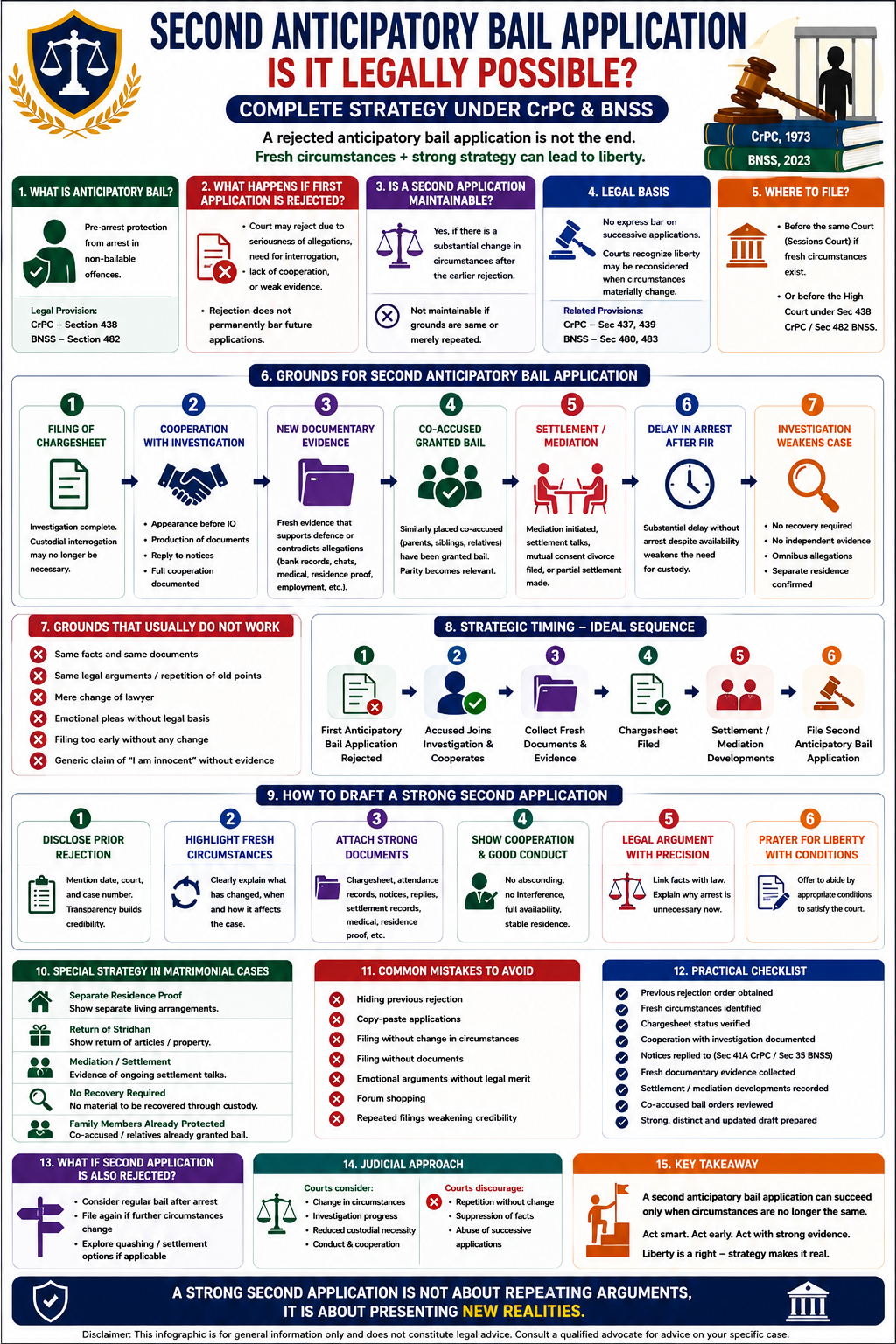
Indian courts do permit a second anticipatory bail application, but only under legally sustainable circumstances such as change in circumstances, emergence of new facts, procedural developments, fresh evidence, or material changes in investigation.
Therefore, understanding when a second anticipatory bail application is maintainable—and how to strategically prepare it—can make the difference between liberty and custody.
This article explains the legal framework, maintainability principles, strategic grounds, judicial approach, drafting strategy, and defence tactics, with references to both the Code of Criminal Procedure, 1973 (CrPC) and the Bharatiya Nagarik Suraksha Sanhita, 2023 (BNSS).
What Is Anticipatory Bail?
Anticipatory bail protects a person from arrest in a non-bailable offence.
It allows the accused to seek pre-arrest protection when they reasonably apprehend arrest.
Relevant provisions include:
Under CrPC
- Section 438 CrPC
Under BNSS
- Section 482 BNSS
Courts granting anticipatory bail may impose conditions such as:
- Cooperation with investigation
- Appearance before investigating officer
- Non-interference with witnesses
- Travel restrictions
- Preservation of evidence
What Happens If the First Anticipatory Bail Application Is Rejected?
The first anticipatory bail application may be rejected by:
- Sessions Court
- High Court
Common reasons include:
- Serious allegations
- Incomplete investigation
- Need for custodial interrogation
- Lack of cooperation
- Weak documentation
- Premature filing
However, rejection of the first application does not permanently bar future applications.
That said, a second application cannot become an appeal in disguise.
The accused must demonstrate something legally new.
Is a Second Anticipatory Bail Application Maintainable?
Yes.
A second anticipatory bail application is maintainable if there is a substantial change in circumstances after the earlier rejection.
Courts generally ask:
“What has changed since the previous rejection?”
If nothing material has changed, the second application may fail at the threshold.
Therefore, maintainability depends on fresh grounds—not repetition of old arguments.
Legal Basis for Successive Bail Applications
Although Section 438 CrPC (Section 482 BNSS) does not expressly mention successive applications, Indian courts recognise the principle that liberty may be reconsidered when circumstances materially change.
This principle also aligns with broader bail jurisprudence under:
- Section 437 CrPC (Section 480 BNSS)
- Section 439 CrPC (Section 483 BNSS)
Therefore, successive bail applications are not prohibited—but they require justification.
What Qualifies as “Change in Circumstances”?
This is the most critical question.
A second anticipatory bail application usually succeeds only when new developments arise.
Ground 1: Filing of Chargesheet
One of the strongest grounds.
Relevant provisions:
- Section 173 CrPC (Section 193 BNSS) – Police report
Once the investigation is complete and the chargesheet is filed:
- Custodial interrogation may become unnecessary
- Evidence may already be collected
- The prosecution’s need for arrest may weaken
Therefore, filing of chargesheet often becomes a valid fresh ground.
Ground 2: Cooperation With Investigation
If the earlier rejection was based on non-cooperation, subsequent cooperation may change the situation.
Examples:
- Appearance before investigating officer
- Production of documents
- Joining investigation
- Responding to notices
Relevant notice provision:
- Section 41A CrPC (Section 35 BNSS)
Documented cooperation significantly improves credibility.
Ground 3: New Documentary Evidence
Fresh evidence may change the court’s view.
Examples:
- Bank records
- Travel documents
- Digital chats
- Medical records
- Residence proof
- Employment records
Such evidence may:
- Contradict allegations
- Show false implication
- Prove separate residence
- Disprove presence at the alleged incident
Ground 4: Co-Accused Granted Bail
If similarly placed co-accused obtain protection, parity becomes relevant.
Examples:
- Parents granted bail
- Siblings granted bail
- Co-accused discharged from similar allegations
Parity is not automatic, but it strengthens the case.
Ground 5: Settlement Negotiations or Mediation
In matrimonial disputes, settlement developments may materially change the case.
Examples:
- Mediation initiated
- Settlement terms recorded
- Mutual consent divorce filed
- Partial settlement payments made
Courts may consider these developments.
Ground 6: Delay in Arrest Despite FIR
If substantial time passes after FIR registration and the accused remains available, the prosecution’s urgency may weaken.
Questions courts may consider:
- Why was arrest not made earlier?
- Was the accused available throughout?
- Was there any attempt to abscond?
Delay can support a fresh application.
Ground 7: False or General Allegations Revealed During Investigation
Sometimes investigation itself weakens the prosecution.
Examples:
- No recovery required
- No independent witness support
- Omnibus allegations against relatives
- Separate residence confirmed
This may justify a fresh attempt.
Grounds That Usually Do NOT Work
Courts usually reject second applications based on:
- Same facts
- Same documents
- Same legal arguments
- Mere change of lawyer
- Emotional pleas
- Generic “I am innocent” claims
Repetition is not strategy.
Can You File Before the Same Court?
Possibly—but strategy matters.
Before Sessions Court
A second application before the Sessions Court may be maintainable if:
- Fresh circumstances arise after rejection
Before High Court
If Sessions Court rejects relief, the accused may approach the High Court.
Relevant provision:
- Section 438 CrPC (Section 482 BNSS)
The High Court independently examines maintainability.
Strategic Timing for the Second Application
Timing can determine success.
A strong sequence may look like:
Step 1 – First application rejected.
Step 2 – Accused joins investigation.
Step 3 – Documents collected.
Step 4 – Chargesheet filed.
Step 5 – Settlement or mediation begins.
Step 6 – Second anticipatory bail filed.
This creates a stronger narrative.
How to Draft a Strong Second Anticipatory Bail Application
The second application must clearly disclose:
Prior Rejection
Never suppress previous rejection.
Mention:
- Date
- Court
- Case number
Transparency builds credibility.
Fresh Circumstances
Clearly identify:
- What changed
- When it changed
- How it affects custodial necessity
This section often decides the case.
Documentary Support
Attach:
- Chargesheet
- Attendance proofs
- Notice replies
- Settlement records
- Medical documents
- Residence proof
Documents matter more than allegations.
Bail Conduct and Availability
Show:
- Stable residence
- No absconding
- No witness interference
- Full cooperation
Conduct influences discretion.
Special Strategy in Matrimonial Cases
In matrimonial prosecutions such as:
- Section 498A IPC cases
- Dowry allegations
- Domestic violence-linked complaints
The following fresh grounds often become effective:
Separate Residence Proof
Parents or siblings living separately.
Return of Stridhan
Property already returned.
Mediation Proceedings
Settlement underway.
No Recovery Required
Custodial interrogation no longer necessary.
Family Members Already Protected
Parity argument strengthens.
Common Mistakes in Second Bail Applications
Avoid:
Hiding Previous Rejection
Courts treat suppression seriously.
Copy-Paste Drafting
Every fresh application must show fresh grounds.
Filing Too Early
Without change in circumstances.
Filing Without Documents
Assertions alone rarely work.
Emotional Arguments Without Legal Basis
Liberty requires legal structure.
What If the Second Application Is Also Rejected?
Further remedies may still exist depending on circumstances:
- Fresh application after later developments
- Regular bail after appearance
- Interim protection in exceptional situations
- Quashing or other strategic remedies
However, repeated applications without new grounds may harm credibility.
Practical Checklist Before Filing
Before filing a second anticipatory bail application, ensure:
- Previous rejection order obtained
- Fresh circumstances identified
- Chargesheet status verified
- Investigation cooperation documented
- Notices responded to
- Documentary evidence collected
- Settlement developments recorded
- Co-accused orders reviewed
- Draft clearly distinguishes old and new grounds
Judicial Approach
Courts generally protect personal liberty—but they also guard against abuse of successive applications.
Courts look for:
- Genuine change in circumstances
- Procedural fairness
- Reduced custodial necessity
- Documentary credibility
- Consistent conduct
Courts discourage:
- Forum shopping
- Repetitive litigation
- Suppression of prior orders
Therefore, credibility becomes as important as legal merit.
Conclusion
A rejected anticipatory bail application is not necessarily the end of the road.
Indian criminal law allows a second anticipatory bail application—but only when:
- Facts materially change
- Investigation progresses
- New evidence emerges
- Cooperation improves
- Settlement developments occur
- Custodial necessity weakens
By:
- Acting strategically
- Preserving documents
- Demonstrating cooperation
- Drafting with precision
- Filing at the right time
an accused can significantly improve the chances of securing pre-arrest protection.
In criminal litigation, a second bail application succeeds not because it is repeated—but because the circumstances are no longer the same.
Related Legal Concepts
Index of Legal Strategies and Defence is here.
Key Contributor :
Mrs. Suprajaa Rajan B.Com., LL.B., LL.M.
+91-9606345150

