Matrimonial criminal litigation can become emotionally exhausting, financially draining, and legally complex. Complaints involving allegations of cruelty, dowry harassment, domestic violence, maintenance, breach of trust, child custody, or financial abuse often trigger multiple parallel proceedings.
In such situations, many accused persons unknowingly make strategic mistakes during the early stages of litigation. Unfortunately, these mistakes often strengthen the prosecution’s case, weaken the defence, and create long-term legal complications.
However, most of these errors are entirely avoidable.
Therefore, understanding the top mistakes accused persons make in matrimonial cases—and how to avoid them—can dramatically improve case outcomes.
This article explains the 10 most common strategic mistakes, the legal consequences of each, and the corrective strategy, with references to both the Code of Criminal Procedure, 1973 (CrPC) and the Bharatiya Nagarik Suraksha Sanhita, 2023 (BNSS).
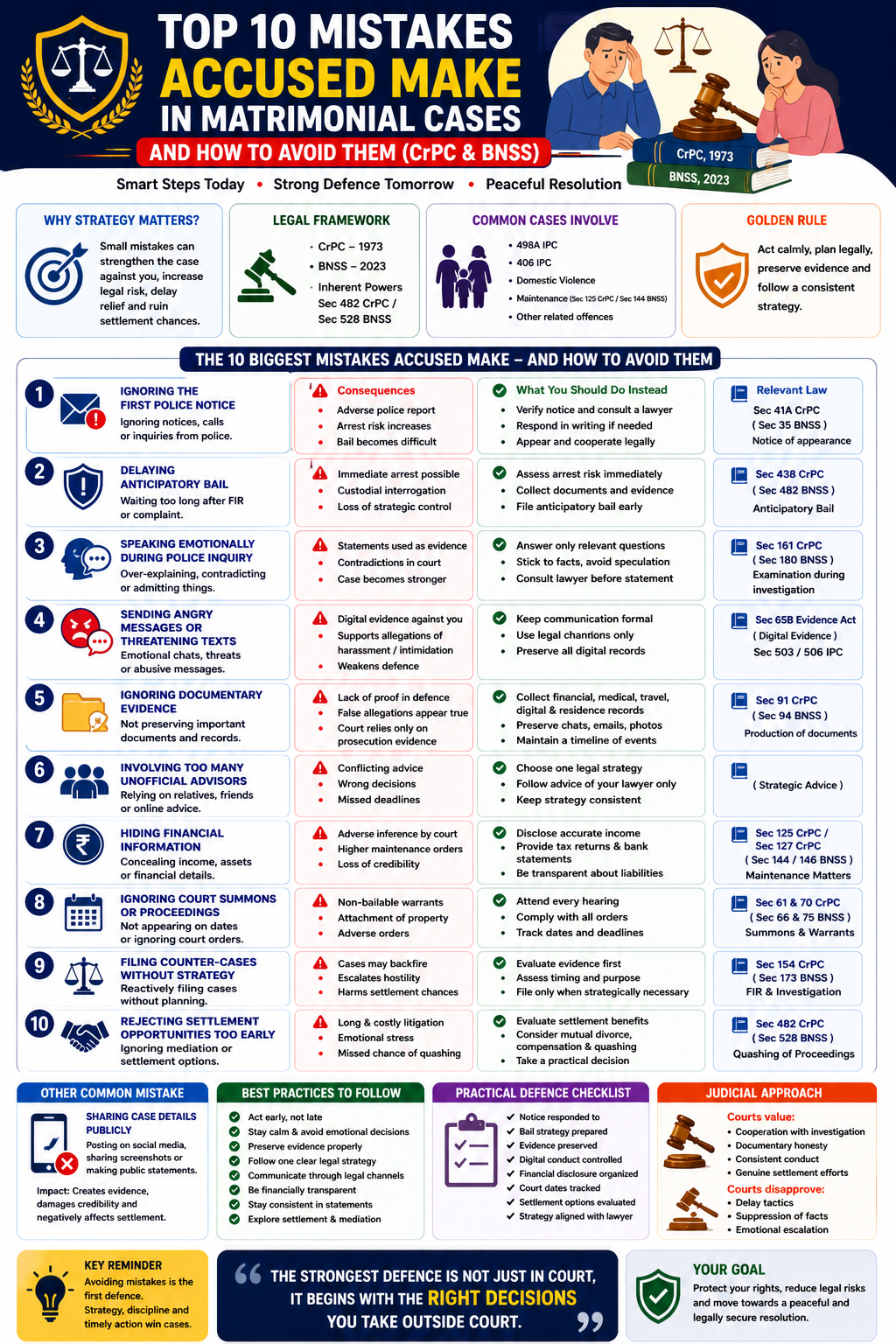
Mistake #1: Ignoring the First Police Notice
One of the biggest mistakes accused persons make is ignoring:
- Police calls
- WhatsApp messages from investigating officers
- Written notices
- Calls for inquiry
Particularly notices issued under:
- Section 41A CrPC (Section 35 BNSS) – Notice of appearance before police
Many people assume:
“If I don’t appear, nothing will happen.”
That assumption can be costly.
Ignoring such notices may lead to:
- Adverse police reports
- Allegations of non-cooperation
- Stronger grounds for arrest
- Difficulty in obtaining bail
What You Should Do Instead
Immediately:
- Verify authenticity of notice
- Consult counsel
- Send a formal written reply
- Appear through proper legal guidance
- Maintain proof of cooperation
Mistake #2: Delaying Anticipatory Bail
Many accused wait until:
- Police pressure increases
- Arrest becomes imminent
- Family members panic
By then, valuable time may already be lost.
Anticipatory bail is available under:
- Section 438 CrPC (Section 482 BNSS)
Delay can create:
- Urgent arrests
- Custodial interrogation risks
- Reduced strategic control
What You Should Do Instead
The moment an FIR or credible complaint surfaces:
- Assess arrest risk
- Collect documents
- File anticipatory bail proactively
Early action often changes the entire trajectory of the case.
Mistake #3: Speaking Emotionally During Police Inquiry
Many accused try to “explain everything” emotionally.
They:
- Overtalk
- Volunteer unnecessary facts
- Make inconsistent statements
- Admit facts without understanding consequences
These statements may later create contradictions.
Relevant investigation provisions include:
- Section 161 CrPC (Section 180 BNSS) – Examination during investigation
What You Should Do Instead
During inquiry:
- Answer only relevant questions
- Stick to facts
- Avoid speculation
- Avoid emotional narratives
- Speak after legal consultation
In criminal litigation, precision matters more than volume.
Mistake #4: Sending Angry Messages or Threatening Texts
After litigation begins, many accused send:
- Emotional WhatsApp messages
- Threatening texts
- Audio messages
- Social media posts
These messages often become evidence.
Digital records can support allegations involving:
- Harassment
- Intimidation
- Mental cruelty
- Threats
What You Should Do Instead
After litigation starts:
- Keep communication formal
- Use written legal channels
- Avoid emotional confrontation
- Preserve all digital records
Silence is often stronger than reaction.
Mistake #5: Ignoring Documentary Evidence
Many accused assume:
“Truth alone will win.”
Unfortunately, courts decide based on evidence.
Important records include:
- Bank statements
- Salary records
- Medical documents
- Travel history
- Property documents
- Chat records
- Emails
- Photographs
What You Should Do Instead
Immediately preserve:
- Financial records
- Digital communications
- Residence proof
- Employment documents
- Timeline documents
Evidence collected early often becomes decisive.
Mistake #6: Involving Too Many Unofficial Advisors
Many families rely on:
- Relatives
- Friends
- Social media groups
- Unverified online advice
Conflicting advice creates confusion.
Common consequences:
- Missed deadlines
- Wrong filings
- Contradictory positions
- Strategic inconsistency
What You Should Do Instead
Choose:
- One coordinated legal strategy
- One litigation roadmap
- Documented instructions
Consistency builds credibility.
Mistake #7: Hiding Financial Information
In maintenance and domestic violence litigation, some accused conceal:
- Salary
- Rental income
- Investments
- Business earnings
Courts take a strict view of suppression.
Maintenance proceedings may arise under:
- Section 125 CrPC (Section 144 BNSS)
- Alteration under Section 127 CrPC (Section 146 BNSS)
Suppression may result in:
- Adverse inference
- Higher maintenance
- Loss of credibility
What You Should Do Instead
Disclose:
- Accurate income
- Genuine liabilities
- Existing dependents
- Tax records
Transparency strengthens defence.
Mistake #8: Ignoring Court Summons or Proceedings
Some accused think:
“My lawyer will handle everything.”
They stop attending:
- Court dates
- Verification hearings
- Settlement proceedings
Ignoring summons can trigger:
- Non-bailable warrants
- Proclamation proceedings
- Adverse orders
Relevant provisions include:
- Section 61 CrPC (Section 66 BNSS) – Summons
- Section 70 CrPC (Section 75 BNSS) – Warrant
What You Should Do Instead
Track:
- Every hearing
- Every compliance direction
- Every filing deadline
Personal involvement matters.
Mistake #9: Filing Counter-Cases Without Strategy
Many accused immediately file:
- Defamation complaints
- Assault complaints
- Counter FIRs
- Civil suits
Sometimes these cases are emotionally driven, not strategically planned.
Poorly timed counter-litigation may:
- Backfire
- Escalate hostility
- Harm settlement chances
- Create contradictory records
What You Should Do Instead
Before filing any counter-action:
- Assess evidentiary strength
- Evaluate timing
- Align with overall defence theory
Strategic litigation always beats reactive litigation.
Mistake #10: Rejecting Settlement Opportunities Too Early
Some accused believe:
“I will fight till the end.”
While trial may be necessary in some cases, many matrimonial disputes resolve more effectively through:
- Mediation
- Mutual consent divorce
- Financial settlement
- FIR quashing
High Courts may quash proceedings under:
- Section 482 CrPC (Section 528 BNSS)
Premature rejection of settlement may:
- Prolong litigation for years
- Increase legal expenses
- Affect employment, travel, family peace
What You Should Do Instead
Evaluate:
- Settlement viability
- Financial exposure
- Trial risks
- Long-term personal goals
Settlement is not weakness—timely settlement is strategy.
Bonus Mistake: Sharing Case Details Publicly
Many accused post:
- Case updates on social media
- Screenshots
- Allegations
- Personal attacks
This may:
- Create fresh evidence
- Damage settlement prospects
- Affect judicial perception
Better Approach
Keep:
- Case documents private
- Communications confidential
- Strategy limited to legal team
Practical Defence Checklist
If you are facing matrimonial criminal litigation, ensure:
- Police notices responded to
- Bail strategy prepared
- Evidence preserved
- Digital conduct controlled
- Financial disclosure organised
- Court dates tracked
- Settlement options evaluated
- Counter-cases strategically assessed
Judicial Approach
Courts increasingly value:
- Cooperation with investigation
- Documentary honesty
- Consistent conduct
- Genuine settlement efforts
- Procedural discipline
Conversely, courts scrutinise:
- Delay tactics
- Suppression
- Evasive conduct
- Emotional escalation
Your conduct outside the courtroom can influence what happens inside it.
Conclusion
In matrimonial criminal litigation, many cases are won—or lost—long before trial begins.
The accused often weaken their own defence by:
- Acting emotionally
- Ignoring notices
- Delaying legal action
- Mishandling evidence
- Rejecting strategic solutions
However, by:
- Acting early
- Staying disciplined
- Preserving evidence
- Following one coherent legal strategy
- Evaluating settlement intelligently
you can significantly improve your legal position.
In matrimonial litigation, the strongest defence often begins with avoiding preventable mistakes.
Index of Legal Strategies and Defence is here.
Key Contributor :
Mrs. Suprajaa Rajan B.Com., LL.B., LL.M.
+91-9606345150

