Police interrogation forms an important part of criminal investigations. However, many individuals become anxious when they receive a notice asking them to appear before the police for questioning. Therefore, it is essential to understand the legal framework governing police interrogation and the rights available to individuals during the investigation process. Indian criminal procedure provides safeguards to ensure that police interrogation remains lawful, fair, and respectful of personal liberty.
This article explains how to prepare for police interrogation, the legal rights available during questioning, and the relevant provisions under both CrPC and BNSS.
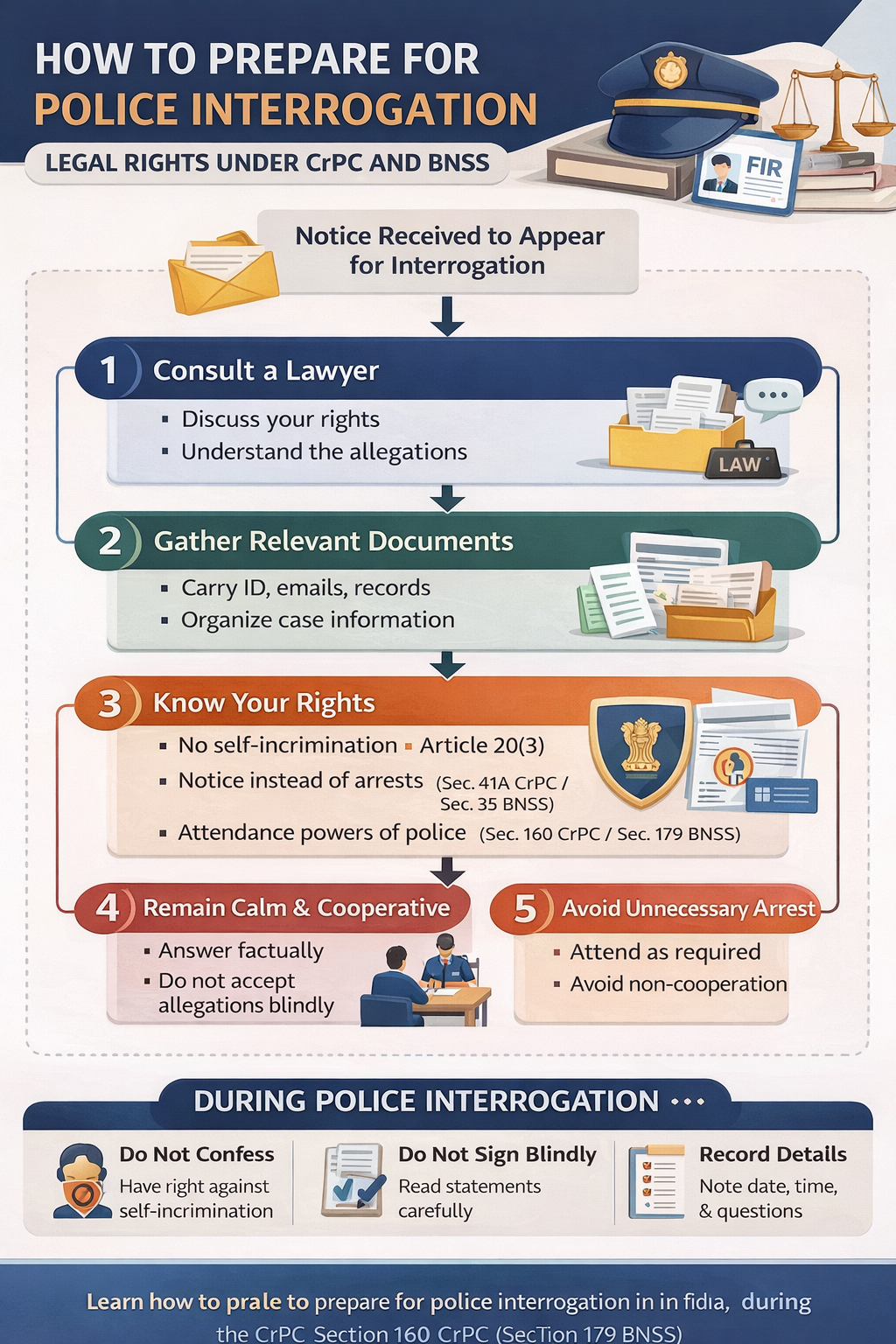
Understanding the Purpose of Police Interrogation
Police interrogation primarily aims to collect information relevant to an ongoing investigation. Investigating officers question individuals to understand the circumstances of the alleged offence and gather evidence.
Generally, the police may question:
The accused person
Witnesses
Persons suspected of having information about the incident
The law authorises the police to summon individuals for questioning under Section 160 CrPC (Section 179 BNSS), which empowers a police officer to require the attendance of witnesses during investigation.
However, this power must be exercised reasonably and only for the purpose of investigation.
Receiving a Notice for Interrogation
In many situations, the police issue a formal notice directing a person to appear before the investigating officer.
Such notices are typically issued under Section 41A CrPC (Section 35 BNSS). This provision requires the police to issue a notice of appearance in cases where arrest is not immediately necessary.
When you receive such a notice, you should carefully verify:
Date and time of appearance
Name and designation of the investigating officer
Police station issuing the notice
Case reference details
Responding to the notice responsibly and appearing before the police as required demonstrates cooperation with the investigation and may also reduce the likelihood of arrest.
Consult a Lawyer Before Appearing
Before attending police interrogation, it is advisable to consult a legal professional. A lawyer can explain your rights and help you understand the nature of the allegations.
Legal advice becomes particularly important when:
You are named in the FIR
The alleged offence is serious
The investigation may lead to arrest
Although the lawyer may not always be present throughout the interrogation, courts have recognised the right of the accused to consult legal counsel during investigation.
Carry Relevant Documents and Information
Proper preparation can make the interrogation process smoother. Therefore, you should organize all relevant documents and information connected to the investigation.
These may include:
Identification documents
Communication records such as emails or messages
Financial or transaction records
Travel documents if relevant to the case
Providing accurate documentation helps ensure that the investigation proceeds efficiently and transparently.
Remain Calm and Cooperative
During interrogation, it is important to maintain a calm and cooperative approach. Investigating officers ask questions to clarify facts and gather information.
Therefore:
Listen carefully to each question
Provide factual and accurate answers
Avoid speculation or unnecessary statements
At the same time, cooperation does not mean that you must accept allegations without clarification.
Right Against Self-Incrimination
One of the most important constitutional protections during police interrogation is the right against self-incrimination.
Article 20(3) of the Constitution of India provides that no person accused of an offence shall be compelled to be a witness against themselves.
Therefore:
You cannot be forced to confess
Statements obtained through coercion have no legal value
Investigating officers must follow lawful procedures during questioning
This safeguard ensures that investigations respect the fundamental rights of individuals.
Protection Against Unnecessary Arrest
In many situations, individuals fear that police interrogation may lead to immediate arrest. However, the law places important restrictions on the power of arrest.
Under Section 41A CrPC (Section 35 BNSS), the police must issue a notice of appearance rather than arrest a person in certain cases where arrest is not necessary.
Furthermore, the Supreme Court in Arnesh Kumar v. State of Bihar emphasised that police officers must avoid automatic or mechanical arrests during investigations.
Consequently, if a person cooperates with the investigation, arrest may often be avoided.
Avoid Signing Documents Without Reading Them
During interrogation, investigating officers may record statements or prepare documents related to the investigation.
Before signing any document, you should:
Carefully read the contents
Confirm that the statement accurately reflects your responses
Seek clarification if any portion is unclear
Signing documents without understanding them may lead to serious legal consequences later in the proceedings.
Maintain Personal Records of the Interrogation
It is also advisable to maintain a record of important details related to the interrogation process.
You may note:
Date and time of questioning
Duration of interrogation
Name and designation of the investigating officer
Important questions asked during the session
Keeping such records can help identify procedural irregularities if they arise later in the investigation.
What to Do if You Face Harassment
Police interrogation must always remain lawful and respectful. Investigating authorities cannot use threats, intimidation, or physical coercion.
If any such conduct occurs, you may:
Inform your lawyer immediately
Approach senior police authorities
Seek legal remedy before the appropriate court
Courts treat allegations of illegal interrogation practices very seriously and may intervene to protect the rights of individuals.
Importance of Legal Awareness
Many individuals feel uncertain when they are called for police questioning. However, understanding the legal framework governing interrogation can significantly reduce anxiety.
By knowing your rights and responsibilities, you can cooperate with the investigation while safeguarding your legal interests.
Legal awareness ensures that the investigation proceeds in a fair, transparent, and lawful manner.
Conclusion
Police interrogation is a crucial stage of the criminal investigation process. At the same time, the law provides safeguards to protect individuals from arbitrary or coercive practices.
If you receive a notice to appear before the police, you should:
Review the notice carefully
Seek legal advice when necessary
Appear before the investigating officer as required
Cooperate with the investigation while protecting your rights
By understanding the legal provisions under Section 41A CrPC (Section 35 BNSS) and Section 160 CrPC (Section 179 BNSS), individuals can approach police interrogation with confidence and awareness of their legal protections.
Index of Legal Strategies and Defence is here.
Key Contributor :
Mrs. Suprajaa Rajan B.Com., LL.B., LL.M.
+91-9606345150

