A Step-by-Step Guide to Defamation Proceedings Under Indian Law
Understanding the Life Cycle Stages of a defamation case helps individuals protect their reputation and pursue legal remedies when someone harms their reputation through false statements.
Defamation occurs when a person makes or publishes a false statement that harms another person’s reputation in the eyes of society. Indian law recognises defamation as both a civil wrong (tort) and a criminal offence.
Criminal defamation is defined under Section 499 of the Indian Penal Code, 1860, which corresponds to Section 356 of the Bharatiya Nyaya Sanhita, 2023 (BNS). The punishment for defamation appears under Section 500 IPC, which corresponds to Section 356(2) BNS.
Furthermore, the procedural aspects of criminal defamation cases follow the provisions of the Code of Criminal Procedure, 1973 (CrPC) and the Bharatiya Nagarik Suraksha Sanhita, 2023 (BNSS).
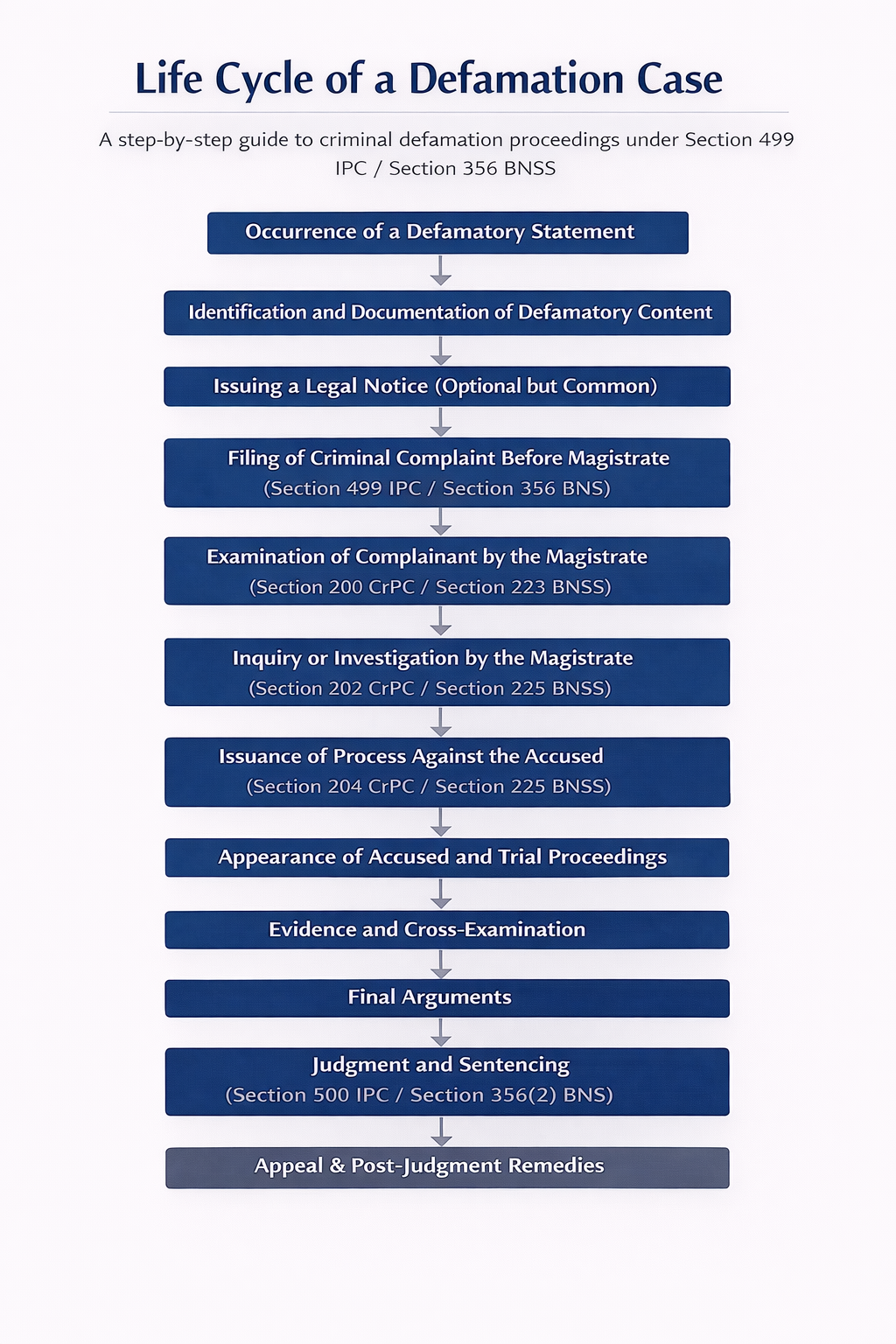
The following stages explain the complete life cycle of a criminal defamation case in India.
1. Legal Foundation of Defamation Law
First, it is important to understand the legal framework governing defamation in India.
Under Section 499 IPC / Section 356 BNS, defamation occurs when a person makes or publishes any imputation concerning another person with the intention of harming their reputation.
However, the law also recognises several exceptions. For instance, statements made in good faith for public interest or fair criticism of public conduct may not amount to defamation.
If a statement satisfies the legal ingredients of defamation and does not fall under any exception, the aggrieved person may initiate legal proceedings.
2. Stage One: Occurrence of a Defamatory Statement
Typically, a defamation dispute begins when a person publishes or communicates a harmful statement about another person.
The defamatory statement may appear in various forms. For example, it may appear in newspapers, online posts, social media content, speeches, or written communications.
If the statement damages the reputation of the affected person in the eyes of others, it may constitute defamation.
However, the aggrieved person must demonstrate that the statement is false and that it has caused reputational harm.
3. Stage Two: Identification and Documentation of Defamatory Content
After the defamatory statement becomes known, the aggrieved person must identify and document the content carefully.
For example, the person may collect copies of newspaper publications, screenshots of online posts, or recordings of speeches containing the defamatory statement.
Proper documentation plays an important role because the complainant must later produce this material as evidence before the court.
Therefore, preserving the defamatory material becomes an essential early step in the case.
4. Stage Three: Issuing a Legal Notice (Optional but Common)
Before initiating formal proceedings, the aggrieved person may issue a legal notice to the alleged defamer.
The notice typically demands that the person withdraw the defamatory statement and issue a public apology.
Additionally, the notice may warn that failure to comply will lead to legal proceedings for defamation.
Although the law does not always require such notice, many parties use it to resolve disputes without litigation.
5. Stage Four: Filing of Criminal Complaint Before Magistrate
If the dispute remains unresolved, the aggrieved person may file a criminal complaint for defamation before the appropriate Magistrate.
The complaint alleges the commission of the offence under Section 499 IPC / Section 356 BNS, punishable under Section 500 IPC / Section 356(2) BNS.
Criminal defamation cases generally proceed as private complaints, where the aggrieved person directly approaches the Magistrate.
The Magistrate then examines the complaint and supporting material.
6. Stage Five: Examination of Complainant by the Magistrate
After receiving the complaint, the Magistrate examines the complainant and any supporting witnesses.
This examination occurs under Section 200 of the Code of Criminal Procedure, 1973, which corresponds to Section 223 of the Bharatiya Nagarik Suraksha Sanhita, 2023.
During this stage, the Magistrate records the complainant’s statement under oath.
The purpose of this stage is to determine whether the complaint contains sufficient grounds to proceed further.
7. Stage Six: Inquiry or Investigation by the Magistrate
Next, the Magistrate may conduct a preliminary inquiry to verify the allegations.
This stage occurs under Section 202 CrPC, which corresponds to Section 225 BNSS.
The Magistrate may examine additional witnesses or review documents to determine whether the case merits further proceedings.
This stage prevents frivolous complaints from proceeding to trial.
8. Stage Seven: Issuance of Process Against the Accused
If the Magistrate finds sufficient grounds, the court issues summons to the accused person.
This stage occurs under Section 204 CrPC, which corresponds to Section 227 BNSS.
The summons directs the accused to appear before the court on a specified date.
Once the accused appears before the court, the criminal proceedings formally begin.
9. Stage Eight: Appearance of Accused and Trial Proceedings
After receiving the summons, the accused appears before the Magistrate either personally or through legal counsel.
The court explains the allegations relating to the offence of defamation under Section 500 IPC / Section 356 BNS.
If the accused denies the allegations, the matter proceeds to trial.
During the trial, both parties receive the opportunity to present their evidence.
10. Stage Nine: Evidence and Cross-Examination
At this stage, the complainant presents evidence supporting the allegations of defamation.
For example, the complainant may produce the defamatory publication, witness testimony, and other documentary evidence.
The accused then cross-examines the complainant’s witnesses.
After the complainant completes evidence, the accused may present defence evidence. The defence may rely on statutory exceptions such as truth, public interest, or fair comment.
11. Stage Ten: Final Arguments
After completion of evidence, both parties present their final arguments before the Magistrate.
The complainant argues that the accused intentionally published defamatory statements that harmed reputation.
Conversely, the accused attempts to establish that the statement was true, made in good faith, or protected by legal exceptions.
The court carefully evaluates the evidence, legal provisions, and applicable precedents.
12. Stage Eleven: Judgment and Sentencing
Finally, the Magistrate delivers the judgment after considering the entire record.
If the court finds the accused guilty, it may impose punishment under Section 500 IPC / Section 356(2) BNS.
The punishment may include imprisonment, fine, or both.
However, if the court finds insufficient evidence or accepts a valid legal defence, it may acquit the accused.
13. Appeal and Post-Judgment Remedies
After the judgment, the aggrieved party may challenge the decision before the appellate court.
The appellate court reviews the legality and correctness of the judgment.
Depending on the facts of the case, the appellate court may confirm, modify, or set aside the decision of the trial court.
Conclusion
Defamation law plays an important role in protecting the reputation and dignity of individuals. False and malicious statements can seriously harm a person’s social standing and professional life.
Therefore, Indian law provides a structured mechanism under Section 499 IPC / Section 356 BNS to address such misconduct.
Understanding the life cycle of a defamation case helps individuals take appropriate legal action and protect their reputation through lawful means.
Other Life Cycles: DV Case Lifecycle || Maintenance Case u/s 125 CrPC Lifecycle. Index is here.
Key Contributor :
Mrs. Suprajaa Rajan B.Com., LL.B., LL.M.
+91-9606345150

