False allegations of domestic violence can have serious legal, social, and professional consequences. While the Protection of Women from Domestic Violence Act, 2005 was enacted to protect women from genuine abuse, courts have also acknowledged that misuse of legal provisions may occur in certain cases.
Therefore, when a person faces false or exaggerated domestic violence allegations, it becomes crucial to adopt a structured legal defence strategy. A well-planned approach can help demonstrate the truth, challenge unsupported allegations, and protect the rights of the accused.
This article explains the legal framework governing domestic violence cases in India and the practical defence strategies that can be used when allegations are false or misleading.
Understanding Domestic Violence Law in India
The Protection of Women from Domestic Violence Act, 2005 provides civil remedies to women who experience abuse within a domestic relationship. The law allows courts to grant several types of relief, including:
Protection orders
Residence orders
Monetary relief (maintenance)
Compensation orders
Custody orders for children
Proceedings under the Act are usually conducted before a Magistrate Court and are meant to provide quick protection and relief to the aggrieved person.
However, because the law is broad in scope, allegations are sometimes exaggerated or unsupported by evidence. In such cases, the respondent must present a strong factual and legal defence.
Common Situations Where False Allegations Arise
False domestic violence allegations often emerge in the context of ongoing matrimonial disputes. For instance, such complaints may arise during:
Divorce proceedings
Maintenance disputes
Property conflicts between spouses
Child custody battles
In some situations, the complaint is filed as a litigation strategy to gain leverage in matrimonial negotiations. However, courts generally examine the credibility of allegations and the supporting evidence before granting relief.
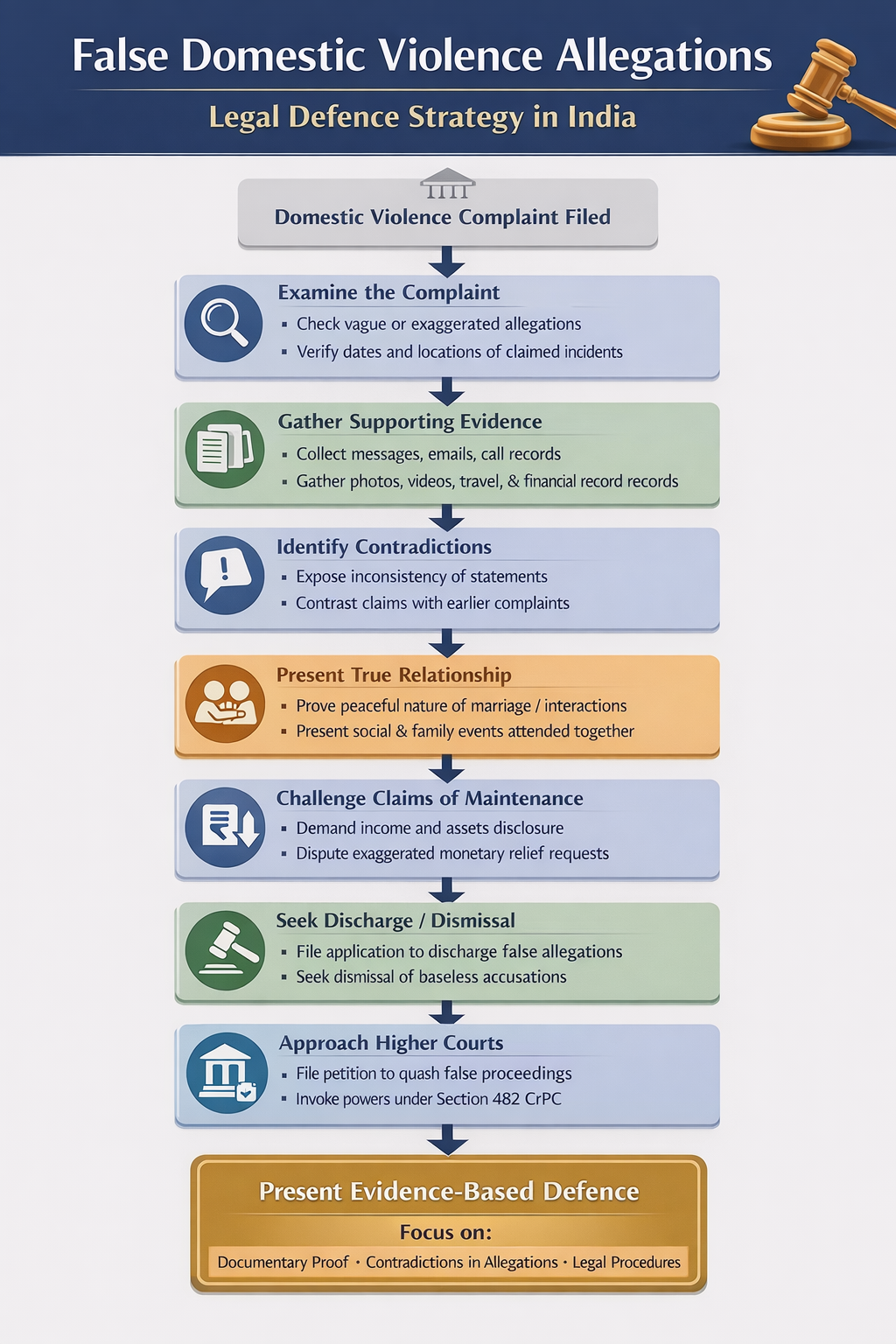
Step 1: Carefully Examine the Domestic Violence Complaint
The first step in defending a false case is to analyse the complaint in detail.
Important aspects to examine include:
Specific allegations made against the respondent
Dates and locations of alleged incidents
Whether the allegations are vague or inconsistent
Whether other family members are unnecessarily implicated
Often, false complaints contain generalised accusations without specific details, which can be challenged before the court.
Step 2: Gather Documentary and Electronic Evidence
Evidence plays a critical role in defending domestic violence allegations. Therefore, the respondent should collect all relevant documentation that may contradict the claims.
Useful evidence may include:
Messages, emails, and call records
Photographs or videos
Travel records showing absence from the alleged location
Financial documents
Medical records
Such evidence can demonstrate that the alleged incidents did not occur or were misrepresented.
Step 3: Identify Contradictions in the Allegations
In many false cases, the complaint may contain inconsistent statements or factual contradictions.
For example:
Conflicting timelines of alleged incidents
Claims that contradict documentary evidence
Statements that differ from earlier complaints or legal pleadings
During cross-examination, highlighting these inconsistencies can significantly weaken the credibility of the allegations.
Step 4: Demonstrate the True Nature of the Relationship
Another important defence strategy is to present the actual circumstances of the marital relationship.
This may involve demonstrating:
Peaceful interactions between the spouses
Continued communication after the alleged incidents
Social or family events attended together
Such evidence can indicate that the relationship did not reflect the pattern of abuse alleged in the complaint.
Step 5: Challenge Monetary Relief or Maintenance Claims
Domestic violence complaints frequently include requests for monetary relief or maintenance.
However, courts consider:
The financial capacity of both parties
Existing maintenance orders in other proceedings
The actual needs of the claimant
Guidelines laid down in Rajnesh v. Neha require both parties to disclose income, assets, and liabilities to prevent exaggerated financial claims.
Step 6: Seek Discharge or Dismissal Where Appropriate
If the allegations are clearly baseless, the respondent may request the court to dismiss the complaint or drop certain respondents.
Courts often discharge family members who are falsely implicated without specific allegations.
Additionally, higher courts have repeatedly cautioned against the mechanical implication of multiple relatives in matrimonial disputes.
Step 7: Approach Higher Courts for Relief
In cases where the complaint is clearly malicious or legally unsustainable, the respondent may approach the High Court for relief.
Under Section 482 of the Code of Criminal Procedure – High Courts possess the authority to quash proceedings that amount to abuse of the legal process.
However, this remedy is generally used only when the allegations do not disclose any offence even if accepted at face value.
Importance of Legal Representation
Domestic violence cases often involve complex factual disputes and emotional allegations. Therefore, it is essential to obtain competent legal representation.
An experienced lawyer can:
Analyse the complaint strategically
Identify weak points in the allegations
Present documentary evidence effectively
Conduct cross-examination to expose inconsistencies
Professional legal assistance ensures that the defence is structured, credible, and legally sound.
Judicial Approach Toward Misuse of Matrimonial Laws
Indian courts have acknowledged concerns about misuse of certain matrimonial provisions. In the landmark case of Arnesh Kumar v. State of Bihar,
the Supreme Court emphasised the need to prevent unnecessary arrests in matrimonial disputes.
Such judicial observations highlight the importance of balancing the protection of genuine victims with safeguards against misuse of the law.
Conclusion
False domestic violence allegations can place an individual under significant legal and personal pressure. Nevertheless, courts rely heavily on evidence, consistency of statements, and factual credibility when evaluating such complaints.
Therefore, an effective defence strategy should focus on:
Careful examination of allegations
Strong documentary and electronic evidence
Identification of inconsistencies in the complaint
Demonstrating the true nature of the marital relationship
By presenting a clear, evidence-based defence, respondents can ensure that courts arrive at a fair and balanced decision based on facts rather than unverified allegations.
Index of Legal Strategies and Defence is here.
Key Contributor :
Mrs. Suprajaa Rajan B.Com., LL.B., LL.M.
+91-9606345150

