Understanding the legal safeguards that protect personal liberty in matrimonial criminal proceedings.
Arrest in matrimonial disputes under Section 498A of the Indian Penal Code was once routine and immediate. Complaints often led to mechanical arrests of husbands and relatives.
The legal landscape changed significantly after the Supreme Court’s landmark ruling in:
Arnesh Kumar v. State of Bihar
In this case, the judgment reshaped arrest jurisprudence in matrimonial offences and reinforced constitutional protection under Article 21.
This article explains the law thereafter, the procedural safeguards under the Code of Criminal Procedure, 1973, and what accused persons must know.
I. The Legal Position Before Arnesh Kumar
Indian Penal Code
Section 498A IPC is cognizable, non-bailable and non-compoundable. Since the offence is cognizable, police had wide discretion to arrest without warrant. Accordingly, in practice, arrest often followed immediately after FIR registration.
Courts observed misuse through mechanical implication of elderly parents, married sisters living separately and distant relatives. This raised serious concerns regarding the abuse of process.
II. The Turning Point: Arnesh Kumar Judgment
In Arnesh Kumar, the Supreme Court held that:
Arrest is not mandatory in every 498A case.
Police must justify necessity of arrest under Section 41 CrPC.
Failure to comply may invite departmental action.
The Court emphasised that personal liberty cannot be curtailed casually. Additionally, this ruling applies not only to 498A but to all offences punishable up to seven years.
III. Section 41 CrPC – When Can Police Arrest?
Code of Criminal Procedure, 1973
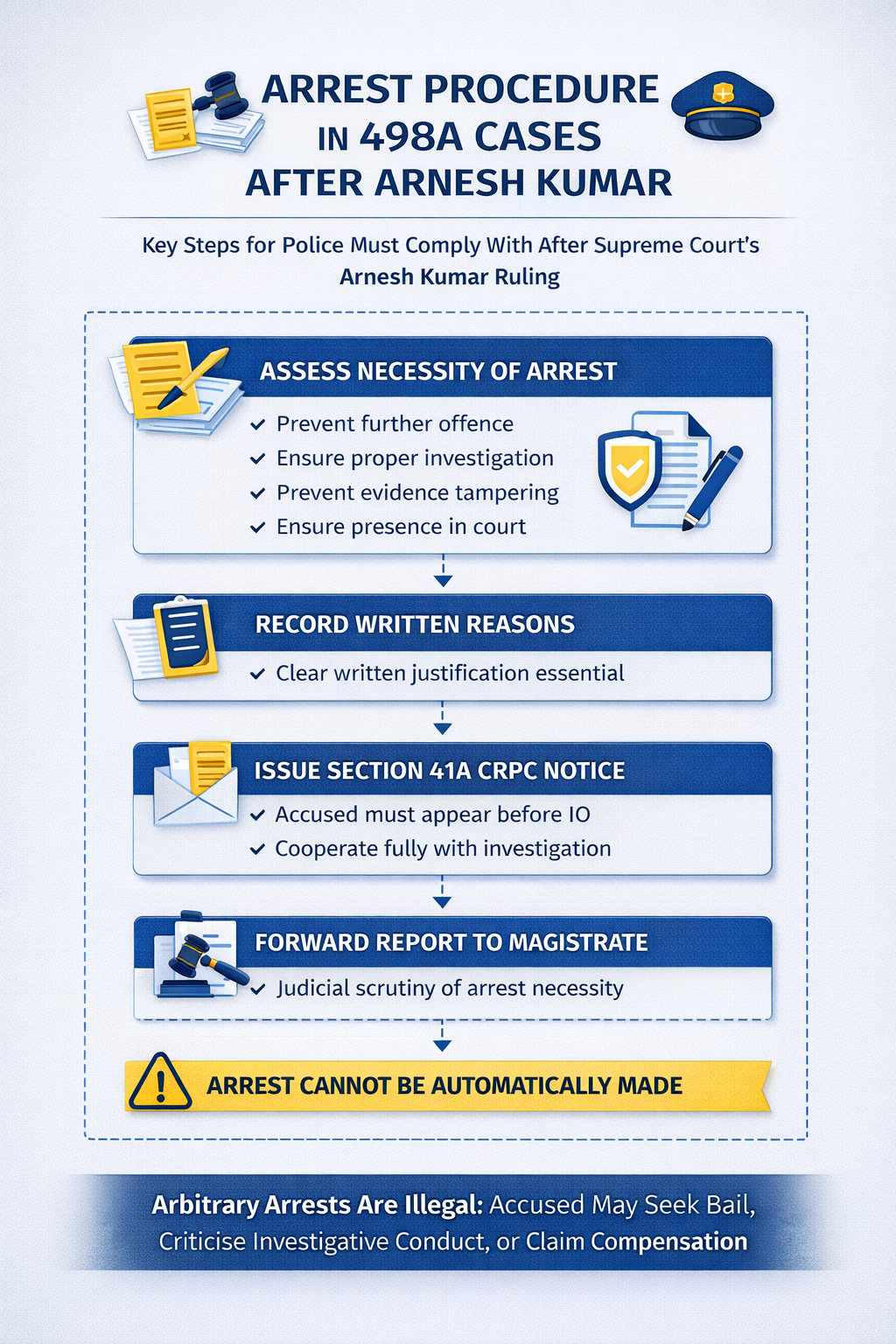
Under Section 41(1)(b) CrPC, police may arrest only if they believe it is necessary to:
Prevent further offence
Ensure proper investigation
Prevent tampering of evidence
Prevent inducement or threat to witnesses
Ensure presence in court
Police must record reasons in writing and the arrest cannot be automatic.
IV. Section 41A CrPC – Notice of Appearance
Instead of immediate arrest, police must ordinarily issue:
Notice under Section 41A CrPC
The accused must:
Appear before the Investigating Officer and,
Cooperate with investigation
If the accused complies, arrest should not follow unless justified by fresh reasons.
V. Checklist Police Must Follow
After Arnesh Kumar, police must:
- Assess necessity of arrest
- Record written reasons
- Issue 41A notice
- Avoid mechanical detention
- Forward reasons to Magistrate
The Magistrate must independently examine whether arrest is justified.
VI. What Happens If Police Violate These Safeguards?
If arrest occurs without compliance:
Accused may seek immediate bail
Courts may criticise investigative conduct
Departmental action may follow
Compensation may be claimed in extreme cases
Violation of procedure can strengthen defence during trial.
VII. Protection for Relatives and Senior Citizens
Courts frequently reiterate that distant relatives cannot be arrested without specific allegations. General and omnibus accusations are insufficient grounds for custodial arrest. High Courts often intervene under Section 482 CrPC to prevent abuse.
VIII. Practical Steps If You Receive 41A Notice
If you receive a Section 41A notice:
Do not ignore it.
Consult legal counsel immediately.
Appear as required.
Cooperate with investigation.
Preserve documentary evidence.
Non-compliance may weaken your position.
IX. Anticipatory Bail Still Remains Important
Even after Arnesh Kumar, anticipatory bail remains a vital safeguard.
Where there is:
Risk of arbitrary arrest
Threat of custodial harassment
Multiple accused family members
Filing under Section 438 CrPC ensures additional protection.
Read also : Anticipatory Bail in Matrimonial Offences – Complete Guide
X. Judicial Approach After Arnesh Kumar
Post-2014, courts increasingly:
Scrutinise arrest memos
Examine compliance with Section 41
Criticise routine detention
Emphasise proportionality
The guiding principle remains: Arrest is an exception, not the rule.
Conclusion
The decision in Arnesh Kumar v. State of Bihar, hence, marked a watershed moment in matrimonial criminal jurisprudence. Altogether, it restored balance between protection of complainants and preservation of personal liberty.
Section 498A remains a serious offence. However, arrest cannot be mechanical or punitive. Police must undeniably demonstrate necessity. Magistrates must exercise independent scrutiny.
Understanding arrest procedure subsequently empowers accused persons to assert their constitutional rights lawfully and strategically.
Frequently Asked Questions
No. They must comply with Section 41 CrPC and consider issuing notice under Section 41A.
No. Arrest is permissible where statutory conditions are satisfied.
It applies to offences punishable up to seven years.
Courts may treat such arrest as illegal and grant relief.
Index of Legal Strategies and Defence is here.
Key Contributor :
Mrs. Suprajaa Rajan B.Com., LL.B., LL.M.
+91-9606345150

