Strategic legal protection to safeguard your liberty before arrest in matrimonial criminal proceedings.
Matrimonial disputes frequently escalate into criminal complaints under provisions such as Section 498A IPC, the Dowry Prohibition Act, or allied offences. In many cases, accused individuals face the threat of immediate arrest.
Anticipatory bail serves as a critical safeguard. It protects personal liberty while the investigation proceeds.
This guide explains the legal framework, judicial principles, procedure, and strategic considerations involved in seeking anticipatory bail in matrimonial cases.
I. What Is Anticipatory Bail?
Anticipatory bail is pre-arrest protection granted by a Court under:
Code of Criminal Procedure, 1973. Specifically under Section 438 CrPC. It allows a person to seek bail in anticipation of arrest, even before police take them into custody. Unlike regular bail, anticipatory bail prevents detention itself.
II. Why Is Anticipatory Bail Crucial in Matrimonial Cases?
Offences commonly invoked include:
Section 498A IPC (Cruelty)
Section 406 IPC (Criminal breach of trust)
Sections 3 & 4 of the Dowry Prohibition Act
These offences are:
Cognizable
Non-bailable
Arrest can severely impact:
Employment
Passport status
Reputation
Elderly parents and relatives
Therefore, immediate pre-arrest strategy becomes essential.
III. Supreme Court Safeguards Against Arbitrary Arrest
The landmark judgment in Arnesh Kumar v. State of Bihar transformed arrest jurisprudence in 498A cases.
The Supreme Court held:
Police cannot automatically arrest the accused.
They must satisfy conditions under Section 41 CrPC.
Notice under Section 41A CrPC should ordinarily precede arrest.
This decision strengthened the constitutional protection of personal liberty under Article 21.
Read also : “Arrest Procedure in 498A Cases After Arnesh Kumar”
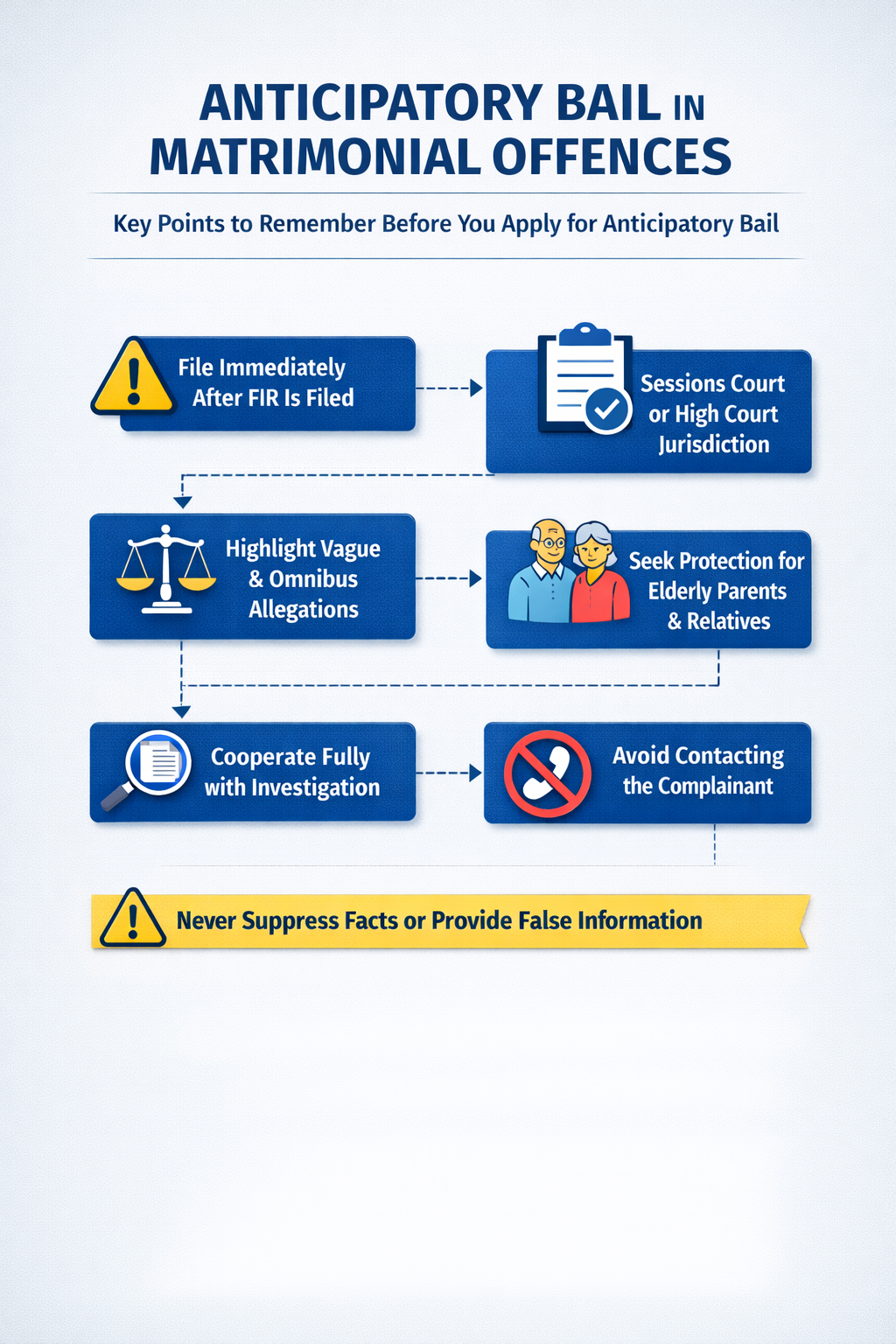
IV. When Should You Apply for Anticipatory Bail?
You should apply immediately if:
FIR has been registered.
Police have issued a notice.
There is apprehension of arrest.
Multiple family members are named without specific allegations.
Delay may weaken your legal position. Early filing signals cooperation and preparedness.
V. Which Court Has Jurisdiction?
Application may be filed before:
Sessions Court
High Court
Generally, the Sessions Court is approached first unless exceptional circumstances justify direct High Court intervention.
VI. What Factors Do Courts Consider?
Courts evaluate:
- Nature and gravity of allegations
- Specificity of accusations
- Role attributed to each accused
- Possibility of absconding
- Likelihood of tampering with evidence
- Criminal antecedents
Vague and omnibus allegations often strengthen the case for anticipatory bail. Courts increasingly recognise that matrimonial disputes sometimes involve exaggerated complaints.
VII. Conditions Imposed by Courts
Anticipatory bail orders may include:
Cooperation with investigation
No contact with complainant
No tampering with evidence
Travel restrictions
Violation of conditions can lead to cancellation of bail.
VIII. Protection for Parents and Relatives
Courts frequently observe misuse through mechanical implication of:
Elderly parents
Married sisters living separately
Distant relatives
Where allegations lack specific overt acts, courts are inclined to grant protection.
IX. Common Mistakes to Avoid
- Ignoring police notice
- Filing incomplete application
- Suppressing facts
- Adopting aggressive or retaliatory approach
Strategic transparency strengthens credibility before the Court.
X. Can Anticipatory Bail Be Cancelled?
Yes. Anticipatory bail can be cancelled if :
Conditions are violated
False information was provided
Accused obstructs investigation
Courts retain the power to cancel protection.
XI. Strategic Considerations in Matrimonial Cases
Anticipatory bail must align with broader litigation strategy, especially where parallel proceedings exist:
Domestic Violence cases
Maintenance proceedings
Divorce petitions
Coordinated legal planning prevents contradictions across cases.
Conclusion
Anticipatory bail in matrimonial offences is not merely a procedural remedy. It is a constitutional shield against unnecessary arrest.
Courts recognise the need to balance protection of genuine victims with safeguards against abuse of process. Early, structured legal action significantly improves the likelihood of securing protection.
Liberty once lost is difficult to restore. Strategic defence must begin before arrest.
Index of Legal Strategies and Defence is here.
Frequently Asked Questions
No. It depends on facts and judicial discretion.
Yes, if allegations are general and lack specificity.
Usually yes, unless exempted by the Court.
Yes. Courts may consider bona fide settlement while granting protection.

