A division bench of Delhi High Court observed as follows, while upholding the Family Court’s decision not to grant alimony.
From Paras 53 to 57,
53. In the present Appeal, the Appellant‟s primary challenge is directed against the learned Family Court‟s finding on cruelty. The evidence on record unequivocally establishes a sustained pattern of mental cruelty inflicted by the Appellant upon the Respondent.
54. The most compelling evidence comprises the series of text messages sent from the Appellant‟s mobile number between March and June 2011. These messages, which contained vile, derogatory, and scandalous language, including questioning the Respondent‟s legitimacy and making reprehensible allegations against his mother, were proved beyond doubt.
55. Specific messages dated 09.05.2011, 15.05.2011, and 27.06.2011, which included terms such as “bastard”, “son of a bitch,” and suggestions that his mother should “earn through prostitution”, are by themselves sufficient to constitute mental cruelty of the gravest kind.
56. The Appellant‟s explanation that the Respondent must have sent these messages to himself from her phone is inherently improbable and was rightly rejected by the learned Family Court as an afterthought, particularly since this defense was never pleaded in the written statement and no corroborative evidence was adduced to support it.
57. Words and communications of the sort proved in this case are not innocuous. The law recognizes that mental cruelty may be visited by persistent and deliberate verbal abuse and conduct that degrades a spouse and injures reputation and self-respect. The text messages in question contained imputations of illegitimacy, filthy epithets directed at the Respondent‟s mother and other degrading expressions a pattern of conduct which, cumulatively, the learned Family Court was entitled to regard as causing grave mental agony to the Respondent.
From Para 82,
82. The provision under Section 25 is fundamentally equitable in nature and aims to secure financial justice between spouses, ensuring that a party lacking independent means of subsistence is not left destitute following the dissolution of marriage. However, the grant of such relief is not automatic; it is contingent upon proof of genuine financial necessity and equitable considerations.
83. In the present case, the Appellant is an officer of the IRTS, a highly esteemed branch of the Indian Civil Services, whereas the Respondent is a practicing lawyer.
84. It is an undisputed fact that the Appellant, being a Group ‘A’ officer, holds a senior and responsible position in the Government of India and receives a regular and substantial salary along with numerous allowances and service benefits commensurate with her post. The material on record does not disclose any evidence of financial hardship, dependency, or extraordinary circumstances that would render her incapable of maintaining herself with dignity. There is also no pleading or proof of any financial liability, medical condition, or familial obligation that could necessitate monetary support from the Respondent. Additionally, there is no evidence to suggest a substantial difference between the incomes of the parties.
85. Judicial discretion under Section 25 cannot be exercised to award alimony where the applicant is financially self-sufficient and independent, and such discretion must be exercised properly and judiciously, based on the record, the relative financial capacities of the parties, and the absence of any material demonstrating economic vulnerability on the part of the Appellant.
86. A careful examination of the record further reveals that the parties cohabited as husband and wife only for a brief and transitory period, and the marriage did not evolve into a stable or enduring union characterized by emotional, social, or financial interdependence. The absence of any child from the wedlock further eliminates a continuing financial responsibility that might otherwise justify an award of alimony or maintenance.
87. It is a settled principle that permanent alimony is intended as a measure of social justice and not as a tool for enrichment or equalizing the financial status of two capable individuals. The law requires that the applicant demonstrate a genuine need for financial assistance. In the present case, the Appellant‟s position as a senior government officer, her steady and substantial income, and the absence of dependents collectively establish that she is fully capable of maintaining herself. No evidence of financial incapacity, duress, or other compelling circumstances has been presented to justify judicial intervention.
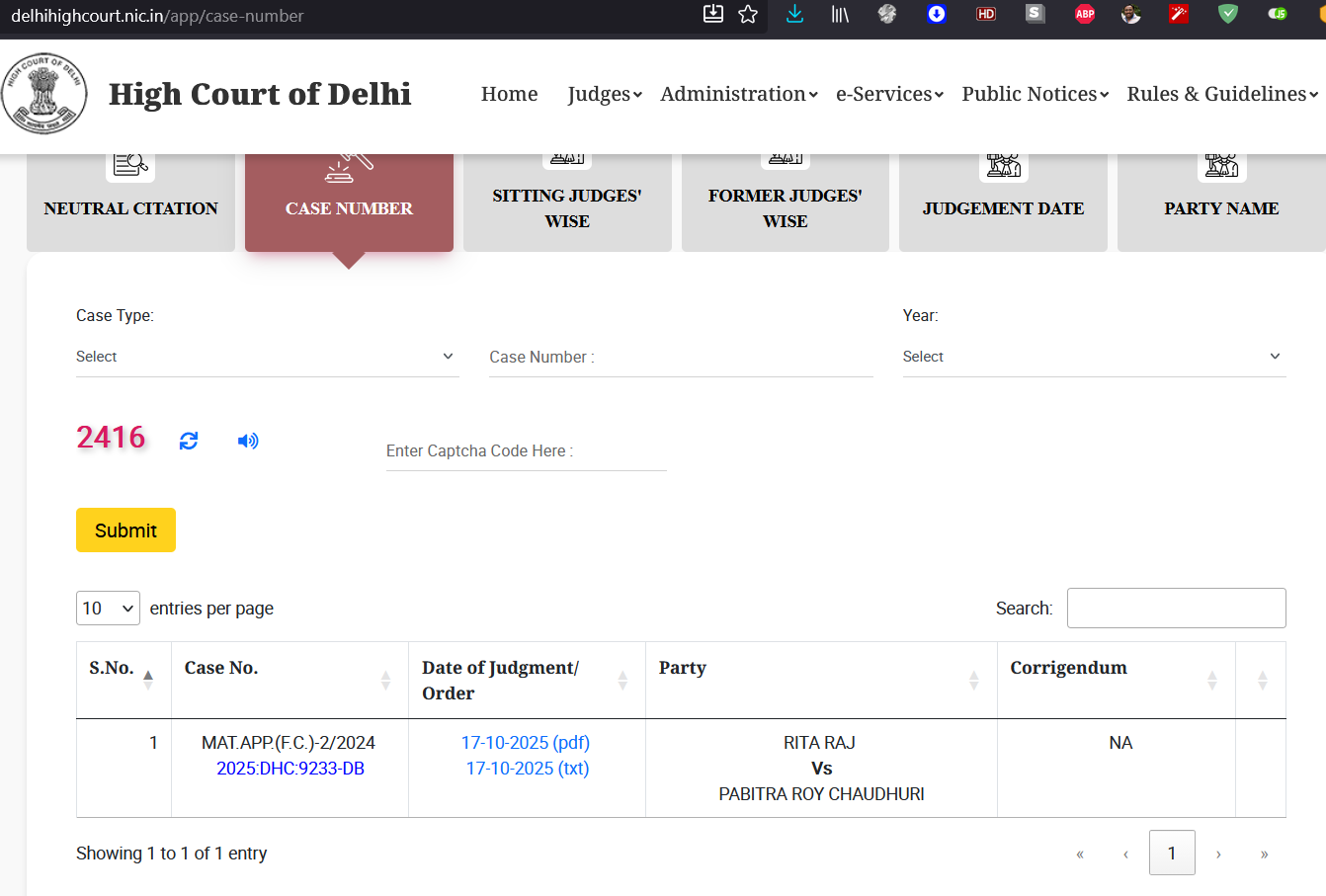
Citations: [2025:DHC:9233-DB]
Other Sources:
https://indiankanoon.org/doc/156230068/
https://www.casemine.com/judgement/in/68f2a09ee5e6a9673013a510
Index of Maintenance and Alimony judgment under Hindu Marriage Act is here.

