web analytics

Menu

Skip to content
Shades of Knife
  • Home
  • True Colors of a Vile Wife
  • Need Inspiration?
  • Blog Updates
  • SOK Gallery
  • Vile News Reporter
  • About Me
  • Contact Me

Shades of Knife

True Colors of a Vile Wife

Month: March 2026

Interim Bail Application Format – Draft, Procedure & Sample Template

Posted on March 31 by Suprajaa Rajan

Interim Bail Application Format – Draft, Procedure & Sample Template

In criminal proceedings, there are situations where an accused requires immediate but temporary relief from custody. In such cases, an interim bail application becomes an important legal remedy. Unlike regular bail, interim bail is granted for a short, specific period, often pending final hearing of bail or due to urgent circumstances.

Therefore, understanding how to draft an effective interim bail application is crucial for both litigants and legal practitioners.

This article explains the legal framework, key considerations, and provides a ready-to-use draft format with copy-to-clipboard functionality.

I. What is Interim Bail?

Interim bail refers to temporary release from custody granted for a limited duration, usually:

  • Pending disposal of anticipatory bail application (Section 438 CrPC)

  • Pending hearing of regular bail application (Sections 437/439 CrPC)

  • On humanitarian grounds (medical emergency, family crisis, etc.)

Although the Code of Criminal Procedure, 1973 does not expressly define interim bail, courts exercise their inherent and discretionary powers to grant such relief.

II. Corresponding Provisions under BNSS, 2023

Under the Bharatiya Nagarik Suraksha Sanhita, 2023 (BNSS):

  • Section 482 BNSS – corresponds to Section 438 CrPC (anticipatory bail)

  • Section 480 BNSS – corresponds to Section 437 CrPC (bail by Magistrate)

  • Section 483 BNSS – corresponds to Section 439 CrPC (bail by Sessions/High Court)

Thus, interim bail is granted within the framework of these provisions, depending on the stage of the case.

III. When Can Interim Bail Be Filed?

An interim bail application may be filed in situations such as:

  • When anticipatory bail is pending for hearing

  • When the accused needs temporary relief before regular bail is decided

  • In cases involving medical emergencies

  • For family obligations (marriage, funeral, etc.)

  • When immediate custody is not necessary

Therefore, interim bail acts as a short-term protection of liberty.

IV. Key Factors Considered by Courts

While granting interim bail, courts consider:

  • Urgency of the situation

  • Nature of allegations

  • Conduct of the accused

  • Need for custodial interrogation

  • Possibility of misuse of liberty

Consequently, the application must clearly demonstrate urgency and bona fide intent.

V. Essential Elements of an Interim Bail Application

Before drafting, you should include:

  • Details of FIR and sections invoked

  • Current stage of proceedings

  • Specific reason for seeking interim relief

  • Duration for which bail is sought

  • Undertaking to cooperate with investigation

  • Assurance not to tamper with evidence

These elements help establish credibility and necessity of interim relief.

VI. Drafting Strategy

While drafting an interim bail application:

  • Focus on urgency and necessity

  • Keep the application short and precise

  • Avoid detailed merits of the case

  • Clearly mention time period requested

  • Maintain a respectful tone

Unlike regular bail, interim bail depends heavily on immediate circumstances.

VII. Sample Draft Format – Interim Bail Application


Sample Draft – Interim Bail Application

BEFORE THE HONOURABLE COURT OF [COURT NAME] AT [CITY]

Criminal Application No.: [____]

In the matter of:

[Name of Applicant]
…Applicant

Versus

State of [State]
…Respondent


APPLICATION FOR GRANT OF INTERIM BAIL

Most Respectfully Submitted:

1. That the Applicant has been implicated in FIR No. [____] registered at [Police Station] for offences alleged under Sections [____].

2. That the Applicant is seeking interim bail pending disposal of the main bail application.

3. That the present application is being filed due to urgent circumstances, namely [mention reason – medical emergency/family function/other].

4. That the Applicant is a law-abiding citizen and has no intention to abscond or evade the process of law.

5. That the Applicant undertakes to cooperate with the investigation and appear before the authorities as and when required.

6. That the Applicant undertakes not to tamper with evidence or influence any witnesses.

7. That the Applicant seeks interim bail for a limited period of [number of days].

PRAYER

In view of the above, it is most respectfully prayed that this Hon’ble Court may be pleased to grant interim bail to the Applicant for a limited period in the interest of justice.


Place: [City]
Date: [Date]


Counsel for the Applicant
[Signature]

✔ Draft Copied Successfully!

VIII. Common Mistakes to Avoid

Avoid the following while filing interim bail:

  • Not specifying urgent reason

  • Seeking vague or indefinite time period

  • Arguing full merits of the case

  • Failing to provide undertakings

Instead, focus on clarity, urgency, and limited relief.

Conclusion

Interim bail serves as an important temporary safeguard of personal liberty in urgent situations. Therefore, a well-drafted application can ensure timely relief while maintaining compliance with legal procedure.

By clearly presenting urgency, duration, and willingness to cooperate, applicants can effectively seek interim protection from custody.


Index of Legal Templates and Drafting is here.


Disclaimer

These templates are provided for educational and informational purposes. Every case depends on specific facts and procedural posture. Professional legal advice should be obtained before filing any application.


Related Legal Concepts

Explore related stages and concepts in criminal procedure:

  • Cancellation of bail
  • Bail conditions
  • Difference between bail, interim bail and anticipatory bail
  • Discretionary Powers of Courts
  • Doctrine of Personal Liberty

Key Contributor :

Mrs. Suprajaa Rajan B.Com., LL.B., LL.M.

+91-9606345150

Posted in Legal Procedure | Tagged CrPC bail format Interim Bail interim bail application Legal templates and drafting | Leave a comment

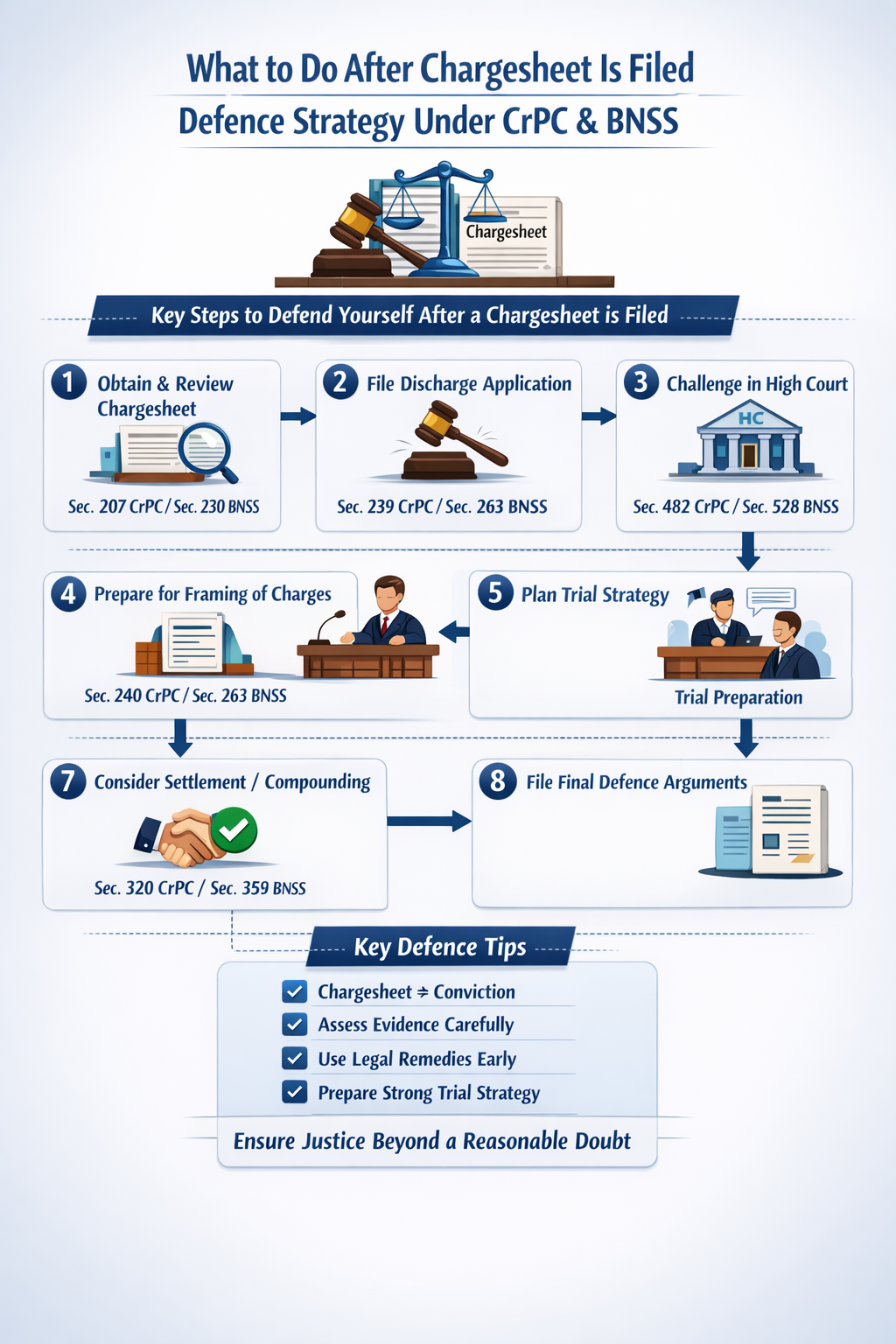
What to Do After Chargesheet Is Filed – Defence Strategy

Posted on March 31 by Suprajaa Rajan

Once the police complete the investigation, they file a chargesheet before the Magistrate. At this stage, the case formally moves from investigation to trial. Therefore, it becomes crucial for the accused to understand the next legal steps, available remedies, and defence strategies.

Many individuals assume that filing of a chargesheet means the case is proven. However, that is incorrect. A chargesheet only reflects the opinion of the investigating agency, and the court independently evaluates whether sufficient grounds exist to proceed.

This article explains what to do after a chargesheet is filed, along with the corresponding provisions under the Code of Criminal Procedure, 1973 (CrPC) and the Bharatiya Nagarik Suraksha Sanhita, 2023 (BNSS).

What Is a Chargesheet?

A chargesheet is a report filed by the police after completing the investigation under:

  • Section 173 CrPC (Section 193 BNSS)

It contains:

  • Details of the allegations

  • Evidence collected during investigation

  • List of witnesses

  • Documents relied upon by the prosecution

Once filed, the court examines whether a prima facie case exists against the accused.

Step 1: Obtain and Review the Chargesheet

After the chargesheet is filed, the accused should immediately obtain a copy of:

  • Chargesheet

  • Witness statements

  • Documents relied upon

The court supplies these documents under:

  • Section 207 CrPC (Section 230 BNSS)

At this stage, you must carefully analyse:

  • Whether allegations are specific or vague

  • Whether evidence supports the accusations

  • Whether contradictions exist in witness statements

A detailed review helps build an effective defence strategy.

Step 2: Consider Filing a Discharge Application

If the chargesheet does not disclose a prima facie case, the accused can file a discharge application.

Relevant provisions include:

  • Section 239 CrPC (Section 263 BNSS) – Warrant cases

  • Section 227 CrPC (Section 250 BNSS) – Sessions cases

The court may discharge the accused if:

  • Evidence is insufficient

  • Allegations are inherently improbable

  • No offence is made out even if allegations are accepted

This is one of the most crucial defence remedies after filing of chargesheet.

Step 3: Challenge the Proceedings Before High Court

In appropriate cases, the accused may approach the High Court to challenge the chargesheet.

This power is exercised under:

  • Section 482 CrPC (Section 528 BNSS)

The High Court may quash proceedings if:

  • The case is malicious or false

  • No offence is disclosed

  • Continuation of proceedings amounts to abuse of process

However, courts exercise this power sparingly and only in exceptional cases.

Step 4: Prepare for Framing of Charges

If the court does not discharge the accused, it proceeds to the next stage:

  • Framing of charges

Relevant provisions:

  • Section 240 CrPC (Section 263 BNSS)

  • Section 228 CrPC (Section 251 BNSS)

At this stage:

  • The court formally states the accusations

  • The accused pleads guilty or claims trial

Therefore, it is important to prepare legal arguments to show that charges should not be framed in the first place.

Step 5: Plan Trial Strategy

Once charges are framed, the case proceeds to trial. At this stage, the defence must shift focus to trial preparation.

Key steps include:

  • Analysing prosecution evidence

  • Identifying contradictions in witness statements

  • Preparing cross-examination strategy

  • Collecting defence evidence

A strong trial strategy ensures that the prosecution is put to strict proof of its case.

Step 6: Cross-Examination of Prosecution Witnesses

Cross-examination plays a decisive role in criminal trials.

The defence must:

  • Test the credibility of witnesses

  • Expose inconsistencies

  • Challenge exaggerated or false claims

Effective cross-examination can significantly weaken the prosecution’s case.

Step 7: Consider Compounding or Settlement (If Applicable)

In certain offences, the law allows compounding of offences.

Relevant provision:

  • Section 320 CrPC (Section 359 BNSS)

Additionally, in matrimonial disputes, parties may opt for:

  • Settlement agreements

  • Mediation

  • Mutual consent divorce

In such cases, the accused may also seek quashing of proceedings before the High Court.

Step 8: File Written Arguments and Final Defence

After completion of evidence, the defence must present:

  • Written arguments

  • Legal submissions

  • Case law supporting acquittal

At this stage, the court evaluates whether the prosecution has proved the case beyond reasonable doubt.

Key Defence Considerations

While handling a case after filing of chargesheet, the accused should keep the following points in mind:

  • A chargesheet does not mean conviction

  • Courts independently assess evidence

  • Early legal strategy can significantly impact the outcome

  • Consistency in defence is crucial throughout proceedings

Therefore, adopting a structured and timely legal approach is essential.

Read also : Legal Templates and Drafting here. 

Conclusion

The filing of a chargesheet marks a critical transition from investigation to trial. However, it also opens multiple legal remedies and defence strategies for the accused.

By:

  • Carefully reviewing the chargesheet

  • Filing discharge applications where appropriate

  • Challenging proceedings before higher courts

  • Preparing a strong trial strategy

the accused can effectively defend the case.

Ultimately, criminal law requires the prosecution to prove its case beyond reasonable doubt. Therefore, a well-prepared defence can ensure that justice is based on evidence rather than allegations.


Index of Legal strategies and Defence is here.


Key Contributor :

Mrs. Suprajaa Rajan B.Com., LL.B., LL.M.

+91-9606345150


Posted in Legal Procedure | Tagged Discharge application Filing Of Chargesheet Does Not Justify Framing Of Charges Legal Remedies after chargesheet Legal Strategies and Defence | Leave a comment

Tushar Sampat Mane and Ors Vs State of Maharashtra on 8 Aug 2025 – Judgment Summary

Posted on March 26 by Suprajaa Rajan

The Bombay High Court in Tushar Sampat Mane and Ors Vs State of Maharashtra on 8 Aug 2025 held that courts must quash criminal proceedings when allegations fail to meet the legal threshold of cruelty under Section 498A IPC. The Court found that the allegations were exaggerated, omnibus, and not grave in nature.

It further observed that prior knowledge of the husband’s medical condition weakens claims of suppression. Additionally, routine marital discord or trivial disputes cannot amount to cruelty.

Therefore, the Court concluded that continuation of criminal proceedings would amount to abuse of process of law.


“5. Therefore, either the case may come under Explanation (a) or Explanation (b) or in some cases it may be both. But such cruelty then should be of a grave nature.”

“5. Now, except the statement of informant there is nothing in the charge sheet. The Investigating Officer has not even taken care to make inquiry with the neighbours of applicants regarding the treatment given by applicants to informant.”

“5. Making annoying statements that informant was not wearing proper clothes, was not able to cook food properly, cannot be said to be acts of grave cruelty or harassment.”

“7. When the relationship gets strained, it appears that exaggerations are made.”

“7. When everything was disclosed prior to the marriage and allegations are omnibus or of not so grave for befitting in the concept of cruelty contemplated under Section 498-A of the Indian Penal Code, it would be an abuse of process of law if the applicants are asked to face the trial.”

Decision

The Court allowed the criminal application. It quashed Regular Criminal Case under Sections 498A, 323, 504, 506 read with Section 34 IPC (corresponding provisions under BNS).

The Court held that allegations lacked gravity and specificity. It further held that continuation of proceedings would amount to abuse of process of law.


Tushar Sampath Mane and Ors Vs State of Maharashtra on 8 Aug 2025

Citation :2025:BHC-AUG:21166-DB

Other Sources :


Index of Quash Judgment u/s 482 Cr.P.C is here.


Related Legal Concepts

Explore related stages and concepts in criminal procedure:

  • Meaning of cruelty under Criminal law
  • Omnibus Allegations in matrimonial cases
  • Dowry Demand and Harassment
  • Matrimonial Disputes vs Criminal Liability


Key Contributor : 

Mrs. Suprajaa Rajan B.Com., LL.B., LL.M.

+91-9606345150

Posted in High Court of Bombay Judgment or Order or Notification | Tagged 2-Judge (Division) Bench Decision Abuse Or Misuse of Process of Court CrPC 482 - Quash Summary Post Tushar Sampat Mane and Ors Vs State of Maharashtra | Leave a comment

Vikaramjeet Rana Vs The State of NCT of Delhi and Anr on 6 Nov 2025 – Judgment Summary

Posted on March 24 by Suprajaa Rajan

The Delhi High Court held that interim rent maintenance under the DV Act cannot continue after the wife acquires her own residence.

The Court observed that the purpose of rent is to provide immediate shelter. Once the wife purchases a house, that need ends. Therefore, continuation of rent becomes unjust enrichment.Further, the Court recognised that change in circumstances under Section 25 DV Act (now read with BNSS framework) permits modification of earlier orders.

Accordingly, the Court set aside the order allowing adjustment of rent towards EMI payments.

The following paragraphs form the core reasoning of the decision:

“26. It needs no reiteration that the Domestic Violence Act had been enacted with the intention of providing immediate relief and support to a wife who has been subjected to domestic violence. The legislative intent behind the D.V. Act is to provide succour to women who are financially vulnerable and subjected to domestic violence. However, the said provision cannot be stretched to benefit a woman who is financially independent and capable of maintaining herself.”

“29. No doubt, the Interim Order directed payment of Rent of Rs.20,000/- per month. However, here is a situation when the Petitioner is claiming change of circumstances and thus, modification of this Order in terms of Section 25(2) D.V. Act which provides that in case of change of circumstances the Order may be recalled, modified or altered.”

“30. In the present case, indeed there is a change in circumstance as a flat has been admittedly acquired by Respondent No.2. The question is whether she should now continue to get Rs.20,000/- per month towards Rent.”

“31. As already noted, the purpose of granting maintenance under the D.V. Act was to provide the Respondent with alternate accommodation. However, she having acquired a flat in Hauz Khas, Delhi, she cannot be held to be in need of immediate shelter. Therefore, it would not be appropriate, fair, or just to direct that the maintenance of Rs.20,000/- per month be continued, as has been rightly argued by the Petitioner. Once a flat has been acquired by the Respondent, there remains no justification to direct continuation of payment of Rs.20,000/- per month by the Petitioner.”

“32. The very substratum upon which the maintenance was granted, has ceased to exist with the acquisition of the property. To permit the continuation of such payment, would be to allow the Respondent undue benefit, which is contrary to the purpose of interim relief under the D.V. Act.”

Decision

The Court thus allowed the revision petition. It set aside the order that permitted rent adjustment towards EMI payments. It held that rent maintenance cannot continue after property acquisition.

The Court directed that payment of ₹20,000 per month shall stop from May 2024.


Vikaramjeet Rana Vs The State of NCT of Delhi and Anr on 6 Nov 2025

Index of Maintenance Judgments under Hindu Marriage Act is here. 


Citation : 2025:DHC:9719

Other Sources :


Related Legal Concepts

  • Interim Maintenance under DV act
  • Change in circumstances in maintenance law
  • Rent Vs EMI-legal distinction
  • Purpose of Interim Relief in DV Act

Key Contributor : 

Mrs. Suprajaa Rajan B.Com., LL.B., LL.M.

+91-9606345150

Posted in High Court of Delhi Judgment or Order or Notification | Tagged 1-Judge Bench Decision CrPC Sec 125 or BNSS Sec 144 - Interim Maintenance Reduced Protection of Women from Domestic Violence Act 2005 PWDV Act Sec 20 - Maintenance Granted PWDV Act Sec 25 - Change in Circumstances Vikaramjeet Rana Vs The State of NCT of Delhi and Anr | Leave a comment

Sandeep Pathak and Ors Vs Lalitha Tiwari on 10 Mar 2026 – Judgment Summary

Posted on March 23 by Suprajaa Rajan

The Delhi High Court in Sandeep Pathak and Ors Vs Lalitha Tiwari quashed criminal proceedings under Section 498A IPC (Section 85 BNS), Section 406 IPC (Section 316 BNS), and the DV Act.

The Court held that vague and omnibus allegations cannot establish cruelty or criminal breach of trust. It also ruled that DV Act proceedings cannot survive after divorce, as the domestic relationship ceases.

Further, the Court found that the wife filed proceedings after the divorce decree. Therefore, it treated the case as an abuse of process under Section 482 CrPC (Section 528 BNSS).

“45. From the entire allegations as discussed above, it emerges that the essential ingredients of Section 498A IPC are not made out from the Complaint made by Respondent No.2.”

“46. In light of the above findings, it is concluded that it is clearly a case which comes in the category of abuse of the process of law, meriting quashing of the FIR.”

“52. Thus, aside from omnibus allegations, no prima facie case of entrustment of jewellery has been made out. Thus, no offence under Section 406 IPC is made out in the Complaint against the Petitioners.”

“55. As discussion above in detail, there is not an iota of even a prima facie case of cruelty or of harassment of the Complainant by the Petitioners. There is also no element of cruelty or entrustment made out from the facts alleged by the Respondent in her Complaint. Moreover, as discussed above from the facts, when comprehensively considered, reflects that it is a case of abuse of process of law, justifying the quashing of the FIR and the Chargesheet filed therein.”

“69. Thus, the chronology of events clearly indicates that the criminal and DV proceedings were initiated after the marital relationship had already been dissolved by a decree of divorce, and is a subsequent attempt to revive matrimonial disputes through criminal proceedings, which is clearly an abuse of the process of law and an afterthought.”


“70. In view of the above discussion, the Complaint under the DV Act is based on the same vague and omnibus allegations which have already been examined in the context of the FIR. Further, the Complaint has been instituted after the decree of divorce dated 05.09.2012, which has attained finality, thereby bringing the domestic relationship between the parties to an end. In the absence of any specific allegations of domestic violence and a subsisting domestic relationship, continuation of the present proceedings would amount to an abuse of the process of law.”

Decision

The Court allowed both petitions. It quashed the FIR and DV Act complaint, held that the allegations were vague and legally insufficient. It also held that the domestic relationship had ended due to divorce.

Therefore, continuation of proceedings would amount to abuse of process under Section 482 CrPC ( Section 528 BNSS).


Sandeep Pathak and Ors Vs. Lalita Tiwari on 10 Mar 2026

Citation :

Other Sources :


Related Legal Concepts

Explore related stages and concepts in criminal procedure:

  • Quashing of FIR
  • Abuse of process of law
  • Domestic Relationship requirement
  • Abuse of process of law
  • Omnibus allegations in Criminal Law
  • Stridhan and Entrustment


Key Contributor :

Mrs. Suprajaa Rajan B.Com., LL.B., LL.M.

+91-9606345150


Posted in High Court of Delhi Judgment or Order or Notification | Tagged 1-Judge Bench Decision CrPC 482 – IPC 498A Quashed IPC 498A - Cruelty Not Proved PWDV act | Leave a comment

Arrest and Custodial Procedure Explained

Posted on March 22 by Suprajaa Rajan

Arrest and custodial procedure form a critical part of criminal law, as they directly impact the personal liberty of an individual. The law, therefore, carefully regulates the power of the police to arrest and detain a person while ensuring that constitutional safeguards and procedural protections are strictly followed.

Under Indian law, the procedure relating to arrest and custody is governed by the Code of Criminal Procedure, 1973 and corresponding provisions under the Bharatiya Nagarik Suraksha Sanhita, 2023.

Additionally, these provisions strike a balance between the need for effective investigation and the protection of individual rights.

Meaning of Arrest

Arrest refers to the act of taking a person into custody under lawful authority, thereby restraining their liberty.

A police officer may arrest a person:

  • To prevent the commission of an offence

  • To ensure proper investigation

  • To prevent tampering with evidence

  • To secure the presence of the accused before the court

However, the power of arrest is not absolute and must be exercised in accordance with law and judicial guidelines.

Statutory Framework

The law governing arrest and custody is contained in:

  • Section 41 CrPC (Section 35 BNSS) – When police may arrest without warrant

  • Section 41A CrPC (Section 35(3) BNSS) – Notice of appearance

  • Section 46 CrPC (Section 43 BNSS) – How arrest is made

  • Section 50 CrPC (Section 47 BNSS) – Grounds of arrest to be informed

  • Section 57 CrPC (Section 58 BNSS) – Production before Magistrate within 24 hours

  • Section 167 CrPC (Section 187 BNSS) – Procedure for remand

These provisions collectively regulate the entire process of arrest and detention.

Arrest Without Warrant

The police may arrest a person without a warrant in certain circumstances under:

  • Section 41 CrPC (Section 35 BNSS)

However, the law requires that arrest must be based on reasonable suspicion and necessity.

The police must justify arrest on grounds such as:

  • Preventing further offence

  • Proper investigation

  • Preventing disappearance of evidence

Thus, arrest cannot be made mechanically and must satisfy legal necessity.

Notice of Appearance Instead of Arrest

In less serious cases, the police may issue a notice under:

  • Section 41A CrPC (Section 35(3) BNSS)

This provision requires the accused to appear before the police without being arrested.

This ensures that arrest is avoided where:

  • Custodial interrogation is not required

  • The accused cooperates with investigation

This provision acts as an important safeguard against unnecessary arrests.

Procedure of Arrest

The law prescribes a specific procedure for effecting arrest.

Under Section 46 CrPC (Section 43 BNSS):

  • The police must physically restrain the person or submit to custody

  • Excessive force cannot be used

  • Arrest must follow due process

Additionally, the police must:

  • Inform the person of the grounds of arrest

  • Allow communication with a lawyer or relative

These safeguards ensure transparency and accountability.

Rights of Arrested Person

The law provides several rights to a person who has been arrested.

These include:

  • Right to be informed of the grounds of arrest (Section 50 CrPC / Section 47 BNSS)

  • Right to inform a relative or friend

  • Right to legal representation

  • Right to be produced before a Magistrate within 24 hours (Section 57 CrPC / Section 58 BNSS)

These rights protect individuals from arbitrary detention and abuse of power.

Custodial Detention and Remand

After arrest, the police may seek custody of the accused for investigation purposes.

Under Section 167 CrPC (Section 187 BNSS):

  • The accused must be produced before a Magistrate

  • The Magistrate may grant police custody or judicial custody

  • Custody is subject to time limits prescribed by law

This stage ensures judicial oversight over detention.

Police Custody vs Judicial Custody

The law distinguishes between two types of custody:

Police Custody

  • The accused remains in the custody of the police

  • Used for interrogation and investigation

Judicial Custody

  • The accused is sent to jail

  • Police do not have direct control

This distinction ensures that custodial powers are regulated and supervised.

Safeguards Against Arbitrary Arrest

Courts have emphasised that arrest should not be made routinely.

In the landmark case of Arnesh Kumar v. State of Bihar, the Supreme Court laid down strict guidelines to prevent misuse of arrest powers, especially in matrimonial offences.

The Court held that:

  • Arrest must be justified

  • Police must record reasons for arrest

  • Compliance with Section 41 CrPC is mandatory

These guidelines reinforce the principle that liberty cannot be curtailed without valid reasons.

Importance of Custodial Procedure

Custodial procedure ensures that detention is:

  • Lawful

  • Necessary

  • Subject to judicial scrutiny

It ,thus, prevents abuse of power while enabling the police to conduct effective investigation.

Conclusion

Arrest and custodial procedure thus represent a sensitive area of criminal law where the powers of the state intersect with individual liberty. The law, therefore, imposes strict safeguards to ensure that arrest is exercised fairly, reasonably, and in accordance with due process.

By balancing investigative needs with constitutional protections, the legal framework undeniably ensures that justice is administered without compromising fundamental rights.

Related Legal Concepts

Explore related stages and concepts in criminal procedure:

  • Cognizable and Non-Cognizable Offences
  • First Information Report (FIR)
  • Police Investigation
  • Bail Law Explained
  • Criminal Trial Procedure


Index of Law Concepts explained here.


Key Contributor :
Mrs. Suprajaa Rajan B.Com., LL.B., LL.M.
+91-9606345150

Posted in LLB Study Material | Tagged 498A arrest procedure BNSS CrPC 41A - Notice of appearance before police officer CrPC 46 - Arrest how made Law Concepts explained | Leave a comment

Cognizable and Non-Cognizable Offences

Posted on March 22 by Suprajaa Rajan

The classification of offences into cognizable and non-cognizable forms the foundation of criminal procedure in India. This distinction determines the powers of the police, the procedure for investigation, and the role of the court at the initial stage of proceedings.

Under Indian law, these classifications are defined in:

  • Section 2(c) CrPC (Section 2(1)(c) BNSS) – Cognizable offence

  • Section 2(l) CrPC (Section 2(1)(l) BNSS) – Non-cognizable offence

Understanding this distinction is essential because it directly affects how and when criminal law is set into motion.

What is a Cognizable Offence?

A cognizable offence is an offence in which the police have the authority to:

  • Register a First Information Report

  • Investigate the case

  • Arrest the accused without a warrant

This power is derived from:

  • Section 156 CrPC (Section 175 BNSS) – Police power to investigate cognizable offences

Cognizable offences are generally serious in nature and involve a higher degree of harm to society.

Examples of Cognizable Offences

  • Murder

  • Rape

  • Kidnapping

  • Dowry death

  • Serious offences under criminal law

Because of their seriousness, the law allows the police to act immediately without prior court approval.

What is a Non-Cognizable Offence?

A non-cognizable offence is an offence in which the police do not have the authority to:

  • Arrest without a warrant

  • Investigate without prior permission of a Magistrate

This restriction is governed by:

  • Section 155 CrPC (Section 174 BNSS)

In such cases, the police must:

  • Record the information in a register

  • Refer the complainant to the Magistrate

  • Seek permission before initiating investigation

Examples of Non-Cognizable Offences

  • Defamation

  • Public nuisance

  • Simple hurt (in certain cases)

  • Minor disputes

These offences are generally less serious and do not require immediate police intervention.

Key Differences Between Cognizable and Non-Cognizable Offences

The distinction between these two categories lies in the extent of police powers and procedural requirements.

Cognizable Offences

  • Police can register FIR directly

  • Investigation begins without court permission

  • Arrest can be made without warrant

  • Usually involve serious offences

Non-Cognizable Offences

  • FIR is not registered in the usual manner

  • Police require Magistrate’s permission to investigate

  • Arrest requires warrant

  • Usually involve less serious offences

Thus, the classification ensures a balance between police authority and judicial oversight.

Role of Police in Both Types of Offences

In cognizable offences, the police play an active and immediate role. They can initiate investigation independently and take necessary steps to prevent further harm.

In contrast, in non-cognizable offences, the police act in a limited capacity. They primarily record the complaint and guide the complainant towards the Magistrate.

This distinction ensures that serious offences receive prompt attention, while minor disputes are subject to judicial supervision.

Judicial Control and Safeguards

The law imposes procedural safeguards to prevent misuse of police powers.

In cognizable offences:

  • Courts may review arrests and investigation

  • Judicial oversight ensures fairness

In non-cognizable offences:

  • Magistrate approval acts as a safeguard

  • Prevents unnecessary police interference

Therefore, the classification protects both individual liberty and public interest.

Importance in Criminal Procedure

The classification of offences plays a critical role in the functioning of the criminal justice system.

It determines:

  • How quickly the police can act

  • Whether prior court approval is required

  • The level of urgency attached to the offence

  • The procedural path of the case

Thus, it forms the starting point of criminal proceedings.

Practical Significance

Understanding whether an offence is cognizable or non-cognizable helps individuals:

  • Know their legal rights

  • Understand police powers

  • Decide the appropriate legal remedy

  • Navigate the criminal justice system effectively

This distinction also assists courts in maintaining a structured and efficient legal process.

Conclusion

The classification of offences into cognizable and non-cognizable categories,thus, ensures a balanced approach in criminal law. While cognizable offences empower the police to act swiftly in serious matters, non-cognizable offences introduce judicial oversight to prevent misuse of authority.

This framework reflects the core principle of criminal law — maintaining a balance between effective law enforcement and protection of individual rights.

Related Legal Concepts

Explore related concepts to understand how criminal proceedings are initiated:

  • First Information Report (FIR)
  • Police Investigation
  • Charge Sheet and Final Report
  • Discharge of Accused
  • Criminal Trial Procedure


Index of Law Concepts explained here.


Key Contributor :
Mrs. Suprajaa Rajan B.Com., LL.B., LL.M.
+91-9606345150


Posted in LLB Study Material | Tagged Bharatiya Nagarik Suraksha Sanhita 2023 (CrPC) Criminal law in India First Information Report Law Concepts explained | Leave a comment

Criminal Trial Procedure in India

Posted on March 21 by Suprajaa Rajan

A criminal trial is the formal judicial process through which a court determines the guilt or innocence of an accused person based on evidence presented before it. The trial ensures that justice is administered in accordance with established legal principles, including fairness, due process, and the presumption of innocence.

The procedure governing criminal trials is laid down under the Code of Criminal Procedure, 1973 and its corresponding provisions under the Bharatiya Nagarik Suraksha Sanhita, 2023.

A criminal trial begins after the court takes cognisance of an offence and proceeds through several structured stages until the delivery of judgment.

Types of Criminal Trials

The law recognises different types of trials depending on the nature and seriousness of the offence.

Sessions Trial

Serious offences such as those punishable with severe penalties are tried by a Court of Session. These trials are governed by:

  • Sections 225–237 CrPC (Sections 248–260 BNSS)

Warrant Trial

Cases involving offences punishable with imprisonment exceeding two years are tried as warrant cases:

  • Sections 238–250 CrPC (Sections 261–273 BNSS)

Summons Trial

Less serious offences are tried as summons cases:

  • Sections 251–259 CrPC (Sections 274–282 BNSS)

Thus, the classification ensures that procedure varies according to the gravity of the offence.

Stages of Criminal Trial

A criminal trial follows a structured sequence. Each stage plays a specific role in ensuring fairness and proper adjudication.

1. Taking Cognisance

The trial process begins when the Magistrate takes cognisance under:

  • Section 190 CrPC (Section 210 BNSS)

At this stage, the court examines the police report or complaint and decides whether to proceed.

2. Appearance of Accused

Once the court takes cognisance, it secures the presence of the accused by issuing:

  • Summons

  • Warrant

This ensures that the accused appears before the court and participates in the proceedings.

3. Supply of Documents

The court must provide copies of relevant documents to the accused under:

  • Section 207 CrPC (Section 230 BNSS)

These documents include:

  • Charge sheet

  • Statements of witnesses

  • Other material relied upon by the prosecution

This step ensures transparency and fairness.

4. Framing of Charges

Next, the court frames charges under:

  • Section 228 CrPC (Section 251 BNSS)

  • Section 240 CrPC (Section 263 BNSS)

At this stage, the court formally informs the accused of the allegations. The accused may either plead guilty or claim trial.

5. Prosecution Evidence

If the accused claims trial, the prosecution begins presenting evidence.

This stage includes:

  • Examination-in-chief of witnesses

  • Cross-examination by the defence

  • Re-examination if required

The prosecution must prove its case beyond reasonable doubt.

6. Statement of Accused

After the prosecution evidence concludes, the court records the statement of the accused under:

  • Section 313 CrPC (Section 351 BNSS)

This allows the accused to explain the circumstances appearing in evidence against them.

7. Defence Evidence

The accused may then present defence evidence, although this step is optional.

The defence may:

  • Examine witnesses

  • Produce documents

  • Challenge prosecution evidence

This stage strengthens the principle of fair opportunity to defend.

8. Final Arguments

Both parties present their final arguments.

  • The prosecution summarises evidence to establish guilt

  • The defence highlights inconsistencies and raises doubts

The court, thus, evaluates these submissions before delivering judgment.

9. Judgment

Finally, the court delivers judgment under:

  • Section 353 CrPC (Section 392 BNSS)

The court may:

  • Convict the accused, or

  • Acquit the accused

The judgment must contain reasons and findings based on evidence.

Standard of Proof in Criminal Trials

The prosecution must establish guilt beyond reasonable doubt. This high standard protects individuals from wrongful conviction.

If reasonable doubt exists, the court must give the benefit of doubt to the accused and acquit them.

Rights of the Accused During Trial

The criminal trial process protects several fundamental rights of the accused.

These include:

  • Right to a fair trial

  • Right to legal representation

  • Right to cross-examine witnesses

  • Right against self-incrimination

These safeguards ensure that the trial remains just, impartial, and balanced.

Importance of Criminal Trial Procedure

Criminal trial procedure ensures that justice is not arbitrary but follows a structured legal process.

It:

  • Protects individual liberty

  • Ensures accountability for offences

  • Maintains public confidence in the justice system

Therefore, a properly conducted trial is essential for the rule of law.

Conclusion

The criminal trial procedure, thus, forms the backbone of the justice delivery system. It, undeniably, ensures that courts determine guilt or innocence through a fair and structured process.

By incorporating safeguards, procedural checks, and judicial oversight, the system therefore balances the rights of the accused with the need to prosecute offences effectively and uphold justice.

Related Legal Concepts

Explore the earlier stages that lead to a criminal trial:

  • First Information Report (FIR)
  • Police Investigation
  • Charge Sheet and Final Report
  • Discharge of Accused
  • Framing of Charges

Index of Law Concepts explained here.


Key Contributor :

Mrs. Suprajaa Rajan B.Com., LL.B., LL.M.

+91-9606345150


Posted in LLB Study Material | Tagged BNSS 379 - Procedure in cases mentioned in section 215 Criminal Trial procedure CrPC 225 - Trial to be conducted by Public Prosecutor CrPC 313 - Power to examine the accused Law Concepts explained | Leave a comment

Framing of Charges Explained

Posted on March 20 by Suprajaa Rajan

Framing of charges is a crucial stage in criminal proceedings where the court formally defines the specific accusations against the accused. At this stage, the court determines whether sufficient grounds exist to proceed with a trial.

Under Indian criminal law, the provisions relating to framing of charges are contained in:

  • Section 228 CrPC (Section 251 BNSS) – Framing of charge in Sessions cases

  • Section 240 CrPC (Section 263 BNSS) – Framing of charge in warrant cases

These provisions ensure that the accused receives clear and precise notice of allegations, thereby enabling the preparation of an effective defence.

Meaning and Purpose of Framing of Charges

Framing of charges refers to the process by which the court specifies the offences for which the accused will be tried.

At this stage, the court:

  • Identifies the applicable legal provisions

  • Defines the nature of the accusation

  • Clarifies the scope of the trial

Therefore, framing of charges serves as the foundation of the trial process, as it determines the direction and scope of evidence.

Statutory Framework

The procedure for framing charges varies depending on the nature of the case.

Sessions Cases

For serious offences triable by a Court of Session:

  • Section 228 CrPC (Section 251 BNSS)

Warrant Cases

For cases based on police reports:

  • Section 240 CrPC (Section 263 BNSS)

These provisions require the court to assess the material on record before proceeding further.

Stage of Framing of Charges

The court frames charges after considering discharge applications and before the commencement of trial.

At this stage, the court examines:

  • Charge sheet and accompanying documents

  • Statements of witnesses

  • Submissions of the prosecution and defence

However, the court does not conduct a detailed evaluation of evidence. Instead, it determines whether a prima facie case exists.

Standard Applied by Courts

While framing charges, courts apply a prima facie standard, not proof beyond reasonable doubt.

This means:

  • The court assumes the prosecution case to be true at this stage

  • The court checks whether the allegations disclose an offence

  • The court avoids detailed scrutiny of evidence

If the material raises a strong suspicion against the accused, the court proceeds to frame charges.

Procedure for Framing of Charges

The court follows a structured process while framing charges.

First, the judge examines the record and hears both parties.
Next, the judge determines whether sufficient grounds exist.
Then, the court formally frames the charges in writing.

After framing charges:

  • The charges are read and explained to the accused

  • The accused is asked whether they plead guilty or claim trial

This ensures that the accused fully understands the nature of the allegations.

Contents of a Charge

A charge must contain specific details to ensure clarity and fairness.

It generally includes:

  • Name of the offence

  • Relevant legal provisions

  • Time and place of occurrence

  • Particulars of the alleged act

Clear drafting of charges prevents ambiguity and ensures a fair trial process.

Alteration or Addition of Charges

Courts retain the power to modify charges if required.

Under Section 216 CrPC (Section 239 BNSS), the court may:

  • Alter existing charges

  • Add new charges

This power can be exercised at any stage before judgment, provided the accused is not prejudiced.

Difference Between Discharge and Framing of Charges

Although both stages occur consecutively, they serve different purposes.

Discharge:

  • Occurs when evidence is insufficient

  • Prevents the case from proceeding

Framing of Charges:

  • Occurs when sufficient grounds exist

  • Initiates the trial

Thus, discharge filters cases, while framing charges commences the adjudicatory process.

Importance in Criminal Trials

Framing of charges plays a vital role in ensuring fairness and transparency.

It:

  • Defines the scope of trial

  • Informs the accused of allegations

  • Prevents surprise during trial

  • Ensures focused presentation of evidence

Therefore, it safeguards both prosecution interests and defence rights.

Conclusion

Framing of charges marks the formal beginning of a criminal trial. It ensures that the accused clearly understands the allegations and that the trial proceeds within a defined legal framework.

By applying a prima facie standard and maintaining procedural safeguards, courts ensure that only legally sustainable cases proceed to trial, thereby upholding the integrity of the criminal justice system.

Related Legal Concepts

Understand how framing of charges fits into the broader criminal procedure:

  • First Information Report (FIR)
  • Police Investigation
  • Charge Sheet and Final Report
  • Discharge of Accused
  • Criminal Trial Procedure


Index of Law Concepts explained here.


Key Contributor :

Mrs. Suprajaa Rajan B.Com., LL.B., LL.M.

+91-9606345150


Posted in LLB Study Material | Tagged Criminal Trial process CrPC 228 - Framing of charge CrPC 240 - Framing of Charge framing of charges | Leave a comment

Memo to Court Seeking Compliance of Affidavit of Assets & Liabilities

Posted on March 20 by Suprajaa Rajan

A strategic legal remedy when courts proceed with interim maintenance without financial disclosure.

In matrimonial litigation, courts sometimes proceed to pass interim maintenance orders without insisting on the mandatory Affidavit of Assets & Liabilities. However, such an approach directly contradicts the binding guidelines laid down by the Supreme Court in Rajnesh v. Neha.

Therefore, when a court attempts to grant interim relief without financial disclosure, the aggrieved party must act immediately by filing a Memo seeking compliance with Supreme Court guidelines.

This article provides a practical legal response, procedural clarity, and a ready-to-use draft format.

I. Legal Position – Mandatory Financial Disclosure

The Supreme Court in Rajnesh v. Neha clearly held that:

  • Both parties must file Affidavit of Assets & Liabilities

  • Courts must not decide maintenance arbitrarily

  • Financial disclosure ensures fair and realistic assessment

Therefore, passing interim orders without such affidavits may result in:

  • Violation of principles of natural justice

  • Arbitrary determination of maintenance

  • Grounds for challenge before appellate court

II. What Should You Do in This Situation?

If the court indicates that it may proceed without affidavit:

Step 1: File a Memo Immediately

You must bring this issue formally on record.

Step 2: Refer to Supreme Court Guidelines

Specifically highlight Rajnesh v. Neha compliance.

Step 3: Request Court to Defer Interim Order

Seek direction to both parties to file affidavits first.

Step 4: Preserve Your Right to Challenge

This memo creates a record for appeal/revision if needed.

III. Who Should File This Memo?

  • The Respondent (usually husband in maintenance cases)

  • Through advocate on record

  • Or in person, if no advocate is engaged

IV. Drafting Strategy

While drafting this memo:

  • Keep it respectful, not confrontational

  • Avoid accusing the court directly

  • Use language like “in light of binding precedent”

  • Focus on procedural compliance, not merits

V. Sample Draft Format – Memo Seeking Compliance with Affidavit Requirement


Sample Draft – Memo Seeking Filing of Affidavit of Assets & Liabilities (Rajnesh v. Neha Compliance)

BEFORE THE HONOURABLE COURT OF [COURT NAME] AT [CITY]

Case No.: [____]

In the matter of:

[Name of Applicant/Wife]
…Applicant

Versus

[Name of Respondent/Husband]
…Respondent


MEMO ON BEHALF OF RESPONDENT SEEKING COMPLIANCE OF AFFIDAVIT OF ASSETS & LIABILITIES

Most Respectfully Submitted:

1. That the present matter is pending before this Hon’ble Court and is listed for hearing on interim relief.

2. That this Hon’ble Court is considering grant of interim maintenance in the present proceedings.

3. It is respectfully submitted that the Hon’ble Supreme Court in Rajnesh v. Neha (2021) 2 SCC 324 has laid down mandatory guidelines requiring both parties to file detailed Affidavit of Assets and Liabilities before determination of maintenance.

4. That in the present case, the Applicant has not filed the Affidavit of Assets and Liabilities as mandated by the Hon’ble Supreme Court.

5. That in absence of such financial disclosure, any determination of interim maintenance may not reflect the true financial position of the parties.

6. Therefore, it is most respectfully submitted that both parties may be directed to file their Affidavit of Assets and Liabilities before passing any interim order.

PRAYER

In view of the above, it is most respectfully prayed that this Hon’ble Court may be pleased to:

a) Direct the parties to file Affidavit of Assets and Liabilities in compliance with Supreme Court guidelines; and

b) Defer consideration of interim maintenance till such affidavits are placed on record.


Place: [City]
Date: [Date]


Counsel for the Respondent
[Signature]

✔ Draft Copied Successfully!

VI. What If the Court Still Passes an Interim Order?

If the court proceeds despite this memo:

  • You can file Revision / Appeal before higher court

  • Challenge order as contrary to Supreme Court guidelines

  • Highlight absence of financial disclosure

This memo becomes critical evidence to show you objected at the right stage.

Conclusion

When courts proceed without insisting on Affidavit of Assets & Liabilities, it is essential to respond strategically rather than passively. Therefore, filing a well-drafted memo invoking Supreme Court guidelines ensures procedural fairness and protects your legal rights.

Ultimately, this approach strengthens your case both at the trial stage and in appellate proceedings.


Index of Legal Templates and Drafting is here.


Disclaimer

These templates are provided for educational and informational purposes. Every case depends on specific facts and procedural posture. Professional legal advice should be obtained before filing any application.


Key Contributor :

Mrs. Suprajaa Rajan B.Com., LL.B., LL.M.

+91-9606345150


Posted in Legal Procedure | Tagged Affidavit of assets and liabilities Filing a memo Rajnesh Vs Neha | Leave a comment

Post navigation

  • Older posts

Search within entire Content of “Shades of Knife”

My Legal X Timeline

Advocate Sandeep Pamarati 🇮🇳💪👨🏻‍🎓 Follow

AP High Court Advocate with M Tech (CS) || 12 years in 'Software Industry' as Solution Architect || Blogs at https://t.co/29CB9BzK4w || #TDPTwitter

SandeepPamarati
Retweet on Twitter Advocate Sandeep Pamarati 🇮🇳💪👨🏻‍🎓 Retweeted
its_me_jasraj 𝗗𝗿.𝗝𝗮𝘀𝗿𝗮𝗷 𝗣𝗿𝗮𝗷𝗮𝗽𝗮𝘁𝗶 @its_me_jasraj ·
21 Jun

5 Protein Facts They Never Told You ✅

Reply on Twitter 2068689430140080559 Retweet on Twitter 2068689430140080559 120 Like on Twitter 2068689430140080559 402 X 2068689430140080559
Retweet on Twitter Advocate Sandeep Pamarati 🇮🇳💪👨🏻‍🎓 Retweeted
mohiniwealth Mohini Maheshwari @mohiniwealth ·
22 Jun

The Dark Truth 🥷

Reply on Twitter 2068918051966513614 Retweet on Twitter 2068918051966513614 58 Like on Twitter 2068918051966513614 233 X 2068918051966513614
Retweet on Twitter Advocate Sandeep Pamarati 🇮🇳💪👨🏻‍🎓 Retweeted
shree_2_2 श्री @shree_2_2 ·
21 Jun

He spoke on behalf of all nationalists loved this side of Anand sir😅😅😅

Reply on Twitter 2068683121504170027 Retweet on Twitter 2068683121504170027 317 Like on Twitter 2068683121504170027 817 X 2068683121504170027
Retweet on Twitter Advocate Sandeep Pamarati 🇮🇳💪👨🏻‍🎓 Retweeted
shoneekapoor ShoneeKapoor @shoneekapoor ·
20 Jun

Judge Calls Wife’s Beating “Blessing”? Gender Reverse Karke Dekho

A husband tells the court that his wife beats him. In a viral clip from Gwalior Bench proceedings, the judge is heard saying:

“Husband who gets beaten up by his wife is a lucky man. That beating is a blessing.

Reply on Twitter 2068312690423185883 Retweet on Twitter 2068312690423185883 257 Like on Twitter 2068312690423185883 490 X 2068312690423185883
Load More

Recent Posts

  • Pavul Yesu Dhasan Vs Registrar SHRC of TN and Ors on 30 Apr 2025 June 18, 2026
  • Manoj Kumar Vs Nita Bharti on 17 Mar 2026 June 17, 2026
  • Cruelty as a Criminal Offence Explained June 12, 2026
  • Bail Compliance Undertaking Format – Draft, Legal Requirements & Sample Template June 12, 2026
  • Warning Signs of Escalating Matrimonial Litigation – Early Red Flags Every Spouse Should Recognize June 12, 2026

Most Read Posts

  • Reply to Section 41A CrPC Notice – Format with Legal Explanation (4,939 views)
  • Anu Aggarwal Vs Sushant Aggarwal on 20 Jan 2026 (3,473 views)
  • Umme Farva Vs State of U.P. and Anr on 14 Jan 2026 (3,359 views)
  • Charge Sheet and Final Report Explained (2,808 views)
  • Regular Bail Application Format (Section 437/439 CrPC) (2,187 views)
  • Neha Lal Vs Abhishek Kumar on 20 Jan 2026 (1,998 views)
  • Arrest Procedure in 498A cases after Arnesh Kumar (1,929 views)
  • Discharge Application Format in 498A Case – Draft, Procedure & Sample Template (1,772 views)
  • Can You Travel Abroad After an FIR Is Registered? – Legal Position Explained (1,685 views)
  • Atul Kumar Bajpai Vs State of UP and Anr on 17 Sep 2025 (1,536 views)

Tags

Reportable Judgement or Order (433)2-Judge (Division) Bench Decision (413)Legal Procedure Explained - Interpretation of Statutes (382)Landmark Case (381)1-Judge Bench Decision (362)Catena of Landmark Judgments Referred/Cited to (293)Work-In-Progress Article (215)3-Judge (Full) Bench Decision (101)Sandeep Pamarati (92)Article 21 - Protection of life and personal liberty (80)Issued or Recommended Guidelines or Directions or Protocols to be followed (71)Perjury Under 340 CrPC (66)Absurd Or After Thought Or Baseless Or False Or General Or Inherently Improbable Or Improved Or UnSpecific Or Omnibus Or Vague Allegations (61)Reprimands or Setbacks to YCP Govt of Andhra Pradesh (49)Summary Post (47)CrPC 482 - Quash (43)HM Act 13 - Divorce Granted to Husband (42)Legal Terrorism (41)Divorce granted on Cruelty ground (41)Not Authentic copy hence to be replaced (40)

Categories

Supreme Court of India Judgment or Order or Notification (753)Bare Acts or State Amendments or Statutes or GOs or Notifications issued by Central or State Governments (328)High Court of Andhra Pradesh Judgment or Order or Notification (186)High Court of Delhi Judgment or Order or Notification (164)High Court of Bombay Judgment or Order or Notification (112)High Court of Karnataka Judgment or Order or Notification (93)Legal Procedure (77)High Court of Madras Judgment or Order or Notification (70)High Court of Allahabad Judgment or Order or Notification (61)LLB Study Material (59)General Study Material (56)High Court of Punjab & Haryana Judgment or Order or Notification (52)Assorted Court Judgments or Orders or Notifications (50)High Court of Kerala Judgment or Order or Notification (46)Prakasam DV Cases (46)Judicial Activism (for Public Benefit) (45)District or Sessions or Magistrate Court Judgment or Order or Notification (44)High Court of Madhya Pradesh Judgment or Order or Notification (38)High Court of Gujarat Judgment or Order or Notification (28)High Court of Calcutta Judgment or Order or Notification (27)

Recent Comments

  • eCourts India on Compromise-Based Quashing in Matrimonial Cases – Complete Legal Strategy
  • The Divorce Law Firm on Life Cycle Stages of a Divorce case
  • The Divorce Law Firm on Life Cycle Stages of a Divorce case
  • ShadesOfKnife on Sandeep Pamarati Vs Ungrateful Knife (IPC 498A Case)
  • KONURU VINAYKUMAR on Sandeep Pamarati Vs Ungrateful Knife (IPC 498A Case)

Archives of SoK

  • June 2026 (9)
  • May 2026 (24)
  • April 2026 (33)
  • March 2026 (42)
  • February 2026 (30)
  • January 2026 (21)
  • December 2025 (2)
  • November 2025 (3)
  • October 2025 (17)
  • September 2025 (12)
  • August 2025 (5)
  • July 2025 (10)
  • June 2025 (15)
  • May 2025 (3)
  • April 2025 (10)
  • March 2025 (7)
  • February 2025 (8)
  • January 2025 (1)
  • December 2024 (3)
  • November 2024 (4)
  • October 2024 (16)
  • September 2024 (15)
  • August 2024 (14)
  • July 2024 (11)
  • June 2024 (18)
  • May 2024 (13)
  • April 2024 (9)
  • March 2024 (23)
  • February 2024 (15)
  • January 2024 (11)
  • December 2023 (11)
  • November 2023 (9)
  • October 2023 (13)
  • September 2023 (12)
  • August 2023 (15)
  • July 2023 (17)
  • June 2023 (11)
  • May 2023 (6)
  • April 2023 (5)
  • March 2023 (10)
  • February 2023 (9)
  • January 2023 (12)
  • December 2022 (12)
  • November 2022 (8)
  • October 2022 (13)
  • September 2022 (17)
  • August 2022 (10)
  • July 2022 (21)
  • June 2022 (27)
  • May 2022 (23)
  • April 2022 (32)
  • March 2022 (17)
  • February 2022 (6)
  • January 2022 (2)
  • December 2021 (7)
  • November 2021 (7)
  • October 2021 (6)
  • September 2021 (10)
  • August 2021 (31)
  • July 2021 (45)
  • June 2021 (17)
  • May 2021 (17)
  • April 2021 (18)
  • March 2021 (58)
  • February 2021 (14)
  • January 2021 (50)
  • December 2020 (35)
  • November 2020 (68)
  • October 2020 (67)
  • September 2020 (28)
  • August 2020 (41)
  • July 2020 (20)
  • June 2020 (36)
  • May 2020 (40)
  • April 2020 (38)
  • March 2020 (26)
  • February 2020 (43)
  • January 2020 (35)
  • December 2019 (34)
  • November 2019 (4)
  • October 2019 (18)
  • September 2019 (57)
  • August 2019 (33)
  • July 2019 (12)
  • June 2019 (18)
  • May 2019 (5)
  • April 2019 (19)
  • March 2019 (58)
  • February 2019 (11)
  • January 2019 (90)
  • December 2018 (97)
  • November 2018 (43)
  • October 2018 (31)
  • September 2018 (73)
  • August 2018 (47)
  • July 2018 (143)
  • June 2018 (92)
  • May 2018 (97)
  • April 2018 (59)
  • March 2018 (8)

Blogroll

  • Daaman Promoting Harmony 0
  • Fight against Legal Terrorism Fight against Legal Terrorism along with MyNation Foundation 0
  • Good Morning Good Morning News 0
  • Insaaf India Insaaf Awareness Movement 0
  • MyNation Hope Foundation Wiki 0
  • MyNation.net Equality, Justice and Harmony 0
  • Sarvepalli Legal 0
  • Save Indian Family Save Indian Family Movement 0
  • SIF Chandigarh SIF Chandigarh 0
  • The Male Factor The Male Factor 0
  • Unitedmen Foundation a dedicated community forged with the mission to unite men facing legal challenges in marital disputes. 0
  • Vaastav Foundation The Social Reality 0
  • Vinayak my2centsworth – This blog is for honest law abiding men, married or planning to get married 0
  • Voice4india Indian Laws, Non-profits, Environment 0
  • Writing Law Writing Law by Ankur 0

RSS Cloudflare Status

  • ARN (Stockholm) on 2026-06-25 June 25, 2026
    THIS IS A SCHEDULED EVENT Jun 25, 00:00 - 05:00 UTC Jun 19, 14:18 UTC Scheduled - We will be performing scheduled maintenance in ARN (Stockholm) datacenter on 2026-06-25 between 00:00 and 05:00 UTC.Traffic might be re-routed from this location, hence there is a possibility of a slight increase in latency during this maintenance window […]
  • ARN (Stockholm) on 2026-06-24 June 24, 2026
    THIS IS A SCHEDULED EVENT Jun 24, 00:00 - 05:00 UTC Jun 19, 13:08 UTC Scheduled - We will be performing scheduled maintenance in ARN (Stockholm) datacenter on 2026-06-24 between 00:00 and 05:00 UTC.Traffic might be re-routed from this location, hence there is a possibility of a slight increase in latency during this maintenance window […]
  • MSP (Minneapolis) on 2026-06-23 June 23, 2026
    THIS IS A SCHEDULED EVENT Jun 23, 03:00 - 08:00 UTC Jun 18, 18:30 UTC Scheduled - We will be performing scheduled maintenance in MSP (Minneapolis) datacenter on 2026-06-23 between 03:00 and 08:00 UTC.Traffic might be re-routed from this location, hence there is a possibility of a slight increase in latency during this maintenance window […]

RSS List of Spam Server IPs from Project Honeypot

  • 34.14.86.214 | SD June 22, 2026
    Event: Bad Event | Total: 12 | First: 2026-01-12 | Last: 2026-06-22
  • 34.52.210.100 | S June 22, 2026
    Event: Bad Event | Total: 2 | First: 2026-06-22 | Last: 2026-06-22
  • 45.174.88.88 | S June 22, 2026
    Event: Bad Event | Total: 10 | First: 2025-08-07 | Last: 2026-06-22
Owned and Operated by Advocate Sandeep Pamarati
Proudly powered by WordPress
Theme: Flint by Star Verte LLC

Bad Behavior has blocked 1252 access attempts in the last 7 days.

pixel