Citation: AIR 1982 SC 1473, 1983 SCR (1) 456
Indiakanoon link: https://indiankanoon.org/doc/496663/
[related_posts_by_tax title=”5 Recently Updated Posts, Similar or Related To Above Post” orderby=”post_modified” posts_per_page=”5″ show_date=”true”]
Citation: AIR 1982 SC 1473, 1983 SCR (1) 456
Indiakanoon link: https://indiankanoon.org/doc/496663/
[related_posts_by_tax title=”5 Recently Updated Posts, Similar or Related To Above Post” orderby=”post_modified” posts_per_page=”5″ show_date=”true”]
Taking lead from here, Here is the structure to the contents of the proposed Writ Petition to get 125 CrPC Stuck Down from CrPC Statute to be filed in High Court of AP in 2019.
Problem Statement:
To show violation of a Fundamental Right bestowed upon all citizens by Article 21 of Constitution of India, for it is only for enforcement right that a writ petition can be maintained in this Court under Article 226.
[related_posts_by_tax title=”5 Recently Updated Posts, Similar or Related To Above Post” orderby=”post_modified” posts_per_page=”5″ show_date=”true”]
In this wonderful judgment from Hon’ble High Court of Bombay, the Hon’ble Justice has rubbed in it the lower court magistrate without any tolerance. See the rotten mindsets of magistrates of lower courts.
From Para 8,
The learned Magistrate has gone on record saying that filing of divorce petition by the respondent against the petitioner after 23 years of marriage itself amounted to domestic violence. The remark is outlandish and, if I may say so, is alien to the known jurisprudential concepts. If this is the way how the applications filed under Section 12 of the D.V. Act are decided, as has been done in the present case by the learned Magistrate, as rightly submitted by the learned Counsel for the respondents, all the provisions of law, be they be from Hindu Code Bill or Family Courts Act or D.V.Act, creating rights and obligations of parties while maintaining a fine balance between the competing interests of both sides, would be rendered nugatory and a party would dither to initiate a proceeding for assertion of his right, for the fear of being labelled as merchant of domestic violence. The learned Magistrate shall do well to avoid making such remarks without giving any thought to rights and obligations of parties under the law.
This judgment also relies on another Bombay High Court judgment from 2014, available here.
In this wonderful landmark judgment, Justice Shri Nagamuthu has delivered a death-knell to the false case filing lair knifes.
From Para 13,
Now, the question is as to whether the wife, who has been neglected by her husband or refused to be maintained, is aggrieved person, as defined in Section 2(a) of the Act. In other words, whether such neglect or refusal by the husband would amount to domestic violence as defined in Section 3 of the Act.
From Para 15,
For the wife, maintenance paid by way of maintenance amount payable by the husband is a financial resource for her. Similarly, the denial of household necessities of the wife is also an economic abuse. The husband is bound to maintain the wife. If he neglects or fails to maintain, the wife is deprivation of her financial resources to maintain herself and to meet her household necessities. Denial of either of these two would amount to economic abuse. Such economic abuse will amount to domestic violence. The wife, who is the victim of such domestic violence, is, therefore, entitled for monetary relief under Section 20 of the Act.
From Para 17,
The next question, which arises for consideration, is as to whether an order for maintenance made by a Magistrate under Section 125 of the Code, shall be a bar for a Magistrate acting under Section 20 of the Act to pass an order for maintenance. In this regard, again, we should have a look into the Section 20(1)(d) of the Act, which states that the monetary relief granted under Section 20 of the Act may include an order for maintenance, in addition to an order of maintenance under Section 125 of the Code. Thus, it is crystal clear that a previous order for maintenance passed by a Magistrate under Section 125 of the Code, is not a bar for a Magistrate acting under Section 20 of the Act to pass yet another order granting monetary relief under Section 20 of the Act, by way of maintenance under Section 125 of the Code. Here, it needs to be noted that the subsequent order made under Section 20 of the Act is not in any way in modification or variation of the earlier order made under Section 125 of the Code by a Magistrate.
From Para 18,
If the wife wants to modify an order made under Section 125 of the Code, seeking enhancement of the maintenance amount, the only option available for her is to file a petition under Section 127 of the Code before the same Magistrate, who passed the order. In other words, the order made under Section 125 of the Code can be modified or varied only by the same Magistrate, who passed the earlier order. An order made under Section 125 of the Code for maintenance by one Magistrate cannot be varied or modified by a Magistrate acting under Section 20 of the Act. Therefore, it should be noted that a monetary relief granted towards maintenance under Section 20 of the Act may be not in modification of the previous order for maintenance passed under Section 125 of the Code, but it may be in addition to the said order for maintenance passed under Section 125 of the Code. If an order has already been made under Section 125 of the Code for maintenance, there can be no doubt that the wife had proved either neglect or refusal on the part of the husband. If the wife wants an order under Section 20 of the Act, in addition to the order under Section 125 of the Code, she has to prove fresh acts of the husband constituting the domestic violence subsequent to the passing of the earlier order under Section 125 of the Code. She cannot rely on the acts of the husband constituting domestic violence, which happened prior to the passing of the order under Section 125 of the Code. For getting an order under Section 20 of the Act, in addition to the earlier order under Section 125 of the Code, the wife should plead and prove that subsequent to the said order made under Section 125 of the Code, the husband had caused domestic violence and on account of the same, she had suffered loss and thus, she is entitled for additional amount as maintenance. Thus, it is manifestly clear that a previous order made under Section 125 of the Code is not a bar for an aggrieved wife to approach a Magistrate under Section 20 of the Act, for monetary relief as an additional relief of maintenance, provided subsequent to the passing of the earlier order under under Section 125 of the Code, the husband has committed domestic violence resulting loss to the wife.
From Para 19,
In this regard, we may also take note of Section 36 of the Act, which states that the provisions of this Act shall be in addition to and in derogation of the provisions of any other law, for the time being in force, which means Section 20 of the Act is not in derogation of Section 125 of the Code. It also needs to be clarified that as and when there is neglect or refusal on the part of the husband to maintain the wife, she has got option either to seek remedy under Section 125 of the Code or under Section 20 of the Act. If she elects to make a claim under Section 125 of the Code, on the same cause of action, she cannot, simultaneously, make a claim under Section 20 of the Act and vice versa. On the said cause of action, if the Magistrate dismisses the claim made by the petitioner under Section 125 of the Code, then, on the same set of allegation and cause of action, the wife cannot change her course and make a claim under Section 20 of the Act. Similarly, having elected to approach the Court under Section 20 of the Act, after having failed in her attempt to get maintenance, on the same set of allegations and cause of action, she cannot make a fresh allegation under Section 125 of the Code for maintenance. Having chosen one forum, if the aggrieved wants to approach the other forum, such approach could be made only on fresh grounds, which occurred subsequent to the order passed by the other forum.
Citation: 2016 All MR(Cri)168,
This was referred to in this 2018 judgment here.
[related_posts_by_tax title=”5 Recently Updated Posts, Similar or Related To Above Post” orderby=”post_modified” posts_per_page=”5″ show_date=”true”]
In this wonderful judgment, Justice Shri M.S.Ramesh has held that “The petitioner herein having chosen to invoke the provisions of the Domestic Violence Act seeking for monetary relief under Section 20(3), cannot subsequently invoke Section 125 Cr.P.C., for maintenance on the same set of facts and cause of action in view of my reasonings given above.” The cunning knife had her teeth broken and sent back for trying to manipulate and gain illegal benefits from Hon’ble Courts.
The government is equally to blame for causing such situation, whereby, a complainant is given two ‘options’ for same set of cause of action, under civil law itself. This is a clear case of aiding Double Jeopardy and needs to be dealt with iron fists of Judiciary.
In this judgment, Hon’ble Apex Court has held that, delay in executing a death sentence is violation of Article 21 of Constitution of India.
Case background:
A prisoner condemned to death over eight years ago claims that it is not lawful to hang him now. Let us put the worst against him first. He was the principal accused in the case and, so to say, the archvillian of a villainous piece. He was the brain behind a cruel conspiracy to impersonate Customs officers’ pretend to question unsuspecting visitors to the city of Madras, abduct them on the pretext of interrogating them, administer sleeping pills to the unsuspecting victims steal their cash and jewels and finally murder them. The plan was ingeniously fiendish and the appellant was the architect. There is no question that the learned Sessions Judge very rightly sentenced him to death But that was in January 1975. Since then he has been kept in solitary confinement, quite contrary to our ruling in Sunil Batra v. Delhi Administration(1). Before that he was a ’prisoner under remand’ for two years. So, the prisoner claims that to take away his life after keeping him in jail for ten years, eight of which in illegal solitary confinement, is a gross violation o the Fundamental Right guaranteed by Art. 21 af the Constitution.
Hon’ble Court rules:
So, what do we have now? Arts. 14, 19 and 21 are not mutually exclusive. They sustain, strengthen and nourish each other. They are available to prisoners as well as free men. Prison walls do not keep out Fundamental Rights. A person under sentence of death may also claim Fundamental Rights. The fiat of Art. 21, as explained, is that any procedure which deprives a person of his life or liberty must be just, fair and reasonable. Just, fair and reasonable procedure implies a right to free legal services where he cannot avail them. It implies a right to a speedy trial. It implies humane conditions of detection, preventive or punitive. ’Procedure established by law’ does not end with the pronouncement of sentence; it includes tho carrying out of sentence. That is as far as we have gone so far. It seems to us but a short step, but a step in the right direction, to hold that prolonged detention to await the execution of a sentence of death is an unjust, unfair and unreasonable procedure and the only way to undo the wrong is to quash the sentence of death.
Final Words:
What may be considered prolonged delay so as to attract the constitutional protection of Art. 21 against the execution of a sentence of death is a ticklish question. In Ediga Annamma’s case, two years was considered sufficient to justify interference with the sentence of death. In Bhagwan Baux’s case, two and a half years and in Sadhu Singh’s case, three and a half years were taken as sufficient to justify altering the sentence of death into one of imprisonment for life. The Code of Criminal Procedure provides that a sentence of death imposed by a court of Session must be confirmed by the High Court. The practice, to our knowledge, has always been to give top priority to the hearing of such cases by the High Courts. So, also in this Court. There are provisions in the Constitution (Arts. 72 and 161) which invest the President and the Governor with power to suspend, remit or commute a sentence of death. Making all reasonable allowance for the time necessary for appeal and considered of reprieve, we think that delay exceeding two years in the execution of a sentence of death should be considered sufficient to entitle the person under sentence of death to invoke Art. 21 and demand the quashing of the sentence of death. We therefore accept the special leave petition, allow the appeal as also the Writ Petition and quash the sentence of death. In the place of the sentence of death, we substitute the sentence of imprisonment for life.
Citation: AIR 1983 SC 361, 1983 AIR 361, 1983 SCR (2) 348, 1983 SCC (2) 68, 1983 SCALE (1)115
Indiankanoon link: https://indiankanoon.org/doc/1536503/
[related_posts_by_tax title=”5 Recently Updated Posts, Similar or Related To Above Post” orderby=”post_modified” posts_per_page=”5″ show_date=”true”]
This judgment is considered a stain on the history of the court, which had delivered a judgment that has trummelled on the rights of citizens.
Case background:
The President of India, during the Emergency, made such a proclamation and many people were detained under various laws. Some of them moved high courts seeking a writ of habeas corpus. The Government said, since the right to move courts for the enforcement of Article 21 is suspended, the petitions were not maintainable.
Real Story:
https://en.wikipedia.org/wiki/Hans_Raj_Khanna#The_Habeas_Corpus_Case
https://www.bloombergquint.com/opinion/vr-krishna-iyer-the-super-judge#gs.89TGyeW0
Hon’ble Court rules:
The 4 out of 5 judges on the bench held that “The width and amplitude of the power of detention under section 3 of the Act is to be adjudged in the context of the emergency proclaimed by the President. The Court cannot compel the detaining authority to give the particulars of the grounds on which he had reasonable cause to believe that it was necessary to exercise this control. An investigation into facts or allegations of facts based on malafides is not permissible because such a course will involve advertence to the grounds of detention and materials constituting those grounds which is not competent in the context of the emergency”
Justice Hans Raj Khanna is the sole dissenting voice on the bench and after referring to earlier A.K.Gopalan case he held that “The argument that suspending the right of a person to move any court for the enforcement of right to life and personal liberty is done under a constitutional provision and, therefore, it cannot be said that the resulting situation would mean the absence of the Rule of law cannot stand close scrutiny for it tries to equate illusion of the Rule of Law with the reality of Rule of Law.“
And “The suspension of the right to move a court for the enforcement of the right contained in Art. 21 cannot have the effect of debarring an aggrieved person from approaching the courts with the complaint regarding deprivation of life or personal liberty by an authority on the score that no power has been vested in the authority to deprive a person of life or liberty. The pre-supposition of the existence of substantive power to deprive a person of his life or personal liberty in Art. 21 even though that article only mentions the procedure, would not necessarily point to the conclusion that in the event of the suspension of the right to move any court for the enforcement of Art. 21, the suspension would also dispense with the necessity of the existence of the substantive power The co-existence of substantive power and procedure established by law for depriving R person of his life and liberty which is implicit in Art. 21 would not lead to the result that even if there is suspension of the right regarding procedure, suspension would also operate upon the necessity of substantive power. What is true of a proposition need not be true of the converse of that proposition. The suspension of the right to make. any court for the enforcement of the right contained in Art. 21 may have the effect of dispensing with the necessity of prescribing procedure for the exercise.. Of substantive power to deprive a person of his life or personal liberty, it can in no case have the effect of permitting an authority to deprive a person of his life or personal liberty without the existence of substantive power. The close bond which is there between the existence of substantive power of depriving a Person of his life or personal liberty and the procedure for the exercise of that power, if the right contained in Art. 21 were in operation, would not necessarily hold good if that right were suspended because the removal of compulsion about the prescription of procedure for the exercise of the substantive power would not do away with the compulsion regarding the existence of that power.”
Final Words
There is no sufficient ground to interfere with the view taken by all the nine High Courts which went into the matter that the Presidential order dated June 27, 1975, did not affect the maintainability of the habeas corpus petitions to question the legality of the detention orders.
The principles which should be followed by the courts in dealing with petitions for writs of habeas corpus to challenge the legality of detention are well-established.
Unanimity obtained without sacrifice of conviction commends the decision to public confidence. Unanimity which is merely formal and which is recorded at the expense of strong conflicting views is not desirable in a court of last resort.
A dissent in a court of last resort is an appeal to the brooding spirit of the law, to the intelligence of a future day when a later decision may possibly correct the error into which the dissenting Judge believes the court have been betrayed.
Observation: Judges are not there simply to decide cases, but to decide them as they think they should be decided, and while it may be regrettable that they cannot always agree, it is better that their independence should be maintained and recognise than that unanimity should be secured through its sacrifice.
Citation: AIR 1976 SC 1207, 1976 SCR 172, 1976 SCC (2) 521
Indiankanoon link: https://indiankanoon.org/doc/1735815/
[related_posts_by_tax title=”5 Recently Updated Posts, Similar or Related To Above Post” orderby=”post_modified” posts_per_page=”5″ show_date=”true”]
This is one of the foremost judgments on the interpretation of Article 21 of Constitution of India. It was delivered by a constitutional bench of 6 judges including Hon’ble CJI, Shri Kania, Hiralal J.
Case background:
Mr. A.K. Gopalan was a communist leader who was detained to the Madras Jail, under Preventive Detention Act, 1950 and he challenged his detention by stating that, his personal liberty was being hampered as he had the right to equality of law.
Hon’ble Court rules:
The court held that the word used in Article 21 just meant procedural due process and since the preventive detention law under which Gopalan was detained was a valid law, Gopalan’s detention was lawful even though that law may have violated some of his other Fundamental Rights such has his Right to Freedom of Movement under Article 19, or, the detention was arbitrary under Article 14.
This doctrine is commonly known as “procedural due process”.
Citation: AIR 1950 SC 27, 1950 SCR 88
Indiankanoon link: https://indiankanoon.org/doc/1857950/
The index page is here.
Some goals to achieve by April, 2021. (Some ideas of Other High Courts to be implemented in AP and vice-versa here)
Note: The ones at the top are the Latest ones that I am working on. Closed ones slowly move down this list.



Procedure to be followed for all above activities
Activities involved in ‘Ideation/ Ground Work‘ Stage:
Activities involved in ‘Preparing Initial Draft‘ Stage:
Activities involved in ‘Enhancement and Enrichment‘ Stage:
Activities involved in ‘Closed‘ Stage:
Repositories:
MASTER SITEMAP here.
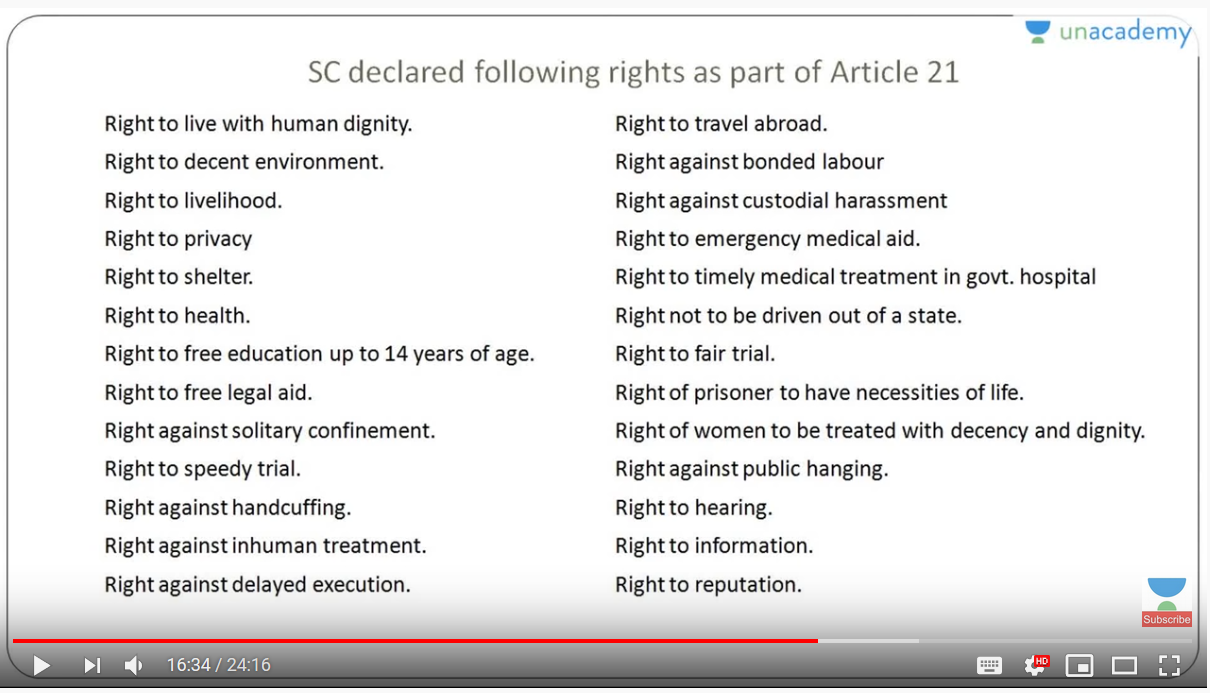
Over the years and decades, Article 21 of the Constitution of India has been expanded a lot, to cover various rights of individuals with changing times and needs of society. Listed below are some.
Article 21 provides, “No person shall be deprived of his life or personal liberty except according to procedure established by law.“
A screen-capture from a training session on the Unacademy platform, lists several rights available under Article 21.
During 1950-1955
During 1956-1960
During 1961-1965
During 1966-1970
During 1971-1975
During 1976-1980
During 1981-1985
During 1986-1990
During 1991-1995
During 1996-2000
During 2001-2005
During 2006-2010
During 2011-2015
During 2016-2020
During 2021-2025
Dismissed Petitions:
MAIN Index is here.
Bad Behavior has blocked 279 access attempts in the last 7 days.

